Global Dialysis Perspective: Sri Lanka
Oct 24, 2023
Introduction
Sri Lanka is an island situated in the Indian Ocean, just to the south of the Indian peninsula. It has a land area of 65,610 km2 and a population of approximately 22 million. The population is distributed among nine provinces, with an average population density of 347.1 persons/km2 . The Western Province, which is the country’s economic and administrative hub, has the highest population density of 1705.8 persons/km2 . Sri Lanka has an aging population: the number of persons over the age of 65 years has increased from 4% in 1970 to 11% in 2019. Sri Lanka is a multiethnic society comprising Sinhalese (75%), Sri Lankan Tamils (15%) and Sri Lankan Moors (9%) (1). Sri Lanka has a high adult literacy rate, which was 93% for men and 91% for women in 2017
Sri Lanka is categorized as a lower-middle-income country, according to the World Bank country classification by income level. The economy has shown a declining trend over the last few years, compounded by the negative effects of the coronavirus disease 2019 pandemic in 2020 and 2021. The subsequent economic recovery has been hampered by raging inflation, foreign exchange devaluation, and foreign currency deficit, resulting in the estimated year-on-year gross domestic product growth rate for the first quarter of 2022 turning negative at 1.6%.
CLICK HERE TO GET CISTANCHE FOR CKD
Burden of CKD in Sri Lanka
Diseases of the urinary system, under which CKD is classified, was the fourth leading cause of hospitalization (1830 per 100,000 population) and the eighth leading cause of hospital deaths (14.4 per 100,000 population) in Sri Lanka in 2019, according to the Annual Health Statistics Report (2). However, the exact prevalence of CKD and ESKD is unknown due to the absence of an updated CKD registry in the country. A recent cross-sectional epidemiologic study conducted in the Western Province revealed a CKD prevalence of 15% among adults (3). The prevalence of CKD was higher in individuals with diabetes (28%) and hypertension (21%). In another study, conducted in a rural population in Sri Lanka, CKD prevalence was 58% among individuals with hypertension, which was 1.6 and 3.4 times that found in Bangladesh and Pakistan, respectively (4).
The country’s CKD burden has risen further over the last two decades due to the detection of CKD in an increasing number of individuals from the north-central region of Sri Lanka who do not have the traditional risk factors, such as diabetes or hypertension, or any other known causes of kidney disease. This disease, now termed CKD of unknown etiology (CKDu), was first reported in the districts of Anuradhapura and Polonnaruwa in the North Central Province but was subsequently identified in other hot spots in the adjacent Kurunegala, Matale, and Badulla districts. The prevalence of CKD in these endemic areas ranges from 5% to 15%, with .75% of individuals with CKD not having the traditional risk factors for CKD (5,6). The disease predominantly affects young and middle-aged farmers living in these areas. The characteristic histopathologic lesion is chronic tubulointerstitial nephritis (7). Environmental nephrotoxic agents, such as agrochemicals, heavy metals (such as cadmium, arsenic, and lead), excess fluoride and hardness in water, and exposure to heat stress and dehydration, are some of the postulated causative factors for the disease, but none have yet been proven (8,9). Many steps have been taken by the Sri Lankan government to mitigate the disease, including providing demineralized water, banning the importation of certain agrochemicals, and providing health advice on food and food preparation.

Dialysis Services in Sri Lanka
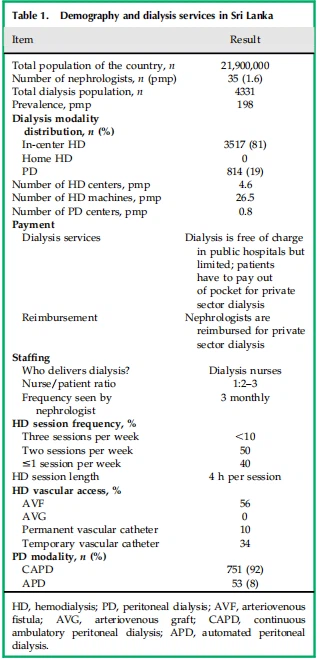
Sri Lanka has a universal healthcare system that extends free healthcare to all citizens. The Ministry of Health provides government-funded free healthcare services via a tiered network of urban tertiary care hospitals coupled with smaller provincial and district hospitals and peripheral clinics. Hemodialysis is the main modality of RRT for patients with ESKD and is mainly available in tertiary care hospitals based in larger cities (Table 1). Almost all of the state-funded dialysis units are hospital-based with very few stand-alone dialysis units. Most of these units are overwhelmed by the excessive number of patients requiring chronic RRT, resulting in many prioritizing dialysis to individuals with kidney transplant plans and younger patients with fewer comorbidities. Most patients are dialyzed only twice per week, with a considerable number of patients only receiving dialysis once per week or even less. Only a few hospitals in the private sector provide dialysis. Most of these hospitals are in the Western Province (Figure 1), and access is limited to patients who can afford the out-of-pocket expenditure.
For most patients, initiation of dialysis is via temporary vascular catheters, with only a minority having mature arteriovenous fistulae (AVF) at the start of maintenance dialysis. This is due to many factors, including delayed referral to nephrology services, poor patient uptake, and delays in creating AVF due to a lack of trained staff and the nonavailability of surgical theater facilities.

Peritoneal dialysis (PD) is grossly underused in Sri Lanka as a modality of chronic RRT. Most patients are unwilling to accept PD as a mode of RRT due to their reluctance to accept the responsibility of performing the treatment by themselves. In addition, lack of trained staff, interruptions in the supply of dialysis solutions and catheters, increased cost, and lack of reimbursement to nephrologists have contributed to the underutilization of PD. However, PD has attracted renewed interest with the recent emergence of the CKDu epidemic in the country, which mostly affects patients living in rural areas who have poor access to hemodialysis services based in cities. Nephrologists from National Hospital Kandy, in collaboration with Stanford University in the United States, have successfully started a continuous ambulatory PD (CAPD) program in the CKDu-affected region in Girandurukotte (10). Patients’ ability to continue being employed while on treatment, availability of good family support, non-reliance on complex technology and electricity, and less requirement for travel contributed to the increased uptake of CAPD in this program. PD is performed using double-cuffed, flexible PD catheters inserted by the open surgical method or percutaneously. The standard 1.5%, 2.5%, and 4.25% dextrose solutions are used. Periodic educational and quality improvement programs have helped to reduce the PD peritonitis rate to 0.38 per patient-year (11).
Dialysis Funding
Both hemodialysis and CAPD are provided free of charge in public hospitals. A hemodialysis session in the state sector costs approximately 38 USD, whereas it costs between 39 and 43 USD in the private sector. Considering most patients undergo twice-weekly dialysis, the approximate cost per month for a patient on hemodialysis is 300–350 USD. In comparison, the monthly cost for CAPD is approximately 552 USD, and automated PD (APD) is 522 USD (12). These costs suggest the provision of HD is cheaper compared with PD, but the HD costs would be considerably higher if provided three times per week. Although hemodialysis and medications are provided free of charge in the state sector, indirect expenses, including transport and loss of work due to treatment, have resulted in many patients not attending dialysis sessions regularly.

Patients have to bear the cost of dialysis out of pocket in the private sector. Patients in low-income groups are supported by the government through the President’s Fund, where 400,000 LKR (1000 USD) per patient is paid directly to the private dialysis unit. This will cover the cost of dialysis for approximately 3 months and no more funding is available for patients who exhaust this amount. Charity organizations, such as the All-Ceylon Kidney Patients Association, bear a proportion of the cost of each dialysis session for patients with a very low income. The APD program is conducted as a public-private partnership, where the private agent provides the APD machine (the cost reimbursed by the government), the training, and the continuation of care for the patients, whereas the government provides the PD catheter and dialysis solutions.
Supportive Service Of Wecistanche-The largest cistanche exporter in the China:
Email:wallence.suen@wecistanche.com
Whatsapp/Tel:+86 15292862950
Shop:
https://www.xjcistanche.com/cistanche-shop
CLICK HERE TO GET NATURAL ORGANIC CISTANCHE EXTRACT WITH 25% ECHINACOSIDE AND 9% ACTEOSIDE FOR KIDNEY INFECTION