Green Tea Epigallocatechin-3-gallate (EGCG) Targeting Protein Misfolding in Drug Discovery For Neurodegenerative Diseases Part 2
Jun 25, 2024
3. Protein Misfolding in Neurodegenerative Diseases
The conversion of proteins from their native state to misfolded aggregates is associated with and thought to be the cause of some NDs, including AD and PD [133]. The misfolding, aggregation, and deposition of specific proteins are the key characteristics of most progressive NDs [21,134].
Protein is one of the essential nutrients for the human body. It is the basic element that constitutes the body's cells and is also one of the important material bases for various physiological functions of the human body. Protein also plays an important role in improving memory.
First of all, protein can help us enhance our thinking ability and thus improve our memory, because protein is the basic component of nerve cells. Neurons are the basic units that constitute the brain and nervous system. Memory processing and information transmission in the brain require communication and coordination between neurons. Therefore, adequate protein intake can help us protect the nervous system and enhance the interaction between nerve cells and neurons in the brain, thereby improving the ability to learn, remember, and think.
Secondly, protein can help us stabilize our emotions, relieve anxiety and stress, and thus promote memory improvement. Studies have shown that people who lack protein often show symptoms of emotional instability such as irritability, tension, and irritability because protein is the basis for synthesizing emotion-regulating substances. It can help the human body synthesize neurotransmitters such as dopamine, thereby regulating emotions. When our emotions are as stable and relaxed as possible, the brain's information processing ability can be maximized, and our memory will also improve accordingly.
In summary, protein is an important nutrient necessary for the human body, and it also plays an irreplaceable role in improving memory. Therefore, we must focus on protein intake in our daily diet, enhance the functions of various important organs of the body, improve thinking ability and emotional stability, and make us perform better and better in learning and work. It can be seen that we need to improve memory, and Cistanche can significantly improve memory because Cistanche has antioxidant, anti-inflammatory, and anti-aging effects, which can help reduce oxidation and inflammatory reactions in the brain, thereby protecting the health of the nervous system. In addition, Cistanche can also promote the growth and repair of nerve cells, thereby enhancing the connectivity and function of neural networks. These effects can help improve memory, learning ability, and thinking speed, and can also prevent the occurrence of cognitive dysfunction and neurodegenerative diseases.

Click now to improve brain function
Aβ, tau, α-syn, TDP-43, huntingtin, or the prion protein (PrP) are just a few examples of disease-specific proteins that can aggregate and contribute to the pathogenesis of NDs (Figure 2).
The misfolded protein aggregates cause cellular toxicity and eventually lead to cell death in neurodegenerative pathologies. In all cases, the aggregation process plays a key role in the disease progression either due to a loss of protein function (as a result of the aggregation itself) or to the toxicity of soluble aggregates [17,22].

Given that NDs originate through a common pathway of aggregation, with aggregates sharing a similar structure, it is not surprising that these aggregates cause cellular damage through similar mechanisms.
However, key differences among misfolded proteins occur due to the location of the aggregates, whether intra- or extracellular, and their concentration, which depends on several factors, including the stability of the fibrils [93].
It is well known that the misfolding, aggregation, and accumulation of proteins culminate in damage to the neurons in which the proteins accumulate, causing the neurodegeneration process [135].
A particular protein can fold into a stable alternative conformation, which in most cases results in its aggregation and accumulation in tissues as fibrillar deposits [136].
Increasing evidence shows that the assembly of amyloid fibrils is accompanied by conformational changes in the aggregating proteins. The 'natively unfolded' polypeptides Aβ and α-syn, for example, have a primarily random-coil structure in their soluble, native state [24].
However, in the fibrillogenesis process (Figure 3), their structure converts into a β-sheet conformation, suggesting that β-sheet formation drives the amyloid assembly process.
In addition, in vitro experiments suggest that these misfolded proteins readily form cross-β structures with an aggregation kinetics profile that typically displays a sigmoidal curve where the proteins assemble into oligomers (lag phase) before fibril elongation (growth phase) and a plateau where the fibrils and free monomers are in equilibrium (saturation phase) [137,138].

Indeed, amyloid fibril formation is a complex, multiphase process consisting of three phases: nucleation or the lag phase, elongation or the growth phase, and saturation phase.
The lag phase starts with monomers undergoing structural rearrangements and self-assembly into dimers, trimers, and/or oligomers. In the growth phase, the oligomeric nucleus acts as a template for the monomers in solution and proceeds by fibril elongation, aided by fragmentation, secondary nucleation, and fibril conjoining.
Finally, the fibril formation reaches an equilibrium in the saturation phase with mature fibrils and a reduced concentration of the monomeric species [138].
Notably, Stanley Prusiner's discovery that the PrP can misfold into a pathological conformation that encodes structural information capable of both propagating and inducing severe neuropathology has contributed significantly toward understanding other NDs [139,140].
While there is increasing evidence that other NDs, especially AD (Aβ and tau) and PD (α-syn), exhibit at least some of the same properties as misfolded PrP, many NDs with a protein misfolding component are now referred to as 'prion-like' [141,142].
Even though distinct proteins are involved in each ND, the process of protein misfolding and aggregation is strikingly similar. Misfolded proteins are transferred between cells, becoming what is referred to as 'pathological seeds' [136].
Experimental studies suggest that these assemblies come from the prion-like seeded aggregation of specific misfolded proteins that upbuild and accumulate to form the intracellular and/or extracellular lesions typical of each disorder [135,143,144]. The prion paradigm has thus emerged as a unifying molecular basis for the pathogenesis of many NDs [145].
The prion paradigm holds that the misfolding and seeded aggregation of certain proteins is a fundamental cause of specific disorders. This discovery has vast implications for understanding the mechanisms involved in the initiation and progression of NDs, as well as for the design of novel treatment and diagnosis strategies.
Researchers are now focusing on developing therapies for protein misfolding disorders that employ diverse strategies. These include inhibiting the production of disease-relevant proteins that are prone to misfolding, inhibiting the aggregation of misfolded proteins, removing and preventing the spread of aggregated misfolded proteins, and manipulating cellular systems to mitigate the toxic effects of misfolded proteins [19].
Since protein misfolding and aggregation are the leading causes of many NDs, several studies have examined the potential of targeting the fibrillization process of amyloid proteins to combat neurodegeneration.
An array of compounds has been identified as potential inhibitors or modulators of protein misfolding and aggregation. Notably, most of the promising molecules that have been identified target misfolded Aβ and α-syn; these molecules appear to bind to oligomers and larger aggregates such as amyloid plaques [146,147].
Such compounds can be categorized into three main types: antibodies, peptide inhibitors, and small molecule inhibitors such as NPs [132]. Finally, given multiple lines of evidence that support protein misfolding as a common cause and pathological mechanism in NDs, it has been suggested that a common therapy for these incurable disorders might be possible [24].
It is important to note that the potential of EGCG against many NDs reinforces the possibility of developing a common drug therapy for different NDs. In recent decades, the role of natural polyphenol EGCG against protein misfolding and aggregation has been widely studied.
A variety of evidence is now available to support the potential of EGCG to inhibit fibrillization and potentially induce the disassembly of misfolded aggregated proteins (Aβ, tau, and α-syn) [148–151].
3.1. Misfolded Aβ in AD
Aβ is a misfolded peptide involved in AD pathogenesis, and the plaque composed of aggregated Aβ peptide features prominently in AD pathology; thus, most drugs tested for AD over the past two decades have targeted the Aβ peptide [50,66].
The Aβ peptides are 39–42-residue-long peptides found in the senile plaques of AD patients' brains [61]. These peptides are proteolytic fragments generated by the metabolism of the transmembrane amyloid precursor protein (APP), which then self-aggregate in aqueous solution, going from soluble and mainly unstructured monomers to insoluble ordered fibrils.
As soon as Aβ aggregates into fibrils outside the cell, it becomes resistant to proteolytic cleavage [61,152]. The cleavage of APP by a complex family of enzymes (γ-secretases and β-secretases) releases Aβ peptides as mainly unstructured monomers [152]. Given the hydrophobicity of the primary structure, Aβ can be divided into four regions: two hydrophobic ones and two hydrophilic ones.
The 16 first N-terminal residues constitute a hydrophilic tail, while the two hydrophobic regions are comprised of the central L17–A21 portion and the C-terminus A30–V40/A42, which are separated by the central hydrophilic region E22–G29.
The two Aβ hydrophobic regions exhibit a secondary structure propensity for β-structures. These regions transiently adopt β conformations and may then transiently fold into a hairpin.
It has been suggested that Aβ monomers in solution adopt a transient hairpin-like conformation, whereas residues D23 to K30 are directly involved in hairpin formation [152]. As mentioned previously, despite the harmful properties of senile plaques, a large body of evidence implicates soluble oligomeric Aβ as the most neurotoxic molecular species [70,153,154].
The misfolding and extracellular aggregation of Aβ peptides have been recognized as the main cause of AD progression, leading to the formation of toxic Aβ oligomers and deposition of β-amyloid plaques in the brain [61]. It has been suggested that oligomeric Aβ species may represent a valid biological target [66,155,156].
3.2. Misfolded α-Syn in PD
The α-syn protein is predominantly localized at synaptic sites, where it interacts with many partners such as monoamine transporters, cytoskeletal components, lipid membranes, chaperones, and synaptic vesicle (SV)-associated proteins [157].

The α-syn is monomeric and disordered in its physiological form, though some studies debate whether it adopts a helical tetramer in vivo [158–160]. In addition to intracellular aggregation of the misfolded α-syn being linked to PD, it has been implicated in other NDs like AD, multiple system atrophy (MSA), and dementia with Lewy bodies.
Furthermore, a disorder group called synucleinopathies is characterized by the accumulation of inclusions rich in the α-syn protein that can appear later in life [161,162]. It is thought that different types of aggregated species (oligomers, protofibrils, fibrils, and others) are formed during the process of α-syn aggregation in these synucleinopathies and that at least some might be neurotoxic and lead to neurodegeneration [163].
Hence, targeting neuronal accumulation of α-syn is appealing as a potential method to halt or delay the progression of PD and other synucleinopathies [164].
The 140-amino acid α-syn is a 14 kDa neuronal protein encoded by the SNCA gene on human chromosome 4 [165]. Its primary amino acid sequence can be divided into three major domains: the N-terminal domain (1–60), the central domain (61–95), and the C-terminal domain (96–140).
The N-terminal domain, which contains a multi-repeated consensus sequence (KTKEGV) and has an α-helical propensity, is characterized by an amphipathic lysine-rich amino terminus, which plays a crucial role in modulating its interactions with membranes and a disordered, acidic carboxy-terminal tail. The tail has been implicated in regulating its nuclear localization and interactions with metals, small molecules, and proteins.
The central region of α-syn contains a highly hydrophobic motif known as the non-amyloid-β component of AD amyloid plaques (NAC), which is involved in α-syn aggregation when acquiring the β-sheet structure. The NAC region is indispensable for α-syn aggregation.
The C-terminal domain is enriched with negatively charged and proline residues, providing flexibility to the polypeptide [166,167]. Since the NAC region of α-syn confers a high propensity for the protein to misfold, it forms β-sheet amyloid assemblies, also termed fibrils, under pathological conditions. However, the α-syn assembly into amyloid fibrils is dynamic, and the existence of intermediate oligomeric species has been studied extensively [164].
Similar to oligomeric Aβ, α-syn oligomers cause more neurotoxic effects than larger fibrillar assemblies, inferring that they might be the main pathogenic species [168].
The toxic intermediate hypothesis builds on this view, suggesting that toxic oligomers disrupt the integrity of membranes via amyloid pore formation, while the fibrillar endproducts are simply a by-product of detoxification.
This view is supported by the fact that fibril-containing Lewy bodies are often found in healthy dopaminergic neurons [169–171].
4. EGCG for Treating Neurodegenerative Diseases
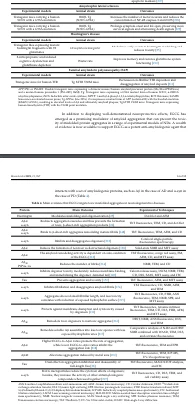
In light of the major potential of using green tea in ND treatment, green tea catechins have been extensively studied, including in vitro and in vivo studies and clinical trials [16,117]. The therapeutic potential of EGCG, the major bioactive compound of green tea, is now well-known in ND research [10]. Over the last 20 years, EGCG has been shown to counteract oxidative stress and improve AD- and PD-like phenotypes in different in vitro and in vivo models (Tables 2 and 3).

4.1. Evidence from In Vitro Neurotoxicity Models
In the 1990s, studies with the Aβ-induced neurotoxicity model showed that the presence of Aβ1-42 leads to neurotoxicity and increased protein oxidation and, as a result, oxidative stress [220–222].
The neurotoxicity of the Aβ protein is mediated through oxygen free radicals and can be attenuated by antioxidants and free radical scavengers. The attenuation of oxidative stress by antioxidant compounds can, therefore, be a potential therapeutic strategy for treating AD.
In the early 2000s, the potent antioxidant properties of the green tea polyphenol EGCG were investigated in an Aβ-induced neurotoxicity model using cultured hippocampal neurons, with the results suggesting that EGCG has protective effects against Aβ-induced neuronal apoptosis from scavenging reactive oxygen species. This was one of the first reports on the benefits of EGCG for preventing AD [172].
Subsequently, the molecular mechanism underlying the neuroprotective effect of EGCG in the Aβ-induced neurotoxicity model was investigated with a focus on the cellular metabolism of reduced glutathione with antioxidant properties. The results indicated that EGCG treatment fortified the cellular glutathione pool via elevated expression of γ-glutamylcysteine ligase [176].
Oxidative stress has also been shown to induce BACE-1 protein upregulation in neuronal cells, which is the rate-limiting enzyme in APP processing and Aβ generation, as well as being a therapeutic target for AD [223,224]. Although exposure of Aβ1-42 to neuronal culture increased BACE-1 protein levels, EGCG treatment significantly attenuated the Aβ-induced production of radical oxygen and β-sheet structure formation [174].
In the early 2010s, it was known that EGCG inhibits Aβ and α-syn fibrillogenesis in cell-free assays; researchers then investigated whether EGCG can remodel insoluble Aβ and α-syn aggregates in a cell model system [148].
This research showed that EGCG can reduce cellular toxicity of mature Aβ and α-syn fibrils by remodeling their structure. The EGCG-mediated remodeling of β-sheet-rich amyloid structures leads to the appearance of smaller amorphous protein aggregates that are nontoxic to mammalian cells [148]. In 2017, the employment of α-syn-transduced PC12 cells was performed to investigate the protective effects of EGCG, providing evidence that EGCG can protect these cells against α-syn-induced damage by inhibiting the overexpression and fibrillation of α-syn in the cells [151].
A more recent study reported that EGCG can interfere with Cu(II)-induced fibrillation of α-syn and protect cell viability. The researchers demonstrated that EGCG inhibits the generation of Cu(II)-induced reactive oxygen species (ROS), leading to reduced overexpression and fibrillation of α-syn in the cells. Moreover, the combination of Cu and EGCG exhibited better cryoprotection than EGCG alone. Here, it is worth noting that Cu(II) is an oxidant that also accelerates fibrillation and protein aggregation [183].
There are also pieces of evidence of neuroprotective effects of EGCG in neurotoxicity models of PD Parkinsonian neurotoxins including compounds like 6-hydroxydopamine (6-OHDA), 1-methyl-4-phenyl-1,2,3,6-tetrahydropyridine (MPTP), rotenone (ROT), and paraquat. EGCG has demonstrated remarkable neuronal protection against paraquat, 6-OHDA, and MPP+ neurotoxicity, though not against ROT [173,175,178,180,181].
In an evaluation of the neuroprotective effects of EGCG on ROT-treated dissociated mesencephalic cultures and organotypic striatal cultures, EGCG partially counteracted the effects of ROT in striatal slice cultures through the reduction of nitric oxide (NO) but did not dissociate cells against ROT toxicity [178].

Although the latter study did not demonstrate that EGCG protects against ROT-induced neurotoxicity in cell models, it was recently reported that EGCG had a neuroprotective effect in vivo on ROT-induced PD models [206,207]. Together, these results from in vitro neurotoxicity models support the notion that EGCG can be used as a neuroprotective agent to treat NDs.
For more information:1950477648nn@gmail.com