Group I MGluRs in Therapy And Diagnosis Of Parkinson’s Disease: Focus On MGluR5 Subtype Part 1
Apr 24, 2023
Abstract
Metabotropic glutamate receptors (mGluRs; members of class C G-protein-coupled receptors) have been shown to modulate excitatory neurotransmission, regulate presynaptic extracellular glutamate levels, and modulate postsynaptic ion channels on dendritic spines. mGluRs were found to activate myriad signaling pathways to regulate synapse formation, long-term potentiation, autophagy, apoptosis, necroptosis, and pro-inflammatory cytokines release. A notorious expression pattern of mGluRs has been evident in several neurodegenerative diseases, including Alzheimer’s disease, Parkinson’s disease, Huntington’s disease, and schizophrenia. Among the several mGluRs, mGluR5 is one of the most investigated types of considered prospective therapeutic targets and potential diagnostic tools in neurodegenerative diseases and neuropsychiatric disorders. Recent research showed mGluR5 radioligands could be a potential tool to assess neurodegenerative disease progression and trace respective drugs’ kinetic properties. This article provides insight into the group I mGluRs, specifically mGluR5, in the progression and possible therapy for PD.
Keywords
glutamate signalling; metabotropic glutamate receptors; C G-protein-coupled receptors; neurodegenerative diseases; positron emission tomography; radioligands; Cistanche benefits.
Click here to know the effects of Cistanche
Introduction
Glutamate, the most important excitatory neurotransmitter of the mammalian central nervous system (CNS), has a critical role in developing memory and synaptic plasticity. However, glutamate hyperactivation could precede and/or exaggerate neurodegenerative disease pathology [1,2]. There are two distinct glutamate receptors, namely ionotropic glutamate receptors (iGluRs) and metabotropic glutamate receptors (mGluRs). Unlike iGluRs, which are ligand-gated ion channels that promote excitatory neurotransmission rapidly [3], mGluRs promote G-protein uncoupling. mGluRs uncouple Gα-βγ G-proteins and increase Gα-mediated intracellular second messenger level or βγ-mediated ion channel regulation and stimulate non-canonical pathways [4,5]. The mGluRs belong to class c G-protein-coupled receptors (GPCRs), and so far, eight subtypes have been identified. These subtypes are further divided into three sub-categories according to phenotypes and intracellular signaling [6–8]. Group I consists of mGluR1 and mGluR5 that couple to Gαq/11 G-proteins, promoting intracellular Ca2+ efflux [9,10]. Group II contains mGluR2 and mGluR3; and mGluR4, mGluR6, mGluR7, and mGluR8 belong to group III mGluRs [8]. Both group II and III mGluRs negatively regulate adenylyl cyclase via Gαi, and they can inhibit glutamate or γ-aminobutyric acid (GABA) release via auto-receptor action [11].
Parkinson’s disease (PD), the second most prevalent neurodegenerative disease, is characterized by motor and non-motor disability manifestation, and this chronic progressive neurodegenerative disease affects mostly older adult people but could also affect younger people. Mounting evidence suggests that glutamate and dopamine regulate neurotransmission in the nigrostriatal, mesocortical, and mesolimbic systems [1–4]. However, this mutual signaling has been shown to conspicuously affect PD [5], where increased mGluR expression led to the poisoning of dopaminergic neurons in the substantia nigra [6]. Increased glutamate release, at the pathological condition, due to impaired glutamate reuptake at the presynaptic membrane, increases extracellular glutamate concentration. Excessive glutamate release could increase Na+ and Ca2+ concentration, and that could directly induce neuronal cell death and neurodegeneration in PD. In addition, activated microglia and reactive astrocytes can exacerbate the condition by increasing the large volume of glutamate released.
Considerable evidence indicates that pharmacological inhibition by glutamatergic antagonists or negative allosteric modulation of group 1 mGluRs has been shown to protect dopaminergic neurons and ameliorate dyskinesia in PD animal models [12–14]. Specifically targeting mGluR5 could ameliorate motor and/or cognitive impairment. These studies suggest that the anomalies in group 1 mGluR expression might have a pathological connection to PD progression or exaggeration; therefore, glutamate receptors are exciting targets for novel drug design.
Assessment of both PD patients and animal brains has reported upregulation of mGluR5 expression, which is proportionally related to the elevated levels of α-synuclein (αS) aggregation [15], a well-known hallmark of PD. In contrast, some studies have reported that αS selectively binds to mGluR5, not mGluR3, at its N-terminal region and stimulates microglia-mediated neuroinflammation [16]. Small, single-site trials of a highly specific radiopharmaceutical of mGluR5 in PD have been conducted to enlighten pathological connection; however, the outcome is complicated or inconclusive [17,18]. This review discusses the most recent findings on mGluR5 in PD progression, highlighting its importance in designing novel therapeutics and diagnosing PD.

Cistanche pills
Localisation of Group I mGluRs in the Brain
The members of the group I mGluRs are widespread throughout the brain. mGluR1 is highly expressed in the cerebellar cortex neurons, olfactory bulb, lateral septum, globus pallidus, entopeduncular nucleus, ventral pallidum, magnocellular preoptic nucleus, and thalamic nuclei [19–21]. mGluR5 is mostly expressed in the telencephalon, specifically in the cerebral cortex, hippocampus, subiculum, olfactory bulb, striatum, nucleus accumbens, and lateral septal nucleus [22–24]. A high expression of mGluR5 could be seen in the superficial dorsal horn of the spinal cord [8]. In the CA3 region of the hippocampus, cerebellum, olfactory bulb, and thalamus, mGluR1 has been observed to be highly expressed, while mGluR5 has high expression in the CA1 and CA3 region of the hippocampus, cortex, striatum, and olfactory bulb [25]. A comparative study using rat and monkey brains showed that high-dense mGluR1 expression was found at the plasma membrane, whereas a bulk amount of mGluR5 was expressed in the intracellular compartment of the substantia nigra. Plasma membrane-bound group I mGluRs are primarily extrasynaptic or expressed in the main body of symmetric, GABAergic, and striatonigral synapses in rats and monkeys [21].
Both receptors have shown subtype-specific variation in their localization and expression during the development of the brain [26,27]. For example, mGluR1 expression increases gradually in both the hippocampus and neocortex during the development phase [26]. In the cortex, mGluR5a expression reaches a peak during the second postnatal week and falls subsequently [26], while mGluR5b mRNA level increases postnatally, and this subtype is predominantly expressed in adults [28].
The activation and expression pattern of group I mGluRs might have a regulatory role in various aspects of neurogenesis and synaptogenesis during the development phase of the cortex [28,29]. A pattern of distribution of group I mGluRs in a region of the brain relates to their distinct functions. Microscopic analysis of mGluR1 and mGluR5 showed that they are localized outside postsynaptic membranes in the perisynaptic annulus around the synaptic junctions [30]. Group I mGluRs are also present in peripheral cells outside the brain, regulating nociceptive signaling and inflammatory pain [31].
In terms of cellular specificity, although most of the mGluRs are expressed in the neuronal cells, exceptionally, mGluR3 and mGluR5 have been expressed in the glial cells throughout the brain. However, cell genotypic variation would be the reason for the difference in the expression of mGluRs in different cell types. To clarify this context and establish a database of mGluRs expression intensity in different cell types in the cortex, Zhang et al. (2014) [32] have conducted a high-resolution transcriptome using RNA-Seq of purified neurons, astrocytes, microglia, and various maturation states of oligodendrocytes from mouse cortex. That study indicates that mGluR1 is mostly expressed in neurons, whereas mGluR5 has more intense expression in the astrocytes than in neurons in the cortex.
Group I mGluRs Signalling in Brain
Basic Signalling of Group I mGluRs
Both members of the group I mGluR contain an extracellular domain for natural ligand binding and a seven-transmembrane domain (7TM) for synthetic allosteric modulator binding. The mGluR1 ligand binding site has a crystal structure that separates two globular domains by a hinge region and expresses the receptors’ resting or active form by opening or closing, respectively, in the absence of a ligand [33]. Human mGluR1 and mGluR50 s crystal structures of the isolated 7TM domain have been well studied [34,35]. Interestingly, these structural studies found that the mGluR1 has a large β-hairpin confirmation at the 2nd extracellular loop position, like the class A GPCRs. Another interesting observation was that the transmembrane region of mGluR1 could form a dimer by TM1–TM1 interactions and these interactions are stabilized by cholesterol molecules [34].
Group, I mGluR activation has been reported to induce myriad oscillatory responses of distinct frequencies largely due to a single amino acid residue in the G-protein coupling domain of mGluR1 (D854) and mGluR5 (T840) [25]. Furthermore, the lipid content of the plasma membrane might have an influence on the activity of group I mGluRs. Both members of this group have been seen to be present in membranes with a lipid-augmented environment [36,37]. However, not of these receptors have been seen to be associated with the lipid-rich rafts, suggesting that the association might be transient. A study reported that this association between lipid raft and mGluR1 depends on the cholesterol content of the membrane and could be improved by the agonist binding [38]. The TM5 and the third intracellular loop of the receptor have a cholesterol-binding motif that increases cholesterol levels in the membrane, enhancing the agonist-mediated activation of the receptor. However, depletion in the cholesterol level inhibits the mGluR1-dependent extracellular signaling-regulated kinase (ERK) signaling activation [25,38]. These data indicate association and positive regulation of group I mGluR signaling activation by the lipid rafts and membrane cholesterol.

Herba Cistanche
Group I mGluRs are positively coupled to the G-protein Gαq/11, which at the downstream stimulates phospholipase Cβ1 (PLCβ1) and activates diacylglycerol (DAG) and inositol-1,4,5-triphosphate (IP3). The IP3 receptors (IP3R) then trigger the intracellular Ca2+ release [8], whereas DAG at the plasma membrane, together with extracellular Ca2+, activates protein kinase C (PKC) and activates phospholipase D (PLD), phospholipase A2 (PLA2), and mitogen-activated protein kinase (MAPKs) pathways [39]. The activation of PKC via mGluR5 can also stimulate NMDAR [40]. However, N-methyl-D-aspartate receptor (NMDAR)-dependent activation of calcineurin, a Ca2+ channel-dependent phosphatase, reverses the PKC-mediated desensitization of mGluR5 [41]. Additionally, mGluR1 can upregulate the NMDAR cascade in cortical neurons through Ca2+-, calmodulin-, and Src-dependent proline-rich tyrosine kinase (Pyk2) activation [42]. In addition, mGluR1/5- mediated Homer protein interactions are also significant. Homer can phosphoryl IP3 and activate ryanodine receptors and Shank proteins, which are part of the NMDAR protein complex [43,44]. The coupling of Homer proteins and mGluR1/5 also activates Akt via involving phosphoinositide 3-kinase (PI3K), phosphoinositide-dependent kinase (PDK1), and PI3K enhancer (PIKE), which leads to neuroprotection (Figure 1) [45,46]. Although group I mGluRs bind to Gαq/11, overexpression of these receptors showed coupling to Gαs and Gαi/o as well. Similarly, mGluR1a has been shown to couple to Gαi/o, leading to cAMP stimulation in overexpressed Chinese hamster ovary (CHO) cells [47]. This example suggests that group I mGluRs could couple to a variety of G-proteins, and understanding them might reveal endogenous receptor mechanisms in native form, which could lead to understanding these receptor mechanisms in vivo as well.
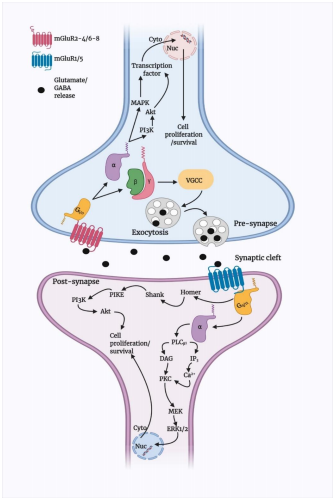
Further, a group I mGluRs also modulate the ERK signaling cascade through IP3- stimulated Ca2+ release, Homer proteins, and Pyk2 [48,49]. Activation of ERK is important for the modulation of cell growth, differentiation, and survival, as well as the increment of neurotrophic factors such as brain-derived neurotrophic factor (BDNF) [50], indicating group I mGluR-mediated neuroprotection could rely on activation of ERK signaling. However, as discussed above, mGluR5 is more highly expressed in glial cells than in neurons, specifically in the astrocytes (Figure 2), where they form complexes with IP3 and increase intracellular Ca2+ to facilitate glutamate release and contribute to the apoptosis of astrocytes [51–54]. Studies also found that mGluR5 activation in cortical and hippocampal astrocytes can stimulate MAPK pathways and PLD signaling [55,56]. Selective activation of mGluR5 by an agonist inhibits microglial activation and associated neuroinflammation and neurotoxicity via the Gαq-signal transduction pathway [57].

Group I mGluR Desensitisation and Trafficking
Many GPCRs undergo desensitization via activation of the second messenger pathway to protect receptors from prolonged over-stimulation. Desensitization results from the uncoupling of a specific GPCR from the respective G-protein involved. Several GPCR desensitization mechanisms have been assessed, and the observations suggest that the process depends on several facts, including the type of receptor, type of ligand, and type of system [59–61]. Phosphorylation plays a crucial part in some GPPCR desensitization; phosphorylation leads the receptor to bind to adapter proteins, such as β-arrestin, which interferes with G-protein coupling and leads to the second messenger pathway generation [59]. For others, endocytosis plays a crucial part in desensitization [61].
Several kinase-dependent desensitizations of group I mGluRs have been tested so far, and it has been seen that PKC is important in the agonist-mediated desensitization of group I mGluRs. For example, phosphorylation of mGluR1a by PKC leads to the desensitization of the receptor [62]. Interestingly, activation of PKC has been shown to affect the mGluR1 pathway coupled to Gαq, but it does not affect the coupling of the receptor to the cAMP pathway. These data indicate selective desensitization of mGluR1 via PKC activation [10]. The desensitization of the mGluR5 has been well studied rather than mGluR1. The presence of several serine/threonine residues in mGluR5 is presumably involved in the PKC-mediated desensitization process. mGluR5 has a calmodulin-binding site, and in the basal state, calmodulin interacts with mGluR5 at the region of the S881 and S890 amino acid residue sites of the receptor, and PKC has been shown to phosphorylate these two-binding sites [63]. In contrast to PKC-mediated inhibition of calmodulin binding to mGluR5 via phosphorylation, calmodulin can inhibit PKC-dependent phosphorylation of the receptor [64]. These data suggest that PKC-dependent phosphorylation and calmodulin-binding counterbalance each other. PKA, another second messenger-dependent protein kinase, shows the opposite effect on the group I mGluR desensitization process. PKA activation results in the dissociation of adapter proteins from the C-terminal of the receptor and leads to the inhibition of receptor endocytosis and agonist-dependent desensitization of mGluR1 [62]. For many GPCR desensitizations, G-protein coupled receptor kinases (GRKs) play a crucial role. GRK-mediated phosphorylation of specific residues of the receptor results in the binding of β-arrestin that uncouples the receptor from the respective G-proteins [59–61]. It has been suggested by several studies that GRKs could regulate the desensitization of both members of the group I mGluR when heterologously expressed in HEK293 cells and primary neurons [65–67]. GRK2 has been involved in the desensitization process of mGluR1 and mGluR5, which seems to be phosphorylation independent [66,68]. Conversely, GRK4 has shown the selective desensitization of mGluR1 in cerebellar Purkinje neurons but not mGluR5 [67]; likewise, GRK5 affects mGluR1-mediated Purkinje turnover [69]. Since GRKs typically are not limited to their substrate specificity, it has been challenging to find GRK-mediated residual modification in group I mGluRs.

Cistanche supplements
References
1. Ferraguti, F.; Crepaldi, L.; Nicoletti, F. Metabotropic Glutamate 1 Receptor: Current Concepts and Perspectives. Pharmacol. Rev. 2008, 60, 536–581.
2. Jakaria, M.; Park, S.-Y.; Haque, M.E.; Karthivashan, G.; Kim, I.-S.; Ganesan, P.; Choi, D.-K. Neurotoxic Agent-Induced Injury in Neurodegenerative Disease Model: Focus on Involvement of Glutamate Receptors. Front. Mol. Neurosci. 2018, 11, 307.
3. Dingledine, R.; Borges, K.; Bowie, D.; Traynelis, S.F. The glutamate receptor ion channels. Pharmacol. Rev. 1999, 51, 7–61.
4. Pin, J.-P.; Galvez, T.; Prézeau, L. Evolution, structure, and activation mechanism of family 3/C G-protein-coupled receptors. Pharmacol. Ther. 2003, 98, 325–354.
5. Willard, S.S.; Koochekpour, S. Glutamate, Glutamate Receptors, and Downstream Signaling Pathways. Int. J. Biol. Sci. 2013, 9, 948–959.
6. Gerber, U.; Gee, C.; Benquet, P. Metabotropic glutamate receptors: Intracellular signaling pathways. Curr. Opin. Pharmacol. 2007, 7, 56–61.
7. Pin, J.-P.; Duvoisin, R. The metabotropic glutamate receptors: Structure and functions. Neuropharmacology 1995, 34, 1–26.
8. Ribeiro, F.; Vieira, L.B.; Pires, R.G.; Olmo, R.P.; Ferguson, S.S. Metabotropic glutamate receptors and neurodegenerative diseases. Pharmacol. Res. 2017, 115, 179–191.
9. Abdul-Ghani, M.A.; Valiante, T.A.; Carlen, P.L.; Pennefather, P.S. Metabotropic glutamate receptors coupled to IP3 production mediate inhibition of IAHP in rat dentate granule neurons. J. Neurophysiol. 1996, 76, 2691–2700.
10. Dhami, G.K.; Ferguson, S.S. Regulation of metabotropic glutamate receptor signaling, desensitization and endocytosis. Pharmacol. Ther. 2006, 111, 260–271.
11. Schoepp, D.D. Unveiling the functions of presynaptic metabotropic glutamate receptors in the central nervous system. J. Pharmacol. Exp. Ther. 2001, 299, 12–20.
12. Kang, Y.; Henchcliffe, C.; Verma, A.; Vallabhajosula, S.; He, B.; Kothari, P.J.; Pryor, K.; Mozley, P.D. 18F-FPEB PET/CT Shows mGluR5 Upregulation in Parkinson’s Disease. J. Neuroimaging 2018, 29, 97–103.
13. Berg, D.; Godau, J.; Trenkwalder, C.; Eggert, K.; Csoti, I.; Storch, A.; Huber, H.; Morelli-Canelo, M.; Stamelou, M.; Ries, V.; et al. AFQ056 treatment of levodopa-induced dyskinesias: Results of 2 randomized controlled trials. Mon. Disord. 2011, 26, 1243–1250.
14. Armentero, M.-T.; Fancellu, R.; Nappi, G.; Bramanti, P.; Blandini, F. Prolonged blockade of NMDA or mGluR5 glutamate receptors reduces nigrostriatal degeneration while inducing selective metabolic changes in the basal ganglia circuitry in a rodent model of Parkinson’s disease. Neurobiol. Dis. 2006, 22, 1–9.
15. Price, D.L.; Rockenstein, E.; Ubhi, K.; Phung, V.; MacLean-Lewis, N.; Askay, D.; Cartier, A.; Spencer, B.; Patrick, C.; Desplats, P.; et al. Alterations in mGluR5 Expression and Signaling in Lewy Body Disease and Transgenic Models of Alpha-Synucleinopathy—Implications for Excitotoxicity. PLoS ONE 2010, 5, e14020.
16. Zhang, Y.-N.; Fan, J.-K.; Gu, L.; Yang, H.-M.; Zhan, S.-Q.; Zhang, H. Metabotropic glutamate receptor 5 inhibits α-synuclein-induced microglia inflammation to protect from neurotoxicity in Parkinson’s disease. J. Neuroinflammation 2021, 18, 23.
17. Wang, W.-W.; Zhang, X.-R.; Zhang, Z.-R.; Wang, X.-S.; Chen, J.; Chen, S.-Y.; Xie, C.-L. Effects of mGluR5 Antagonists on Parkinson’s Patients with L-Dopa-Induced Dyskinesia: A Systematic Review and Meta-Analysis of Randomized Controlled Trials. Front. Aging Neurosci. 2018, 10, 262.
18. Crabbé, M.; Van der Perren, A.; Weerasekera, A.; Himmelreich, U.; Baekelandt, V.; Van Laere, K.; Casteels, C. Altered mGluR5 binding potential and glutamine concentration in the 6-OHDA rat model of acute Parkinson’s disease and levodopa-induced dyskinesia. Neurobiol. Aging 2018, 61, 82–92.
19. Martin, L.J.; Blackstone, C.D.; Huganir, R.L.; Price, D.L. Cellular localization of a metabotropic glutamate receptor in rat brain. Neuron 1992, 9, 259–270.
20. Abe, T.; Sugihara, H.; Nawa, H.; Shigemoto, R.; Mizuno, N.; Nakanishi, S. Molecular characterization of a novel metabotropic glutamate receptor mGluR5 coupled to inositol phosphate/Ca2+ signal transduction. J. Biol. Chem. 1992, 267, 13361–13368.
21. Hubert, G.W.; Paquet, M.; Smith, Y. Differential Subcellular Localization of mGluR1a and mGluR5 in the Rat and Monkey Substantia Nigra. J. Neurosci. 2001, 21, 1838–1847.
22. Shigemoto, R.; Nomura, S.; Ohishi, H.; Sugihara, H.; Nakanishi, S.; Mizuno, N. Immunohistochemical localization of a metabotropic glutamate receptor, mGluR5, in the rat brain. Neurosci. Lett. 1993, 163, 53–57.
23. Romano, C.; Sesma, M.A.; McDonald, C.T.; O’Malley, K.; Van den Pol, A.N.; Olney, J.W. Distribution of metabotropic glutamate receptor mGluR5 immunoreactivity in rat brain. J. Comp. Neurol. 1995, 355, 455–469.
24. Bhattacharyya, S. Inside story of Group I Metabotropic Glutamate Receptors (mGluRs). Int. J. Biochem. Cell Biol. 2016, 77, 205–212.
25. Catania, M.V.; Landwehrmeyer, G.B.; Testa, C.; Standaert, D.; Penney, J.; Young, A. Metabotropic glutamate receptors are differentially regulated during development. Neuroscience 1994, 61, 481–495.
26. Lopez-Bendito, G.; Shigemoto, R.; Fairén, A.; Luján, R. Differential distribution of group I metabotropic glutamate receptors during rat cortical development. Cereb. Cortex 2002, 12, 625–638.
27. Romano, C.; van den Pol, A.N.; O’Malley, K.L. Enhanced early developmental expression of the metabotropic glutamate receptor mGluR5 in rat brain: Protein, mRNA splice variants, and regional distribution. J. Comp. Neurol. 1996, 367, 403–412.
28. Martínez-Galán, J.R.; López-Bendito, G.; Luján, R.; Shigemoto, R.; Fairén, A.; Valdeolmillos, M. Cajal-Retzius cells in early postnatal mouse cortex selectively express functional metabotropic glutamate receptors. Eur. J. Neurosci. 2001, 13, 1147–1154.
29. Luján, R.; Nusser, Z.; Roberts, J.D.B.; Shigemoto, R.; Somogyi, P. Perisynaptic Location of Metabotropic Glutamate Receptors mGluR1 and mGluR5 on Dendrites and Dendritic Spines in the Rat Hippocampus. Eur. J. Neurosci. 1996, 8, 1488–1500.
30. Bhave, G.; Karim, F.; Carlton, S.M.; Iv, R.W.G. Peripheral group I metabotropic glutamate receptors modulate nociception in mice. Nat. Neurosci. 2001, 4, 417–423.
31. Zhang, Y.; Chen, K.; Sloan, S.A.; Bennett, M.L.; Scholze, A.R.; O’Keeffe, S.; Phatnani, H.P.; Guarnieri, P.; Caneda, C.; Ruderisch, N.; et al. An RNA-sequencing transcriptome and splicing database of glia, neurons, and vascular cells of the cerebral cortex. J. Neurosci. 2014, 34, 11929–11947.
32. Tsuchiya, D.; Kunishima, N.; Kamiya, N.; Jingami, H.; Morikawa, K. Structural views of the ligand-binding cores of a metabotropic glutamate receptor complexed with an antagonist and both glutamate and Gd 3+. Proc. Natl. Acad. Sci. USA 2002, 99, 2660–2665.
33. Wu, H.; Wang, C.; Gregory, K.J.; Han, G.W.; Cho, H.P.; Xia, Y.; Niswender, C.M.; Katritch, V.; Meiler, J.; Cherezov, V.; et al. Structure of a Class C GPCR Metabotropic Glutamate Receptor 1 Bound to an Allosteric Modulator. Science 2014, 344, 58–64.
34. Doré, A.S.; Okrasa, K.; Patel, J.C.; Serranovega, M.J.; Bennett, K.A.; Cooke, R.M.; Errey, J.C.; Jazayeri, A.; Khan, S.; Tehan, B.; et al. Structure of class C GPCR metabotropic glutamate receptor 5 transmembrane domain. Nat. Cell Biol. 2014, 511, 557–562.
35. Burgueño, J.; Enrich, C.; Canela, E.I.; Mallol, J.; Lluís, C.; Franco, R.; Ciruela, F. Metabotropic glutamate type 1α receptor localizes in low-density caveolin-rich plasma membrane fractions. J. Neurochem. 2003, 86, 785–791.
36. Francesconi, A.; Kumari, R.; Zukin, R.S. Regulation of Group I Metabotropic Glutamate Receptor Trafficking and Signaling by the Caveolar/Lipid Raft Pathway. J. Neurosci. 2009, 29, 3590–3602.
37. Kumari, R.; Castillo, C.; Francesconi, A. Agonist-dependent Signaling by Group I Metabotropic Glutamate Receptors Is Regulated by Association with Lipid Domains. J. Biol. Chem. 2013, 288, 32004–32019.
38. Hermans, E.; Challiss, J. Structural, signaling and regulatory properties of the group I metabotropic glutamate receptors: Prototypic family C G-protein-coupled receptors. Biochem. J. 2001, 359, 465–484.
39. Lu, W.-Y.; Xiong, Z.-G.; Lei, S.; Orser, B.A.; Dudek, E.; Browning, M.D.; Macdonald, J.F. G-protein-coupled receptors act via protein kinase C and Src to regulate NMDA receptors. Nat. Neurosci. 1999, 2, 331–338.
40. Alagarsamy, S.; Marino, M.J.; Rouse, S.T.; Gereau, R.; Heinemann, S.F.; Conn, P.J. Activation of NMDA receptors reverse desensitization of mGluR5 in native and recombinant systems. Nat. Neurosci. 1999, 2, 234–240.
41. Heidinger, V.; Manzerra, P.; Wang, X.Q.; Strasser, U.; Yu, S.P.; Choi, D.W.; Behrens, M.M. Metabotropic glutamate receptor 1-induced upregulation of NMDA receptor current: Mediation through the Pyk2/Src-family kinase pathway in cortical neurons. J. Neurosci. 2002, 22, 5452–5461.
42. Tu, J.C.; Xiao, B.; Yuan, J.P.; Lanahan, A.A.; Leoffert, K.; Li, M.; Linden, D.J.; Worley, P.F. Homer Binds a Novel Proline-Rich Motif and Links Group 1 Metabotropic Glutamate Receptors with IP3 Receptors. Neuron 1998, 21, 717–726.
43. Tu, J.C.; Xiao, B.; Naisbitt, S.; Yuan, J.P.; Petralia, R.S.; Brakeman, P.; Doan, A.; Aakalu, V.K.; Lanahan, A.A.; Sheng, M.; et al. Coupling of mGluR/Homer and PSD-95 Complexes by the Shank Family of Postsynaptic Density Proteins. Neuron 1999, 23, 583–592.
44. Rong, R.; Ahn, J.-Y.; Huang, H.; Nagata, E.; Kalman, D.; Kapp, J.A.; Tu, J.; Worley, P.F.; Snyder, S.H.; Ye, K. PI3 kinase enhancer— Homer complex couples mGluR1 to PI3 kinase, preventing neuronal apoptosis. Nat. Neurosci. 2003, 6, 1153–1161.
45. Hou, L.; Klann, E. Activation of the Phosphoinositide 3-Kinase-Akt-Mammalian Target of Rapamycin Signaling Pathway Is Required for Metabotropic Glutamate Receptor-Dependent Long-Term Depression. J. Neurosci. 2004, 24, 6352–6361.
46. Aramori, I.; Nakanishi, S. Signal transduction and pharmacological characteristics of a metabotropic glutamate receptor, mGluRl, in transfected CHO cells. Neuron 1992, 8, 757–765.
47. Mao, L.; Yang, L.; Tang, Q.; Samdani, S.; Zhang, G.; Wang, J.Q. The Scaffold Protein Homer1b/c Links Metabotropic Glutamate Receptor 5 to Extracellular Signal-Regulated Protein Kinase Cascades in Neurons. J. Neurosci. 2005, 25, 2741–2752.
48. Nicodemo, A.A.; Pampillo, M.; Ferreira, L.T.; Dale, L.B.; Cregan, T.; Ribeiro, F.M.; Ferguson, S.S. Pyk2 uncouples metabotropic glutamate receptor G protein signaling but facilitates ERK1/2 activation. Mol. Brain 2010, 3, 4.
49. Balazs, R. Trophic Effect of Glutamate. Curr. Top. Med. Chem. 2006, 6, 961–968.
50. Biber, K.; Laurie, D.J.; Berthele, A.; Sommer, B.; Tölle, T.R.; Gebicke-Härter, P.-J.; Van Calker, D.; Boddeke, H.W.G.M. Expression and Signaling of Group I Metabotropic Glutamate Receptors in Astrocytes and Microglia. J. Neurochem. 1999, 72, 1671–1680.
51. Miller, S.; Romano, C.; Cotman, C.W. Growth factor upregulation of a phosphoinositide-coupled metabotropic glutamate receptor in cortical astrocytes. J. Neurosci. 1995, 15, 6103–6109.
52. Pasti, L.; Volterra, A.; Pozzan, T.; Carmignoto, P. Intracellular Calcium Oscillations in Astrocytes: A Highly Plastic, Bidirectional Form of Communication between Neurons and AstrocytesIn Situ. J. Neurosci. 1997, 17, 7817–7830.
53. Niswender, C.M.; Conn, P.J. Metabotropic Glutamate Receptors: Physiology, Pharmacology, and Disease. Annu. Rev. Pharmacol. Toxicol. 2010, 50, 295–322.
54. Servitja, J.-M.; Masgrau, R.; Sarri, E.; Picatoste, F. Group I Metabotropic Glutamate Receptors Mediate Phospholipase D Stimulation in Rat Cultured Astrocytes. J. Neurochem. 1999, 72, 1441–1447.
55. Peavy, R.D.; Conn, P.J. Phosphorylation of Mitogen-Activated Protein Kinase in Cultured Rat Cortical Glia by Stimulation of Metabotropic Glutamate Receptors. J. Neurochem. 1998, 71, 603–612.
56. Byrnes, K.R.; Stoica, B.; Loane, D.; Riccio, A.; Davis, M.; Faden, A.I. Metabotropic glutamate receptor 5 activation inhibits microglial associated inflammation and neurotoxicity. Glia 2009, 57, 550–560.
57. Iacovelli, L.; Bruno, V.; Salvatore, L.; Melchiorri, D.; Gradini, R.; Caricasole, A.; Barletta, E.; De Blasi, A.; Nicoletti, F. Native group-III metabotropic glutamate receptors are coupled to the mitogen-activated protein kinase/phosphatidylinositol-3-kinase pathways. J. Neurochem. 2002, 82, 216–223.
58. Krupnick, J.G.; Benovic, J.L. The role of receptor kinases and arrestins in G protein—Coupled receptor regulation. Annu. Rev. Pharmacol. Toxicol. 1998, 38, 289–319.
59. Kelly, E.; Bailey, C.; Henderson, G. Agonist-selective mechanisms of GPCR desensitization. Br. J. Pharmacol. 2008, 153, S379–S388.
60. Ferguson, S.S. Evolving concepts in G protein-coupled receptor endocytosis: The role in receptor desensitization and signaling. Pharmacol. Rev. 2001, 53, 1–24.
61. Francesconi, A.; Duvoisin, R.M. Opposing effects of protein kinase C and protein kinase A on metabotropic glutamate receptor signaling: Selective desensitization of the inositol trisphosphate/Ca 2+ pathway by phosphorylation of the receptor-G protein coupling domain. Proc. Natl. Acad. Sci. USA 2000, 97, 6185–6190.
62. Gereau, R.W.; Heinemann, S.F. Role of Protein Kinase C Phosphorylation in Rapid Desensitization of Metabotropic Glutamate Receptor. Neuron 1998, 20, 143–151.
63. Minakami, R.; Jinnai, N.; Sugiyama, H. Phosphorylation and Calmodulin Binding of the Metabotropic Glutamate Receptor Subtype 5 (mGluR5) Are Antagonistic in Vitro. J. Biol. Chem. 1997, 272, 20291–20298.
64. Dale, L.B.; Bhattacharya, M.; Anborgh, P.H.; Murdoch, B.; Bhatia, M.; Nakanishi, S.; Ferguson, S.S. G Protein-coupled Receptor Kinase-mediated Desensitization of Metabotropic Glutamate Receptor 1A Protects against Cell Death. J. Biol. Chem. 2000, 275, 38213–38220.
65. Dale, L.B.; Babwah, A.V.; Bhattacharya, M.; Kelvin, D.J.; Ferguson, S.S. Spatial-Temporal Patterning of Metabotropic Glutamate Receptor-mediated Inositol 1,4,5-Triphosphate, Calcium, and Protein Kinase C Oscillations: Protein kinase C-dependent receptor phosphorylation is not required. J. Biol. Chem. 2001, 276, 35900–35908.
66. Sorensen, S.D.; Conn, P. G protein-coupled receptor kinases regulate metabotropic glutamate receptor 5 function and expression. Neuropharmacology 2003, 44, 699–706.
67. Ribeiro, F.; Ferreira, L.T.; Paquet, M.; Cregan, T.; Ding, Q.; Gros, R.; Ferguson, S.S. Phosphorylation-independent Regulation of Metabotropic Glutamate Receptor 5 Desensitization and Internalization by G Protein-coupled Receptor Kinase 2 in Neurons. J. Biol. Chem. 2009, 284, 23444–23453.
68. Sallese, M.; Salvatore, L.; D’Urbano, E.; Sala, G.; Storto, M.; Launey, T.; De Blasi, A.; Nicoletti, F.; Knopfel, T. The G-protein-coupled receptor kinase GRK4 mediates homologous desensitization of metabotropic glutamate receptors. FASEB J. 2000, 14, 2569–2580.
69. Yamasaki, T.; Fujinaga, M.; Kawamura, K.; Furutsuka, K.; Nengaki, N.; Shimoda, Y.; Shiomi, S.; Takei, M.; Hashimoto, H.; Yui, J.; et al. Dynamic Changes in Striatal mGluR1 But Not mGluR5 during Pathological Progression of Parkinson’s Disease in Human Alpha-Synuclein A53T Transgenic Rats: A Multi-PET Imaging Study. J. Neurosci. 2016, 36, 375–384.
Shofiul Azam 1,† , Md. Jakaria 1,2,†, JoonSoo Kim 1, Jaeyong Ahn 1, In-Su Kim 3,* and Dong-Kug Choi 1,3,*
1 Department of Applied Life Science, Graduate School, BK21 Program, Konkuk University, Chungju 27478, Korea; shofiul_azam@hotmail.com (S.A.); md.jakaria@florey.edu.au (M.J.); kgfdkr@gmail.com (J.K.); neverland072@kku.ac.kr (J.A.)
2 Melbourne Dementia Research Centre, The Florey Institute of Neuroscience and Mental Health, The University of Melbourne, Parkville, VIC 3052, Australia
3 Department of Biotechnology, College of Biomedical and Health Science, Research Institute of Inflammatory Disease (RID), Konkuk University, Chungju 27478, Korea
* Correspondence: kis5497@hanmail.net (I.-S.K.); choidk@kku.ac.kr (D.-K.C.); Tel.: +82-43-840-3905 (I.-S.K.); +82-43-840-3610 (D.-K.C.); Fax: +82-43-840-3872 (D.-K.C.)
† These authors contributed equally to this work.