Habitual Sleep And Kidney Function in Chronic Kidney Disease
Mar 06, 2022
Contact: emily.li@wecistanche.com
Habitual sleep and kidney function in chronic kidney disease: the Chronic Renal Insufficiency Cohort study
KRISTENL. KNUTSON 1 et al
Keywords circadian rhythms, nephrology, proteinuria, renal
SUMMARY
Physiological evidence suggests that sleep modulates kidney function. Our objective was to examine the cross-sectional association between kidney function and objectively-estimated habitual sleep duration, quality, and timing in a cohort of patients with mild to moderate chronic kidney disease. This study involved two US clinical centers of the Chronic Renal Insufficiency Cohort (CRIC) study, including 432 participants in a CRIC ancillary sleep study. Habitual sleep duration, quality, and timing were measured using wrist actigraphy for 5–7 days. Validated sleep questionnaires assessed subjective sleep quality, daytime sleepiness, and risk of sleep apnea. Kidney function was assessed with the estimated glomerular filtration rate using the ChronicKidney Disease Epidemiology Collaboration equation, and the urinary protein to creatinine ratio. Lower estimated glomerular filtration rate was associated with shorter sleep duration ( 1.1 mL min -1 1.73 m-2 per hour less sleep, P = 0.03), greater sleep fragmentation ( 2.6 mL min-1 1.73 m-2 per 10% higher fragmentation,P < 0.001) and later timing of sleep ( 0.9 mL min-1 1.73 m-2 per hour later, P = 0.05). Higher protein to creatinine ratio was also associated with greater sleep fragmentation (approximately 28% higher per 10% higher fragmentation, P < 0.001). Subjective sleep quality, sleepiness, and persistent snoring were not associated with the estimated glomerular filtration rate or protein to creatinine ratio. Thus, worse objective sleep quality was associated with a lower estimated glomerular filtration rate and higher protein to creatinine ratio. Shorter sleep duration and later sleep timing were also associated with a lower estimated glomerular filtration rate. Physicians treating patients with chronic kidney disease should consider inquiring about sleep and possibly sending for clinical sleep assessment. Longitudinal and interventional trials are needed to understand causal direction.

Cistanche-chronic kidney disease
INTRODUCTION
Over 20 million adults (approximately 10% of the adult US population) have chronic kidney disease (CKD; Coresh et al., 2007; Eckardt et al., 2013). Impaired kidney function is associated with increased risk of cardiovascular disease and age-adjusted mortality and, as kidney function worsens, these risks increase (Eckardt et al., 2013; Gansevoort et al.,2013). Thus, the identification of novel, modifiable risk factors associated with the progression of CKD would increase our understanding of the pathophysiology of CKD and potentially lead to new therapies to prevent or delay end-stage renal disease (ESRD) and reduce the health burden associated with CKD.
One novel risk factor may be inadequate sleep, including insufficient sleep, poor sleep quality and later sleep timing. Under normal conditions, sleep profoundly modulates the key hormones involved in the control of kidney function, particularly those of the rennin–angiotensin–aldosterone system, which exhibit large diurnal variations that are dependent on sleep (Brandenberger et al., 1994; Charloux et al., 1999; Hurwitz et al., 2004; Turek et al., 2012). Normal sleep suppresses urinary sodium excretion (Rubin et al.,1978), and acute total sleep deprivation reduces the normal nocturnal increases in plasma renin activity (PRA) and aldosterone (Charloux et al., 2001). Sleep quality, independent of sleep duration, may also play an important role in kidney function because, during normal sleep, the rapid eye movement (REM)–non(N)REM cycle drives a robust ultradian oscillation of PRA and aldosterone (Brandenberger et al., 1988, 1994). Experimental studies that manipulated sleep or the circadian system have observed significant changes in several physiological systems that could affect kidney function, including increased sympathetic nervous system activity (Buxton et al., 2010; Spiegel et al., 1999, 2004; Stamatakis and Punjabi, 2010; Tasali et al., 2008), alterations in the 24-h profiles of growth hormone and cortisol (Buxton et al., 2010; Spiegel et al., 1999, 2000), increased blood pressure (Sayk et al., 2010; Scheer et al., 2009; Tochikubo et al., 1996), and impaired glucose tolerance (Buxton et al., 2010; Leproult et al., 2014; Nedeltcheva et al., 2009; Scheer et al., 2009; Spiegel et al., 1999; Stamatakis and Punjabi, 2010; Tasali et al., 2008). Given these established associations between sleep, circadian alignment, and several physiological systems that affect kidney function, it is possible that habitual sleep patterns could influence the risk and severity of CKD.
Previous research has found that self-reported habitual sleep duration is associated with prevalent and incident CKD (Turek et al., 2012). Studies have found that the prevalence of kidney disease or renal hyperfiltration was higher in those reporting short sleep duration as well as in those reporting long sleep durations compared with those sleeping 7–8 h per night (Cheungpasitporn et al., 2016; Kim et al., 2017; Lin et al., 2017; Salifu et al., 2014), although one study only observed this association in women (Choi et al., 2017). Further, the incidence of proteinuria was greater among people reporting shorter sleep duration (≤5 h per night) in a sample of employees of Osaka University in Japan (Yamamoto et al., 2012). Finally, a study of Japanese type 2 diabetic patients without CKD found that both self-reported short and long sleep durations were significantly associated with higher urinary albumin–creatinine ratios (Ohkuma et al., 2013). Whether or not sleep characteristics are associated with kidney function among people who already have kidney disease remains to be determined.
The aim of the present study was to examine the association between sleep and kidney function, as assessed by both the estimated glomerular filtration rate (eGFR) and the urine protein to creatinine ratio (PCR) in patients with mild to moderate CKD. Habitual sleep duration, quality, and timing were objectively assessed via actigraphy, and self-reports of sleep quality; daytime sleepiness, and risk of sleep apnea were obtained via questionnaires. Our hypothesis was that inadequate sleep, defined as shorter sleep duration, poorer sleep quality, later sleep timing or greater daytime sleepiness would be associated with worse kidney function.
MATERIALS AND METHODS
CRIC and HCRIC cohorts
The Chronic Renal Insufficiency Cohort (CRIC) Study is a prospective observational study of over 3000 subjects with CKD (Feldman et al., 2003). The CRIC Study was established in order to improve our understanding of CKD and its relationship with cardiovascular disease and other complications of CKD. At enrollment, participants were aged 21–74 years, had an eGFR value above 20 mL min 1 1.73 m 2 and below 50–70 mL min 1 1.73 m 2, depending on age, and approximately 50% had type 2 diabetes mellitus. Exclusion criteria included being institutionalized; having previously undergone dialysis for longer than 1 month; having a previous diagnosis of polycystic kidney disease; having had an organ or bone marrow transplant; having been on immunosuppressive drugs for kidney disease in the past 6 months; cancer chemotherapy within 2 years; current participation in another research study including clinical trials; having New York Heart Association Class III or IV heart failure, cirrhosis, HIV infection or AIDS, multiple myeloma or renal cell carcinoma (Yaffe et al., 2010). CRIC participants were recruited at seven sites across the USA. This sleep ancillary study recruited subjects from two of these sites: University of Illinois, Chicago, Illinois, USA; and Case Western Reserve University, including the University Hospital, the affiliated MetroHealth System, and Cleveland Clinic, in Cleveland, Ohio, USA. A second cohort, the Hispanic CRIC (HCRIC) cohort, was created to increase the number of Hispanics in the study (Fischer et al., 2011). The inclusion/exclusion criteria and the clinical evaluations for HCRIC were identical to CRIC; however, HCRIC involved only one site, the University of Illinois, Chicago, USA. Participants in the CRIC and HCRIC studies participated in annual clinical examinations. We used the clinical data that were obtained closest to the sleep assessment in our analyses. The interval between the clinical examination and the sleep, assessment was 21 days on average; 63% of the sample had the two assessments within 90 days of each other and 92% within 180 days.
Institutional review boards at the University of Chicago, University of Illinois, Chicago, USA, and all three sites of Case Western Reserve University, Cleveland, Ohio, USA approved the protocol. All participants provided written informed consent.

Cistanche-kidney disease symptoms
Measurements
Outcome measures
Kidney function was assessed using eGFR and PCR because of their well-established and complementary roles in staging CKD and predicting outcomes. Fasting blood samples were drawn at each clinical examination and serum creatinine was assayed. A 24-h urine collection was also collected at each clinical examination, and protein and creatinine levels were measured. The eGFR (mL min 1 1.73 m 2) was calculated using the Chronic Kidney Disease Epidemiology Collaboration (CKD-EPI) equation (Levey et al., 2009). This equation includes log serum creatinine (modeled as a 2-slope linear spline with sex-specific knots), sex, race, and age on the natural scale (Levey et al., 2009). The urine PCR (mcg mg 1) was also calculated.
Sleep
This study included both objective estimates of habitual sleep patterns using wrist activity monitoring and subjective estimates of sleep quality and daytime sleepiness. We also used a validated screening instrument to identify participants likely to have sleep apnea due to snoring symptoms.
Participants wore a wrist activity monitor (Actiwatch-16 in CRIC and Actiwatch-2 in HCRIC, Philips/Respironics, Bend OR, USA) continuously for 5–7 days to estimate habitual sleep duration and quality (n = 405). Participants in the CRIC Study were also asked to wear an activity monitor (Actiwatch-64, Philips/Respironics, Bend OR, USA) on one foot at night only for up to 3 nights in order to estimate periodic leg movements, and a subset complied and had valid data. In addition, both CRIC and HCRIC participants completed a series of validated questionnaires to estimate the risk of sleep apnea, daytime sleepiness, and subjective sleep quality.
The activity monitors contain highly sensitive omnidirectional accelerometers that counted movements in 30-s epochs. Wrist actigraphy has been validated against
polysomnography, demonstrating a correlation for sleep duration between 0.82 in insomniacs and 0.97 in healthy subjects (Jean-Louis et al., 1997). We calculated several measures of sleep using the associated Actiware software. Sleep duration is the amount of time that is spent sleeping between sleep onset and final awakening. Sleep fragmentation is a marker of sleep quality and is an index of restlessness expressed as a percentage. It is calculated by summing the percentage of the sleep period that is spent moving (a 30-s epoch with more than 2 activity counts is considered moving) and the percentage of the number of immobile phases (consecutive 30-s epochs with no movement) that last only 1 min or less. Sleep start time is the time of sleep onset and a marker of the timing of the sleep period. Sleep start time is calculated by the software as the beginning of the first 10-min period in which no more than one 30-s epoch is scored as mobile. From the foot actigraphy, we estimated the periodic leg movement index (PLMI), which is the number of leg movements per hour of sleep, using the Actiware-PLM software. We then dichotomized this variable into <15 and ≥15 movements perh.
We administered three validated questionnaires: the Pittsburgh Sleep Quality Index (PSQI), the Epworth Sleepiness Scale (ESS), and the Berlin questionnaire. The PSQI is a validated 19-item questionnaire assessing subjective sleep quality over the past month (Buysse et al., 1989). Scores range from 0 to 21, and a score greater than 5 indicates poor subjective sleep quality. The ESS is an eight-item questionnaire assessing daytime sleepiness (Johns, 1991, 1992). Scores range from 0 to 24, and a score greater than 10 indicates excessive daytime sleepiness. Finally, the Berlin questionnaire is a validated screening tool for sleep apnea (Netzer et al., 1999). Typically, a participant is identified as highly likely to have sleep apnea if two of three conditions were met: (1) persistent snoring symptoms; (2) persistent daytime dysfunction or sleepiness; or (3) obesity or hypertension. However, because hypertension was present in 95% of this sample, we used only the ‘persistent snoring symptoms’ as an indicator of sleep apnea risk.
Covariates
Covariates used in these analyses include age, sex, race/ethnicity, body mass index (BMI), current smoker, alcohol use, and fasting glucose level or presence of diabetes. Four racial/ethnic groups were examined: non-Hispanic white; non-Hispanic black; Hispanic/Latino; and other race or ethnicity. BMI (kg m-2) was calculated using measured height and weight. Participants were asked if they were a current smoker (yes/no) and if they consumed alcohol (yes/no). Fasting blood samples were obtained at the clinical examination and levels of glucose were measured. The presence of diabetes was defined as fasting glucose≥126 mg dL-1, random glucose ≥200 mg dL-1 or the use of insulin or antidiabetic medication.

Statistical analysis
For descriptive analyses, we calculated means and standard deviations for continuous variables and the percentages for the categorical variables. We examined the distribution of our outcome measures, and PCR was log-transformed due to a skewed distribution. Thus, the regression coefficients are interpreted as percent change per unit increase in the sleep measure. To test for associations between the sleep measures and the outcome measures, eGFR, and PCR, we used separate linear regression models for each outcome and each sleep measure. Covariates in these initial models included age, race, sex, BMI, study site (Chicago or Ohio), systolic blood pressure, and fasting glucose. In addition, because there have been reports of a U-shaped association between renal function and sleep duration (Lin et al., 2017), we added a quadratic term for sleep duration to the sleep duration models. For the illustrations, we calculated the quartiles for sleep duration, sleep fragmentation, and sleep start time, and calculated the marginal means for eGFR and PCR for each quartile from regression models that included the covariates. The mean PCR in these figures was back-transformed from the natural log used in the regression models. Finally, we created interaction terms between the presence of diabetes and each sleep measure as continuous variables, and between sex and each sleep measure to see if the associations between sleep and kidney function varied either between those with and without diabetes or between men and women. All analyses were conducted using Stata SE v14 (StataCorp, College Station, TX, USA).
RESULTS
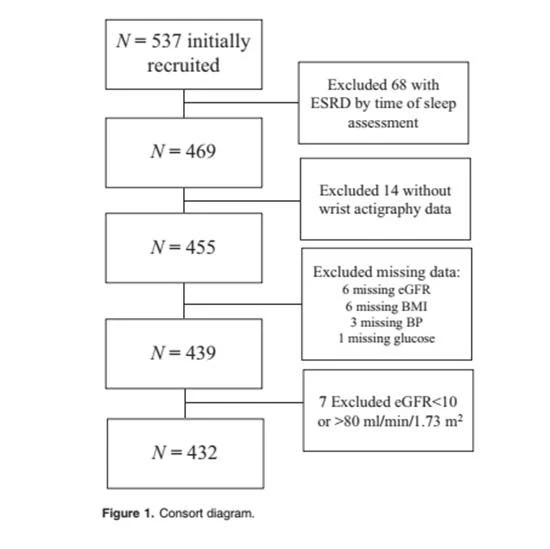
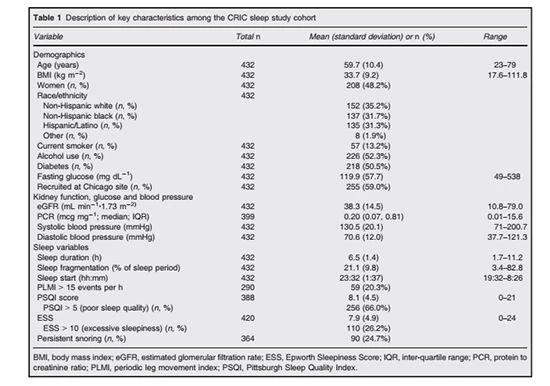
Sixty-eight participants developed ESRD prior to the sleep assessment and therefore were excluded from these analyses (Fig. 1). In addition, we excluded participants missing key data and who had an eGFR<10 or >80 mL min-1 1.73 m-2. Our final sample size was 432 patients. The description of the sample is presented in Table 1. The average age was approximately 60 years and 61% of the sample was obese (BMI≥30 kg m-2). Almost half of the participants were women, and half of the sample had diabetes. On average, these patients slept for 6.5 h per night, but this ranged from about 2 h per night to 10 h per night. Patients went to bed at 23:30 hours on average. Of those with foot actigraphy, 20% had a PLMI at or above 15 movements perh. Nearly two-thirds of the participants had PSQI scores above the clinical threshold for poor sleep quality (score >5), and more than 25% had ESS scores above the clinical threshold for excessive daytime sleepiness. Approximately one-quarter of the sample had persistent snoring. Furthermore, 80% of participants qualified for at least one of the following: poor subjective sleep quality (PSQI > 5); excessive daytime sleepiness (ESS > 10); or persistent snoring.
Many of the sleep measures were correlated, albeit only weakly or modestly. For example, shorter sleep duration was associated with greater sleep fragmentation (r = 0.39,P < 0.001) and later sleep start time (r = 0.36,P < 0.001). Higher PLMI was associated with greater sleep fragmentation (r = 0.28, P < 0.001). Higher PSQI scores were associated with greater sleep fragmentation (r = 0.16, P = 0.001), but not with sleep duration or sleep timing (both P > 0.05). Greater subjective sleepiness was associated with shorter sleep duration (r = 0.30, P < 0.001), greater sleep fragmentation (r = 0.16, P < 0.001) and later sleep timing (r = 0.13, P = 0.006).
Association between sleep and eGFR
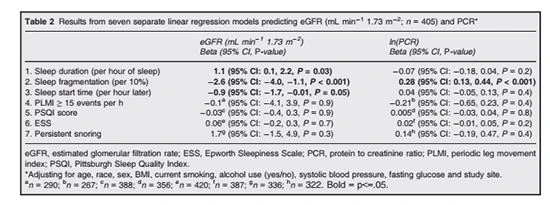
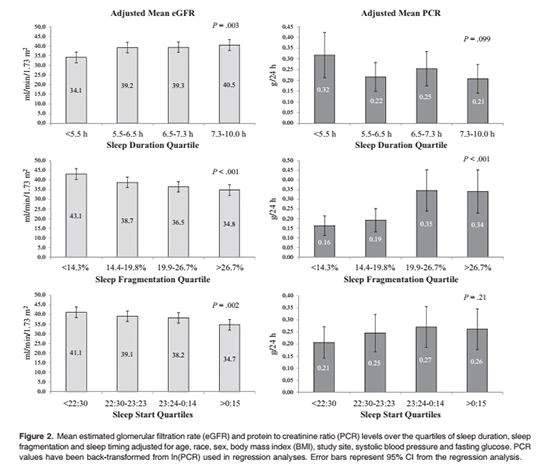
Figure 2 presents the adjusted means of eGFR for the quartiles of sleep duration, sleep fragmentation, and sleep timing. Results from multivariable linear regression analyses predicting eGFR are presented in Table 2. Lower eGFR was associated with shorter sleep duration (1.1 mL min-1∙1.73 m-2 per hour less sleep), greater sleep fragmentation ( 2.6 mL min-1 1.73 m-2 per 10% higher sleep fragmentation) and later sleep timing ( 0.9 mL min-1∙1.73 m-2 per hour later). Subjective sleep quality, subjective sleepiness, PLMI, and persistent snoring were not associated with eGFR. The quadratic term for sleep duration was not significant (P = 0.30), indicating the absence of a U-shaped association between sleep duration and eGFR.
Association between sleep and PCR
Figure 2 also presents the unadjusted associations between the distribution of PCR and the quartiles of sleep duration, sleep fragmentation, and sleep timing. Median PCR was significantly higher in those with greater sleep fragmentation, but there was no significant association between PCR and sleep duration or sleep timing quartiles. In the linear regression models (Table 2), PCR was only associated with greater sleep fragmentation (approximately 28% higher PCR per 10% higher sleep fragmentation). Habitual sleep duration, the quadratic term for sleep duration, sleep start time, PLMI, subjective sleep quality, sleepiness, and persistent snoring were not associated with PCR.
We examined whether the associations between the measures of sleep and the measures of kidney function varied by diabetes status or sex by testing interaction terms in each of the models. The interaction term between diabetes and PLMI was considered significantly associated with eGFR and in PCR (P < 0.10). Thus, stratified analyses were performed for these models. Among patients with CKD without diabetes, having a PLMI ≥ 15 events per h was associated with lower eGFR (beta = 3.8 mL min-1 1.73 m-2, P = 0.2, n = 154) and a higher PCR (approximately 28% higher,P = 0.36, n = 141), although neither association was significant. Among patients with CKD with diabetes, having a PLMI ≥ 15 events per h was associated with higher eGFR (beta = 4.0 mL min-1 1.73 m-2, P = 0.1, n = 136) and lower PCR (approximately 63% lower, P = 0.07, n = 126), but neither association reached statistical significance. The diabetes interaction terms in all other models were not significant, and none of the interaction terms with sex was significant (all P > 0.10).

DISCUSSION
In this sample of patients with pre-dialysis CKD, greater sleep fragmentation was associated with worse kidney function, as represented by both eGFR and the urine PCR. Shorter sleep duration and later sleep timing were also associated with lower eGFR but not PCR. Subjective sleep quality, sleepiness, and persistent snoring (a symptom of sleep apnea) were not associated with the kidney function measures.
Our study found that reduced sleep quality, as represented by greater sleep fragmentation, was associated with reduced eGFR and increased PCR. Experimentally induced sleep fragmentation in young healthy adults significantly reduced insulin sensitivity, impaired glucose metabolism, and attenuated nocturnal blood pressure dipping (Sayk et al., 2010; Stamatakis and Punjabi, 2010; Tasali et al., 2008), which are risk factors for the development of diabetes and hypertension. Diabetes and hypertension are, in turn, major risk factors for the development of CKD (Centers for Disease and Prevention, 2007). Further, experimental sleep fragmentation led to a 14% increase in cardiac sympathovagal balance, suggesting a shift toward higher sympathetic activity (Tasali et al., 2008). If sympathetic nervous activity is elevated due to habitual sleep fragmentation, then this could impair kidney function (Masuo et al., 2010). Unfortunately, previous experimental studies that manipulated sleep duration or quality have not examined effects on kidney function measures. One other observational study did use actigraphy and estimated sleep fragmentation (Agarwal and Light, 2011). They found no association between sleep fragmentation and eGFR; however, this analysis included only 27 patients with CKD.
A bidirectional relationship between sleep duration and quality and kidney function is possible. Only a few studies have documented sleep quality and duration in CKD prior to kidney failure. Evidence suggests that sleep disturbances in CKD could be a precursor of the more severe sleep disturbances described in ESRD (Turek et al., 2012). Studies that used actigraphy reported that individuals with ESRD had more disturbed sleep than individuals with CKD (Agarwal and Light, 2011; Barmar et al., 2009). Elevated sympathetic nervous system activity can lead to fragmented sleep and, conversely, fragmented sleep is associated with activation of the sympathetic nervous system. This bidirectional relationship could constitute a vicious circle where sleep problems and reduced kidney function enhance one another.
The finding that later sleeps timing is associated with kidney function is a novel discovery and it may be related to circadian rhythms. A possible explanation for the association between sleep timing and kidney function is circadian misalignment between endogenous clocks. Circadian misalignment can arise when behaviors such as sleep and meals occur at times that are not in synchrony with our endogenous clocks, and therefore key organ systems do not respond properly or work efficiently. Circadian clocks in renal cells seem to play an important role in the regulation of fluid levels and blood pressure homeostasis (Tokonami et al., 2014), thus if there is desynchrony between the circadian rhythms in the kidney and behaviors such as sleep, it is possible that disturbances in kidney function could occur. An additional possible explanation for the association between later sleep timing and worse kidney function involves melatonin release. Melatonin is a hormone secreted predominantly by the pineal gland and this secretion is inhibited by light. People who stay up later will be exposed to artificial light at night, and because light suppresses melatonin, melatonin levels may be lower in later sleepers. Melatonin has antioxidant properties and the administration of melatonin protected kidney allografts from ischemia/reperfusion injury-induced renal dysfunction and tubular injury in an animal model (Li et al., 2009). A recent study in obese mice (Ob/Ob) found that melatonin administration was associated with beneficial changes in the renal proximal convoluted tubules, which suggests that melatonin may be protective against renal morphological damage and dysfunction due to obesity (Stacchiotti et al., 2014). The strengths of this study include the objective estimates of sleep duration, quality, and timing, the large and ethnically diverse sample. There are a few limitations to note, however. This study did not have an objective measure of obstructive sleep apnea (OSA), and OSA may be associated with worse kidney function in patients with CKD (Pierratos and Hanly, 2011), although not all studies have observed these associations (Fornadi et al., 2014). While we did use a validated screening tool to identify patients with persistent snoring, a major symptom of sleep apnea, it is possible that the prevalence of apnea was underestimated. Previous epidemiological data suggested that year-to-year variability in sleep duration and quality is quite low in middle-aged adults (Knutson et al., 2007), although the stability of sleep habits in patients with CKD has not been examined. Finally, the study design is cross-sectional, and the direction of effect cannot be determined. Our study found significant associations between worse sleep quality, as indicated by greater sleep fragmentation, and reduced kidney function (either lower eGFR or higher PCR). Shorter sleep duration and later sleep timing were also associated with worse kidney function as indicated by lower eGFR. Future research should employ longitudinal and interventional designs in order to determine whether poor sleep quality or circadian disruption can impair kidney function. Physicians treating patients with CKD should consider inquiring about sleep and possibly sending for clinical sleep assessment. Importantly, future research should examine whether improving sleep quality and/or optimizing circadian rhythms in patients with CKD can slow CKD progression.

ACKNOWLEDGEMENTS
Funding for the CRIC Study was obtained under a cooperative agreement from the US National Institute of Diabetes and Digestive and Kidney Diseases (U01DK060990, U01DK060984, U01DK061022, U01DK061021, U01DK061028, U01DK060980, U01DK060963, and U01DK060902). Funding for the CRIC Sleep Ancillary study was obtained through an award from the National Institutes of Health (R01DK0716960). In addition, this work was supported in part by the Clinical and Translational Science Collaborative of Cleveland, UL1TR000439 from the National Center for Advancing Translational Sciences (NCATS) component of the National Institutes of Health and NIH Roadmap for Medical Research, the University of Illinois at Chicago CTSAUL1RR029879. Dr. Knutson is also supported by the NIDDK R01DK095207. Dr. Lash is funded by the NIDDK K24D K092290. Dr. Ricardo is funded by the NIDDK K23DK094829. These funders played no role in the study design, data collection, data analysis, data interpretation, or manuscript preparation.
AUTHOR CONTRIBUTIONS
Research idea and study design: KLK, JL, JH, JDT, MR, LJA, LAB, MKT, SPS, MRW, EVC; data acquisition: KLK, ACR, NT, JC; data analysis/interpretation: KLK, JL, ACR, EVC; statistical analysis: KLK. Each author contributed important intellectual content during manuscript drafting or revision and accepts accountability for the overall work by ensuring that questions pertaining to the accuracy or integrity of any portion of the work are appropriately investigated and resolved. KLK takes responsibility that this study has been reported honestly, accurately, and transparently; that no important aspects of the study have been omitted; and that any discrepancies from the study as planned have been explained.
CONFLICT OF INTEREST
Kristen L. Knutson: National Sleep Foundation Poll Fellow; James Lash: none; Ana C. Ricardo: none; James Herdegen: none; J. Daryl Thornton: none; Mahboob Rahman: none; Nicolas Turek: none; Janet Cohan: none; Lawrence J. Appel: none; Lydia A. Bazzano: none; Manjula Kurella Tamura: none; Susan P. Steigerwalt: PI for a Medtronic SPYRAL trial (but no direct compensation to her); Matthew R. Weir: ad hoc scientific advisor to Janssen, Astra Zeneca, Boehringer Ingelheim, MSD, Boston Scientific, Sanofi; Eve Van Cauter: consultant for Philips/Respironics for devices that may improve sleep quality, investigator-initiated grant support from Merck and Astra-Zeneca.
REFERENCES
Agarwal, R. and Light, R. P. Sleep and activity in chronic kidney disease: a longitudinal study. Clin. J. Am. Soc. Nephrol., 2011, 6:1258–1265.
Barmar, B., Dang, Q., Isquith, D., Buysse, D. and Unruh, M.Comparison of sleep/wake behavior in CKD stages 4 to 5 and hemodialysis populations using wrist actigraphy. Am. J. Kidney Dis., 2009, 53: 665–672.
Brandenberger, G., Follenius, M., Simon, C., Ehrhart, J. and Libert, J.P. Nocturnal oscillations in plasma renin activity and REM–NREM sleep cycles in man: a common regulatory mechanism? Sleep,1988, 11: 242–250.
Brandenberger, G., Follenius, M., Goichot, B., Saini, J., Ehrhart, J.and Simon, C. Twenty-four-hour profiles of plasma renin activity in relation to the sleep-wake cycle. J. Hypertens., 1994, 12: 277–283.
Buxton, O. M., Pavlova, M., Reid, E. W., Wang, W., Simonson, D. C.and Adler, G. K. Sleep restriction for 1 week reduces insulin sensitivity in healthy men. Diabetes, 2010, 59: 2126–2133.
Buysse, D. J., Reynolds, C. F. 3rd, Monk, T. H., Berman, S. R. and Kupfer, D. J. The Pittsburgh Sleep Quality Index: a new instrument for psychiatric practice and research. Psychiatry Res., 1989, 28:193–213.
Centers for Disease and Prevention Prevalence of chronic kidney disease and associated risk factors – the United States, 1999–2004. Morb. Mortal. Wkly Rep., 2007, 56: 161–165.
Charloux, A., Gronfier, C., Lonsdorfer-Wolf, E., Piquard, F. and Brandenberger, G. Aldosterone release during the sleep-wake cycle in humans. Am. J. Physiol., 1999, 276: E43–E49.
Charloux, A., Gronfier, C., Chapotot, F., Ehrhart, J., Piquard, F., and Brandenberger, G. Sleep deprivation blunts the nighttime increase in aldosterone release in humans. J. Sleep Res.,2001, 10: 27–33.
Cheungpasitporn, W., Thongprayoon, C., Gonzalez-Suarez, M. L. et al. The effects of short sleep duration on proteinuria and chronic kidney disease: a systematic review and meta-analysis. Nephrol.Dial. Transplant., 2016, 32: 991–996
Choi, H., Kim, H. C., Lee, J. Y., Lee, J. M., Choi, D. P. and Suh, I. Sleep duration and chronic kidney disease: the Korean Genome and Epidemiology Study (KoGES)-Kangwha study. Korean J.Intern. Med., 2017, 32: 323–334.
Coresh, J., Selvin, E., Stevens, L. A. et al. Prevalence of chronic kidney disease in the United States. JAMA, 2007, 298: 2038–2047.
Eckardt, K. U., Coresh, J., Devuyst, O. et al. Evolving importance of kidney disease: from subspecialty to global health burden. Lancet, 2013, 382: 158–169.
Feldman, H. I., Appel, L. J., Chertow, G. M. et al. The Chronic Renal Insufficiency Cohort (CRIC) Study: design and methods. J. Am. Soc. Nephrol., 2003, 14: S148–S153.
Fischer, M. J., Go, A. S., Lora, C. M. et al. CKD in Hispanics: baseline characteristics from the CRIC (Chronic Renal Insufficiency Cohort) and Hispanic-CRIC Studies. Am. J. Kidney Dis.,2011, 58: 214–227.
Fornadi, K., Ronai, K. Z., Turanyi, C. Z. et al. Sleep apnea is not associated with worse outcomes in kidney transplant recipients. Sci. Rep., 2014, 4: 6987.
Gansevoort, R. T., Correa-Rotter, R., Hemmelgarn, B. R. et al. Chronic kidney disease and cardiovascular risk: epidemiology, mechanisms, and prevention. Lancet, 2013, 382: 339–352.
Hurwitz, S., Cohen, R. J. and Williams, G. H. Diurnal variation of aldosterone and plasma renin activity: timing relation to melatonin and cortisol and consistency after prolonged bed rest. J. Appl. Physiol., 2004: 1406–1414.
Jean-Louis, G., Von Gizycki, H., Zizi, F., Spielman, A., Hauri, P. and Taub, H. The actigraph data analysis software: I. A novel approach to scoring and interpreting sleep-wake activity. Percept. Mot. Skills, 1997, 85: 207–216.
Johns, M. W. A new method for measuring daytime sleepiness: the Epworth Sleepiness Scale. Sleep, 1991, 14: 540–545.
Johns, M. W. Reliability and factor analysis of the Epworth Sleepiness Scale. Sleep, 1992, 15: 376–381.
Kim, C. W., Chang, Y., Sung, E. et al. Sleep duration and quality in relation to chronic kidney disease and glomerular hyperfiltration in healthy men and women. PLoS ONE, 2017, 12: e0175298.
Knutson, K. L., Rathouz, P. J., Yan, L. L., Liu, K. and Lauderdale, D.S. Intra-individual daily and yearly variability in actigraphically recorded sleep measures: the CARDIA study. Sleep, 2007, 30:793–796.
Leproult, R., Holmback, U. and Van Cauter, E. Circadian misalignment augments markers of insulin resistance and inflammation, independently of sleep loss. Diabetes, 2014, 63: 1860–1869.
Levey, A. S., Stevens, L. A., Schmid, C. H. et al. A new equation to estimate glomerular filtration rate. Ann. Intern. Med., 2009, 150:604–612.
Li, Z., Nickkholgh, A., Yi, X. et al. Melatonin protects kidney grafts from ischemia/reperfusion injury through inhibition of NF-kB and apoptosis after experimental kidney transplantation. J. Pineal Res., 2009, 46: 365–372.
Lin, M., Su, Q., Wen, J. et al. Self-reported sleep duration and daytime napping are associated with renal hyperfiltration in the general population. Sleep Breath, 2017, https://doi.org/10.1007/s11325-017-1470-0 (Epub ahead of print).
Masuo, K., Lambert, G. W., Esler, M. D., Rakugi, H., Ogihara, T. and Schlaich, M. P. The role of sympathetic nervous activity in renal injury and end-stage renal disease. Hypertens. Res., 2010, 33:521–528.
Nedeltcheva, A. V., Kessler, L., Imperial, J. and Penev, P. D. Exposure to recurrent sleep restriction in the setting of high caloric intake and physical inactivity results in increased insulin resistance and reduced glucose tolerance. J. Clin. Endocrinol. Metab., 2009,94: 3242–3250.
Netzer, N., Stoohs, R., Netzer, C., Clark, K., and Strohl, K. Using the Berlin Questionnaire to identify patients at risk for the sleep apnea syndrome. Ann. Intern. Med., 1999, 131: 485–491.
Ohkuma, T., Fujii, H., Iwase, M. et al. Association between sleep duration and urinary albumin excretion in patients with type 2 diabetes: the Fukuoka Diabetes Registry. PLoS ONE, 2013, 8:e78968.
Pierratos, A. and Hanly, P. J. Sleep disorders over the full range of chronic kidney disease. Blood Purif., 2011, 31: 146–150.
Rubin, R. T., Poland, R. E., Gouin, P. R. and Tower, B. B. Secretion of hormones influencing water and electrolyte balance (antidiuretic hormone, aldosterone, prolactin) during sleep in normal adult men.Psychosom. Med., 1978, 40: 44–59.
Salifu, I., Tedla, F., Pandey, A. et al. Sleep duration and chronic kidney disease: analysis of the national health interview survey. Cardiorenal Med., 2014, 4: 210–216.
Sayk, F., Teckentrup, C., Becker, C. et al. Effects of selective slow-wave sleep deprivation on nocturnal blood pressure dipping and daytime blood pressure regulation. Am. J. Physiol. Regul. Integr. Comp. Physiol., 2010, 298: R191–R197.
Scheer, F. A., Hilton, M. F., Mantzoros, C. S. and Shea, S. A. Adverse metabolic and cardiovascular consequences of circadian misalignment. Proc. Natl Acad. Sci. USA, 2009, 106: 4453–4458.
Spiegel, K., Leproult, R., and Van Cauter, E. Impact of sleep debt on metabolic and endocrine function. Lancet, 1999, 354: 1435–1439.
Spiegel, K., Leproult, R., Colecchia, E. F. et al. Adaptation of the 24-h growth hormone profile to a state of sleep debt. Am. J. Physiol. Regul. Integer. Comp. Physiol., 2000, 279: R874–R883.
Spiegel, K., Leproult, R., L’hermite-Baleriaux, M., Copinschi, G., Penev, P. D. and Van Cauter, E. Leptin levels are dependent on sleep duration: relationships with sympathovagal balance, carbohydrate regulation, cortisol, and thyrotropin. J. Clin. Endocrinol.Metab., 2004, 89: 5762–5771.
Stacchiotti, A., Favero, G., Giugno, L. et al. Mitochondrial and metabolic dysfunction in renal convoluted tubules of obese mice: protective role of melatonin. PLoS ONE, 2014, 9: e111141.
Stamatakis, K. A. and Punjabi, N. M. Effects of sleep fragmentation on glucose metabolism in normal subjects. Chest, 2010, 137: 95–101.
Tasali, E., Leproult, R., Ehrmann, D. A. and Van Cauter, E. Slowwave sleep and the risk of type 2 diabetes in humans. Proc. Natl Acad. Sci. USA, 2008, 105: 1044–1049.
Tochikubo, O., Ikeda, A., Miyajima, E. and Ishii, M. Effects of insufficient sleep on blood pressure monitored by a new multi biomedical recorder. Hypertension, 1996, 27: 1318–1324.
Tokonami, N., Mordasini, D., Pradervand, S. et al. Local renal circadian clocks control fluid-electrolyte homeostasis and BP. J.Am. Soc. Nephrol., 2014, 25: 1430–1439.
Turek, N. F., Ricardo, A. C., and Lash, J. P. Sleep disturbances as nontraditional risk factors for development and progression of CKD: a review of the evidence. Am. J. Kidney Dis., 2012, 60: 823–833.
Yaffe, K., Ackerson, L., Kurella Tamura, M. et al. Chronic kidney disease and cognitive function in older adults: findings from the chronic renal insufficiency cohort cognitive study. J. Am. Geriatr. Soc., 2010, 58: 338–345.
Yamamoto, R., Nagasawa, Y., Iwatani, H. et al. Self-reported sleep duration and prediction of proteinuria: a retrospective cohort study. Am. J. Kidney Dis., 2012, 59: 343–355.