Hotan Treasure · Cistanche - Desert Ginseng Nourished By Kunlun Snow Water
Aug 17, 2026
Hotan Treasure · Cistanche - "Desert Ginseng" Nourished by Kunlun Snow WaterOn the southern edge of the Taklamakan Desert, in the hidden depths of the Kunlun Mountains where snow quietly seeps into the sandy soil, there grows a magical plant known as the "desert ginseng" - Cistanche tubulosa. It does not compete for spring, does not admire prosperity, silently absorbs the essence of heaven and earth in extreme drought and heat, and completes the transformation of life under the dark sand layer. It is a treasure of Hotan, a health treasure passed down for thousands of years on the Silk Road, and a great gift bestowed upon humanity by nature.

The name 'calm' in the Millennium Pharmacopoeia
The name Cistanche tubulosa comes from its medicinal properties of "calm" and "gentle". Li Shizhen wrote in the "Compendium of Materia Medica": "This substance is nourishing but not steep, hence it is called calm. It has a calm and gentle appearance." These four words fully express the character of Cistanche tubulosa - not urgent or impatient, not fierce or fierce, like an elder who has gone through vicissitudes but is as warm as jade, nourishing life in the most gentle way possible.
The medicinal history of Cistanche tubulosa can be traced back to the Qin and Han dynasties over two thousand years ago. It was first recorded in the earliest surviving Chinese medicinal monograph, "Shennong Bencao Jing," and is classified as a "top-grade" herb. The book states that it has a sweet taste and a slight warmth. It is known for its five functions and seven injuries, tonifying the middle, removing cold, heat, and pain from the stem, nourishing the five organs, strengthening yin, nourishing essence and qi, having more children, and treating women's ailments. Long-term consumption can lighten the body. "In medical practice before the Sui and Tang dynasties, Cistanche tubulosa was mainly used to regulate deficiency diseases such as five functions and seven injuries, lack of essence and children, and was truly the medicine of emperors.
During the Kaiyuan period of the Tang Dynasty, "Daozang" ranked Cistanche tubulosa alongside Dendrobium officinale, Tianshan snow lotus, Centennial Polygonum multiflorum, Cordyceps sinensis, and others, and honored it as one of the "Nine Great Immortal Herbs of China". Since the Han Dynasty, Hetian Cistanche has been a precious treasure presented to the court by various countries in the Western Regions. Legend has it that during Genghis Khan's expedition, it was Cistanche tubulosa that helped the Mongolian cavalry recover their strength and boost their morale; Emperor Qianlong of the Qing Dynasty, who lived to the age of 89, is said to have benefited from his daily habit of drinking wine soaked in Cistanche tubulosa.

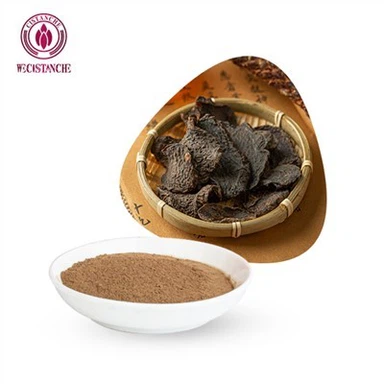
Chinese herb cistanche
Throughout history, medical experts have highly praised Cistanche tubulosa. According to Ni Zhumo's "Compendium of Materia Medica" in the Ming Dynasty, "Cistanche tubulosa is a medicinal herb that nourishes the gate of life, nourishes kidney qi, and replenishes essence and blood... This is a tonic that is warm but not hot, firm but not steep, warm but not dry, smooth but not leaking; hence it is called calm and composed." "The" Explanation of Jade Tree Medicinal Herbs "also praises it:" The prescription book describes it as nourishing the essence of the body, pleasing the color and prolonging the years, regulating men's yang and women's yin, and not overflowing. These words that span thousands of years together outline the irreplaceable position of Cistanche tubulosa in the traditional Chinese medicine system.
Half Snow Mountain, Half Desert - A Unique Geography Gifted by Heaven and Earth
If you want to ask where the most authentic Cistanche tubulosa is in the world, there is only one answer - Hotan, Xinjiang.
Hotan, located on the "Golden Latitude Line" at 37 ° N latitude, is situated at the northern foot of the Kunlun Mountains and the southern edge of the Taklamakan Desert. This is the intersection of the most extreme landforms on Earth: on one side stands the towering Kunlun Snow Mountain, covered in snow all year round and crisscrossed by glaciers; on the other side is the vast and boundless Sea of Death, with thousands of miles of yellow sand and surging heat waves. Between the snow-capped mountains and the desert, a rare "ice and fire" microclimate has formed, and Cistanche tubulosa was born precisely in this extreme boundary zone.
The unique geographical location endows Hotan with three irreplaceable natural advantages:
Ultra-long sunshine: Hotan has an annual sunshine duration of over 3500 hours, equivalent to enjoying nearly 10 hours of "natural sunbathing" every day. Strong ultraviolet radiation and sufficient light provide abundant energy for the photosynthesis of Cistanche tubulosa, leading to a much higher accumulation of active substances than in other production areas.
The huge temperature difference between day and night: During the day, the temperature can soar above 30 ℃, and suddenly drop below 10 ℃ at night, with a maximum temperature difference of 28 ℃. During the day, high temperatures accelerate nutrient synthesis, while at night, low temperatures lock in active ingredients. Phenylethanolic glycosides - the core substance that determines the efficacy of Cistanche tubulosa - have doubled their synthesis efficiency in such an environment. Local herdsmen often say, "The greater the temperature difference, the more solid the cut of Cistanche, and the more vigorous it is to chew
Pure sandy soil: The whole area of Hotan is covered with loose and breathable sandy soil, with excellent drainage. The root system of Cistanche tubulosa can freely extend without clogging or rotting, like sleeping on a "natural breathable bed". It grows thick and strong, and the texture is clear and distinguishable after slicing.
What's even rarer is that the Hotan River and the Yulong Kashgar River rush down from the Kunlun Mountains and flow throughout the entire region. This water pattern of 'drought without exhaustion, moistening without waterlogging', combined with the natural permeability of sandy soil, ensures that Cistanche tubulosa neither shrinks due to drought nor rots due to excessive moisture - everything is in just the right natural balance.
Kunlun Mountains Snow Water - The Source of Life Deep in the Earth
If sunshine and temperature difference are the "sunshine code" of Cistanche tubulosa, then the snow water of Kunlun Mountains is its true "source of life".
Kunlun Mountain, known as the "ancestor of ten thousand mountains", has a snow-capped peak that never melts all year round and extremely abundant glacier reserves. Every spring and summer, as the temperature warms up, glacier meltwater rushes down along mountain valleys, seeping into underground aquifers and slowly flowing towards the edge of the Taklamakan Desert. This underground river, stretching for hundreds of kilometers, is the lifeline that Hetian Cistanche relies on for survival.

Kunlun Mountain snow water is not ordinary surface water. It has undergone decades or even hundreds of years of filtration and mineralization in underground rock formations, dissolving more than ten rare minerals and trace elements such as calcium, magnesium, potassium, strontium, selenium, etc., making it a natural "mountain mineral water". When this mineral-rich snow water infiltrates into the sandy soil, is absorbed by the roots of the host plant Salix koraiensis and Salix koraiensis, and then transmitted to Cistanche tubulosa through the parasitic relationship, Cistanche tubulosa will complete the final concentration of the essence of heaven and earth under the dark sand layer.
Therefore, the effective ingredient content of Hetian Cistanche is second to none in the country. Scientific testing has shown that the total amount of echinacroside and verbascoside in Hetian Guanhua Cistanche can reach 1.5% to 1.8%, far exceeding the standard line of 0.3% in the Chinese Pharmacopoeia; The polysaccharide content is as high as 22% to 25%, which is significantly ahead of traditional production areas such as Alxa in Inner Mongolia. Behind these numbers is the silent gift of the Kunlun Mountains' millennium glaciers.

Main Chemical Constituents of Cistanche tubulosa
Click here to view Cistanche Enhance Immunity products
【Ask for more】 Email:cindy.xue@wecistanche.com / WhatsApp: 0086 18599088692 / WeChat: 18599088692
It is worth mentioning that the parasitic characteristics of Cistanche tubulosa determine its extreme pickiness towards the growth environment. It cannot survive independently and must parasitize on the roots of Haloxylon ammodendron or Salix matsudana, relying on the host to provide nutrients and water. And Haloxylon ammodendron and willow are precisely the toughest sand-fixing plants in the Taklamakan Desert. So, a delicate natural loop was formed: Kunlun snow water nourished Haloxylon ammodendron and Willow, Haloxylon ammodendron and Willow nurtured Cistanche tubulosa, and Cistanche tubulosa nourished human health in return - all things are connected and live on endlessly.
Miracle of Life and Ecological Protection in the Desert
Cistanche tubulosa is a perennial parasitic herbaceous plant belonging to the family Leuciscinae in plant taxonomy. It quietly grows underground for 2 to 4 years, relying on the host root system to provide nutrients. It does not see the sun and does not carry out photosynthesis, so it does not contain chlorophyll. Its body is light yellow or yellow-brown, covered with layers of scales, resembling the armor of ancient soldiers. In Hotan folk culture, the unexcavated Cistanche tubulosa is vividly called the "Black Commander".
By the end of spring and the beginning of summer, the fleshy stem of Cistanche tubulosa breaks through the sand and produces spike-like inflorescences, which can reach a height of 50 to 100 centimeters. Then photosynthesis begins, and the scales gradually turn from yellow-brown to blue-purple. After the flowers wither and seeds form, the seeds scatter with the wind and search for the host root system again, opening a new cycle of life. This kind of plant intelligence that perseveres in extreme environments and achieves self-realization through parasitism has amazed countless botanists.

Cistanche tubulosa
However, in the 1990s, due to long-term indiscriminate mining, wild Cistanche resources were on the brink of depletion, and the desert ecology suffered serious damage. The turning point occurred in 1990 when Professor Tu Pengfei of Peking University led a team to root in the western desert area, overcoming the technological bottleneck of large-scale planting of parasitic plants for the first time in the world, and creating an innovative path for the coordinated development of "medicinal herb production desert control industrial development".
Nowadays, a large number of red willows and red willows have been planted in the windproof and sand-fixing forest belt of 3046 kilometers on the edge of the Taklamakan Desert, providing vast growth space for Cistanche tubulosa. Red willows have locked in the thousand-year flowing sand, while Cistanche has given birth to the 'desert gold'. The former 'Sea of Death' is becoming a vibrant oasis, and Cistanche tubulosa is the most dazzling star in this green transformation.

Host of Cistanche tubulosa- Red Willow
The health code of the hometown of longevity
Hotan is known as the "hometown of longevity in the world". On this land, centenarians are not uncommon. They have a rosy complexion and a lively spirit, and many of them can still work in the fields and graze camel sheep. When people explore the health secrets of these long-lived elderly people, a common answer emerges - Cistanche tubulosa.
Drinking medicinal tea is a deeply ingrained lifestyle habit in the Hotan area. Whether in the fields or on the kang in the courtyard, what is cooked in a copper pot is often a handful of Cistanche with a few goji berries and slices of longan. The elderly say, 'Drinking a bowl of Cistanche tea every day can relieve waist soreness, leg weakness, and bowel movements.' This simple wisdom of life coincides with the research conclusions of modern pharmacology.

Harvest of Cistanche tubulosa
Modern scientific research has revealed the scientific connotation of the "longevity code" of Cistanche tubulosa:
Anti-aging and antioxidant: The phenylethanoid glycosides contained in Cistanche tubulosa have significant free radical scavenging ability, which can significantly reduce the content of lipid peroxides in the blood and liver; The polysaccharides it contains can significantly enhance mitochondrial enzyme activity and delay the aging process through multiple pathways.
Tonifying kidney and strengthening yang, enhancing function: Cistanche tubulosa can stimulate the pituitary gland and adrenal gland, promote hormone release, and have a regulatory function similar to adrenal cortex hormones. It can resist fatigue, improve physical function, and tonify yang without harming yin. Long-term use is not easy to cause internal heat.
Protecting the cardiovascular system: Studies have shown that Cistanche tubulosa has the effects of lowering blood lipids, anti-arteriosclerosis, and protecting the myocardium, which has profound significance in preventing cardiovascular and cerebrovascular diseases.
Neuroprotection and Intelligence: Cistanche tubulosa can improve cognitive function and enhance memory, demonstrating potential value in the prevention and treatment of neurodegenerative diseases such as Parkinson's disease and Alzheimer's disease.
Moisturizing the intestines and promoting bowel movements: For elderly habitual constipation, Cistanche tubulosa promotes small bowel movement, increases bowel volume and frequency, and is particularly suitable for the elderly and weak due to its ability to tonify the kidneys and nourish essence.
The nourishing characteristics of Cistanche tubulosa can be summarized in eight words: "Warm but not dry, nourishing but not greasy". It is not as strong and nourishing as ginseng, nor as fierce and damaging as rhubarb. Instead, it slowly nourishes the five organs and moisturizes the muscles and bones in a calm and unhurried manner. For this reason, the "Compendium of Materia Medica" refers to it as a "tonic" that is particularly suitable for long-term care of the elderly.
In the bazaar of Hotan, stalls drying Cistanche tubulosa can be seen everywhere, and the air is filled with a faint herbal fragrance. Uyghur compatriots call Cistanche tubulosa "Tushiganzhaidike" - meaning "carrot that rabbits love to eat". In the Uyghur medical system, it is also listed as a superior nourishing medicine. Han medicine and Wei medicine have reached a consensus across ethnic groups on this medicinal herb.
From Endangered to Industrial: The Green Rise of Gold Production in Sandy Land
During the 14th Five-Year Plan period, Hotan Prefecture embarked on a distinctive development path of "ecological industrialization and industrial ecologicalization". At present, the planting area of traditional Chinese medicine in the whole region has exceeded 740000 mu, of which the planting area of Cistanche tubulosa is about 530000 mu, accounting for about 56% of the national planting area. Hotan has become the main production area of Cistanche tubulosa in China.
Behind the numbers are vivid stories. Maitikasmu Abudula in Abutafulekkule Village, Yutian County, has been planting Cistanche tubulosa at home for nearly 20 years, and now the planting area has expanded to 7000 acres, becoming a major grower in the village. Adili Nurmaimaiti from Cele County has leased 1000 acres of sandy land, using drip irrigation and intercropping methods to achieve two seasons of harvesting per year, with an annual net profit of over 100000 yuan, and has also driven 20 residents to work nearby.

Cistanche tubulosa - a bumper harvest for farmers
The extension of the industrial chain is even more exciting. Two traditional Chinese medicine industrial parks and two traditional Chinese medicine trading centers have been built in the Hotan area, gathering more than 30 pharmaceutical merchants and companies. From sliced and extracted parts of Cistanche tubulosa, oral liquids, to Cistanche glycosides capsules (approved for market in 2005, providing urgently needed drugs for vascular dementia), and then to specialty Cistanche milk tea such as "Xinjiang Rose White" and "Xinjiang Red Warm" - desert plants of the past are entering the daily lives of urbanites in a brand new way.
In 2016, 'Hetian Cistanche' obtained the geographical indication product protection certification from the former General Administration of Quality Supervision, Inspection and Quarantine of China, becoming a 'golden signboard' for Hetian's nationwide and even global expansion. In 2025, the Xinjiang Hetian Cistanche Industry High Quality Development Conference was held, where top experts such as Professor Tu Pengfei from Peking University discussed industrial upgrading plans with local governments and enterprises. The blueprint for the entire industry chain of "planting, processing, sales, research and development" became increasingly clear.
Standing at the foot of Kunlun Mountain, overlooking the green barrier stretching for hundreds of thousands of acres on the southern edge of the Taklamakan Desert, what we see is not only the prosperity of a medicinal herb, but also a magnificent practice of reconciliation between humans and nature.
Cistanche tubulosa, the "desert ginseng" coming from the depths of sandy soil, carries the wisdom of the millennium pharmacopoeia, absorbs the essence of the Kunlun snow water, and witnesses the great changes of Hotan from the "sea of death" to the "basin of treasure". It interprets the true essence of life with the word 'calm' - not rushing or impatient, accumulating strength, and radiating gentle power in extreme situations.
The centenarians in Hotan are still cooking Cistanche tea every day, the red willow forest is still growing tenaciously on the edge of the desert, and the snow water in the Kunlun Mountains is still silently flowing year after year. All of this constitutes an eternal story about life, land, and time - and Cistanche tubulosa is the most touching chapter in this story.