How Drying Methods Shape The Active Compounds Of Desert Cistanche: What The Science Actually Shows
Nov 27, 2026
Introduction: The "Desert Ginseng" Gets a Closer Look
Cistanche deserticola is a plant that sounds almost too strange to be valuable. It is a perennial parasitic herb that cannot survive on its own; instead, it attaches to the roots of desert shrubs such as haloxylon, tamarisk, and four-wing saltbush, quietly drawing nutrients from its host. It grows in some of the most unforgiving environments in China-the arid deserts of Inner Mongolia, Xinjiang, Gansu, Ningxia, and Qinghai. And yet, for more than two thousand years, people have prized it as one of the great tonic herbs of traditional Chinese medicine, calling it the "desert ginseng."
The name is more than poetic. In classic texts like the Shennong Bencao Jing, cistanche was listed in the highest "top grade" of herbs, praised for its ability to restore vitality and nourish the body. Over the centuries, it has been used in teas, porridges, and medicinal wines. In 2023, its reputation received a modern stamp of approval when desert cistanche was officially added to China's catalog of substances recognized as both food and traditional medicine-a regulatory move that opened the door to using it far more widely in everyday foods and supplements.
But here is the challenge that modern manufacturers face: cistanche's value does not come from a single magic molecule. It comes from a family of compounds called phenylethanoid glycosides, and how much of those compounds survive from harvest to final product depends heavily on one often-overlooked step-how the plant is dried.
Phenylethanoid Glycosides: The Molecules That Matter
To understand why drying matters so much, it helps to understand what phenylethanoid glycosides (PhGs) are.
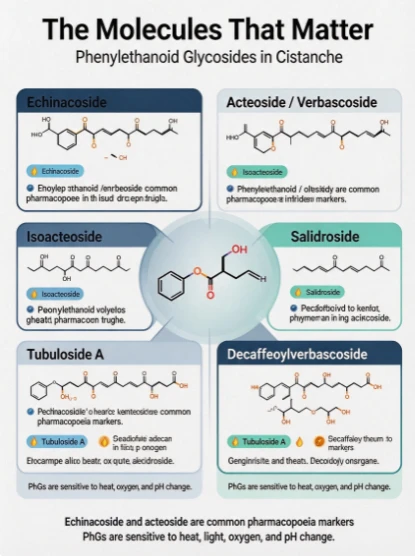
PhGs are a large and diverse group of natural compounds found in many medicinal plants, but they are especially abundant and important in cistanche. Chemically, they are built around a hydroxyphenylethanol core attached to sugar molecules, often with additional acids such as caffeic acid linked on. Scientists have identified more than 570 different PhGs in nature, and they vary enormously in structure. What they share is a set of useful properties: they are water-soluble, they absorb ultraviolet light strongly, and many of them act as powerful antioxidants, helping neutralize the reactive molecules that can damage cells over time.
In cistanche, six PhGs are considered especially important: echinacoside, acteoside (also known as verbascoside), isoacteoside, salidroside, decaffeoylverbascoside, and tubuloside A. Among these, echinacoside and acteoside are so closely tied to cistanche's health benefits that official Chinese pharmacopoeia standards use their combined content as a quality benchmark. Yet PhGs have a significant weakness: they are chemically fragile. They degrade when exposed to strong light, shifts in pH, oxygen, and-critically-heat. That fragility is exactly why the drying process deserves serious attention.
Why Drying Is a Make-or-Break Step
Fresh cistanche is mostly water, and like most agricultural products, it must be dried quickly after harvest to prevent spoilage and make it stable for storage and transport. But drying is not a neutral process. The method you choose-and the temperature you use-can dramatically change what remains inside the plant.
This creates a practical dilemma. Heat speeds up drying and kills microbes, which is good for shelf life and cost. But heat can also destroy the very compounds that make cistanche valuable in the first place. Meanwhile, gentler methods preserve more delicate chemistry but can be slower and far more expensive. Choosing the right drying method is therefore a balancing act between preserving quality and staying economically viable.
Until recently, however, researchers lacked clear evidence to guide that choice. Existing testing methods were mostly built around just two compounds, echinacoside and acteoside, and attempts to measure several PhGs at once often ran into problems-interfering substances in the plant, overlapping peaks on laboratory charts, and unstable results. There was also little solid data comparing how different drying methods affect a full set of PhGs, and even less understanding of what happens to those compounds-and their antioxidant power-once the dried cistanche is actually consumed and passes through digestion.
A Better Way to Measure: Six Compounds at Once
A recent study set out to fill those gaps. The first task was to build a reliable way to measure all six key PhGs at the same time.
The research team developed and optimized a high-performance liquid chromatography (HPLC) method, first confirming the identity of each target compound using high-resolution mass spectrometry. After testing and tuning, they settled on a detection wavelength of 285 nanometers and a carefully designed solvent gradient that cleanly separated the six compounds. They also optimized the sample preparation step, extracting with 60 percent methanol at a solid-to-liquid ratio of 1:60 and using 28 minutes of ultrasonic treatment.
The resulting method passed every test for reliability. Its linearity was excellent, its precision and stability were high, and its recovery rates ranged from about 100 to 106 percent-meaning the method could accurately capture nearly all of the target compounds. The limits of detection were sensitive enough to measure PhGs at the microgram level. In plain terms, the team now had a trustworthy ruler with which to compare different drying techniques.
Putting Five Drying Methods to the Test
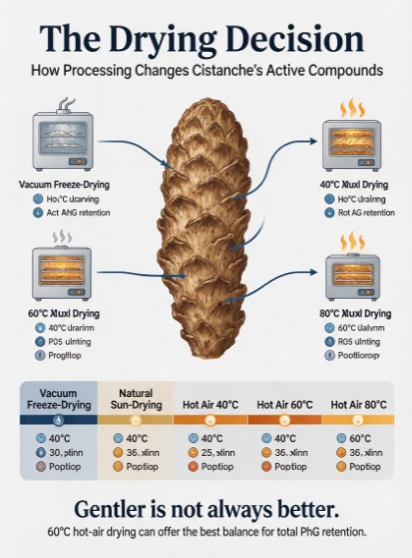
With the measurement tool in hand, the researchers compared five common drying approaches:
Vacuum freeze-drying, a gentle, low-temperature method often considered the gold standard for preserving delicate compounds;
Natural sun-drying, the traditional, low-cost approach;
Hot-air drying at 40 °C, a mild, controlled heat method;
Hot-air drying at 60 °C, a moderate-heat industrial standard;
Hot-air drying at 80 °C, a faster, higher-temperature option.
Each method was applied to cistanche samples, and the six PhGs were measured afterward. The results were surprising-and they challenge some common assumptions about what "best" means in food processing.
What Each Drying Method Did to the Compounds
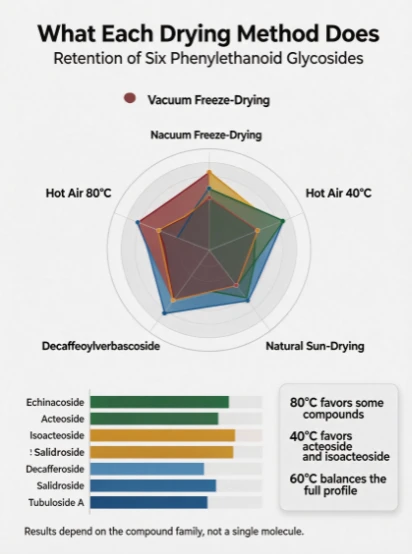
The study found that no single drying method was best for every compound. Instead, different temperatures favored different molecules.
Hot-air drying at 80 °C turned out to be the best at preserving three compounds: decaffeoylverbascoside, salidroside, and echinacoside. At first glance, this seems counterintuitive-after all, heat is supposed to damage delicate PhGs. But the result makes sense when you consider that drying is not simply about degradation. Heat can also trigger chemical transformations that shift the balance of compounds, and in some cases it can help certain forms accumulate.
Hot-air drying at 40 °C, in contrast, was best at preserving acteoside and isoacteoside. These two closely related compounds preferred the gentler heat, where the risk of breakdown was lower.
Perhaps the most striking finding was that vacuum freeze-drying-the method many people assume is superior-produced the lowest content of all six PhGs. This does not mean freeze-drying is "bad" in every way; it remains excellent for preserving many other nutrients. But it does show that for these particular compounds, the widely held assumption that colder is always better does not hold up.
The Practical Winner: Why 60 °C Hot-Air Drying Stands Out
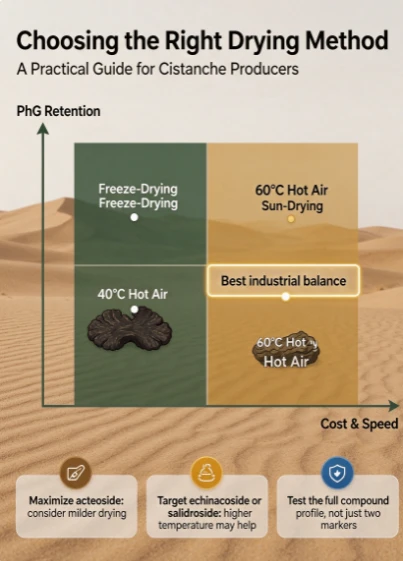
When the researchers looked at the overall picture-not just individual compounds but the complete retention profile-60 °C hot-air drying emerged as the most sensible choice for industrial production.
Its performance was balanced. It did not win first place for any single compound the way 40 °C and 80 °C did, but it preserved a solid, consistent share of all six PhGs together. In manufacturing, that balance matters a great deal: a product's functional value depends on the whole family of compounds working together, not on one molecule alone.
Equally important, 60 °C hot-air drying is economically practical. Vacuum freeze-drying requires expensive equipment and has high operating costs. Drying at 80 °C, while fast, consumes more energy. The 60 °C option sits in the middle-good retention, reasonable speed, and lower equipment and energy costs. For companies trying to produce cistanche at commercial scale, that combination of quality and affordability is exactly what makes a method viable in the real world.
What Metabolomics Revealed About the Chemistry
To understand why different temperatures shifted the compound profile, the team turned to a technique called non-targeted metabolomics, which maps the thousands of small molecules present in a sample.
The analysis revealed something interesting: high-temperature drying actually promoted the accumulation of certain precursor molecules-including chorismate and tyrosine-that sit upstream in the pathway that builds phenylethanoid glycosides. In other words, heat does not only break compounds down. It can also drive the plant's remaining biochemical machinery to produce more of the building blocks that feed into PhG synthesis, ultimately influencing the final distribution of the target compounds.
This helps explain the earlier puzzle. The relationship between heat and cistanche's active compounds is not a simple one-way street of destruction. It is a dynamic process in which degradation and synthesis happen at the same time, and the final result depends on which side wins at a given temperature.
Does the Antioxidant Power Survive Digestion?
Measuring compounds in a dried powder is one thing; knowing whether they still work after someone actually consumes them is another. The human digestive system is a harsh environment, and many promising plant compounds lose their activity as they pass through it.
To explore this, the researchers simulated digestion in the laboratory and tracked both the PhG content and the antioxidant activity before and after.
The starting powders showed clear, concentration-dependent antioxidant activity-meaning the more cistanche powder, the stronger the effect. All samples could neutralize free radicals in standard laboratory tests, although their ability to quench hydroxyl radicals (one particularly reactive type) was relatively weak and showed little difference between drying groups.
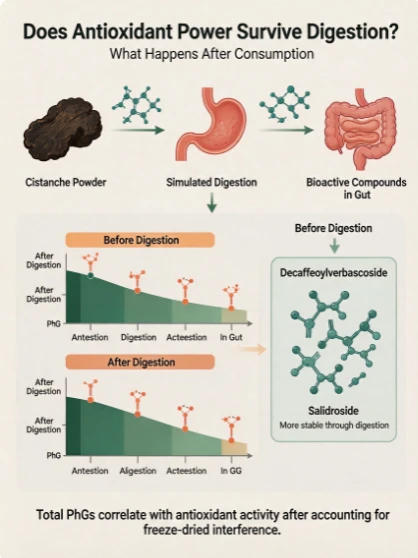
After simulated digestion, the picture changed. PhG levels fell steadily, and antioxidant activity measured by two standard assays dropped significantly as well. But not all compounds faded equally. Two PhGs-decaffeoylverbascoside and salidroside-proved the most stable through digestion, holding onto more of their content than their companions.
Which Compounds Are the Real Antioxidants?
One of the study's most valuable contributions was clarifying which compounds actually drive cistanche's antioxidant effect.
When the researchers looked at all samples together, the relationship between total PhGs and antioxidant activity was weak. The reason turned out to be interesting: in the vacuum freeze-dried samples, other substances-polyphenols, polysaccharides, and related antioxidants-were doing much of the heavy lifting, muddying the picture.
But when they removed the freeze-dried group from the analysis, the pattern snapped into focus. Echinacoside, acteoside, and isoacteoside showed strong, significant positive correlations with two of the antioxidant measurements. Even more telling, the total content of all six PhGs correlated significantly with all three antioxidant indicators used in the study. In other words, once the confounding effect of the freeze-drying group was set aside, the evidence clearly pointed to phenylethanoid glycosides as the core antioxidant players in cistanche.
Practical Takeaways for Producers and Buyers
For anyone working with cistanche-or simply curious about how processing affects the supplements they buy-the study offers several practical lessons.
First, drying method is not a minor detail. It can shift the active-compound profile enough to change the functional value of the final product. Producers should treat it as a key quality-control decision, not an afterthought.
Second, "gentler" does not always mean "better." The cold, high-tech appeal of freeze-drying does not automatically translate into more PhGs. In this case, a simple, mid-temperature hot-air dryer delivered a better overall balance at a fraction of the cost.
Third, temperature targets should match product goals. A manufacturer focused on maximizing echinacoside or salidroside might favor higher-temperature drying, while one emphasizing acteoside might lean toward a milder 40 °C. Understanding these trade-offs allows for intentional product design rather than guesswork.
Fourth, digestion changes everything. A compound that looks abundant in a raw powder may not survive the journey through the gut. The finding that some PhGs are more stable than others is useful for anyone developing cistanche products aimed at delivering real, bioavailable benefit.
Finally, quality testing should look at the whole family of compounds. The new six-compound HPLC method shows that it is now practical to monitor multiple PhGs at once, giving producers and regulators a much clearer picture of true product quality than the older two-compound approach.
Conclusion
Desert cistanche has spent two millennia building a reputation as a gentle but powerful tonic. Modern science is now catching up with that reputation, and the picture emerging is both reassuring and nuanced. The plant's value is real, but it is concentrated in a fragile family of compounds whose fate depends heavily on how the plant is handled after harvest.
The research reviewed here shows that drying is a decisive step, that different temperatures favor different compounds, and that a practical 60 °C hot-air method can preserve the complete set of key phenylethanoid glycosides while remaining affordable at industrial scale. It also clarifies which of those compounds are the true antioxidant workhorses and how they behave during digestion.
For the growing number of food and supplement companies turning to cistanche as a functional ingredient, these findings turn an age-old question-how to dry the harvest-into a scientifically informed choice. And for consumers, they offer a useful reminder: behind every natural health product is a chain of processing decisions, and the best products are the ones where those decisions are made with evidence, not assumption.