How To Build A Better Cistanche Probiotic Fermented Drink For Liver & Kidney Support: A Formula + Process Blueprint (With Data)
Nov 13, 2026
A story most herbal product developers know too well
A brand founder walks into your factory with a clear brief:
"We want a natural Cistanche-based drink that supports liver and kidney wellness, feels premium, and actually tastes good. No heavy masking flavors. No sugar bomb. And we need repeatable bioactive numbers, not 'it depends on the batch.'"
You can almost predict what happens next.
Finished Cistanche Tea Products Sell Oversea

Supportive Service Of Wecistanche-The largest cistanche exporter in the China:
Email:wallence.suen@wecistanche.com
The first prototype delivers "herbal power"… but the odor is too strong, the mouthfeel is rough, and consumer acceptance is low.
The second prototype fixes taste using more sweeteners or flavoring… but the label becomes less "clean," margins compress, and the brand loses its health positioning.
The third prototype tries fermentation… but because the strain–substrate match is generic, the fermentation improves acidity but doesn't reliably enrich key actives, and product quality varies from batch to batch.
This is exactly where a systems-level formula + fermentation design can change the game.
Below is a practical, product-development–oriented breakdown of a patented approach for a compound probiotic Cistanche (肉苁蓉) fermented beverage positioned for "liver & kidney support"-and why the design solves the pain points that hold most "herbal fermented drinks" back.
Who this article is for (and what you'll get)
If you are:
a Cistanche raw material supplier / factory building branded solutions,
a dietary supplement / functional beverage brand looking for a scalable hero SKU,
an R&D team exploring "herb + probiotic fermentation" routes,
you'll get:
a clear map of the customer pain points this formula targets,
a step-by-step formulation + process blueprint,
the strain system + fermentation window,
the measured outcomes (pH, antioxidants, short-chain fatty acids, key glycosides),
and a "why it works" logic you can reuse for your own product pipelines.
1) The customer pain points this formula is designed to solve
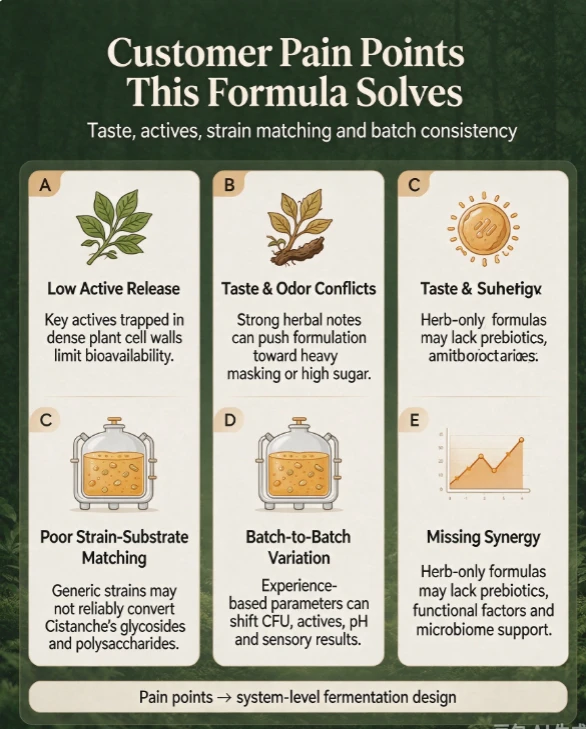
Pain point A - Low release rate and low bioavailability of key actives
Cistanche's key actives (e.g., echinacoside and acteoside/verbascoside) and Poria's β-(1→3)-glucan are largely trapped inside dense plant cell walls. Traditional extraction often struggles with:
limited cell-wall disruption,
incomplete dissolution,
and large molecules that are harder to absorb directly.
Solution concept in this invention: use targeted probiotic fermentation with a multi-strain system to promote bioconversion and enrichment of actives, instead of relying on extraction alone.
Pain point B - Taste and odor conflicts
Cistanche has a characteristic odor that hurts palatability. The usual "solution" is:
add more sugar / strong flavoring,
which conflicts with "clean label" and health positioning.
Solution concept: fermentation naturally increases acidity and generates flavor compounds, reducing the need for heavy masking.
Pain point C - Poor strain–substrate matching in common fermentations
Many herbal fermentations use "generic" probiotic strains or simplistic combinations. Without design around Cistanche's chemical profile (phenylethanoid glycosides, polysaccharides), the fermentation doesn't reliably:
convert target substrates,
enrich the desired functional actives,
or produce consistent metabolite patterns.
Solution concept: a four-strain Lactobacillus combination, activated and prepared in a structured way, then inoculated into a purpose-built substrate.
Pain point D - Unstable quality across batches
Fermentation parameters (temperature/time/inoculation/agitation) are often selected by experience. That leads to batch-to-batch volatility in:
viable counts,
active content,
acidity/pH,
and sensory consistency.
Solution concept: define a fermentation parameter window, and further apply orthogonal design optimization to identify a best-performing combination.
Pain point E - Lack of synergy between actives + functional factors + microbiome support
Traditional "herb-only" formulas may be missing:
prebiotic support,
modern functional factors,
or a coherent synergy mechanism.
Solution concept: combine herbal substrate + functional ingredients + probiotic fermentation into one integrated system.
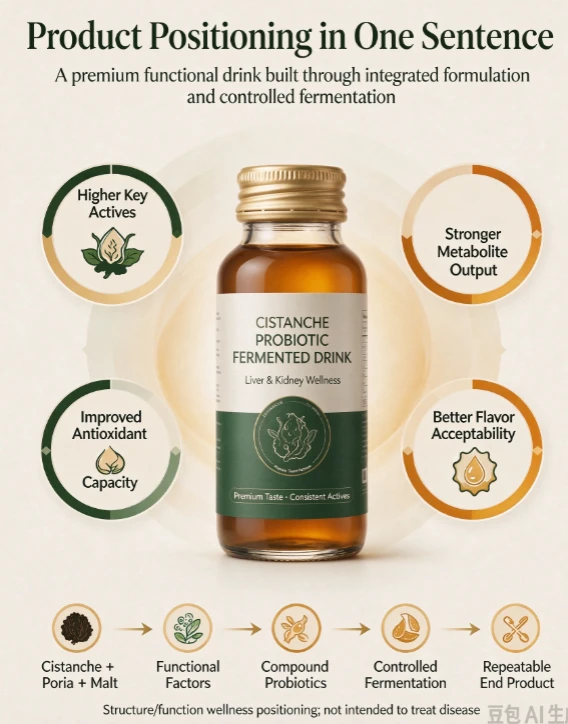
2) What this product is (positioning in one sentence)
A compound probiotic–fermented Cistanche beverage designed to deliver:
higher levels of key herbal actives,
strong microbial metabolite output (e.g., short-chain fatty acids),
improved antioxidant performance,
and better flavor acceptability,
while keeping the formula within a defined, reproducible process.
3) The invention: product name + core process (English translation)
(54) Title of the Invention
A Compound Probiotic Cistanche Fermented Beverage for Kidney- and Liver-Support and Its Preparation Method

(57) Abstract (translated, technical integrity preserved)
This invention discloses a compound probiotic Cistanche fermented beverage for kidney- and liver-support and a preparation method thereof. The method comprises the following steps: mixing Cistanche, Poria, malt, functional ingredients, and natural selenium- and strontium-containing mineral water, followed by sterilization to obtain a fermentation substrate; separately activating strains including Lactobacillus casei, Lactobacillus acidophilus, Lactobacillus rhamnosus, and Lactiplantibacillus plantarum, then centrifuging and freeze-drying and mixing to obtain a compound probiotic powder; culturing the compound probiotic powder in MRS medium to obtain a compound probiotic broth; inoculating the compound probiotic broth into the fermentation substrate for fermentation, then sterilizing to obtain the target compound probiotic Cistanche fermented beverage.
Through an integrated formulation innovation-herb–food compatibility of Cistanche, malt, and Poria; multi-factor functional ingredient compounding; and compound probiotic fermentation-this invention produces a probiotic Cistanche fermented beverage with high active ingredient content, clear functional direction, and good flavor.
4) Step-by-step preparation method
Claim 1 - Preparation method
A method for preparing a compound probiotic Cistanche fermented beverage for kidney- and liver-support, characterized by comprising:
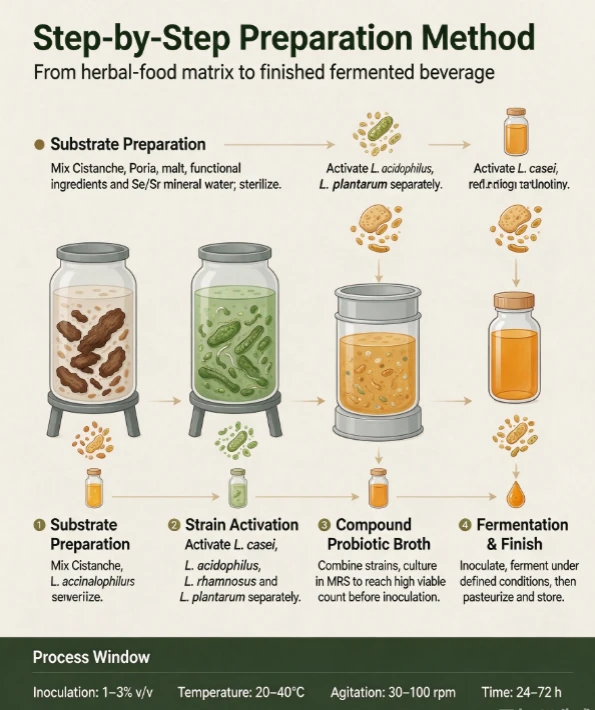
S1. Mix Cistanche, Poria, malt, functional ingredients, and natural selenium- and strontium-containing mineral water, and sterilize to obtain a fermentation substrate.
Wherein the functional ingredients include:
xylo-oligosaccharide,
D-ribose,
pyrroloquinoline quinone disodium salt (PQQ disodium salt),
D-allulose,
monk fruit extract,
xanthan gum,
pectin, and
sodium bicarbonate.
S2. Separately activate strains of:
Lactobacillus casei,
Lactobacillus acidophilus,
Lactobacillus rhamnosus, and
Lactiplantibacillus plantarum;
then centrifuge and freeze-dry and mix to obtain a compound probiotic powder. Culture the compound probiotic powder in MRS medium to obtain a compound probiotic broth.
S3. Inoculate the compound probiotic broth into the fermentation substrate for fermentation; sterilize after fermentation to obtain the compound probiotic Cistanche fermented beverage.
Claim 2 - Substrate composition (parts by weight)
In S1, the parts by weight of each component in the fermentation substrate are:
Cistanche: 5 parts
Poria: 4–6 parts
Malt: 8–12 parts
Xylo-oligosaccharide: 2.5–3 parts
D-ribose: 1.5–2 parts
PQQ disodium salt: 0.002–0.01 parts
D-allulose: 10–15 parts
Monk fruit extract: 0.5–2 parts
Xanthan gum: 0.05–0.1 parts
Pectin: 0.1–0.2 parts
Sodium bicarbonate: 0.4–0.6 parts
Natural selenium- and strontium-containing mineral water: 140–160 parts
Claim 3 - Mineral water selenium/strontium range
In S1, the natural selenium- and strontium-containing mineral water has:
Selenium content: 0.01–0.05 mg/L
Strontium content: 0.24–0.52 mg/L
Claim 4 - Strain activation conditions
In S2, strain activation conditions are:
Temperature: 35–40°C
Time: 12–24 h
Claim 5 - Viable count requirement of compound probiotic broth
In S2, the compound probiotic broth has a viable count of:
> 1×10^-8 CFU/mL (as written in the text)
Claim 6 - Mass ratio of strains in probiotic powder
In S2, the mass ratio of strains in the compound probiotic powder is:
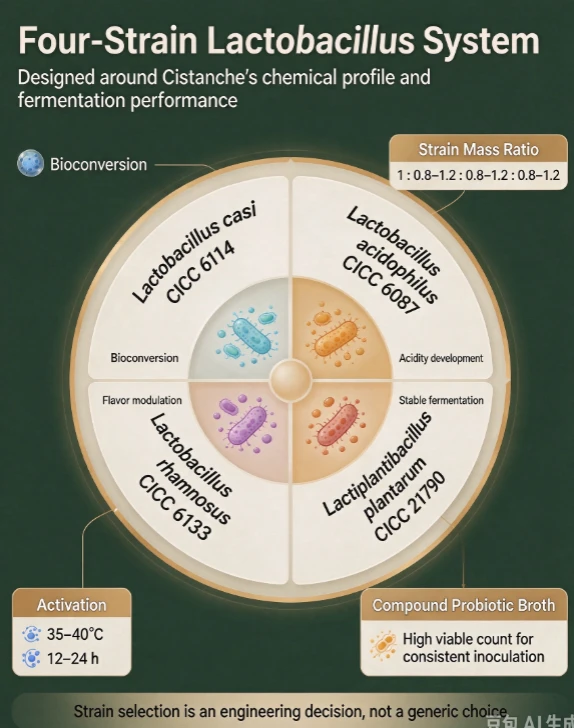
L. casei : L. acidophilus : L. rhamnosus : L. plantarum
= 1 : (0.8–1.2) : (0.8–1.2) : (0.8–1.2)
Claim 7 - Inoculation amount
In S3, the inoculation amount of the compound probiotic broth is:
1–3% (v/v) of the fermentation substrate volume.
Claim 8 - Fermentation conditions
In S3, fermentation conditions are:
Temperature: 20–40°C
Agitation speed: 30–100 r/min
Time: 24–72 h
Claim 9 - Product obtained by the method
A compound probiotic Cistanche fermented beverage prepared by any one of the methods described in Claims 1–8.
Claim 10 - Application
Application of the compound probiotic Cistanche fermented beverage described in Claim 9 in kidney- and liver-support products.
5) Microbial strains and media
According to the detailed description, the strains are specified as:
Lactobacillus casei CICC 6114
Lactobacillus acidophilus CICC 6087
Lactobacillus rhamnosus CICC 6133
Lactiplantibacillus plantarum CICC 21790
All sourced from China Center of Industrial Culture Collection (CICC).
MRS medium composition (per 1 L):
Peptone 10 g
Beef extract 10 g
Yeast extract 5 g
Tween-80 1 g
Dipotassium hydrogen phosphate 2 g
Sodium acetate 5 g
Triammonium citrate 2 g
Magnesium sulfate 0.2 g
Manganese sulfate 0.05 g
Make up to 1 L.
6) Example 1 (process example, translated with full key parameters)
(1) Substrate preparation (herb–food matrix)
Weigh and mix:
Cistanche 5 g
Poria 5 g
Malt 10 g
Xylo-oligosaccharide 2.8 g
D-ribose 1.8 g
PQQ disodium salt 5 mg
Monk fruit 1 g
Xanthan gum 0.069 g
Pectin 0.1104 g
D-allulose 12 g
Sodium bicarbonate 0.5 g
Add 150 mL natural selenium- and strontium-containing mineral water (Se 0.01–0.05 mg/L; Sr 0.24–0.52 mg/L). Mix uniformly, transfer to a sterilization vessel, and sterilize at 121°C for 15 min. Cool to obtain the fermentation substrate.
(2) Strain activation → centrifugation → freeze-drying → compound powder
Each strain is inoculated into a 250 mL flask containing 50 mL sterilized MRS, cultured at 37°C for 24 h (static). Centrifuge at 5000 r/min for 20 min, collect the pellet, freeze-dry to obtain each strain powder (viable count 1.0×10^9 CFU/g). Mix powders of the four strains at 1:1:1:1 to obtain the compound probiotic powder.
(3) Prepare the compound probiotic suspension/broth
Inoculate the compound probiotic powder into a 250 mL flask containing 50 mL sterilized MRS, seal and culture at 37°C until the logarithmic growth phase. Centrifuge at 4°C, 4000 rpm for 10 min, discard supernatant, wash with sterile water, and prepare a bacterial suspension with concentration > 1×10^-8 CFU/mL (as written).
(4) Fermentation
Inoculate at 1% (v/v) into the fermentation substrate; ferment at 30°C for 72 h, with agitation 50 rpm, to obtain the fermented liquid.
(5) Post-processing
After fermentation, mix; take 5 mL for dilution plating as needed. Transfer to sterilized bottles and perform pasteurization at 80°C for 30 min, store at 4°C.
7) Example 2: fermentation optimization (orthogonal design) - and what it teaches product developers
This section is extremely useful for B2B buyers because it tells them what actually drives viable counts.
Orthogonal design factors and levels (from Table 1)
Four factors were selected:
A (Fermentation time / h): 24, 36, 48, 72
B (Inoculation amount / %): 1.0, 2.0, 3.0, 4.0
C (Agitation speed / rpm): 0, 30, 60, 100
D (Fermentation temperature / °C): 30, 35, 37, 40
(These levels are shown in your Table 1 image.)
Key conclusion (rank of influence)
The order of key factors influencing viable counts was reported as:
Inoculation amount (B) > fermentation time (A) > agitation speed (C) > fermentation temperature (D)
This is a practical takeaway: when scaling up, your fastest control lever for stable CFU is often inoculation rate, not just temperature.
Best-performing combination reported
The optimal process combination was described as:
Fermentation time: 72 h
Inoculation amount: 3.0%
Agitation speed: 100 rpm
Fermentation temperature: 37°C
It was also stated that at 0 rpm, insufficient oxygen led to the lowest viable count, while 100 rpm achieved the highest viable count due to "moderate dissolved oxygen."

Validation batches (repeatability)
Three batches were produced under the optimal process and viable counts were:
7.5×10^9 CFU/mL
7.3×10^9 CFU/mL
7.6×10^9 CFU/mL
This strongly supports production repeatability.
8) Results: what improved after probiotic fermentation (data buyers care about)
From the provided table image, the "Example 2 optimal conditions" vs "Comparative Example 1 (no probiotic fermentation; water used instead)" showed improvements in multiple metrics, including:
Bioactive and chemistry indicators (selected)
Polysaccharides: 5.750 mg/mL vs 3.5 mg/mL
Free amino acids: 0.545 mg/mL vs 0.349 mg/mL
Total phenols: 0.132 mg/mL vs 0.071 mg/mL
Total flavonoids: 0.427 mg/mL vs 0.218 mg/mL
Total saponins: 0.348 mg/mL vs 0.156 mg/mL
pH: 3.39 vs 5.39

Key Cistanche markers
Acteoside / Verbascoside (毛蕊花糖苷): 0.087 mg/mL vs 0.079 mg/mL
Echinacoside (松果菊苷): 0.138 mg/mL vs 0.103 mg/mL
Short-chain fatty acids (SCFAs)
Acetic acid: 15.13 μg/mL vs 10.76 μg/mL
Propionic acid: 5.52 μg/mL vs 2.13 μg/mL
Butyric acid: 4.54 μg/mL vs 1.02 μg/mL
Isobutyric acid: 5.27 μg/mL vs 3.01 μg/mL
Antioxidant capacity (in vitro)
DPPH radical scavenging: 87.5% vs 46.8%
Hydroxyl radical scavenging: 49.3% vs 23%
Superoxide anion scavenging: 72.2% vs 64.9%
9) Why this formula is "commercially smart" (not just scientifically interesting)
For factory customers and brands, this design creates a product story that is easy to sell and easy to manufacture at scale.
1) "Herb + fermentation + prebiotic" makes a complete narrative
Cistanche + Poria + malt = herb–food compatibility logic
XOS (xylo-oligosaccharide) = prebiotic support for fermentation and gut-friendly positioning
D-allulose + monk fruit = "better sugar system" for modern consumers
PQQ disodium salt + D-ribose = "modern functional factors" angle (energy, cellular support narratives, market-dependent)

2) Fermentation solves taste while raising technical KPIs
Fermentation lowers pH (to ~3.39 reported) which:
improves microbial safety and stability directionally,
creates natural sourness,
and reduces reliance on heavy masking.
3) A defined parameter window reduces scaling risk
The invention specifies workable ranges:
inoculation 1–3% (v/v),
20–40°C,
30–100 rpm,
24–72 h,
and identifies a best combination. That's exactly what a buyer wants to see when evaluating feasibility.
10) Practical "product development takeaways" you can reuse
Takeaway 1 - Start from pain points, not ingredients
If your customer's biggest problem is taste + inconsistency, then your "hero technology" should be:
fermentation system design,
not just stacking more herbs.
Takeaway 2 - Treat strain selection as an engineering decision
Don't use a generic strain because it's available. Choose strains based on:
target substrates,
desired metabolites (acids, flavor),
and stability under your process constraints.
Takeaway 3 - Build a scalable, documented fermentation window
Even if you later change strains or ingredients, buyers trust you more when you can say:
"Here is the validated window; here is the optimized point; here are the batch repeatability numbers."
11)keyword
Cistanche fermented drink
Cistanche probiotic beverage
compound probiotics fermentation
echinacoside fermentation enhancement
acteoside / verbascoside content
herbal fermentation for functional drinks
prebiotic XOS fermented beverage
Poria malt Cistanche formulation
private label Cistanche drink manufacturer
OEM probiotic herbal beverage
Cistanche extract vs fermentation
gut microbiome friendly herbal drink