Humoral And Cellular Immunity To SARS-CoV-2 Ancestral And Omicron BA.5 Variants Following Vaccination in Myelofibrosis Patients
May 29, 2023
Dear Editor,
Myelofibrosis (MF) is a clonal myeloproliferative neoplasm associated with inflammatory manifestations including fibrosis and constitutional symptoms. The standard treatment for symptomatic MF is ruxolitinib, a JAK1/2 inhibitor (JAKi) that antagonizes cytokine receptor signaling. JAK-dependent cytokine signals are integral to an effective inflammatory response and ruxolitinib treatment is accompanied by an increased risk of infection, including reactivation of the varicella-zoster virus and tuberculosis [1]. Individuals with advanced MF have an increased risk of severe COVID-19, and impaired response to vaccination [2–6].
In response to the COVID-19 pandemic, Australia implemented strict isolation measures. Negligible community transmission of SARS-CoV-2 until November 2021 in South Australia provided the opportunity to assess vaccine responses with minimal interference from natural infection.
Adult patients with primary or secondary MF receiving a JAKi were recruited for a longitudinal observational study of vaccine response. The study was approved by the relevant ethics committee and clinical data was extracted from health records. Patients with MF were prioritized for early vaccination, and most participants received two initial doses of the viral vector-based AZD1222 (University of Oxford/ AstraZeneca), followed by a third dose of an mRNA-platform vaccine, BNT162b2 (Pfizer/BioNTech) or mRNA-1273 (Moderna/NAIAD) [7–9].
Myelofibrosis is a bone marrow disease characterized by fibrous tissue proliferation and fibrin deposition in the bone marrow, leading to a series of symptoms such as anemia and decreased immune function. The immune system plays an important role in the occurrence and development of myelofibrosis.
On the one hand, chronic inflammation is one of the important causes of myelofibrosis. Excessive activation of the immune system will lead to the persistence of inflammatory response, promote the proliferation of myeloid cells, and the occurrence of fibrosis. Therefore, the balance and stability of the immune system are of great significance to prevent the occurrence of myelofibrosis.
On the other hand, the bone marrow is one of the main organs of the immune system, and the production and differentiation of immune cells are completed in the bone marrow. Myelofibrosis leads to impaired bone marrow function, which affects the production and differentiation of immune cells, thereby affecting the normal function of the immune system. The application of immunosuppressive drugs can improve the immune function of patients with myelofibrosis in some cases, but it is necessary to balance the therapeutic effect and side effects of drugs.
Therefore, myelofibrosis is closely related to immunity. By controlling the inflammatory response, maintaining the balance of the immune system, and improving the function of the bone marrow, the onset, and progression of myelofibrosis-related symptoms can be prevented and treated. Therefore, we must improve our immunity. Cistanche has a good effect on improving immunity. The polysaccharides in Cistanche can regulate the immune response of the human immune system, improve the stress ability of immune cells, and enhance the bactericidal effect of immune cells.

Click health benefits of cistanche
Participants provided samples at time points before and after vaccine doses (Fig. 1A). Cellular and humoral immune responses to the original two-dose vaccine schedule were compared to those of 10 healthy controls (HC) of comparable age and sex (Supplementary Table 1). Upon recommendation of a third vaccine dose, the MF cohort was expanded to include individuals receiving alternative therapies other than JAKi, and additional samples were requested within the 14 days preceding (T3), and 28 days following (T4), the third dose. Serological immunity was assessed by SARS-CoV-2 Spikespecific IgG ELISA and live virus neutralization of Ancestral and Omicron BA.5 variants, and T cell immunity by IFNγ-ELISpot.
Forty patients contributed samples with a median follow-up of 356 days after the first vaccine. Patient characteristics are shown in Supplementary Table 2. Patients on a JAKi had features of advanced disease compared to those on alternative therapies, with higher clinical scores (by Dynamic International Prognostic Scoring System-Plus; DIPSS+), lower hemoglobin and platelet counts, and higher LDH. Twenty-four patients were on a JAKi: ruxolitinib (n = 21, median dose 10 mg bd); momelotinib 200 mg/ d (n = 2); or fedratinib 400 mg/d (n = 1). Sixteen patients were on hydroxyurea (n = 8) or no cytoreductive therapy (n = 8). Three patients were in remission following allogeneic stem cell transplantation (3, 4, and 8 years prior), one of whom was on ruxolitinib and ciclosporin for chronic graft-vs-host disease (included in the JAKi cohort). Four patients commenced a JAKi after commencing vaccination, one after the first dose, and three after the second dose, and were included in the non-JAKi cohort.
MF patients receiving a JAKi demonstrated severely impaired humoral and cellular immune responses to the initial two-dose vaccination schedule relative to healthy individuals. Seroconversion (EUROIMMUN ratio ≥1.1) occurred after the first vaccine dose (T1) in 1/16 patients (6.3%) on JAKi, rising to 4/17 (23.5%) after the second dose (Fig. 1B; Supplementary Table 3). By comparison, all HC seroconverted following two doses of AZD1222 (median ratio 4.56 vs 0.40 in MF patients on JAKi, p < 0.0001) (Fig. 1B). Frequency of Spike-reactive IFNγ-secreting T cells was also significantly reduced compared with HC following two doses (median 18.75 [IQR 0–103.2] vs 458 [IQR 134.5–702] SFU per 106 cells; p < 0.0001), as was the change from baseline, a more accurate measure of the magnitude of vaccine response (median 0 vs 248.0, respectively; p < 0.0001) (Fig. 1C, D).
Given the severely impaired immunogenicity of a two-dose vaccination schedule in MF patients receiving a JAKi, we evaluated the response of this group to a third (mRNA-platform) dose relative to a cohort of MF patients receiving alternative therapies. The mean interval from the first dose to T3 and T4 was similar between JAKi and non-JAKi (190 vs 187 days, p = 0.30, and 225 vs 229 days, p = 0.81, respectively). Before a third dose, fewer patients on JAKi therapy seroconverted than MF patients on alternative therapies (24% vs 67%; p = 0.031) (Supplementary Fig. 1A–F). A third dose significantly increased median anti-Spike IgG titers in both groups (Fig. 1E), but titers remained lower in those receiving a JAKi (3.96 vs 8.61; p < 0.0001) (Fig. 1F). T-cell responses did not improve with a third dose in either group (Fig. 1G).
A significant limitation of COVID-19 vaccine research has been interpreting real-world protection from immunogenicity data. Early in the pandemic, Khoury and colleagues [10] described the close correlation between the serological neutralization of live SARSCoV-2 virus and real-world protection from infection. In this data set, 50% protection from infection was achieved at a neutralization titer (IC50) equivalent to 20.2% of the mean titer of a cohort of healthy convalescent individuals (infected with the Wuhan strain). To estimate the level of protection afforded patients in the present study, we measured serological neutralization for 20 healthy convalescent donors from the first SARS-CoV-2 wave in Australia and defined an end-point titer of ≥20 as an effective neutralization threshold for protective immunity (see ‘Methods’).

Following a third vaccine dose, effective neutralization of Ancestral SARS-CoV-2 (A.2.2) increased from 0/18 to 12/20 (60%) for patients on JAKi (p < 0.0001) (Fig. 1H). By comparison, rates for patients on alternative therapies rose from 6/15 (40%) to 15/16 (94%; p = 0.0021) (Fig. 1H). Consistent with antibody escape by the Omicron BA.5 variant, neutralization of BA.5 was reduced for all groups relative to A.2.2 (Fig. 1H–K; Supplementary Fig. 2). Before a third dose, no MF patients on either treatment demonstrated effective neutralization of BA.5 (Fig. 1J). Following a third dose, 69% of patients on alternative therapies demonstrated effective neutralization, compared with 15% on JAKi. Patients who received at least one vaccine dose before commencing JAKi therapy tended to have improved serologic responses (Supplementary Fig. 3).
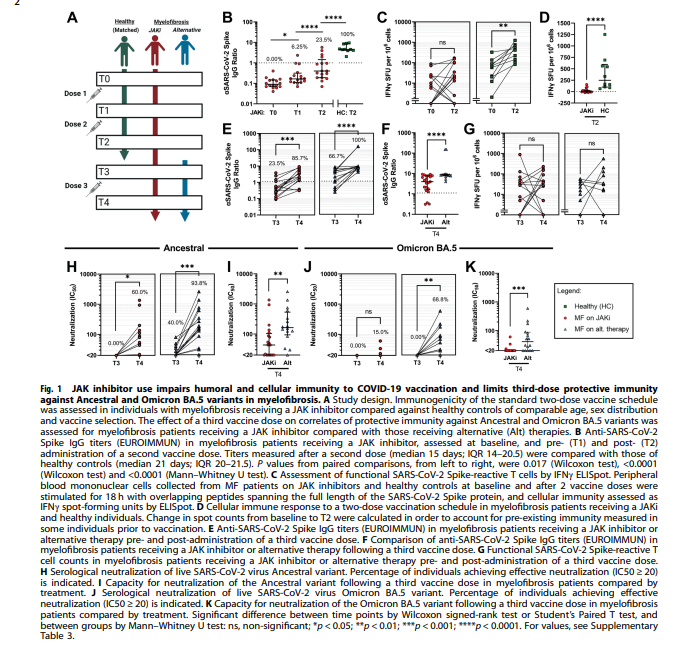
The emergence of SARS-CoV-2 variants that escape vaccine-induced humoral immunity has highlighted the importance of T cells [11–14]. In patients with hematological malignancies, high CD8+ T cell counts are associated with improved outcomes of COVID-19 despite reduced levels of virus-neutralizing antibodies [15]. T-cell responses did not improve significantly after a third vaccination in MF patients. ELISpot counts correlated with anti-S IgG titer (r = 0.37, p = 0.047) and with neutralization of A.2.2 (r = 0.41, p = 0.029), suggesting that patients with a more robust serological response may have a less impaired T cell response.
In a multivariate linear regression model, only JAKi therapy (β = −2.735, 95% CI −4.233 to −1.237; p = 0.0013) and total lymphocyte count (β = 0.9709, 95% CI 0.1609–1.781; p = 0.022) were found to predict T3 serologic response. Only the male sex was predictive of poorer serological response at T4. JAKi treatment predicted poorer neutralization against A.2.2 at T3 and Omicron BA.5 strain at T4 (Supplementary Tables 4–10). By logistic regression and bivariate analysis, only JAKi was associated with nonresponders, with a relative risk of 2.9 (95% CI 1.17–5.20, p = 0.031), 1.67 (1.67–1.92, p = 0.0045), 6.40 (1.25–37.0, p = 0.026) and 2.72 (1.44–6.10, p = 0.0017) for T3 anti-Spike IgG, T3, and T4 Ancestral neutralization, and T4 Omicron BA.5 neutralization, respectively (Supplementary Tables 11–19).

Ten patients (7 males, 3 females) were documented to have SARS-CoV-2 infection during the follow-up period, occurring either after the third vaccine dose (n = 4) or the fourth dose (n = 6). Of the 10 patients, 5 were on ruxolitinib (representing 21% of the JAKi cohort) and 5 were on alternative therapies (representing 31% of the non-JAKi cohort). One patient on ruxolitinib was hospitalized with moderately severe COVID-19 disease. The remainder received either no treatment or outpatient-based oral antiviral therapy, and no patients died from COVID-19.
Patients who had clinical infection had lower median T3 and T4 anti-S antibodies and neutralization of Ancestral and Omicron BA.5 virus compared to the rest of our study cohort, and only two met the threshold for effective neutralization of Omicron BA.5 after the third dose. However, the study was not powered to assess the association between humoral immunity and clinical outcomes, and these observations were not statistically significant (Supplementary Fig. 4, Supplementary Table 20).
This study describes severe impairment of humoral and cellular vaccine responses in MF and identifies JAKi use as a modifiable predictor of inadequate protection against SARS-CoV-2 strains. Following a third vaccine dose, 85% of patients on a JAKi (and >30% on alternative therapies) did not demonstrate effective immunity against Omicron BA.5 and T cell responses, which provide cross-protective immunity in the absence of effective neutralization, remained impaired [15]. Patients and clinicians should be aware that standard vaccination is less effective in MF so that simple hygiene measures to reduce the risk of exposure to SARS-CoV-2 can be employed. Whenever possible, vaccination should be done before the commencement of JAKi therapy. We suggest patients on a JAKi be included among at-risk groups considered for access to prophylactic measures currently in development to protect against current and future viral strains.

Encouragingly, consistent increases in antibody titer were observed for the JAKi cohort with repeated vaccination, suggesting further booster dosing may help overcome this impaired response. These results should assist in the ongoing refinement of COVID-19 vaccination and management guidelines, and motivate investigation into the immunogenicity of other key vaccines in patients receiving ruxolitinib.

ACKNOWLEDGEMENTS
The authors are grateful to all of the patients who donated samples, and to SA Pathology and the staff of the South Australian Cancer Research Biobank for the collection and processing of samples. This work was supported by a grant from the Health Services Charitable Gifts Board (Adelaide, Australia). The following reagent was a generous gift of BEI Resources, NIAID, NIH (Manassas, VA): Peptide Array, SARSRelated Coronavirus 2 Spike (S) Glycoprotein, NR-52402. Figure 1A was generated using BioRender.com.
AUTHOR CONTRIBUTIONS
AAl collected data, performed statistical analysis, and wrote the paper. DMR conceived the project, recruited MF participants, and wrote the paper. GBP performed ELISpot testing and wrote the paper. PAP, AC, and TB performed EUROMMUN assay. CSC and PTC performed ELISpot testing. AAk, AAg, VM, and ST performed live virus neutralization. MT, PH, and SA assisted in data collection.
COMPETING INTERESTS
No external funding was received for this study. DMR declares research funding and honoraria from Novartis and Bristol-Myers Squibb and consultancy for Keros. SA reports previous travel Support from Amgen, Roche, and Novartis. The remaining authors declare no COI.
Open Access
This article is licensed under a Creative Commons Attribution 4.0 International License, which permits use, sharing, adaptation, distribution, and reproduction in any medium or format, as long as you give appropriate credit to the original author(s) and the source, provide a link to the Creative Commons license, and indicate if changes were made. The images or other third party material in this article are included in the article’s Creative Commons license unless indicated otherwise in a credit line to the material. If material is not included in the article’s Creative Commons license and your intended use is not permitted by statutory regulation or exceeds the permitted use, you will need to obtain permission directly from the copyright holder.
REFERENCES
1. Klein K, Stoiber D, Sexl V, Witalisz-Siepracka A. Untwining anti-tumor and immunosuppressive effects of JAK inhibitors—a strategy for hematological malignancies? Cancers 2021;13:2611.
2. Pimpinelli F, Marchesi F, Piaggio G, Giannarelli D, Papa E, Falcucci P, et al. Lower response to BNT162b2 vaccine in patients with myelofibrosis compared to polycythemia vera and essential thrombocythemia. J Hematol Oncol. 2021;14:119.
3. Maneikis K, Šablauskas K, Ringelevičiūtė U, Vaitekėnaitė V, Čekauskienė R, Kryžauskaitė L, et al. Immunogenicity of the BNT162b2 COVID-19 mRNA vaccine and early clinical outcomes in patients with hematological malignancies in Lithuania: a national prospective cohort study. Lancet Haematol. 2021;8:e583–92.
4. Caocci G, Mulas O, Mantovani D, Costa A, Galizia A, Barabino L, et al. Ruxolitinib does not impair the humoral immune response to COVID-19 vaccination with the BNT162b2 mRNA COVID-19 vaccine in patients with myelofibrosis. Ann Hematol. 2022;101:929–31.
5. Barbui T, Vannucchi AM, Alvarez-Larran A, Iurlo A, Masciulli A, Carobbio A, et al. The high mortality rate in COVID-19 patients with myeloproliferative neoplasms after abrupt withdrawal of ruxolitinib. Leukemia 2021;35:485–93.
6. Fiorino F, Ciabattini A, Sicuranza A, Pastore G, Santoni A, Simoncelli M, et al. The third dose of mRNA SARS-CoV-2 vaccines enhances the spike-specific antibody and memory B cell response in myelofibrosis patients. Front Immunol. 2022;13:1017863.
7. Baden LR, El Sahly HM, Essink B, Kotloff K, Frey S, Novak R, et al. Efficacy and safety of the mRNA-1273 SARS-CoV-2 vaccine. N. Engl J Med. 2021;384:403–16.
8. Sadarangani M, Marchant A, Kollmann TR. Immunological mechanisms of vaccine-induced protection against COVID-19 in humans. Nat Rev Immunol. 2021;21:475–84. 9. Polack FP, Thomas SJ, Kitchin N, Absalon J, Gurtman A, Lockhart S, et al. Safety and efficacy of the BNT162b2 mRNA Covid-19 vaccine. N Engl J Med. 2020;383:2603–15.
10. Khoury DS, Cromer D, Reynaldi A, Schlub TE, Wheatley AK, Juno JA, et al. Neutralizing antibody levels are highly predictive of immune protection from symptomatic SARS-CoV-2 infection. Nat Med. 2021;27:1205–11.
11. Pegu A, O’Connell SE, Schmidt SD, O’Dell S, Talana CA, Lai L, et al. The durability of mRNA-1273 vaccine-induced antibodies against SARS-CoV-2 variants. Science 2021;373:1372–7.
12. Planas D, Saunders N, Maes P, Guivel-Benhassine F, Planchais C, Buchrieser J, et al. Considerable escape of SARS-CoV-2 Omicron to antibody neutralization. Nature. 2022;602:671–75.
13. Edara VV, Pinsky BA, Suthar MS, Lai L, Davis-Gardner ME, Floyd K, et al. Infection and vaccine-induced neutralizing-antibody responses to the SARS-CoV-2 B.1.617 variants. N Engl J Med. 2021;385:664–6.
14. Tunbridge M, Perkins GB, Singer J, Salehi T, Ying T, Grubor-Bauk B, et al. Rapamycin and inulin for booster vaccine response stimulation (RIVASTIM)-rapamycin: study protocol for a randomized, controlled trial of immunosuppression modification with rapamycin to improve SARS-CoV-2 vaccine response in kidney transplant recipients. Trials 2022;23:780.
15. Bange EM, Han NA, Wileyto P, Kim JY, Gouma S, Robinson J, et al. CD8+ T cells contribute to survival in patients with COVID-19 and hematologic cancer. Nat Med. 2021;27:1280–9.
For more information:1950477648nn@gmail.com