Humoral Immunity To SARS-CoV-2 MRNA Vaccination in Multiple Sclerosis: The Relevance Of Time Since Last Rituximab Infusion And First Experience From Sporadic Revaccinations
Jun 27, 2023
ABSTRACT
Introduction
The effect of disease-modifying therapies (DMT) on vaccine responses is largely unknown. Understanding the development of protective immunity is of paramount importance to fight the COVID-19 pandemic.
Disease-modifying therapy refers to the alleviation or elimination of symptoms of a disease through a series of treatments, including drug therapy, surgery, radiotherapy, and chemotherapy. Immunity is the body's ability to resist disease, including two aspects of innate immunity and acquired immunity. Disease-modifying therapies are related to immunity as follows:
1. Disease-modifying therapy can improve the body's immunity. The occurrence of some diseases will lead to the decline of the body's immunity, such as cancer, AIDS, and so on. The treatment of these diseases can improve the immune function of patients and increase the body's resistance to diseases.
2. Disease-modifying therapy may affect the body's immunity. Certain drugs and treatments, such as anticancer drugs and radiation therapy, may affect the normal function of the body's immune system. Therefore, it is necessary to pay attention to the impact on the body's immunity during treatment to avoid adverse effects on the body's immune function.
3. After treatment, it is necessary to strengthen the conditioning of the body's immunity. Although disease-modifying therapy can help patients relieve symptoms, the body's immunity may be weakened after treatment. Therefore, patients need to be recuperated after treatment to strengthen the body's immune function and prevent relapse or secondary infection. For example, proper exercise, diet conditioning, nutritional supplements, etc.
In conclusion, there is a close relationship between disease-modifying therapy and immunity, and attention should be paid to the patient's immune function during treatment. From this point of view, we need to improve our immunity. Cistanche has a significant effect on improving immunity because meat paste is rich in a variety of antioxidant substances, such as vitamin C, vitamin C, carotenoids, etc. These ingredients can scavenge free radicals and reduce oxidative stress. Stimulate and improve the resistance of the immune system.

Click cistanche tubulosa benefits
Objective
To characterize humoral immunity after mRNA-COVID-19 vaccination of people with multiple sclerosis (pwMS).
Methods
All pwMS in Norway fully vaccinated against SARS-CoV-2 were invited to a national screening study. Humoral immunity was assessed by measuring antiSARS-CoV-2 SPIKE RBD IgG response 3–12 weeks after full vaccination, and compared with healthy subjects.
Results
528 pwMS and 627 healthy subjects were included. Reduced humoral immunity (anti-SARS-CoV-2 IgG <70 arbitrary units) was present in 82% and 80% of all pwMS treated with fingolimod and rituximab, respectively, while patients treated with other DMT showed similar rates as healthy subjects and untreated pwMS. We found a significant correlation between the time since the last rituximab dose and the development of humoral immunity. Revaccination in two seronegative patients induced a weak antibody response.
Conclusions
Patients treated with fingolimod or rituximab should be informed about the risk of reduced humoral immunity and vaccinations should be timed carefully in rituximab patients. Our results identify the need for studies regarding the durability of vaccine responses, the role of cellular immunity, and revaccinations.
INTRODUCTION
While people with multiple sclerosis (pwMS) do not have an increased risk of SARS-CoV-2 infection or severe COVID-19 disease per se, the risk is elevated in the presence of comorbidities, higher age, greater MS-associated disability, progressive disease course, and ongoing treatment with certain disease-modifying therapies (DMT).1–6 Early initiation of treatment with high-efficacy DMT seems to be the single most important factor in reducing long-term disability in pwMS.7 8 Specific DMT are, however, associated with an increased risk of infections.9 Expert organizations worldwide recommend that all pwMS should be vaccinated against COVID19.10
There is some evidence of reduced humoral immunity after mRNA-COVID-19 vaccines among patients treated with fingolimod and rituximab11 12 and there is a need fa or a better understanding of vaccine responses among patients treated with DMThis article aims to report the first results of a nationwide study designed to assess the development of immunity after COVID-19 vaccination in pwMS. We also report on two incidents of revaccination in pwMS treated with fingolimod and rituximab who showed no antibody response after the first two doses of mRNA vaccine.
METHODS
Study population
All pwMS in Norway were invited to participate in this study via the National MS Registry and Biobank, social me,dia, and web page advertising. Invitation letters were disseminated digitally containing an electronic link/QR-code leading to a digital consent form, a question, are, and a blood test form. Inclusion criteria were MS diagnosis, signed cons, ent, and completed COVID-19 vaccination (ie, either two vaccine doses or past COVID-19 and one vaccine dose). Healthy subjects were recruited among fully vaccinated health workers and blood donors. We report on all patients who donated a blood sample by 30 June 2021.

Antibody measurement
Antibodies full-length Spike (HexaPro) from SARS-CoV-2 and the receptor-binding domain (RBD) were measured using a bead-based flow cytometric assay13 in all included patients 3–12 weeks after full vaccination. Post-immunization Ititersres were used as a correlate of protection,14 and reduced immunity was assumed in cases of IgG <70 arbitrary units (AU) corresponding to a dethatch was lower than found in 99% of all healthy vaccinated subjects. IgG levels <5 AU were defined as no antibody response, while IgG levels between 5 and 70 AU were defined as weak antibody response (figure 1). Calibration to the WHO international standard showed that 70 AU corresponds to approximately 40 binding antibody units pmillilitertre (BAU/mL).

Data collection
Demographic, disease-specific, fic, and treatment-specific variables were acquired through a digital questionnaire and from the Norwegian MS registry and Biobank if needed. Information regarding COVID-19 vaccines was extracted from the Norwegian Immunization Registry, while relevant information regarding COVID-19 disease was extracted from the Norwegian Surveillance System for Communicable Diseases.
Statistics
Continuous and categorical variables were compared using Mann-Whitney and Fisher exact tests, respectively. p-valuable less than 0.05 was considered statistically significant. Correlations were assessed by Spearman p. Hazard ratios were assessed using Cox proportional-hazard models. Statistical analysis was conducted using SPSS V.26.
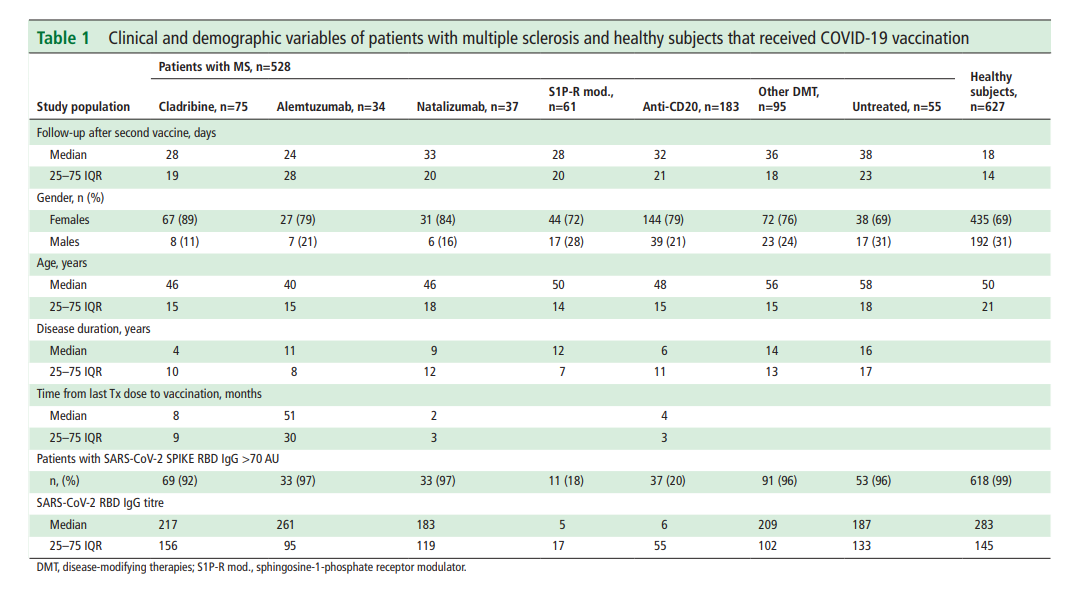
RESULSerumsrum from 627 healthy subjects and 528 pwMS were available for analyses by 30 June 2021. Clinical and demographic variables are presented in Table 1.
The majority of all patients received BNT162b2 (81% as the first, and 86% as the second dose), followed by mRNA-1273 (14% and 14%) and ChAdOx1-S (5% and 0%) of all cases. In the 10 (2%) post-COVID-19 disease patients only one dose was given. The mean time between the two inoculations was 36 days (95% CI 35 to 38 days) and did not differ between the different DMT. The most frequent DMT was rituximab (38%) followed by cladribine (16%), fingolimod (13%), natalizumab (,8%), and alemtuzumab (7%). Other DMT included dimethyl fumarate (6%), teriflunomide (5%), interferons (3%), glatiramer acetate (,3%), and ocrelizumab (1%).
Reduced humoral immunity was present in pwMS treated with fingolimod (82% of all 61 patients, 54% without antibody response) and rituximab (80% of all 183 patients, 48% without antibody response), while patients treated with other DMT showed similar rates as healthy subjects and untreated pwMS (figure 1A). Longer time in the ce the last rituximab infusion and higher CD19-B cell counts were associated with higher levels of protective antibodies (r2 =0.174, p<0.001 and r2 =0.098, p<0.001) (figure 1B, C). The cumulative probability of mounting a normal immune response about the time since ce the last rituximab infusion is illustrated in Figure 1D.
Two patients treated with fingolimod and rituximab were identified in our cohort without antibody response (despite completed vaccination and underwent additionimmunizationsons (1 and 3 months after full vaccination, respectively). Increasing antibody levels were observed in both cases after additional vaccine doses (from <5 AU to 19 and 21 AU, 14 days after 1 and 2 extra doses, respectively).
Additionally, we identified three patients (two on rituximab and b, and one on fingolimod) with no antibody response post-COVID-19. Antibody levels >70 AUs were observed in these three patients 4, 5, and 6 weeks after a single vaccine dose, respectively.
DISCUSSION
We present the first results of a nationwide study of COVID-19 vaccine response in pwMS. Our results demonstrate a normal humoral immune response in most patients, including those receiving cladribine, alemtuzumab, mab, and natalizumab, as well as untreated patients with MS. Treatment with anti-CD20 monoclonal antibodies (rituximab and ocrelizumab) and sphingosine1-phosphate receptor (S1PR) modulators (fingolimod) are associated with attenuated humoral responses.
Our results are in line with previous reports of a decreased humoral immune response in pwMS treated with S1PR modulators and anti-CD20 therapies.12 15 However, a larger proportion of patients on fingolimod in our study showed a normal antibody response despite similar absolute lymphocyte count.12 15 Importantly, we demonstrated that almost one-third of patients in these treatment groups produced an attenuated, but present antibody response.
We also found that three patients with no antibody response post-COVID-19 disease developed protective antibody levels after one dose of vaccination, and that two patients with no antibody response despite timmunizationsons acquired a weak antibody response after further vaccinations, suggesting that patients who fail to respond to initiimmunizationion may have a potential to respond to further vaccination. We found a positive association between time since last rituximab infusion and antibody response, as has been suggested, but not shown previously.12
The main strength of this study is the national cohort design. Although we report on the largest number of patients using high-efficacy treatments to date, our results are based on observational data with limited follow-up and the number of serological samples is not yet sufficient to give a full description of vaccine responses in the entire MS population. Selection bias might be present among early replies. Another weakness of this study is the lack of clinical details (eg, disease courses, the grade of disability), and data regarding patients recently treated with alemtuzumab, while the number of patients in some treatment groups is low. Furthermore, we only report data regarding IgG responses as a correlate of humoral immunity while the adaptive immune response to SARS-CoV-2 seems to depend not only on virus-specific antibodies but also on cellular responses.16
Although absent humoral immunity after full vaccination is frequent in pwMS treated with rituximab and fingolimod, many also have normal or low antibody responses. Our data indicate that all pwMS should be encouraged to follow immunization programs. Vaccinations should preferably be given outside the time interval of one to 1–4 months past rituximab treatment, as the chance of robust IgG response is small until around 5 months after treatment (and then increases markedly), but we underline that vaccination in this time window may induce some humoral response and should be considered individually. Patients treated with S1P-modulators and anti-CD20 therapies should be informed about the risk of attenuated vaccine responses and tested for antibody responses after completing vaccination.
A study of the effect of revaccination in patients with low or no antibody response after two immunizations are initiated following these results.
Correction notice
This article has been corrected since it was first published. The author's name is Kjell-Morten Myhr has been corrected.
Acknowledgments
We express our gratitude to Haakon Haugaa and Andreas Barratt-Due for their help regarding the recruitment of healthy subjects.
Contributors
MK is the submitting and corresponding author. He contributed to the conception and design of the work, collected data, provided and cared for study patients, processed statistical analyses, and composed the manuscript. ARL contributed to the conception and design of the work and revised the work critically for important intellectual content. HMT contributed to the conception and design of the work and revised the work critically for important intellectual content. TTT contributed to the conception and design of the work, conducted immunological analyses, and revised the work critically for important intellectual content. SS-R contributed to the conception and design of the work and revised the work critically for important intellectual content. EBV contributed to the conception and design of the work, conducted immunological analyses, and revised the work critically for important intellectual content. AM contributed to the conception and design of the work and revised the work critically for important intellectual content. SW contributed to the conception and design of the work, supervised invitation of all participants, and revised the work critically for important intellectual content. JA contributed to the conception and design of the work, supervised the invitation of all participants, and revised the work critically for important intellectual content. IASA contributed to the conception and design of the work and revised the work critically for important intellectual content. ØT contributed to the conception and design of the work and revised the work critically for important intellectual content.
TH contributed to the conception and design of the work and revised the work critically for important intellectual content. TB contributed to the conception and design of the work, and revised the work critically for important intellectual content. MK-M contributed to the conception and design of the work and revised the work critically for important intellectual content. HFH contributed to the conception and design of the work and revised the work critically for important intellectual content. JTA served as a scientific advisor, processed pharmacological analyses, and revised the work critically for important intellectual content. LAM contributed to the conception and design of the work, processed immunological analyses, and revised the work critically for important intellectual content. AS contributed to the conception and design of the work, supervised analyses regarding healthy subjects and revised the work critically for important intellectual content. EGC contributed to the conception and design of the work, supervised the study, and revised the work critically for important intellectual content. JTV contributed to the conception and design of the work, processed immunological analyses, supervised the study, and revised the work critically for important intellectual content. FL-J contributed to the conception and design of the work, processed immunological analyses, supervised the study, and revised the work critically for important intellectual content. GON contributed to the conception and design of the work, supervised the study and revised the work critically for important intellectual content. FL-J and GON are shared, the last authors.
Funding
This study has received funding from the South-Eastern HealtAuthorityty of Norway (grant number is not applicable) and from the Coalition for Epidemic Preparedness Innovations (grant number is not applicable). This study has received a research grant (thru ARL) from Sanofi (no grant number is available).
Competing interests
ARL research funding from Sanofi. SW has received speaker honoraria from and served on scientific advisory boards for Biogen, Janssen-Cilag, Sanofi and Novartis. ØT has received speaker honoraria from and served on scientific advisory boards for Biogen, BMS, Jansen, Sanofi, Merck, and Novartis. TH has received speaker honoraria and/or unrestricted research grants from Biogen, Merck, Roche, Novartis, Sanofi, and Bristol-Myers Squibb, and participated in clinical trials organized by Merck, Sanofi, and Roche. TB has received unrestricted research grants from Biogen Idec and Sanofi Genzyme. MK-M has received unrestricted research grants to his institution; scientific advisory board and speaker honoraria from Biogen, Merck, Novartis, Roche, and Sanofi, and has participated in clinical trials organized by Biogen, Merck, Novartis, Roche, and Sanofi. HFH has received honoraria for lecturing or advice from Biogen, Merck, Roche, Novartis, and Sanofi. AS is a shareholder of Age Labs, a molecular diagnostics company that discovers, develops, and commercializes diagnostic tests for the early detection of age-related diseases. EGC has received honoraria for lecturing and advice from Biogen, BMS, Janssen, Merck, Novartis, Roche, and Sanofi.
Patient consent for publication
Not applicable.
Ethics approval
The study was approved by the Norwegian Regional Ethical Committee (200 631 and 2021/8504). All participants gave informed consent before taking part in the study. This study and all authors followed the World Medical Association’s Declaration of Helsinki.

Provenance and peer review
Not commissioned; externally peer-reviewed.
Open access
This is an open-access article distributed by the Creative Commons Attribution Non-Commercial (CC BY-NC 4.0) license, which permits others to distribute, remix, adapt, build upon this work non-commercially, and license their derivative works on different terms, provided the original work is properly cited, appropriate credit is given, any changes made indicated, and the use is non-commercial. See http://creativecommons.org/licenses/by-nc/4.0/.
REFERENCES
1 Reder AT, Centonze D, Naylor ML, et al. COVID-19 in patients with multiple sclerosis: associations with disease-modifying therapies. CNS Drugs 2021;35:317–30.
2 Friedli C, Diem L, Hammer H, et al. Negative SARS-CoV2-antibodies after positive COVID-19-PCR nasopharyngeal swab in patients treated with anti-CD20 therapies. Ther Adv Neurol Disord 2021;14:17562864211016641.
3 Salter A, Fox RJ, Newsome SD, et al. Outcomes and risk factors associated with SARSCoV-2 infection in a North American registry of patients with multiple sclerosis. JAMA Neurol 2021;78:699–708.
4 Sormani MP, De Rossi N, Schiavetti I, et al. Disease-ModifyinTherapieses and coronavirus disease 201Severityty in multiple sclerosis. Ann Neurol 2021;89:780–9.
5 Louapre C, Collongues N, Stankoff B, et al. Clinical characteristics and outcomes in patients with coronavirus disease 2019 and multiple sclerosis. JAMA Neurol 2020;77:1079–88.
6 Spelman T, Forsberg L, McKay K, et al. Increased rate of hospitalization for COVID-19 among rituximab-treated multiple sclerosis patients: a study of the Swedish multiple sclerosis registry. Mult Scler 2021;13524585211026272:13524585211026272.
7 Brown JWL, Coles A, Horakova D, et al. Association of initial disease-modifying therapy with later conversion to secondary progressive multiple sclerosis. JAMA 2019;321:175–87.
8 Hauser SL, Cree BAC. Treatment of multiple sclerosis: a review. Am J Med 2020;133:1380–90.
9 Luna G, Alping P, Burman J, et al. Infection risks among patients with multiple sclerosis treated with fingolimod, natalizumab, rituximab, and injectable therapies. JAMA Neurol 2020;77:184.
10 Reyes S, Cunningham AL, Kalincik T, et al. Update on the management of multiple sclerosis during the COVID-19 pandemic and post-pandemic: an international consensus statement. J Neuroimmunol 2021;357:577627.
11 Simon D, Tascilar K, Fagni F, et al. SARS-CoV-2 vaccination responses in untreated, conventionally treated, and anti-cytokine-treated patients with immune-mediated inflammatory diseases. Ann Rheum Dis 2021;80:1312–6.
12 Achiron A, Mandel M, Dreyer-Alster S, et al. Humoral immune response to COVID-19 mRNA vaccine in patients with multiple sclerosis treated with high-efficacy disease-modifying therapies. Ther Adv Neurol Disord 2021;14:17562864211012835.
13 Holter JC, Pischke SE, de Boer E, et al. Systemic complement activation is associated with respiratory failure in COVID-19 hospitalized patients. Proc Natl Acad Sci U S A 2020;117:25018–25.
14 Earle KA, Ambrosino DM, Fiore-Gartland A, et al. Evidence for antibodies as a protective correlate for COVID-19 vaccines. Vaccine 2021;39:4423–8.
15 Guerrieri S, Lazzarin S, Zanetta C. Serological response to SARS-CoV-2 vaccination in multiple sclerosis patients treated with fingolimod or ocrelizumab: an initial real-life experience. J Neurol 2021:1–5.
16 Ni L, Ye F, Cheng M-L, et al. Detection of SARS-CoV-2-Specific humoral and cellular immunity in COVID-19 convalescent individuals. Immunity 2020;52:971–7.
For more information:1950477648nn@gmail.com