HydroZitLa Inhibits Calcium Oxalate Stone Formation in Nephrolithic Rats And Promotes Longevity in Nematode Caenorhabditis Elegans Part 1
Jul 28, 2023
Low fluid intake, low urinary citrate excretion, and high oxidative stress are the main causative factors of calcium oxalate (CaOx) nephrolithiasis. HydroZitLa contains citrate and natural antioxidants and is developed to correct these three factors simultaneously. Antioxidants theoretically can prolong the lifespan of organisms. In this study, we preclinically investigated the antipathogenic, lifespan-extending, and anti-aging effects of HydroZitLa in HK-2 cells, male Wistar rats, and Caenorhabditis elegans. HydroZitLa significantly inhibited CaOx crystal aggregation in vitro and reduced oxidative stress in HK-2 cells challenged with lithogenic factors. For experimental nephrolithiasis, rats were divided into four groups: ethylene glycol (EG), EG+HydroZitLa, EG+Uralyt-U, and untreated control. CaOx deposits in the kidneys of EG+HydroZitLa and EG+Uralyt-U rats were significantly lower than those of EG rats. Intrarenal expression of 4-hydroxynonenal in EG+HydroZitLa rats was significantly lower than that of EG rats. The urinary oxalate levels of EG+HydroZitLa and EG+Uralyt-U rats were significantly lower than those of EG rats. The urinary citrate levels of EG+HydroZitLa and EG+Uralyt-U rats were restored to the level in normal control rats. In C. elegans, HydroZitLa supplementation significantly extended the median lifespan of nematodes up to 34% without altering feeding ability. Lipofuscin accumulation in HydroZitLa-supplemented nematodes was significantly lower than that of non-supplemented control. Additionally, HydroZitLa inhibited telomere shortening, p16 upregulation, and premature senescence in HK-2 cells exposed to lithogenic stressors. Conclusions, HydroZitLa inhibited oxidative stress and CaOx formation both in vitro and in vivo. HydroZitLa extended the lifespan and delayed the onset of aging in C. elegans and human kidney cells. This preclinical evidence suggests that HydroZitLa is beneficial for inhibiting CaOx stone formation, promoting longevity, and slowing down aging.
Glycoside of cistanche can also increase the activity of SOD in heart and liver tissues, and significantly reduce the content of lipofuscin and MDA in each tissue, effectively scavenging various reactive oxygen radicals (OH-, H₂O₂, etc.) and protecting against DNA damage caused by OH-radicals. Cistanche phenylethanoid glycosides have a strong scavenging ability of free radicals, a higher reducing ability than vitamin C, improve the activity of SOD in sperm suspension, reduce the content of MDA, and have a certain protective effect on sperm membrane function. Cistanche polysaccharides can enhance the activity of SOD and GSH-Px in erythrocytes and lung tissues of experimentally senescent mice caused by D-galactose, as well as reduce the content of MDA and collagen in lung and plasma, and increase the content of elastin, have a good scavenging effect on DPPH, prolong the time of hypoxia in senescent mice, improve the activity of SOD in serum, and delay the physiological degeneration of lung in experimentally senescent mice With cellular morphological degeneration, experiments have shown that Cistanche has the good antioxidant ability and has the potential to be a drug to prevent and treat skin aging diseases. At the same time, echinacoside in Cistanche has a significant ability to scavenge DPPH free radicals and has the ability to scavenge reactive oxygen species and prevent free radical-induced collagen degradation, and also has a good repair effect on thymine free radical anion damage.
Click On Does Cistanche Work
【For more info:george.deng@wecistanche.com / WhatApp:86 13632399501】
Abbreviations
BSA Bovine serum albumin
CaOx Calcium oxalate
COM Calcium oxalate monohydrate
EG Ethylene glycol
H2O2 Hydrogen peroxide
HZL HydroZitLa
iCOCI Indole-reacted calcium oxalate crystallization index
NaOx Sodium oxalate
ROS Reactive oxygen species
RTL Relative telomere length
SIPS Stress-induced premature senescence
TA Tocopheryl acetate
TAC Total antioxidant capacity
4-HNE 4-Hydroxynonenal
Urinary stone disease is an ancient condition in humans documented since the Egyptian era1,2. This disease is still a significant urologic problem worldwide with progressively increasing prevalence. Urinary stones are predominantly composed of calcium oxalate (CaOx), mostly formed in the kidneys, and highly recurrent. Although kidney stone is widely perceived as a not life-threatening condition, it has a lethal consequence. Stones progressively damage kidneys and eventually cause chronic kidney disease3–7. The economic burden of stone disease is substantial, as the cost of stone treatment and management is comparable with the combined cost of prostate and bladder cancer treatments8. Therefore, a new medical prophylaxis for stone formation is needed.
Inadequate fluid intake decreased urinary citrate excretion, and increased oxidative stress are the three main causative factors of CaOx lithogenesis. These factors should be corrected to prevent CaOx calcification. Fluid intake of 2.5–3 L/day is a general preventive measure9. Potassium citrate is a mainstream medication for stone disease because hypocitraturia is the best-known cause of CaOx stone formation and recurrence. Since a long-term treatment with potassium citrate is required to effectively prevent stone disease recurrence, poor adherence becomes an issue because of its side effects and bad/salty taste10–12. Taste enhancement by adding sucralose was shown to improve the tolerance of potassium citrate supplementation13.
Oxidative stress induced by reactive oxygen species (ROS) is vitally involved in CaOx lithogenesis14–19. A low antioxidant diet was demonstrated to contribute to stone formation in experimental rats by increasing ROS production, oxidative stress, and intrarenal CaOx deposition20. Antioxidant intervention attenuated oxidative stress and inhibited CaOx deposition in nephrolithic rats16,21–23. Medicinal plant-based remedies and traditional medicine for stone treatment fundamentally mitigated oxidative stress24.
Traditional herbal medicine or phytomedicine has the advantage of long-standing use in the community, and patients generally consider them as natural and safe regimens. However, it should be noted that scientific evidence of efficacy and safety must be provided before clinical implementation. We hypothesized that the regimen combining modern and traditional medicine could be an innovative solution for minimizing side effects without compromising therapeutic efficacy. We developed a new combination of traditional and modern medicine, called HydroZitLa (Hydrozitla or Hyla), as an alternative treatment for CaOx calculi.

The main active antipathogenic ingredients of HydroZitLa are citrate and banana stem water extract. Banana stem (Musa spp.) is a long-known Indian Ayurvedic traditional medicine for treating urinary stones25, and its stone inhibitory activity has been experimentally demonstrated26–29. Poonguzhali and Chegu showed that banana stem extract significantly reduced urinary oxalate excretion in hyperoxaluric urolithic rats30. The preliminary clinical study by Pillai in 1995 showed that the core of banana pseudostem could be used in urolithiasis treatment31. Furthermore, banana stem juice has a diuretic effect that could help flush out lithogenic crystals and facilitate stone passage. While potassium citrate corrects only the hypocitraturia risk factor by supplying citrate, HydroZitLa beverage can simultaneously correct all three aforementioned CaOx risk factors by increasing fluid intake, restoring urinary citrate, and supplying natural antioxidants.
In this study, we investigated whether HydroZitLa could exert the stone inhibitory effect of CaOx in vitro and in vivo models. The preclinical toxicity of HydroZitLa in human kidney (HK-2) cells and mice was determined. Given that HydroZitLa contained plant-derived antioxidants, we sought to determine whether it could extend the lifespan and reduce the aging phenotype in a Caenorhabditis elegans model. We also investigated whether HydroZitLa could inhibit telomere shortening and premature senescence in HK-2 cells.
Results
HydroZitLa: a safe beverage for consumption. HydroZitLa was negative for Clostridium spp./0.1 g, Salmonella spp./25 g, and Staphylococcus aureus/0.1 g. Arsenic was not detected. Lead was found at an extremely low level (0.033 ppm). Levels of metals, such as Tl, As, Se, Mo, Zn, Sb, Pb, Cd, Co, Ni, Fe, Mn, Cr, Mg, V, Be, Ca, Cu, Ti, Sr, and Li, in HydroZitLa, measured by the inductively coupled plasma-optical emission spectrometry (ICP-OES) are shown in Supplementary Table 1. Toxic metals including Cd, Cr, As, Ni, Tl, Sb, Co, Be, V, and Li were not detected. Trace elements, such as Mg, Zn, Ca, and Fe, were found at 14.04±0.05, 2.09±0.05, 0.86±0.02, and 0.16±0.001 ppm, respectively.
In vitro, cytotoxicity of HydroZitLa in HK-2 cells using the 3-(4,5-dimethylthiazol-2yl)-2,5-diphenyltetrazolium bromide (MTT) assay was performed and reported in our previous study32. Increased HydroZitLa concentration gradually decreased cell survival. Te IC50 of HydroZitLa in HK-2 cells was 24.7% v/v. In vivo, acute toxicity testing revealed that all HydroZitLa-administered mice survived until the end of the experiment (14 days). No gross lesions were found in the visceral organs in the HydroZitLa-administered group and the control group. Therefore, the LD50 of HydroZitLa was>20 mL/kg.
CaOx aggregation inhibition and antioxidant function of HydroZitLa. HydroZitLa significantly inhibited the aggregation of seed calcium oxalate monohydrate (COM) crystals, but bovine serum albumin (BSA, 1 mg/mL) did not (Fig. 1A). Citric acid strongly inhibited COM aggregation (Supplementary Fig. 1).
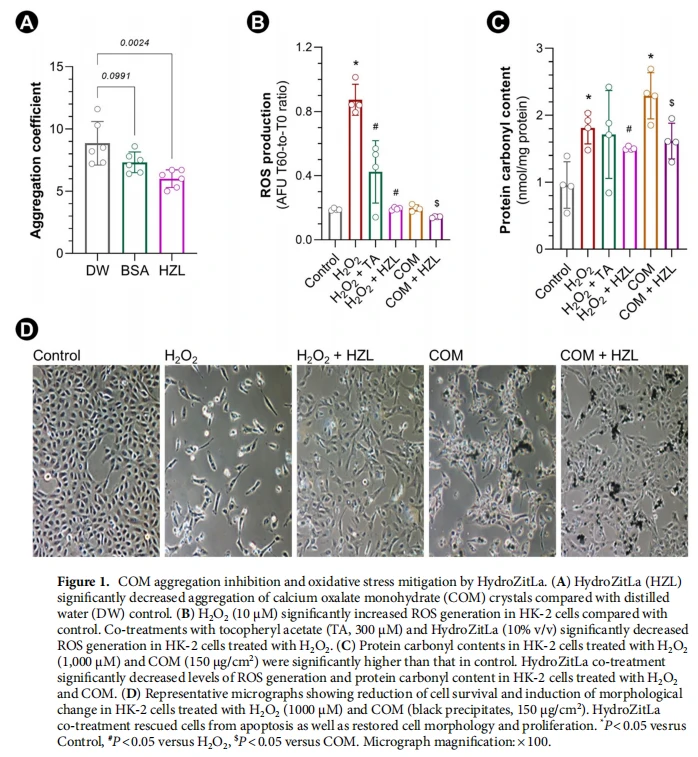
HydroZitLa concentration at 10% (v/v) provided the greatest antioxidative action with the lowest cytotoxicity. Therefore, we used 10% (v/v) HydroZitLa for the subsequent treatment in the cell culture model. ROS production in HK-2 cells exposed to H2O2 and COM was significantly increased compared with control, but it was significantly decreased after HydroZitLa co-treatment (Fig. 1B). In addition, HydroZitLa significantly reduced the levels of protein carbonyl content in HK-2 cells exposed to H2O2 and COM (Fig. 1C). Te exposure of HK-2 cells to H2O2 (1000 µM) and COM (150 µg/cm2 ) caused changes in cell morphology and increased cell death. HydroZitLa cotreatment prevented morphological change, rescued cells from apoptosis, and restored cell proliferation (Fig. 1D).
Inhibition of CaOx crystal deposits in rat kidneys. The biochemical profile of post-intervention 24-h urine samples (day 35) obtained from experimental rats is presented in Table 1. Kidneys of ethylene glycol (EG) rats were enlarged and pale (Fig. 2A), and their weights were significantly greater than that of EG+HydroZitLa and EG+Uralyt-U rats (Fig. 2B). Hematoxylin and eosin (H&E) staining revealed that kidneys of EG rats had a robust sign of inflammation, whereas kidneys of EG+HydroZitLa and EG+Uralyt-U rats appeared normal, similar to that in normal control rats (Fig. 2A). All H&E-stained renal sections are displayed in Supplementary Fig. 2.
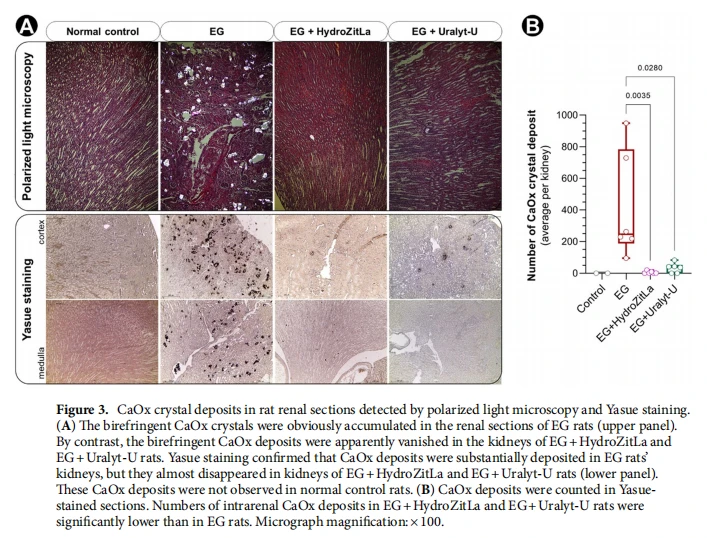
Birefringent CaOx crystal deposits were markedly observed in renal sections of EG rats, but they were not found in kidney sections of normal control rats (Fig. 3A). Tese CaOx deposits almost disappeared in renal sections of EG+HydroZitLa and EG+Uralyt-U rats. Polarized micrographs of all renal sections are shown in Supplementary Fig. 3.

Yasue staining confirmed that CaOx crystals (black precipitates) largely accumulated in the kidneys (in both the cortex and medulla) of EG rats, but this CaOx deposition was remarkably inhibited by HydroZitLa and Uralyt-U (Fig. 3A). Te number of black CaOx precipitates in the kidney sections of EG+HydroZitLa and EG+Uralyt-U rats were significantly lower than those in EG rats (Fig. 3B). Results of Yasue staining of all renal sections are shown in Supplementary Fig. 4.
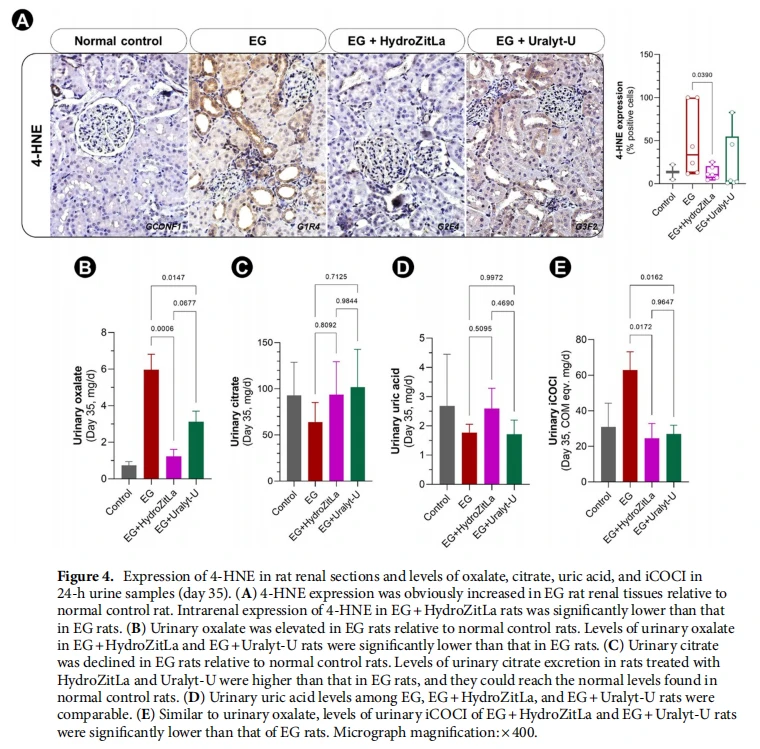
Reduction of 4‑hydroxynonenal (4‑HNE) expression in renal tissues. The intrarenal expression of 4-HNE, as an oxidative stress marker, was markedly increased in EG rats compared with normal control rats (Fig. 4A). Overall, the expressions of 4-HNE in the kidneys of EG+HydroZitLa and EG+Uralyt-U rats were lower than that in EG rats. However, quantitatively, the proportion of 4-HNE-positive cells was significantly lower only in EG+HydroZitLa rats than in EG rats (Fig. 4A). Results of 4-HNE staining of all renal sections are presented in Supplementary Fig. 5. In this study, we also performed immunohistochemical staining for cleaved caspase-3, but we did not observe a significant change of this apoptotic marker among the groups (Supplementary Fig. 6).
Reduction of urinary oxalate and indole‑reacted calcium oxalate crystallization index (iCOCI) levels. Urinary oxalate was elevated in EG rats relative to control rats. This urinary oxalate elevation was significantly reduced after HydroZitLa and Uralyt-U treatments (Fig. 4B). By contrast, urinary citrate was decreased in EG rats relative to control rats. Although HydroZitLa and Uralyt-U treatments did not significantly increase urinary citrate levels relative to EG rats, they could restore urinary citrate levels to the level found in normal control rats (Fig. 4C). Levels of urinary uric acid compared among EG, EG+HydroZitLa, and EG+Uralyt-U groups were not significantly different (Fig. 4D). Similar to urinary oxalate, urinary iCOCI levels of EG+HydroZitLa and EG+Uralyt-U rats were significantly lower than that of EG rats (Fig. 4E).
C. elegans lifespan extension. Supplementation with HydroZitLa (10–40% v/v) significantly extended the maximum lifespan of wild-type C. elegans (Fig. 5A). Te highest lifespan-extending effect was with 30% v/v, which could increase the median survival of nematodes from 16.0 days (control) to 21.5 days (34.4% increase). The median survival of nematodes supplemented with 10%, 20%, and 40% v/v HydroZitLa was significantly prolonged to 18.5 (15.6% increase), 19.5 (21.9% increase), and 21.0 (32.3% increase) days, respectively. The effect of all tested concentrations of HydroZitLa (from 1 to 100% v/v) on the survival of C. elegans is reflected in Supplementary Fig. 7.
Food intake behavior, as indicated by pharyngeal pumping rates, at days 0, 5, 10, and 15 were not significantly different between HydroZitLa-supplemented (20%, 30%, and 40% v/v) and non-supplemented control nematodes (Fig. 5B).
The level of autofluorescent lipofuscin (aging marker) was monitored inside the nematodes after supplementations with 20%, 30%, and 40% v/v HydroZitLa (Fig. 6A). HydroZitLa supplementations at all tested concentrations significantly reduced the levels of lipofuscin accumulation in nematodes compared with control (Fig. 6B).

Inhibition of telomere attrition, p16 upregulation, and premature senescence in HK‑2 cells. The relative telomere lengths of HK-2 cells treated with H2O2, NaOx, and COM were significantly shorter than that of untreated controls (Fig. 6C). HydroZitLa co-treatment significantly impeded the shortening of telomere in HK-2 cells treated with H2O2, NaOx, and COM.
Double staining results of senescence-associated β-galactosidase (SA-β-gal) and p16 demonstrated that H2O2, NaOx, and COM-induced stress-induced premature senescence (SIPS), as indicated by the increased proportion of SA-β-gal-positive cells and p16 upregulation in HK-2 cells (Fig. 6D). p16 was intensively labeled in those SA-β-gal-positive cells. HydroZitLa co-treatment significantly inhibited SIPS (decreased SA-β-gal positivity) and p16 upregulation in HK-2 cells exposed to H2O2, NaOx, and COM (Fig. 6D).
Discussion
Progress in the development of drugs for kidney stone disease is comparatively slow, and no new drugs have been clinically implemented for decades33. A replacement therapy by alkali citrate is still a widely used medication for the prevention of stone recurrence. Gastrointestinal side effects and bad taste are the main drawbacks of potassium citrate treatment that cause poor compliance11–13. The EAU urolithiasis guideline stated that the ideal drug should halt stone formation, have no side effects, and be easy to administer, and these elements are important to achieve good compliance9. In this study, we developed HydroZitLa to address the drawbacks of potassium citrate and to meet the ideal drug criteria as much as possible. Te HydroZitLa beverage has a delicious sour-and-sweet taste. We believed that the poor palatability of potassium citrate could be solved by HydroZitLa similar to reports by Mechlin et al. who demonstrated that the addition of Splenda to potassium citrate helped improve the compliance of potassium citrate therapy13.
A low fluid intake is an important risk factor for CaOx stone formation. Patients with a stone disease are recommended to increase their fluid intake to 2.5–3.0 L/day, but it is relatively difficult for them to maintain adherence, especially in the long term. Current stone medications are made in the form of either powder or tablet. Water intake with these medications is usually inadequate and varied between patients. By contrast, drinking HydroZitLa enabled patients to increase their water intake by at least 500 mL with every pouch consumed. With long-term use, HydroZitLa could promote changes in dietary habits toward increasing daily fluid intake. The toxicity assessment data ensured that HydroZitLa was safe for consumption. Te HydroZitLa beverage concentrate was officially approved by the Tai Food and Drug Administration (FDA) and locally available in Thailand since 2019. To our knowledge, consumers have not reported toxicity or serious side effects.
HydroZitLa significantly inhibited the aggregation of COM crystals in vitro. Although albumin was reported as an inhibitor of CaOx aggregation34, we did not observe the significant inhibition of CaOx aggregation by BSA in our testing system. By contrast, citric acid strongly inhibited COM aggregation in our assay. Plausibly, citric acid contained in HydroZitLa was responsible for the blockage of COM aggregation.

The phenolic content in HydroZitLa was derived from banana stems, blue pea flowers, and sappan wood. The antioxidant properties of banana stem 35, blue pea flowers 36, and sappan heartwood 37 extracts are well documented. The present study showed that HydroZitLa significantly reduced intracellular ROS production and protein oxidation in HK-2 cells exposed to H2O2 and COM. Furthermore, HydroZitLa profoundly rescued HK-2 cells from apoptotic cell death induced by H2O2 and COM. These data highlighted that HydroZitLa had an antioxidative function to mitigate oxidative stress in renal tubular cells.
In this study, we demonstrated in a rat model of CaOx nephrolithiasis in which HydroZitLa significantly inhibited CaOx deposition in rats' kidneys, and its antipathogenic efficacy was equivalent to the Uralyt-U drug. Interestingly, HydroZitLa significantly decreased intrarenal 4-HNE expression, but Uralyt-U did not. HydroZitLa contained antioxidants, but Uralyt-U did not. Our data suggested that alleviation of oxidative stress was an advantage of HydroZitLa over potassium citrate. HydroZitLa and Uralyt-U had comparable efficacy on the reduction of urinary oxalate in nephrolithic rats, although it was more pronounced with HydroZitLa. Significant reduction of urinary iCOCI levels (an indicator of the urinary competency of CaOx crystallization38) was also observed in rats treated with HydroZitLa and Uralyt-U. These indicated that the potential of CaOx crystallization in the urine was decreased after HydroZitLa and Uralyt-U treatments. HydroZitLa appeared to deliver antipathogenic activity primarily through the reduction of urinary oxalate excretion. The funding was corroborated by the reports by Poonguzhali and Chegu who showed that hyperoxaluric rats treated with aqueous banana stem extract significantly reduced urinary oxalate excretion30. Based on the present findings, HydroZitLa induced CaOx stone inhibitory effects equivalent to the currently used potassium citrate, and it could be clinically useful as a new therapeutic alternative for CaOx nephrolithiasis.

A significant increase in urinary citrate levels in nephrolithic rats after HydroZitLa and Uralyt-U treatments was not detected. However, a trend of increased urinary citrate excretion after both treatments was observed. This might be explained by the small sample size (n=6) or the inadequate dose of citrate (2 mEq per day, equal to 0.4 g/kg per day on average). Yasui et al. used potassium citrate (Uralyt, Nippon Chemiphar, Japan) at 0.5 g/kg (low dose) and 20 g/kg (high dose) per day in their experiments to find a significant increase in urinary citrate levels in experimental rats39. Ghaeni et al. treated EG rats with potassium citrate (Sepidaj, Iran) at 2.5 g/kg per day to observe a significant elevation of urinary citrate excretion after treatment40. Thus, a low dose of citrate was likely a reason for not finding a significant elevation of urinary citrate in our rat model following HydroZitLa and Uralyt-U treatments. However, HydroZitLa and Uralyt-U treatments could restore the urinary citrate to the levels observed in normal control rats. This urine citrate normalization could contribute, at least in part, to the inhibition of CaOx formation.
【For more info:george.deng@wecistanche.com / WhatApp:8613632399501】