Impact On Grafted Kidney Function Of Rocuronium-sugammadex Vs Cisatracurium Neostigmine Strategy For Neuromuscular Block Management Ⅱ.
Apr 25, 2024
Results
No significant differences in demographic or other patient characteristics were observed between the sugar-made and neostigmine groups (Table 1). Except for NMBAs and reversal drugs, no differences in anesthetic and surgical characteristics were observed between the two groups (Table 2). Sugammadex was administered for the reversal of moderate and deep NMB in 57.7% and 42.3% of cases, respectively. In the postoperative period, the sugammadex group showed a significantly lower incidence of hypoxemia, shorter PACU stays, and reduced ICU admissions (Table 2). No patient in either group exhibited clinical evidence of major postoperative complications.

HOW LONG DOES IT TAKE FOR CISTANCHE TO WORK?
Regarding perioperative kidney function, serum creatinine (596.0 [478.0-749.0] vs 639.0 [527.7-870.0] μmol/ L, p = 0.0128) and serum urea (14.9 [10.8-21.6] vs 17.1 [13.1-22.0] mmol/L, p = 0.0486) were lower, while eGFR (8.0 [6.0-11.0] vs 8.0 [6.0-10.0], p = 0.0473) was higher in the sugammadex group than in the neostigmine group after surgery (Table 3, Fig. 1). Serum urea remained significantly lower in the first 3 postoperative days (Table 3). No differences in kidney function were observed between the moderate and deep groups of sugammadex patients (Table 3). The proportion of patients with an increase in serum creatinine to > 44 μmol/L was higher in the sugammadex group than in the neostigmine group (first postoperative day: 40 [22.9%] vs 33 [18.9%], p = 0.430; fifth postoperative day: (15 [8.6%] vs 14 [8.0%], p = 1.0). However, the need for postoperative dialysis was higher in the neostigmine group than in the sugammadex group (21 [12%] vs 18 [10.3%], p = 0.734). Body weight (CC = 0.282; p < 0.0001), height (CC = 0.281; p < 0.0001), body mass index (BMI) (CC = 0.165; p = 0.0019), preoperative serum creatinine (CC = 0.779; p < 0.0001), and neostigmine (CC = −0.265; p < 0.001) were correlated with postoperative serum creatinine (Fig. 2). No significant correlations were observed with other drugs involved in NMB management (Fig. 2). During fitted multiple linear regression analysis, body weight (EC = 3.092; SE = 0.988; t = 3.127; p = 0.0019) and preoperative serum creatinine (EC = 0.706; SE = 0.027; t = −25.64; p < 0.0001) were the only variables associated with a higher level of postoperative serum creatinine, while rocuronium was associated with a lower level of postoperative serum creatinine (EC = −0.607; SE = 0.227; t = −2.666; p = 0.008).

Table 1 Patients' characteristics
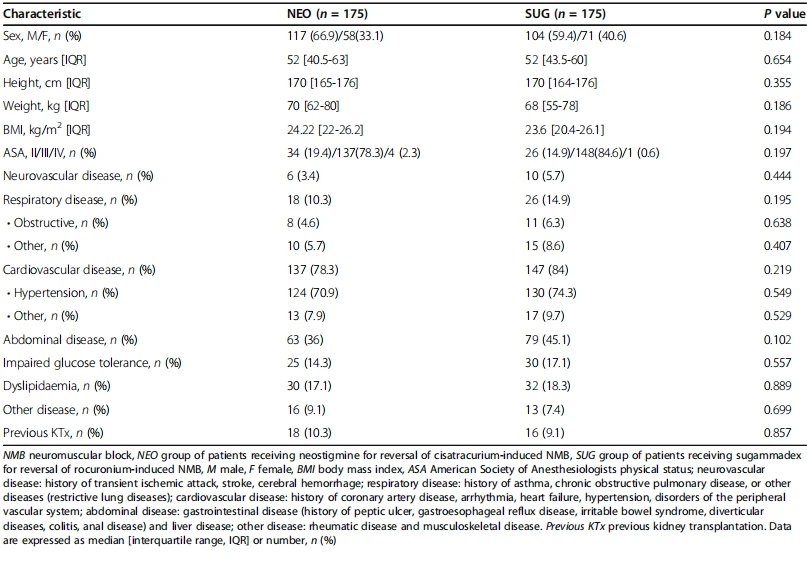

Table 2 Perioperative period

Table 3 Perioperative Kidney Function Varia
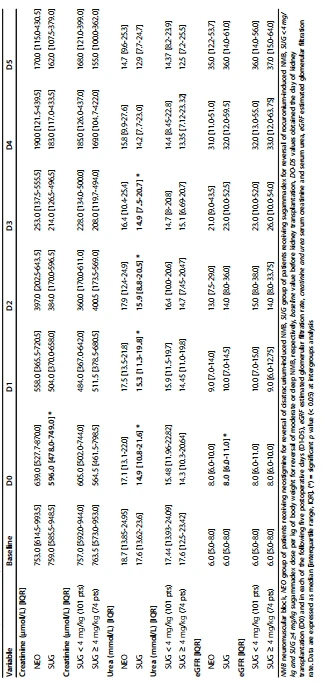

Fig. 1 Box plots comparing sugammadex to neostigmine on kidney function before and after surgery. Boxes represent the median and IQR. "Whiskers" (minimum and maximum marks) represent values 1.5 times the IQR [(1st quartile–1.5 × IQR) and (3rd quartile+1.5 × IQR)]. IQR interquartile range, p p value with significance set at < 0.05, NEO group of patients receiving neostigmine for reversal of cisatracurium-induced neuromuscular block (NMB), SUG group of patients receiving sugammadex for reversal of rocuronium-induced NMB, PRE baseline value (before kidney transplantation), POST first measurement obtained the day of kidney transplantation, creatinine and urea serum creatinine and serum urea, eGRF estimated glomerular filtration rate