Injury Of Exercise-induced Renal Ischemia-reperfusion And The Protective Effect Of Herba Cistanches Combined With Vitamin C in Rats
Mar 04, 2022
Contact: joanna.jia@wecistanche.com
ZHOU Jun - fei1 ,CAO Jian - min2 ,ZHOU Hai - tao3
Abstract: Objective: To study the Herba Cistanches combined with vitamin C’s protective effect and mechanism of movement in rats renal ischemia-reperfusion injury. Methods: Randomly divide 96 7- week - old male Wistar rats into 6 groups: control group ( group C,12), general training group ( group M,12 ), overtraining group ( group OM,24 ),cistanche + overtraining group ( group COM,16 ), vitamin C + overtraining group ( group VCOM,16 ), and cistanche + vitamin C + overtraining group ( group CVCOM,16 ), take a 56 - day of exhaustive swimming training. The COM group, CVCOM group with professional gavage for gastric lavage ( ig), once a day, the dose of 6. 01 g. kg - 1, Ig volume 5mL. kg - 1; group VCOM, group CVCOM uptake an intraperitoneal injection, 100 mg. kg - 1, once a day, the injection volume is 0. 5 mL; other groups ig normal saline. Detect biochemical parameters of serum urea nitrogen and serum creatinine 24 hours later after the last training. Results: 1) In the 8 weeks of overtraining, rats resulted in the movement of “renal ischemia-reperfusion”, the ultrastructure of the kidney was severely damaged, the histopathological changes obviously, renal function was seriously damaged. 2) Serum creatinine and blood urea nitrogen rise. OM group ( P < 0. 01), COM group ( P < 0. 01 ), VCOM group ( P < 0. 01 ), CVCOM group ( P < 0. 05 ) higher than in group C; COM group( P < 0. 05), VCOM group( P < 0. 05 ), CVCOM group( P <0. 01) lower than the OM group; COM group( P < 0. 05), CVCOM groups( P < 0. 01) lower than the VCOM group. 3) SOD activity decreased. OM group ( P < 0. 01), COM group ( P < 0. 01), of VCOM group( P < 0. 01), CVCOM group( P < 0. 05) lower than in group C; M group( P < 0. 05), COM group( P < 0. 05), VCOM group( P < 0. 05), CVCOM group( P < 0. 01) higher than the OM group; COM group( P < 0. 05 ), CVCOM group( P < 0. 01 ) higher than the VCOM group. 4 ) The content of MDA increased, OM group ( P < 0. 01 ), COM group ( P < 0. 01 ), VCOM group ( P <0. 01), CVCOM group( P < 0. 05) higher than in group C; COM group( P < 0. 05), VCOM group ( P < 0. 05), CVCOM group( P < 0. 01) lower than the OM group; COM group( P < 0. 05 ), CV- COM groups ( P < 0. 01) lower than the VCOM group. Conclusion: 1) Overtraining can induce renal ischemia-reperfusion in rats. 2) Cistanche deserticola Y. C. Ma and vitamin C can enhance the activity of SOD, scavenging oxygen free radicals, reduce lipid peroxidation, they have a protective effect on the exercise-induced ischemia-reperfusion kidney. 3) Cistanche is better than vitamin C, but they worked even better when taken both.
Keywords: herba cistanches; vitamin C; exercise-induced ischemia-reperfusion

Cistanche can prevent brain reperfusion injury
With the development of modern Chinese medicine theories, modern pharmacology theories, and modern biotechnology updates, more single-dose or compatible prescriptions are used in sports practice. Traditional Chinese medicine has increasingly shown its unique advantages with its multi-target, multi-channel action, and almost no banned ingredients. It has made certain achievements in improving athletes' physical functions and relieving fatigue. When the body is in a stable state, renal blood flow can be maintained relatively constant through its own regulatory mechanism. During strenuous exercise, renal blood flow changes under the influence of nerve and humoral factors. Due to the redistribution of blood flow in various organs, the blood flow of moving organs, especially muscles, is increased, and renal blood flow drops sharply, and the performance is more obvious with the continuation and increase in the intensity of the exercise process [1]. This incomplete ischemic state of the kidney forms "exercise renal ischemia". After exercise is stopped, renal blood supply is restored to form "reperfusion" after exercise-induced renal ischemia [2]. In the process of ischemia-reperfusion injury, the abnormal increase in the production of free radicals plays an important role.

Cistanche can improve memory and protect brain nerves
Studies have shown that Cistanche has the pharmacological effects of increasing the activity of superoxide dismutase and reducing lipid peroxides, which can eliminate the damage of excessive free radicals generated in the body to the cells of the body [3]; Vitamin C is an important antioxidant in the body, It can also effectively scavenge free radicals [4]. This article studies the effects of Cistanche and vitamin C on the ischemia-reperfusion of the kidneys in rats, and explores the effects and mechanisms of the two in ischemia-reperfusion injury, aiming to provide a theoretical basis for its clinical application.
1 material
1.1 Animals
100 clean-grade male Wistar rats, 42 days old, average weight (201. 8 ± 14. 1) g, provided by the Laboratory Animal Science Department of Peking University Health Science Center, license number SCXK (Beijing) 2006-0008. During the entire test, the temperature in the laboratory was maintained at (22 ± 2) ℃, the relative humidity was 55% to 75%, and the light time changed naturally. All the experimental rats were fed with basic feed (provided by the Laboratory Animal Science Department of Peking University Health Science Center) and distilled water, and they were free to eat and drink. The experiment time is 63 days, and the formal training time is 56 days.
1.2 Experimental medicine Cistanche deserticola
(Cistanche deserticolaY. C. Ma), produced in Inner Mongolia, was purchased from Beijing Tongrentang Pharmacy, batch number: 120224536, and appraised by Senior Engineer Gao Zhanyou of Tianjin Zhongrui Pharmaceutical Co., Ltd. The dried Cistanche with scaled leaves was crushed into a coarse powder and extracted 3 times with 10, 6, 6 times 60% ethanol-water bath, 2 h each time, and the extracts were combined and refrigerated for 24 h, filtered, and the filtrate was decompressed to recover ethanol and concentrated into Extract (equivalent to 2.0g crude drug/g extract), spare [3]. Vitamin C injection (batch number 20120406), provided by Beijing Shuanghe Pharmaceutical.
1.3 Reagents
Serum creatinine (Scr) is determined by Jaffe picric acid method, blood urea nitrogen (BUN) is determined by diacetyl-oxime method, and malondialdehyde (MDA) is determined by colorimetric method; Super-oxide dismutase (SOD) is determined by the xanthine oxidase method, using the kit provided by the Nanjing Jiancheng Institute of Bioengineering, the kit number is 20120511, and the operation is strictly in accordance with the instructions.
1.4 Instrument
BS224S electronic analytical balance (Sartorius, Germany), optical microscope (OLYMPUS, Japan), ALCYON300 automatic biochemical analyzer (Abbott, USA), 756MC UV-Visible spectrophotometer (Shanghai Precision Instrument Factory), and GL- 20G high-speed refrigerated centrifuge (Shanghai Anting).

Cistanche can have neuroprotective effects
2 method
2.1 Animal grouping
After the experimental rats were adaptively reared for 4 days, they were screened for 3 days with 20 min/d of exercise. Individuals who were not suitable for swimming training were eliminated, and the remaining rats were randomly divided into 6 groups by number: control group ( C group) 12 animals, general training group (M group) 12 animals, overtraining group (OM group) 24 animals, Cistanche + overtraining group (COM group) 16 animals, Vitamin C + overtraining group (VCOM group) 16 animals In the Cistanche+Vitamin C+overtraining group (CVCOM group), 16 only had 56 days of swimming training. During training, the COM group and CVCOM group were given intragastric administration (ig) once a day with a dose of 6.01 g/kg and an ig volume of 5 mL/kg; the VCOM group and CVCOM group were given intraperitoneal injection (IP), The dose is 100 mg/kg, once a day, the injection volume is 0.5 mL (the best dose is obtained through preliminary experiments), and the other groups are ig equal amounts of normal saline.
2. 2 Experimental method
2. 2. 1 Training and testing program
Group C was raised routinely, without any intervention, and did not exercise normally. Group M received moderate-intensity swimming training and formal swimming training for 8 weeks. Train for 6 days a week, train once a day, swim in the water for the first time for 20 minutes, and then gradually 72 Increase it to swim 60 minutes a day on the first weekend, 90 minutes a day on the second weekend, and 120 minutes a day on the third weekend, and maintain this amount of exercise for the next 5 weeks. The training arrangements for the other groups in the first 3 weeks are the same as those in Group M, and high-intensity training will be arranged starting from the 4th week. The rats swim with weights and train to exhaustion each time. The standard of exhaustion is that the rat does not rise to the surface of the water 10 s after sinking. Lose 0.5% of body weight in the 1st to 3rd week, lose 1% of body weight in the 4th week, lose 2% of body weight in the 5th week, and train once a day. In the 6th week, train once a day in the morning and afternoon, and in the 7th to 8th weeks, train once a day in the morning, afternoon, and night. All of them lose 5% of their body weight. By the end of the eighth week, rats in groups C and M grew normally without accidental death. The other groups of rats had a higher mortality rate due to tail weight, fatigue failure, unable to recover, and training accidental death. There are 14, 13, 11, 13 left in the OM group, COM group, VCOM group, and CVCOM group respectively. In each group, 10 animals were selected for the experiment, and the others were randomly eliminated.
2. 2. 2 Index measurement
Rats in each group were anesthetized with ether 24 hours after the last swimming training. Blood was taken from the common carotid artery and added with sodium citrate solution for anticoagulation. After 30 minutes in a 37°C water bath, the rats were centrifuged at 4°C 3 000 rpm for 10 minutes, and then separated and prepared. Serum, store it in a refrigerator at -20℃ for future reference. Quickly take the kidneys, remove the fascia, wash the bloodstains in pre-cooled saline, and observe the size, color, and texture of the kidneys with naked eyes. Separate the left kidney, take 0.5 g of the upper pole of the kidney, use 1.5 mL of normal saline was ground at 1°C at 12 000 rpm to make 10% kidney tissue homogenate; kidney tissue specimens were fixed in 10% formaldehyde, embedded in paraffin, and made into 4 um thick sections, stained with HE, and histopathological changes were observed.
2. 3 Evaluation of renal pathological changes
According to Pallets standard [5], 5 fields of view were randomly selected under a 400-fold light microscope, and 10 renal tubules were scored in each field of view. 1) Obviously dilated renal tubules and cell flatness is 1 point; 2) Brush border injury is 1 point, shedding is 2 points; 3) Cell membrane bullae is 1 point, cytoplasmic vacuoles are 1 point; 4) Interstitial edema is 1 point 5) If there are shed necrotic cells in the lumen of the renal tubules without forming casts or fragments, it is worth 1 point, and forming casts or fragments is worth 2 points. The renal tubular score was calculated by two technicians double-blindly, and the average value was taken.
2. 4 Statistics
All data were processed with SPSS 12. 0 statistical software package and the data were expressed as mean ± standard deviation (x s ± s), and normality test was performed on the data; multiple groups of measurement data were used one-way ANOVA, and when the variances were uniform, using one-way ANOVA. LSD method, Dunnett's T3 method is used when the variance is uneven. P <0. 05 is statistically significant.

Cistanche can have neuroprotective effects
3 results
3.1 The pathological changes of exercise, Cistanche, and vitamin C on rat kidney tissue after the determination of Scr and BUN
The kidney tissues of each group were taken to make paraffin sections, stained with HE, and the tissue morphology changes were observed under a light microscope. Under the light microscope. The kidney tissue structure of rats in the static control group and the general training group was normal, and there was no stasis blood, degeneration, and edema, no cast in the lumen of the renal tubules. Large overtraining group Rat glomeruli have congestion, tubule epithelial cell edema, vacuolar degeneration the lumen is dilated, with a small number of shed villi and epithelial cells in the lumen, and Various tube types. The histopathological changes of the other groups are more than those of the overtraining group mild, with slight tubule epithelial cell edema, vacuolar degeneration, dilated lumen phenomenon, there is no protein cast and cell cast. Renal tubules of rats in each group Paller [5] score, there is no significant difference between the static control group and the general training group the difference (P >0.05), the static control group was significantly lower than the other groups (P <0.01), the treatment group was significantly lower than the overtraining group rats (P <0.05), And there were no obvious pathological changes in the glomeruli.
Table 1 Comparison of renal tubular damage scores of rats in each group (n = 10, x x ± s)

3.2 The effects of exercise, Cistanche and vitamin C on the serum BUN and Scr of rats Impact
Table 2 Comparison of serum urea nitrogen and creatinine content of rats in each group (n = 10, x x ± s)
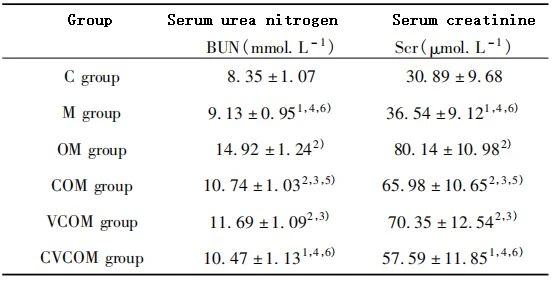
It can be seen from Table 2 that blood urea nitrogen and serum creatinine in each group were significantly increased compared with the control group, and compared with the OM group, the COM group, VCOM group, and CVCOM group were significantly decreased (P <0.05, P <0.05, P, respectively) <0.01); Compared with the VCOM group, the COM group and the CVCOM group significantly decreased (P <0.05, P <0.01 respectively).
3. 3 The effects of exercise, Cistanche, and vitamin C on rat kidney homogenate
Effect of SOD activity and MDA content
Table 3 Comparison of SOD activity and MDA content in rat kidney tissue homogenate in each group (n = 10, x x ± s)

Note: Compared with group C, 1) means P <0.05, 2) means P <0.01; compared with group OM, 3) means P <0.05, 4) means P <0.01. Compared with the VCOM group, 5) means P <0.05, 6) means P <0.01.
It can be seen from Table 3 that the SOD activity of each group was significantly lower than that of the control group. Compared with the OM group, the COM group, VCOM group, and CVCOM group were significantly increased (P <0.05, P <0.05, P <0.01, respectively) ); Compared with the VCOM group, the COM group, and the CVCOM group increased significantly (P <0.05, P<0.01). The MDA content in each group was significantly higher than that of the control group, and compared with the OM group, the COM group, VCOM group, and CVCOM group were significantly decreased (P <0.05, P <0.05, P <0.01); and Compared with the VCOM group, the COM group and the CVCOM group were significantly lower (P<0.05, P<0.01, respectively).
4 Discussion
Renal ischemic reperfusion (I/R) injury is a complex process of pathophysiological changes, and its specific mechanism has not been fully elucidated. But oxygen free radicals (Oxygen free radicals, OFR) play a vital role in the occurrence and development of I/R [6]. Under normal circumstances, a small number of free radicals can be produced in the body, but due to the inactivated free radical enzyme system in the body, free radicals are quickly eliminated without causing damage. During exercise, I/R increases the production of free radicals, which can trigger membrane lipid peroxidation, which leads to changes in membrane liquidity, fluidity, and permeability, which in turn causes membrane dysfunction, especially the destruction of mitochondrial membranes, which will affect cells Metabolism and function, and interfere with the physiological functions of the whole organ. The main substance in the body that scavenges free radicals and reduces their harm is antioxidant enzymes.SOD is the only enzyme that uses oxygen-free radicals as a substrate among thousands of enzymes in aerobic organisms. It catalyzes the formation of hydrogen peroxide from superoxide anions to remove superoxide anions and protects the body from damage. At the same time, within a certain range, when the metabolism of free radicals is enhanced, SOD will increase compensatory. Therefore, the level of SOD activity is a sign of the body's antioxidant capacity. MDA is a major product of cell lipid peroxidation. The MDA content of tissue mitochondria is currently recognized as a sensitive index to measure the body's free radical metabolism [7]. Creatinine and urea nitrogen are catabolism products of muscle and protein respectively, which are mainly eliminated from the kidney through blood circulation. The blood concentration depends on the glomerular filtration capacity. When the kidney parenchyma is damaged, the glomerular filtration rate drops to After the critical point, the concentration of the two will rise significantly [8].

cistanche health benefits
The experimental results showed that 8 weeks of overtraining caused significant changes in the histopathology of rat kidney tissue; blood urea nitrogen and serum creatinine increased (overtraining group (P <0.01), Cistanche + overtraining group (P <0.01), vitamin C + overtraining group (P <0.01), cistanche + vitamin C + overtraining group (P <0.05) higher than the static control group); SOD activity decreased (overtraining group (P <0.01), Cistanche + overtraining group (P <0.01), vitamin C + overtraining group (P <0.01), Cistanche + vitamin C + overtraining group (P <0.05) lower than the static control group); MDA content increased (general training group (P <0.05), overtraining group (P<0.01), cistanche+overtraining group (P<0.01), vitamin C+overtraining group (P<0.01), cistanche+vitamin C+overtraining Group (P<0.05) higher than the static control group). This shows that overtraining has caused the renal ischemia "reperfusion" injury in rats, and the renal function has been severely damaged. However, the histopathological changes of kidney tissue in the Cistanche + overtraining group, vitamin C + overtraining group, and Cistanche + vitamin C + overtraining group (P <0.05) were significantly reduced compared with the overtraining group. Blood urea nitrogen and serum creatinine content Cistanche cistanche + overtraining group (P <0.05), vitamin C + overtraining group (P <0.05), cistanche + vitamin C + overtraining group (P <0.01) lower than the overtraining group; SOD activity, Cistanche + overtraining group (P < 0.05), vitamin C + overtraining group (P < 0.05), cistanche + vitamin C + overtraining group (P <0.01) higher than the overtraining group; MDA content, cistanche + overtraining group (P <0.05), vitamin C + overtraining group (P <0.05), cistanche + vitamin C + overtraining group ( P <0.01) is lower than the overtraining group. It shows that Cistanche and vitamin C can effectively scavenge free radicals, relieve kidney ischemia and hypoxia, inhibit lipid peroxidation, and improve SOD activity. Effectively reduce renal ischemia-reperfusion injury and play a protective role. The mechanism may be: 1) Cistanche can increase the activity of antioxidant enzymes and accelerate the elimination of free radicals. At the same time, it contains a variety of polyphenols, glycosides, and flavonoids, which can remove free radicals from the body and reduce the effect of free radicals on mitochondrial membranes. And the sarcoplasmic omentum causes damage and plays a positive role in reducing the oxidative damage to the enzyme protein [3]. 2) Vitamin C is an important antioxidant vitamin. As a strong antioxidant, it can effectively scavenge oxygen-free radicals, inhibit the initiation of the apoptotic cascade, and reduce the ischemia-reperfusion injury of cells and organs [9]. In addition, among the three treatment groups, blood urea nitrogen, serum creatinine, MDA content, Cistanche + overtraining group (P <0.05), cistanche + vitamin C + overtraining group (P <0.01) were lower than vitamin C + overtraining group; SOD activity, Cistanche + overtraining group (P <0.05), Cistanche + vitamin C + overtraining group (P <0.01) higher than vitamin C + overtraining group. It suggests that the efficacy of Cistanche on exercise-induced renal ischemia-reperfusion injury may be better than vitamin C, and the combination of the two may be more beneficial to the protection of the kidney from ischemia-reperfusion injury.
In summary, heavy-load swimming training caused renal ischemia-reperfusion injury in rats. Both Cistanche and vitamin C have obvious protective effects on renal ischemia-reperfusion injury, possibly by enhancing the activity of superoxide dismutase to eliminate Free radicals reduce lipid peroxidation, and improve kidney function. In terms of efficacy, the combination of the two is better than the two alone, and Cistanche is better than vitamin C, but it may also be related to the dose of the two in the application, and the relationship between the dose and the efficacy needs to be further research.
References:
[1] Barclay WF. Review of Medical Physiology[M]. California: Lange Medical Publication, 1995: 577-580.
[2]Heifets M, Davis TA, Tegtmeyer E, et al. Exercise training a- meliorates progressive renal disease in rats with subtotal nephrectomy[J]. Kidney Int, 1987, 32(6): 815-820.
[3] ZHOU HT (周海涛), CAO JM (Cao Jianmin), LIN Q (林强). Effect of Cistanches Herba on the Swimming Ability and Oxidation Resistance of Mitochondrial in Rats[J]. Chin J Exp Tradit Med Form (Chinese experimental formula Academic Journal), 2012, 18(6): 229-233.
[4]Palazzetti S, Rousseau A S, Richard M J, et al. Antioxidant supplementation preserves antioxidant response in physical training and low antioxidant intake[J]. Br J Nutr, 2004, 91(1): 91 - 100.
[5] Paller MS, Haoidal JR, Ferris T F. Oxygen free radicals in ischemic acute renal failure in the rat [J]. J Clin Invest, 1984, 74 (4): 1156 - 1164.
[6] Wang L (王丽), Mei CL (梅长林). Hypoxia-inducible factor - 1α and oxygen free radicals in renal ischemia-reperfusion in- jury in rats[J]. Chin J Nephrol Journal of Diseases), 2006, 22 (7): 371-373.
[7] Chen PJ, Hirata F. The effects of long-term training at various loads on immunity and neuroendocrine responses in rats[J]. J. NIFS - KJ, 1998, 20(1): 19 - 26.
[8]Hong P (洪平), Chen G (陈耿), Li QZ (李清正), et al. Influence of rapid Weight Loss by Different Temperature on Certain Biochemical Indexes[J]. Chin sport sci(体育科学), 2010, 30(4): 44-48.
[9]Korkmaz A, Kolankaya D. The protective effects of ascorbic acid against renal ischemia-reperfusion injury in male rats [J]. Ren Fail, 2009, 31(1): 36 - 43.