Cistanche Polysaccharides: What They Are, What They're Made Of, And Why Their Antioxidant Activity Matters
Nov 24, 2026
Cistanche Polysaccharides: What They Are, What They're Made Of, and Why Their Antioxidant Activity Matters
Introduction
Cistanche is one of the most storied medicinal plants to come out of the deserts of Central and East Asia. For centuries it has been prized in traditional medicine as a tonic herb, and today it has become a common ingredient in modern health foods, teas, capsules, and extracts sold around the world. What many people don't realize, however, is that beneath the plant's reputation as a general wellness herb lies a rich body of chemistry that scientists are only now beginning to map out.
Among the most interesting of these compounds are the polysaccharides - large, complex carbohydrate molecules that play a surprising number of roles in biology. In a study published in 2021 in the journal Science and Technology of Food Industry, a team of researchers in China set out to answer a very specific question: what exactly are the polysaccharides found in one particular Cistanche species, and how well do they work as antioxidants?
Their findings offer a useful window into what makes Cistanche tick at the molecular level. This article breaks down that research in plain language - explaining what the scientists found, what it means, and where it fits into the bigger picture of Cistanche as a health ingredient.
What Is Cistanche?
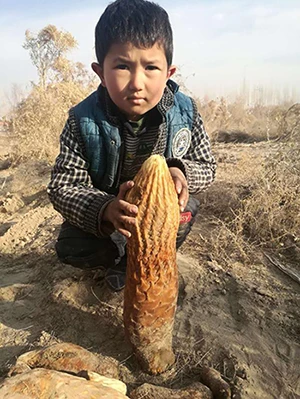
Cistanche is a genus of parasitic flowering plants belonging to the Orobanchaceae family. Unlike ordinary green plants, Cistanche does not photosynthesize on its own in the typical sense. Instead, it attaches itself to the roots of host plants and draws water and nutrients from them. This unusual lifestyle is part of the reason Cistanche survives so well in harsh, arid environments where other vegetation struggles.
The plant's fleshy underground stem is the part most commonly used. In traditional Chinese medicine, Cistanche was first recorded in the Shennong Bencao Jing (the Divine Farmer's Materia Medica), one of the oldest pharmacological texts in existence, where it was described as a precious tonic herb. Over the centuries it has been associated with a wide range of uses, from supporting vitality to aiding digestion.
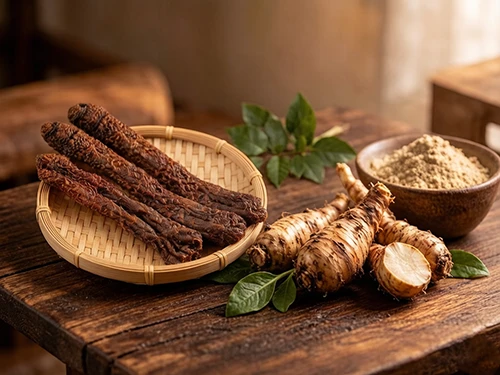
In modern times, Cistanche has crossed over into the mainstream supplement industry. It is now used as a raw material in numerous health products approved by food and drug regulators, appearing in forms as varied as herbal wines, teas, tablets, granules, capsules, and oral liquids.
What makes Cistanche valuable from a scientific standpoint is its chemical profile. The plant contains a wide array of bioactive substances, including:
Phenylethanoid glycosides (a major class of active compounds)
Iridoids
Lignans and their glycosides
Phenolic glycosides
Monoterpene glycosides
Alkaloids
Sugars and sugar alcohols
Sterols
Polysaccharides - the focus of this article
It is the polysaccharide fraction that has attracted growing research interest, because these molecules have been linked to several biological activities that are relevant to health.
What Are Polysaccharides, and Why Do They Matter?
To understand this research, it helps to know what a polysaccharide actually is.
A polysaccharide is a large molecule made up of many smaller sugar units (called monosaccharides) linked together by chemical bonds known as glycosidic bonds. Think of monosaccharides as individual beads and the polysaccharide as a long, branched necklace assembled from those beads.
Polysaccharides are everywhere in nature. Starch in potatoes, cellulose in plant cell walls, and glycogen stored in our muscles are all polysaccharides. But not all polysaccharides are the same. Their biological effects depend heavily on two things:
Which monosaccharides they contain - the types of sugar beads in the chain
How those units are arranged - the size, branching, and three-dimensional shape of the molecule
This is why researchers spend so much effort on "composition analysis." Knowing what a polysaccharide is made of is the first step toward understanding what it can do.
In the context of Cistanche, earlier studies have suggested that its polysaccharides may support immune function, help protect nerve cells, and even play a role in bone health. Research has also indicated that Cistanche polysaccharides may improve learning and memory in certain animal models. These findings have made Cistanche polysaccharides a compelling target for deeper investigation.
But here's the catch: "Cistanche polysaccharide" is not one single molecule. It is a complex mixture, and different species of Cistanche can contain quite different polysaccharide profiles. That's exactly what the 2021 study set out to clarify.

The Plant Behind the Research: Cistanche lanzhouensis
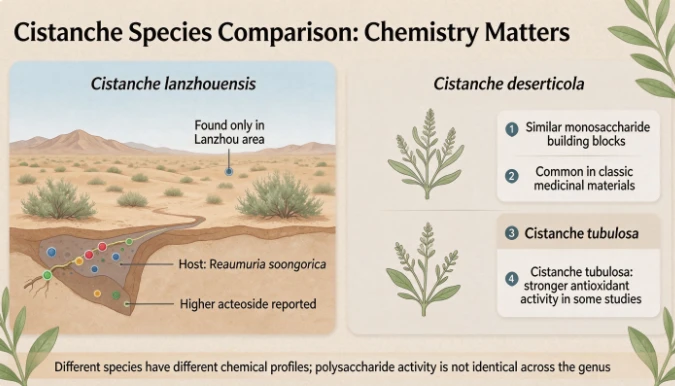
The species examined in this particular study is Cistanche lanzhouensis - a lesser-known member of the Cistanche family. It is a herbaceous parasitic plant that grows in desert grasslands, semi-desert foothill plains, sandy terraces, and loess hills. What makes it especially unusual is its extremely narrow distribution: it is currently known to occur only in the Lanzhou area of Gansu Province, China.
Cistanche lanzhouensis is also a picky parasite. So far, scientists have only ever found it growing on the roots of a single host plant - Reaumuria soongorica, a hardy desert shrub. This extreme specialization is part of what makes the plant both fascinating and, in conservation terms, vulnerable.
In the Lanzhou region, Cistanche lanzhouensis has traditionally been used as a substitute for the more famous Cistanche deserticola. Because the classic medicinal Cistanche has become scarce due to over-harvesting, people have turned to closely related species in the same genus that share similar active compounds. Interestingly, earlier research has found that Cistanche lanzhouensis actually contains a higher level of acteoside (verbascoside) - one of the signature active compounds in Cistanche - than standard Cistanche deserticola.
Despite this, the polysaccharides of Cistanche lanzhouensis had never been formally studied before the 2021 paper. No one had measured their molecular weight, identified their monosaccharide building blocks, or tested their antioxidant activity. That gap is precisely what the study aimed to fill.
How Researchers Extract and Separate Cistanche Polysaccharides
Getting polysaccharides out of a plant is a multi-step process, and the methods used here follow well-established techniques in food and natural-product chemistry. Understanding the basic steps helps make sense of the results.
Step 1: Extraction. The researchers started with 2.5 kilograms of fresh, fleshy stems of Cistanche lanzhouensis. They sliced the stems and boiled them in distilled water - three separate times - to draw out the water-soluble components. The liquid extracts were then combined and mixed with 75% ethanol and left to stand overnight. Ethanol causes polysaccharides to precipitate (separate out of solution as a solid), a classic technique known as "alcohol precipitation." The solid material was collected by centrifugation and freeze-dried, yielding what scientists call the crude polysaccharide, labeled CLP.
Step 2: Separation. Crude extracts are always mixtures. To sort the crude polysaccharide into cleaner fractions, the team used a technique called DEAE-cellulose anion exchange chromatography. This method works by passing the sample through a column that selectively retains charged molecules while allowing neutral ones to flow through.
The result was two distinct fractions:
CLP-1, a neutral polysaccharide, washed out with plain water
CLP-2, an acidic polysaccharide, was then released by rinsing the column with a salt (NaCl) solution
This separation matters because neutral and acidic polysaccharides often behave differently in biological systems, so studying them separately gives a clearer picture of what each contributes.
Step 3: Characterization. Finally, the team measured several key properties of CLP, CLP-1, and CLP-2, including their total sugar content, protein content, uronic acid content, molecular weight, and monosaccharide composition.
Along the way, they also checked whether the samples contained protein or nucleic acid contamination using UV spectroscopy. The neutral CLP-1 showed a clear signal at 280 nm - a wavelength where the amino acids tyrosine and tryptophan absorb light - suggesting it likely contains glycoprotein (a sugar-protein complex). The acidic CLP-2 showed no such peaks, though its overall darker color made that reading less definitive.

What Cistanche Polysaccharides Are Made Of: The Monosaccharide Profile
Perhaps the most illuminating part of the study is the monosaccharide composition analysis. To find out which sugar "beads" make up each polysaccharide, the researchers first broke the large molecules apart by acid hydrolysis, then tagged the released sugars with a chemical marker (PMP derivatization) so they could be detected and measured by high-performance liquid chromatography (HPLC).
The results revealed that the neutral and acidic fractions are built from very different sets of sugars.
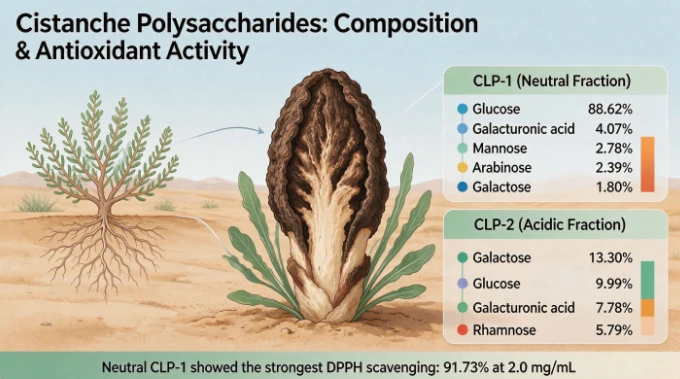
CLP-1 (the neutral fraction) was dominated by glucose. The main monosaccharides detected, with their relative proportions, were:
Glucose: 88.62%
Galacturonic acid: 4.07%
Mannose: 2.78%
Arabinose: 2.39%
Galactose: 1.80%
In other words, nearly nine out of every ten sugar units in CLP-1 is glucose. This makes CLP-1 essentially a glucose-rich neutral polysaccharide, with small amounts of a few other sugars mixed in.
CLP-2 (the acidic fraction) told a completely different story. Its main sugars were:
Galactose: 13.30%
Glucose: 9.99%
Galacturonic acid: 7.78%
Rhamnose: 5.79%
Here, no single sugar dominates. Galactose is the most abundant, and - critically - the fraction contains a much higher proportion of galacturonic acid, a uronic acid. This high uronic acid content is the chemical signature of an acidic polysaccharide, which confirms that the DEAE-cellulose separation worked as intended: CLP-2 really is the "acidic" fraction.
The contrast between the two fractions is striking. CLP-1 is almost 89% glucose, while CLP-2 is a more balanced mixture rich in galactose and galacturonic acid. This difference in building blocks is a strong hint that the two fractions would behave differently in biological tests - a prediction the antioxidant experiments later confirmed.
For context, the team also compared these results with earlier work on standard Cistanche. Previous studies had found that the neutral polysaccharides of Cistanche deserticola are likewise composed largely of glucose, and that its purified polysaccharides contain rhamnose, glucose, and galactose. The fact that Cistanche lanzhouensis shows a similar set of sugars suggests that, at the monosaccharide level, it shares meaningful chemical ground with its better-known relatives - even though it is a distinct species with its own unique host and habitat.
Molecular Weight: Small, Heterogeneous, and Complex
Size matters when it comes to polysaccharides. The molecular weight of a polysaccharide influences how it behaves in solution, how it interacts with cells, and how readily it can be absorbed or recognized by the body.
To measure molecular weight, the researchers used high-performance gel permeation chromatography (HPGPC). This technique separates molecules based on their size as they pass through a column - larger molecules travel faster, smaller ones more slowly.
The key finding was that Cistanche lanzhouensis polysaccharides are not a single, uniform molecule. The HPGPC profiles showed multiple peaks, indicating a mixture of polysaccharides spanning a range of sizes. The molecular weights were distributed mainly in the range of 0 to 10 kDa, which classifies these as small-molecular-weight, heterogeneous polysaccharides.
For reference, 10 kDa is roughly on the smaller end of the spectrum for plant polysaccharides. Many bioactive polysaccharides from fungi and herbs run into the hundreds of thousands of Daltons, so these Cistanche lanzhouensis polysaccharides are relatively compact by comparison.
Both CLP-1 and CLP-2 showed five or more distinct peaks, with uneven, asymmetric peak shapes. In carbohydrate chemistry, this kind of pattern is a clear sign of heterogeneity - meaning each "fraction" is itself still a mixture of several related polysaccharides rather than one pure compound. This is completely normal for natural polysaccharide extracts and doesn't diminish their interest; it simply reflects the inherent complexity of plant carbohydrate chemistry.
The takeaway: Cistanche lanzhouensis contains a diverse family of relatively small polysaccharides, and the neutral and acidic fractions differ not only in their sugar building blocks but also in their size distribution.
Free Radicals and Antioxidants: A Quick Primer
Before diving into the antioxidant results, it's worth taking a moment to understand why antioxidants are such a hot topic in nutrition and wellness.
Our cells run on oxygen, and in the process of producing energy they generate byproducts called free radicals - highly reactive molecules that carry unpaired electrons. Free radicals are not inherently evil; the body produces them constantly as part of normal metabolism, and at moderate levels they even play useful roles in signaling and immune defense.
The problem arises when free radicals build up faster than the body can neutralize them. Because they are so reactive, excess free radicals can damage important biological molecules - proteins, lipids, and DNA - and this oxidative stress has been linked to accelerated aging and a wide range of chronic diseases.
Antioxidants are substances that can neutralize free radicals by donating electrons, essentially "quenching" them before they cause damage. The body produces some antioxidants on its own, but it also relies on dietary sources - vitamin C, vitamin E, polyphenols, and, as this research shows, certain polysaccharides.
For years, synthetic antioxidants were widely used in food preservation. But as concerns about the safety of synthetic additives have grown, scientists have increasingly turned their attention to finding natural antioxidants from plants. This is a major reason why the antioxidant activity of plant polysaccharides has become a focus of modern research.
The Antioxidant Findings: DPPH Scavenging Results
The study tested the antioxidant activity of all three samples - CLP (crude), CLP-1 (neutral), and CLP-2 (acidic) - using two complementary methods. The first was the DPPH free radical scavenging assay, one of the most widely used and trusted tests in antioxidant research.
The DPPH test is elegant in its simplicity. DPPH is a stable free radical that has a deep purple color. When an antioxidant encounters it, the antioxidant donates an electron, and the purple color fades. By measuring how much the color fades, scientists can calculate how effectively a substance neutralizes free radicals.
The results showed a clear hierarchy among the three fractions:
CLP-1 was the standout performer. At a concentration of 2.0 mg/mL, CLP-1 achieved a DPPH scavenging rate of 91.73%. Its IC50 value - the concentration needed to scavenge 50% of the DPPH radicals, where a lower number means stronger activity - was 0.383 mg/mL.
The crude extract, CLP, was also respectable, reaching 80.90% scavenging at 1.0 mg/mL and posting an IC50 of 0.438 mg/mL.
CLP-2, the acidic fraction, was the weakest of the three, lagging clearly behind both CLP and CLP-1.
For a point of reference, the researchers used vitamin C (ascorbic acid, "Vc") as a positive control, since vitamin C is a benchmark antioxidant. Vitamin C achieved 95.45% DPPH scavenging. So while the Cistanche polysaccharides were slightly weaker than pure vitamin C, CLP-1 at its optimal concentration came remarkably close - a notable result for a natural polysaccharide extract.
The dose-response pattern was also informative. Across the tested range of 0.25 to 4.0 mg/mL, both CLP and CLP-1 showed a classic "rise then plateau" pattern: scavenging activity increased with concentration up to a point, then leveled off. This tells us that more is not always better - there appears to be a concentration beyond which additional polysaccharide delivers little extra benefit in this test.
Total Antioxidant Capacity: The ABTS Test
The second method used was the ABTS assay, which measures a sample's total antioxidant capacity - a broader measure than DPPH, because it captures how well a substance neutralizes a different kind of radical.
The ABTS radical is green, and when it is reduced by an antioxidant, the color disappears. By comparing a sample's color change against a standard antioxidant called Trolox (a vitamin E analog), researchers can express a sample's total antioxidant capacity in standardized units (mmol/L Trolox equivalent).
The results echoed the DPPH findings. Across the tested concentration range of 0 to 4.0 mg/mL, the total antioxidant capacity of all three samples rose steadily with concentration. Once again, CLP-1 showed the strongest upward trend, outpacing both the crude CLP and the acidic CLP-2 at the same concentrations.
To be fair, all of the Cistanche polysaccharide samples were considerably weaker than vitamin C in the ABTS test - their total antioxidant capacity was modest in absolute terms. But the direction was clear and consistent: higher concentrations produced higher antioxidant capacity, and the neutral CLP-1 fraction was the best of the three.
Taken together, the two tests tell a coherent story. Cistanche lanzhouensis polysaccharides do possess genuine antioxidant activity, and that activity is concentrated in the neutral glucose-rich fraction (CLP-1). In the DPPH test especially, CLP-1 at 2.0 mg/mL came close to matching the free-radical-scavenging power of vitamin C.

How Cistanche lanzhouensis Compares to Other Cistanche Species
One of the study's most practically useful contributions is the comparison it enables with other, better-studied Cistanche species.
The paper notes that the antioxidant performance of Cistanche lanzhouensis appears weaker than that of Cistanche tubulosa (管花肉苁蓉), the species most commonly used in modern extract production. Earlier studies had reported that Cistanche tubulosa crude polysaccharides show a DPPH IC50 of around 0.079 mg/mL - meaning they are several times more potent in that particular test than the 0.438 mg/mL IC50 recorded for Cistanche lanzhouensis. Another study found that polysaccharides recovered from Cistanche tubulosa residue still displayed antioxidant activity at very low concentrations.
This is not necessarily a criticism of Cistanche lanzhouensis. Different species simply have different chemical profiles, and this study was explicitly designed as an exploratory first look at a plant that had never been analyzed before. But the comparison is worth keeping in mind for anyone evaluating which Cistanche species offers the most value for a particular application.
At the same time, the research also confirmed meaningful similarities. The monosaccharide building blocks identified in Cistanche lanzhouensis - glucose, galactose, mannose, rhamnose, galacturonic acid, and arabinose - match the kinds of sugars found in classic Cistanche deserticola polysaccharides. So while the potency of the antioxidant activity differs, the fundamental chemistry is clearly related. This supports the idea that Cistanche lanzhouensis could serve as a partial substitute or complementary source, especially given that it contains relatively high levels of acteoside.
What These Findings Mean (and What They Don't)
It's important to interpret this research with appropriate caution. Here's what the study does and doesn't tell us.
What it does establish:
Cistanche lanzhouensis contains polysaccharides that can be separated into a neutral fraction (CLP-1) and an acidic fraction (CLP-2).
These polysaccharides are relatively small (mostly below 10 kDa) and highly heterogeneous.
The neutral fraction is glucose-rich, while the acidic fraction is rich in galactose and galacturonic acid.
All three polysaccharide samples show measurable antioxidant activity, with the neutral CLP-1 fraction performing best.
CLP-1's DPPH scavenging at 2.0 mg/mL reached 91.73%, approaching vitamin C's benchmark performance.
What it does not establish:
These were in vitro (test-tube) experiments. They do not prove that Cistanche lanzhouensis polysaccharides deliver the same antioxidant benefits inside the human body.
The study did not test absorption, metabolism, or bioavailability in animals or humans.
Antioxidant activity in a test tube is only one piece of the puzzle; real-world health effects depend on many additional factors.
In short, this research provides valuable foundational data. It maps out what Cistanche lanzhouensis polysaccharides are, how they're structured, and what their antioxidant potential looks like in a controlled setting. That's an essential first step, but it's a starting point rather than a final verdict on health benefits.
Frequently Asked Questions
Q: What is the main finding of the Cistanche polysaccharide study? A: The study showed that Cistanche lanzhouensis polysaccharides are small, diverse carbohydrate molecules that can be split into a neutral glucose-rich fraction and an acidic fraction rich in galactose and galacturonic acid. The neutral fraction demonstrated the strongest antioxidant activity.
Q: Which Cistanche polysaccharide fraction is the best antioxidant? A: The neutral fraction (CLP-1) performed best. At 2.0 mg/mL it scavenged 91.73% of DPPH free radicals, with an IC50 of 0.383 mg/mL - close to the performance of vitamin C under the same test conditions.
Q: Is Cistanche lanzhouensis the same as regular Cistanche? A: No. It's a distinct species in the same Cistanche genus, currently found only in the Lanzhou area of Gansu Province. It shares similar monosaccharide building blocks with classic Cistanche deserticola but has its own unique chemical profile - including a relatively high acteoside content.
Q: Can these results prove Cistanche polysaccharides are good for health? A: Not directly. The antioxidant experiments were conducted in the laboratory (in vitro). They show the polysaccharides have real antioxidant potential, but human clinical studies would be needed to confirm any specific health benefits.
Q: Why are polysaccharides so complex? A: Because they are built from many different monosaccharide units linked in countless possible arrangements. Size, branching, and sugar composition all vary, which is why even a single plant can contain many different polysaccharides.
Conclusion
Cistanche lanzhouensis is a remarkable plant - a rare, host-specific desert parasite that has long served as a regional stand-in for its more famous relatives. The 2021 study reviewed here finally gives this understudied species a proper chemical profile, showing that its polysaccharides are small, diverse, and biologically active.
The headline result is that the neutral polysaccharide fraction, dominated by glucose, displays antioxidant activity that approaches vitamin C's benchmark in the DPPH test. The acidic fraction, rich in galacturonic acid, was less potent but still contributed to the overall activity of the extract.
For readers interested in Cistanche as a wellness ingredient, this research adds another layer of scientific support to an ancient tradition. It reminds us that the value of medicinal plants often lies not in a single "magic" molecule, but in a complex orchestra of compounds - and that polysaccharides are an important part of that story.
As the search for safe, natural antioxidants continues, studies like this one help move the conversation from folklore toward evidence. And for a plant that has survived for centuries in some of the world's harshest landscapes, that's a fitting next chapter.
Reference
Guo Q., Wu Z., Zhou Y., et al. Composition Identification and Antioxidant Activity of Cistanche lanzhouensis Polysaccharides. Science and Technology of Food Industry, 2021, 42(15): 96–103.