Intervention Of Cistanche Tubulosa in Elderly Dementia: Analysis Of Traditional Chinese Medicine Pathogenesis And Modern Pharmacological Research
Apr 14, 2026
Alzheimer's disease (AD) is the main type of senile dementia in Western medicine. It is a degenerative disease of the central nervous system characterized by progressive cognitive decline, memory loss, and behavioral abnormalities. Its onset is insidious, and its course is prolonged, seriously affecting the quality of life of the elderly and bringing heavy burdens to families and society. At present, Western medicine mainly focuses on symptomatic intervention for the treatment of elderly dementia, which cannot fundamentally delay the progression of the disease. Traditional Chinese medicine has unique advantages in the prevention and treatment of chronic and difficult diseases, including overall regulation and consideration of symptoms. As a traditional tonifying Chinese medicine, Cistanche tubulosa is known as the "essence of the earth" and "golden bamboo shoots". It has a sweet and salty taste, a warm nature, and is beneficial to the kidneys and large intestine meridians. It has the effects of tonifying kidney yang, nourishing essence and blood, moistening the intestines, and promoting bowel movements. In recent years, it has been widely used in intervention research for elderly dementia and has achieved significant results. This article analyzes the theoretical basis of Cistanche tubulosa intervention in elderly dementia from the perspective of traditional Chinese medicine pathogenesis, and combines modern pharmacological research results to explore its mechanism of action, providing theoretical support and scientific basis for clinical application.

Cistanche prevents Alzheimer's disease
Analysis of Traditional Chinese Medicine pathogenesis of senile dementia
Alzheimer's disease in traditional Chinese medicine can be classified as "dementia", "forgetfulness", "dementia" and other categories. The discussion in the Yellow Emperor's Inner Canon that "insufficient upper qi causes dissatisfaction in the brain, bitter ringing in the ears, bitter tilting of the head, and dazzling eyes" lays the foundation for the study of its pathogenesis. Based on the discussions of medical experts throughout history and modern clinical practice, the core pathogenesis of Alzheimer's disease can be summarized as "kidney essence deficiency, brain marrow loss of nourishment, and phlegm stasis obstructing the orifices". The three are interrelated and cause and effect each other, jointly leading to the loss of divine function and cognitive impairment, which is also the core target of the intervention effect of Cistanche tubulosa.
(1) Kidney essence deficiency and brain marrow loss of nourishment are the core pathological mechanisms
Traditional Chinese Medicine believes that "the brain is the sea of marrow" and "the kidney controls the bone to produce marrow, and the marrow gathers in the brain". Kidney essence is the material basis for the generation of the brain marrow, and the filling of the brain marrow directly determines the physiological function of the brain. As people reach old age, the function of their organs naturally declines, leading to a decline in yin qi and a gradual depletion of essence and qi in the kidneys. This makes it difficult to nourish the brain marrow, resulting in an empty sea of marrow and a loss of brain nourishment. This leads to dementia symptoms such as memory loss, slow reactions, and indifferent expressions, which are the fundamental causes of senile dementia. The book "Su Wen: The Theory of Ancient Innocence" records: "In women, the Qi Qi Ren meridian is deficient, the Tai Chong meridian is weak, and the Tian Gui meridian is exhausted; in men, the Tian Gui meridian is exhausted, the essence is weak, and the kidneys are weak." It clearly points out the close relationship between aging and kidney essence deficiency. In addition, factors such as long-term fatigue, emotional disorders, and long-term illness can further exacerbate kidney essence deficiency, accelerate brain marrow decline, and promote the progression of dementia. And Cistanche tubulosa is sweet, warm, and moist, warm but not dry, and nourishing but not greasy. Its core function is to tonify kidney yang and nourish essence and blood, which perfectly fits the core pathogenesis of kidney essence deficiency and brain marrow deficiency. It can restore brain function by supplementing kidney essence and filling the brain marrow.

effects of cistanche-improve kidney function
(2) Phlegm and blood stasis obstructing the orifices and disrupting the divine mechanism are important triggers
Elderly patients with kidney essence deficiency for a long time, with no source of qi and blood biochemistry, slow circulation of qi and blood, can cause qi stagnation and blood stasis; At the same time, if the kidney essence is insufficient, the spleen will lose its healthy function, the water and dampness will be disrupted, and dampness will accumulate and produce phlegm. Phlegm turbidity and blood stasis will interweave, blocking the brain meridians and obscuring the clear orifices, leading to the loss of mental function, confusion, and worsening of cognitive impairment. As stated in "Yi Lin Gai Cuo": "If there is blood stasis, the initial illness occurs in the meridians, and prolonged illness enters the meridians, the meridians control the blood, and blood stasis obstructs the brain meridians. If the gods are disturbed, it will lead to dementia. Phlegm and blood stasis obstructing the orifices is not only a pathological product of kidney essence deficiency, but also an important driving force for the progression of senile dementia, forming a vicious cycle of "kidney essence deficiency → phlegm and blood stasis endogenous → brain meridian blockade → loss of divine function". In addition, factors such as emotional disorders and an irregular diet can further exacerbate phlegm and blood stasis obstruction, accelerating the process of dementia.
(3) Dysregulation of internal organs and deficiency of qi and blood are auxiliary pathological mechanisms
The occurrence of senile dementia is not only closely related to the kidneys and brain, but also closely related to the dysfunction of organs such as the heart, liver, and spleen. The heart governs the gods and blood vessels. If the heart qi is insufficient, the heart blood is deficient, and the mind and spirit are not nourished, forgetfulness, insomnia, and mental confusion may occur. The liver is responsible for regulating the flow of emotions, qi, and blood. If the liver fails to regulate the flow of emotions, qi, and blood stasis, and emotional stagnation, it can exacerbate phlegm and blood stasis, blocking the orifices and affecting cognitive function. The spleen is the foundation of postnatal development and the source of qi and blood biochemistry. If the spleen is not functioning properly, qi and blood will be insufficient, phlegm and dampness will be generated internally, further depleting kidney essence and blocking brain meridians. The dysfunction of various organs and viscera mutually affects each other, ultimately leading to the loss of nourishment of the brain and the loss of function, resulting in dementia. Meanwhile, Cistanche tubulosa not only nourishes the kidneys and essence, but also indirectly improves the circulation of qi and blood, resolves phlegm and blood stasis, and provides a guarantee for the nourishment of the brain marrow by regulating the functions of the internal organs.
Modern pharmacological research on the intervention of Cistanche tubulosa in elderly dementia
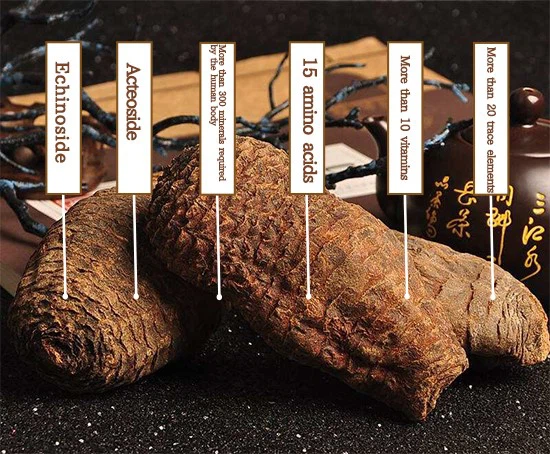
Main Chemical Constituents of Cistanche tubulosa
Modern pharmacological research has shown that Cistanche tubulosa contains various active ingredients such as phenylethanolic glycosides (such as verbascoside and pineal glycoside), Cistanche tubulosa polysaccharides, and Cistanche tubulosa glycosides. These ingredients exert neuroprotective effects through multiple targets and pathways, and their mechanisms are closely related to regulating neurotransmitters, inhibiting neuronal apoptosis, antioxidant and anti-inflammatory effects, and regulating gut microbiota. They are highly compatible with the efficacy of traditional Chinese medicine's "tonifying kidney and nourishing essence, nourishing marrow and brain, resolving phlegm and unblocking collaterals", providing solid scientific support for Cistanche tubulosa intervention in elderly dementia.
(1) Protecting neurons and improving cognitive function
Neuronal damage and apoptosis are the core pathological features of Alzheimer's disease, and Cistanche tubulosa and its active ingredients can protect neurons and improve cognitive function through various pathways. Research has found that active ingredients such as verbascoside and pinealoside in Cistanche tubulosa have high affinity for core targets related to Alzheimer's disease, such as ESR1, BDNF, MAPK1, and APP. They can improve hippocampal neuronal damage and enhance neuronal vitality by upregulating the cAMP signaling pathway and downstream BDNF protein targets. Animal experiments have confirmed that Cistanche tubulosa can effectively improve the learning and cognitive dysfunction of AD model mice. According to the Morris water maze test, it can significantly shorten the escape latency of mice and increase the number of platform crossings; Nissl staining observation shows that Cistanche tubulosa can improve the morphology of hippocampal neurons in mice and reduce neuronal apoptosis. In addition, polysaccharides from Cistanche tubulosa can upregulate the expression of Wnt/β - catenin signaling pathway in the substantia nigra of the brain, inhibit GSK-3 β activity, and protect dopamine neurons; Cistanche glycosides can directly inhibit the neurotoxic effects of amyloid proteins, promote learning and memory function in vascular dementia rats, and provide guarantees for cognitive function recovery.

Benefits of Cistanche tubulosa: Anti-Alzheimer's disease
Click here to view Cistanche Improving Memory and Preventing Alzheimer's Disease products
【Ask for more】 Email:cindy.xue@wecistanche.com / WhatsApp: 0086 18599088692 / Wechat: 18599088692
(2) Regulating neurotransmitters and maintaining brain homeostasis
Imbalance of neurotransmitters in the brain is an important cause of cognitive decline in elderly dementia patients, with a decrease in acetylcholine (ACh) and an excess of glutamate (Glu) being the main manifestations. Acetylcholine is a key neurotransmitter that maintains learning and memory function, and a decrease in its content can lead to memory impairment. Excessive glutamate can cause neurotoxicity and damage to neurons. Cistanche tubulosa and its active ingredients can maintain brain homeostasis by regulating neurotransmitter metabolism. Research has shown that extracts from Cistanche tubulosa can increase acetyltransferase activity in the brain, reduce acetylcholinesterase activity, thereby increasing acetylcholine content and improving learning and memory abilities; Meanwhile, it can inhibit glutamate-induced neuronal apoptosis, reduce glutamate neurotoxicity, and protect nerve cells. In addition, Cistanche tubulosa can regulate the levels of neurotransmitters such as dopamine and serotonin, improve symptoms such as emotional abnormalities and behavioral disorders in patients, and further assist in improving cognitive function.
(3) Antioxidant and anti-inflammatory properties, reducing brain damage
Oxidative stress and neuroinflammatory response are key factors in the onset of Alzheimer's disease in elderly patients. Abnormal elevation of oxidative markers and overexpression of inflammatory factors in the brain of AD patients can accelerate neuronal damage and brain function decline. Cistanche tubulosa and its active ingredients have significant antioxidant and anti-inflammatory effects, which can provide a "dual protective shield" for the brain. The core components of its extract, such as phenylethanolic acid glycoside and pineal acid glycoside, can accurately eliminate oxygen free radicals in the body, regulate oxidative stress balance, and avoid A β deposition and abnormal phosphorylation of Tau protein caused by excessive free radical production (a typical pathological feature of AD); Meanwhile, by downregulating the MAPK and NF - κ B signaling pathways in macrophages, the levels of inflammatory factors can be significantly reduced, thereby inhibiting neuroinflammatory responses. Experimental results have shown that supplementing with oligosaccharides extracted from Cistanche tubulosa significantly reduces the levels of inflammatory markers and effectively inhibits the inflammatory response in rats with spinal cord injury. The total glycosides of Cistanche tubulosa have antioxidant activity both in vivo and in vitro, which can increase the activity of superoxide dismutase (SOD) in brain tissue, reduce the content of malondialdehyde (MDA), and alleviate oxidative stress damage to the brain.

Desert living cistanche-Antioxidant
(4) Multi-pathway regulation to assist in improving pathological conditions
In addition to the core mechanisms mentioned above, Cistanche tubulosa can also assist in intervening in elderly dementia through various pathways, such as regulating immune function, lowering blood sugar, regulating gut microbiota, and balancing cell autophagy. The decline in immune function is a sign of aging and also an accelerator for AD. The water extract of Cistanche tubulosa can induce spleen cell proliferation and T cell activation, upregulate Th-related cytokine expression, activate dendritic cells, enhance the body's immune function, and protect brain health. There is pathophysiological homology between diabetes and AD. Insulin resistance will significantly increase the risk of AD. Echinacin, an extract of Cistanche tubulosa, can reduce liver damage in diabetes, and total glycosides of Cistanche tubulosa have a dose-dependent hypoglycemic effect, which can break the vicious circle of "diabetes AD". In addition, polysaccharides from Cistanche tubulosa can regulate gut microbiota homeostasis, promote beneficial bacterial growth, improve short chain fatty acid production, and enhance cognitive function through the bidirectional regulation mechanism of the brain gut axis; Its active ingredients, verbascoside and pinealoside, can balance cellular autophagy activity, avoid excessive activation or insufficient function of autophagy, reduce neuronal damage, and provide a new pathway for intervention in elderly dementia.
(5) Clinical application verification shows good safety
Clinical studies have confirmed that compound preparations mainly composed of Cistanche tubulosa (such as compound Cistanche puzzle capsules) have significant clinical efficacy in patients with mild to moderate Alzheimer's disease. Sixty-five subjects with mild to moderate Alzheimer's disease were selected for a 6-month clinical observation. The results showed that the Alzheimer's Disease Assessment Scale (ADAS Cog) score and the total score of the Auditory Word Memory Test (AVLT) were significantly increased in the compound Cistanche Puzzle Capsule group, while the scores of the Mini-Mental State Examination (MMSE) and the Clock Drawing Test (CDT) were significantly decreased. This indicates that it can effectively regulate the cognitive function of AD patients, especially in cognitive domains such as episodic memory and visual-spatial processing ability. At the same time, this preparation also has a certain improvement effect on clinical indicators such as alanine aminotransferase (ALT) and urea (BUN), with fewer adverse reactions and higher safety. It is suitable for long-term use and fully reflects the traditional Chinese medicine concept of "preventing disease before it occurs". It can effectively improve patient symptoms and delay disease progression.

Chinese cistanche herb-Improve memory
The occurrence of senile dementia is the result of the combined effects of traditional Chinese medicine's "kidney essence deficiency, brain marrow deficiency, phlegm and blood stasis obstructing the orifices" and Western medicine's "neuronal damage, neurotransmitter imbalance, oxidative stress, inflammatory response" and other factors. As a traditional tonifying Chinese medicine, Cistanche tubulosa's intervention in elderly dementia is based on the core idea of "tonifying the kidneys and nourishing the essence, nourishing the marrow and brain, resolving phlegm and unblocking collaterals" in traditional Chinese medicine, which perfectly fits the core pathogenesis of elderly dementia; Modern pharmacological research further confirms that Cistanche tubulosa exerts neuroprotective and cognitive improvement effects through multiple targets and pathways, such as protecting neurons, regulating neurotransmitters, antioxidant and anti-inflammatory effects, and regulating gut microbiota. This perfectly echoes traditional Chinese medicine theory and reflects the unique advantages of "holistic regulation and specimen consideration" in traditional Chinese medicine.
At present, although research on the intervention of Cistanche tubulosa in elderly dementia has made some progress, there are still some shortcomings. Firstly, the study of the mechanism of action of its active ingredients is mostly focused on animal experiments and in vitro experiments, with small sample sizes and short treatment courses. Further large-scale and long-term follow-up clinical studies are needed to clarify its clinical efficacy and safety; Secondly, the effective ingredient extraction process and dosage form optimization of Cistanche tubulosa still need to be improved to enhance its bioavailability and better exert its pharmacological effects; Thirdly, there is limited research on the synergistic effects of the combination of Cistanche tubulosa and other traditional Chinese medicines in the intervention of elderly dementia. It is necessary to explore more effective compound combination schemes based on the principles of traditional Chinese medicine syndrome differentiation and treatment.
With the acceleration of population aging, the prevention and treatment of senile dementia has become a major public health issue. In the future, we should strengthen the research on the combination of traditional Chinese and Western medicine, deeply explore the core mechanism of Cistanche tubulosa intervention in elderly dementia, optimize the extraction process and dosage form, carry out more high-quality clinical studies, and combine traditional Chinese medicine syndrome differentiation and treatment to fully leverage the advantages of Cistanche tubulosa's "multi-component and multi-target" approach, providing safer and more effective traditional Chinese medicine solutions for the prevention and treatment of elderly dementia, and allowing this traditional Chinese medicine to play a greater role in safeguarding the cognitive health of the elderly and improving their quality of life.