Exploring Jiawei Guifu Lizhong Wan (JWGF) For Benign Prostatic Hyperplasia (BPH) Using UPLC–Q–Orbitrap–MS And Network Pharmacology
Sep 17, 2026
An ingredient- and mechanism-oriented translation + developer-focused blog adaptation for teams building natural, herbal prostate & male urinary supplements (with a Rou Cong Rong / Cistanche factory perspective).
1) Why this matters: BPH is common, chronic, and multi-factorial
Benign Prostatic Hyperplasia (BPH) is one of the most common urinary system conditions in middle-aged and elderly men. It is characterized by benign proliferation of prostatic glandular and stromal components, which can lead to bladder outlet obstruction and lower urinary tract symptoms (LUTS) such as urinary frequency, urgency, weak stream, and difficulty urinating.
Epidemiology is striking: BPH prevalence is about 50% in men over 50, and 80%+ in men over 80, severely affecting quality of life. Mechanisms are not fully understood, but current consensus links BPH to androgen metabolic imbalance, inflammation, oxidative stress, and dysregulated proliferation/apoptosis.
Conventional treatments primarily include α-blockers and 5α-reductase inhibitors. While effective for symptom relief, long-term use can cause adverse effects (e.g., orthostatic hypotension, sexual dysfunction, retrograde ejaculation), and recurrence is common after discontinuation-creating demand for multi-target, low-side-effect natural strategies.
Table 1. Effects of modified Guifu Lizhong Pills on prostate wet weight, organ index, and volume in BPH mice (xˉ±s, n=12)(\bar{x}\pm s,\; n=12)(xˉ±s,n=12)
| Group | Prostate wet weight (mg) | Prostate index (mg·g⁻¹) | Prostate volume (mL) |
|---|---|---|---|
| sham | 0.1324 ± 0.0504 | 0.2437 ± 0.0926 | 0.1483 ± 0.040 |
| model | 0.2671 ± 0.07841)^{1)}1) | 0.5208 ± 0.14751)^{1)}1) | 0.2858 ± 0.09571)^{1)}1) |
| JWGF-L | 0.1621 ± 0.03712)^{2)}2) | 0.3029 ± 0.07002)^{2)}2) | 0.1800 ± 0.03522)^{2)}2) |
| JWGF-M | 0.1600 ± 0.02782)^{2)}2) | 0.2977 ± 0.05482)^{2)}2) | 0.1650 ± 0.03732)^{2)}2) |
| JWGF-H | 0.1431 ± 0.04812)^{2)}2) | 0.2676 ± 0.09512)^{2)}2) | 0.1417 ± 0.02252)^{2)}2) |
| Fina | 0.1627 ± 0.03822)^{2)}2) | 0.3291 ± 0.08582)^{2)}2) | 0.1767 ± 0.05052)^{2)}2) |
Notes: sham, sham operation; model, BPH model; JWGF-L, low dose (4.42 g·kg⁻¹); JWGF-M, medium dose (8.83 g·kg⁻¹); JWGF-H, high dose (17.67 g·kg⁻¹); Fina, finasteride (1 mg·kg⁻¹). 1)P<0.05^{1)} P<0.051)P<0.05 vs sham; 2)P<0.05^{2)} P<0.052)P<0.05 vs model.
2) TCM perspective & the formula background: what is JWGF?
Traditional Chinese Medicine (TCM) has a long history in managing BPH-like presentations, typically categorized under "癃闭" and "精癃." A common TCM pathogenesis summary is:
Kidney yang deficiency as the "root",
phlegm and blood stasis as the "branch."
Jiawei Guifu Lizhong Wan (JWGF) is modified from Guifu Lizhong Wan, a classical formula originating from the Qing dynasty text Sihuting Jifang, itself derived from Fuzi Lizhong Wan.
The research team modified the base formula by adding Red ginseng, deer antler, and nutmeg to better address BPH patterns described as "kidney deficiency with phlegm-stasis binding," aiming to strengthen warming-tonifying effects while also resolving obstruction and stasis.
JWGF composition (as used in the study)
Cinnamon bark (Rou Gui) 3 g
Processed aconite (Fu Pian) 3 g
Codonopsis (Dang Shen) 9 g
Fried atractylodes (Chao Bai Zhu) 9 g
Prepared ginger (Pao Jiang) 9 g
Honey-fried licorice (Zhi Gan Cao) 9 g
Red ginseng (Hong Shen) 6 g
Deer antler (Lu Rong) 3 g
Nutmeg (Rou Dou Kou) 2 g
TCM role allocation (study narrative):
Chief (Jun): deer antler + cinnamon + aconite to warm kidney yang and support "bladder transformation"
Deputy (Chen): red ginseng + prepared ginger + codonopsis + atractylodes to warm and tonify spleen/qi
Assistant (Zuo): nutmeg to regulate qi and transform phlegm
Envoy (Shi): licorice to harmonize
Table 2. Effects of modified Guifu Lizhong Pills on histopathological score and Masson's trichrome positive staining area in prostate tissue of BPH mice (xˉ±s, n=6)(\bar{x}\pm s,\; n=6)(xˉ±s,n=6)
| Group | Histopathological score | Masson-positive area (%) |
|---|---|---|
| sham | 1.17 ± 0.75 | 4.67 ± 1.71 |
| model | 4.50 ± 1.381)^{1)}1) | 13.92 ± 2.061)^{1)}1) |
| JWGF-L | 2.17 ± 0.982)^{2)}2) | 8.72 ± 2.452)^{2)}2) |
| JWGF-M | 2.83 ± 0.982)^{2)}2) | 8.34 ± 2.472)^{2)}2) |
| JWGF-H | 1.50 ± 1.052)^{2)}2) | 8.27 ± 2.692)^{2)}2) |
| Fina | 2.83 ± 1.72 | 8.67 ± 2.792)^{2)}2) |
3) Study goal (plain English): from "what gets into blood" → to "how it works"
The study aimed to clarify:
Which original (prototype) compounds from JWGF actually enter the bloodstream after administration (a key step for identifying "active material basis"), using UPLC–Q–Orbitrap high-resolution mass spectrometry.
Which targets and pathways those absorbed compounds may affect, using network pharmacology, then validating with molecular docking.
Whether JWGF truly improves BPH in vivo, using a testosterone-induced BPH mouse model, measuring:
prostate index
serum hormones and biomarkers
inflammation/oxidative stress markers
histopathology and collagen deposition
pathway protein phosphorylation (Western blot)
Table 3. Effects of modified Guifu Lizhong Pills on serum levels of sex hormones and 5α-reductase activity (xˉ±s, n=10)(\bar{x}\pm s,\; n=10)(xˉ±s,n=10)
| Group | T (µg·L⁻¹) | E₂ (pmol·L⁻¹) | DHT (nmol·L⁻¹) | ASD (µg·L⁻¹) | 5AR (U·L⁻¹) |
|---|---|---|---|---|---|
| sham | 1.90 ± 0.52 | 5.20 ± 0.23 | 1.45 ± 0.18 | 3.46 ± 0.56 | 279.31 ± 8.56 |
| model | 2.40 ± 0.391)^{1)}1) | 8.49 ± 0.091)^{1)}1) | 2.66 ± 0.491)^{1)}1) | 4.86 ± 0.411)^{1)}1) | 341.25 ± 14.181)^{1)}1) |
| JWGF-L | 2.24 ± 0.17 | 6.94 ± 0.232)^{2)}2) | 2.26 ± 0.302)^{2)}2) | 4.33 ± 0.562)^{2)}2) | 333.77 ± 9.43 |
| JWGF-M | 2.14 ± 0.32 | 6.44 ± 0.102)^{2)}2) | 2.02 ± 0.382)^{2)}2) | 4.18 ± 0.402)^{2)}2) | 318.29 ± 10.832)^{2)}2) |
| JWGF-H | 2.00 ± 0.362)^{2)}2) | 5.99 ± 0.212)^{2)}2) | 1.94 ± 0.362)^{2)}2) | 3.94 ± 0.292)^{2)}2) | 316.96 ± 9.482)^{2)}2) |
| Fina | 2.03 ± 0.392)^{2)}2) | 6.07 ± 0.222)^{2)}2) | 1.89 ± 0.272)^{2)}2) | 3.89 ± 0.482)^{2)}2) | 313.47 ± 12.382)^{2)}2) |
4) Methods (developer-relevant details, kept complete but easier to follow)
4.1 Serum pharmacochemistry: UPLC–Q–Orbitrap–MS identification
Goal: identify absorbed "prototype" compounds in medicated serum.
Animals: rats were dosed with JWGF 16.17 g/kg (3× clinical equivalent dose) daily for 7 days.
Blood sampling: 2 hours after final dose.
Sample preparation: protein precipitation with acetonitrile; nitrogen blowdown; methanol reconstitution.
Chromatography: BEH C18 column; gradient elution with 0.1% formic acid water (A) and acetonitrile (B).
MS conditions: positive/negative ion modes; scan m/zm/zm/z 100–1500; compound ID via accurate mass + fragments + database matching (m/z Cloud, PubChem, in-house references, literature).
4.2 Network pharmacology workflow
Obtain SMILES of absorbed compounds from PubChem
Predict targets using SwissTargetPrediction
Collect BPH targets from GeneCards and OMIM
Intersect compound targets with disease targets (Venn)
Build PPI network using STRING + visualize in Cytoscape 3.9.1
Identify core targets with CytoHubba (MCC)
Perform GO and KEGG enrichment (DAVID + visualization platform)
4.3 Molecular docking
Ligands: top 10 key active compounds (from network topology)
Proteins: core targets (from PPI ranking)
Tools: PyMOL preprocessing, AutoDockTools 1.5.7, AutoDock Vina
Criterion: binding energy < –5.0 kcal/mol considered good binding
4.4 Animal validation (BPH model)
72 male KM mice, 6 groups (n=12):
Sham
Model
JWGF-L 4.42 g/kg
JWGF-M 8.83 g/kg
JWGF-H 17.67 g/kg
Positive control: finasteride 1 mg/kg
Model induction: castration + testosterone propionate 5mg/kg5 mg/kg5mg/kg daily for 28 days
Endpoints: prostate wet weight/index; ELISA hormones & cytokines; HE & Masson; Western blot for pathway proteins and proliferation/apoptosis markers
Table 4. Effects of modified Guifu Lizhong Pills on serum levels of inflammatory markers of prostatitis (xˉ±s, n=10)(\bar{x}\pm s,\; n=10)(xˉ±s,n=10)
| Group | PAP (ng·mL⁻¹) | PSA (ng·mL⁻¹) |
|---|---|---|
| sham | 2.21 ± 0.20 | 0.28 ± 0.09 |
| model | 2.84 ± 0.301)^{1)}1) | 0.60 ± 0.061)^{1)}1) |
| JWGF-L | 2.66 ± 0.26 | 0.54 ± 0.08 |
| JWGF-M | 2.56 ± 0.36 | 0.42 ± 0.092)^{2)}2) |
| JWGF-H | 2.47 ± 0.342)^{2)}2) | 0.42 ± 0.062)^{2)}2) |
| Fina | 2.43 ± 0.302)^{2)}2) | 0.39 ± 0.092)^{2)}2) |
5) Key results (translated + structured for supplement R&D readers)
5.1 "What gets into blood": 30 absorbed prototype compounds
The extract contained 104 compounds (flavonoids, terpenes, alkaloids, organic acids, etc.).
After excluding blank serum interference, 30 prototype compounds were detected in medicated serum.
Interpretation for developers: this gives a blood-exposed chemical set-a more practical starting point for identifying efficacy-linked markers than listing only raw herb constituents.
5.2 Target intersection: 141 shared targets with BPH
Predicted targets from absorbed compounds: 461
BPH disease targets collected: 1,738
Intersection: 141 potential therapeutic targets
5.3 Core targets (top nodes)
Top core targets included:
AKT1, EGFR, BCL2, STAT3, HIF1A, JUN, ESR1, NFKB1, CTNNB1, mTOR
5.4 Key pathways enriched (KEGG)
Major enriched pathways:
PI3K/AKT
MAPK
HIF-1
AGE–RAGE
5.5 Key active compounds (top 10 by network degree)
Cinnamaldehyde
Liquiritigenin
"Songbai aldehyde" (as named in the paper)
Formononetin
Cinnamic acid
7-hydroxycoumarin
6-gingerol
Atractylenolide II
α-cyperone
Glycyrrhetinic acid
5.6 Docking: all key compound–target pairs showed good binding
All docking combinations had binding energies below –5.0 kcal/mol, supporting the plausibility of multi-target engagement.
Table 5. Effects of modified Guifu Lizhong Pills on serum levels of inflammatory factors and oxidative stress indicators (xˉ±s, n=10)(\bar{x}\pm s,\; n=10)(xˉ±s,n=10)
| Group | TNF-α (pg·mL⁻¹) | IL-10 (pg·mL⁻¹) | IL-8 (pg·mL⁻¹) | IL-6 (pg·mL⁻¹) | SOD (U·mL⁻¹) | MDA (nmol·mL⁻¹) | CAT (ng·mL⁻¹) |
|---|---|---|---|---|---|---|---|
| sham | 74.94 ± 3.81 | 97.84 ± 6.23 | 8.20 ± 0.68 | 4.98 ± 0.55 | 284.29 ± 16.57 | 7.03 ± 1.48 | 16.63 ± 1.64 |
| model | 94.68 ± 5.671)^{1)}1) | 45.42 ± 4.671)^{1)}1) | 10.34 ± 0.531)^{1)}1) | 13.48 ± 11.191)^{1)}1) | 194.48 ± 18.531)^{1)}1) | 11.7 ± 1.041)^{1)}1) | 10.39 ± 1.031)^{1)}1) |
| JWGF-L | 88.88 ± 4.382)^{2)}2) | 52.64 ± 4.282)^{2)}2) | 9.83 ± 0.78 | 7.74 ± 0.702)^{2)}2) | 260.75 ± 13.292)^{2)}2) | 9.52 ± 0.962)^{2)}2) | 13.75 ± 0.772)^{2)}2) |
| JWGF-M | 87.48 ± 5.532)^{2)}2) | 69.02 ± 7.152)^{2)}2) | 9.49 ± 1.022)^{2)}2) | 8.75 ± 0.802)^{2)}2) | 268.09 ± 18.812)^{2)}2) | 9.19 ± 0.512)^{2)}2) | 14.22 ± 0.912)^{2)}2) |
| JWGF-H | 84.77 ± 3.442)^{2)}2) | 74.78 ± 9.382)^{2)}2) | 9.40 ± 0.352)^{2)}2) | 9.06 ± 0.962)^{2)}2) | 275.27 ± 16.082)^{2)}2) | 8.97 ± 1.192)^{2)}2) | 14.87 ± 0.792)^{2)}2) |
| Fina | 84.75 ± 4.872)^{2)}2) | 74.26 ± 12.192)^{2)}2) | 9.67 ± 0.712)^{2)}2) | 8.98 ± 1.032)^{2)}2) | 255.97 ± 32.032)^{2)}2) | 9.14 ± 1.042)^{2)}2) | 14 |
6) In vivo efficacy: JWGF improved BPH features in mice
6.1 Prostate index & general condition
Model mice showed reduced activity, dull coat, and increased bedding moisture (consistent with urinary issues).
JWGF improved general condition and body weight trend.
Compared with the model group, JWGF reduced prostate wet weight, prostate volume, and prostate index (dose-dependent trend; high dose most notable).
6.2 Histology and fibrosis/collagen deposition
HE staining: model group showed multi-layer epithelial hyperplasia, epithelial shedding, stromal proliferation; JWGF reduced these pathological changes.
Masson staining: model group had significant collagen deposition; JWGF reduced collagen accumulation and improved gland structure.
6.3 Hormones and 5α-reductase activity
Compared with the model group, JWGF:
significantly reduced DHT, E2, androstenedione (ASD) at all doses
reduced 5α-reductase (5AR) notably at medium/high dose
reduced testosterone (T) significantly at high dose (and finasteride)
6.4 Prostate inflammation markers & systemic inflammation
PAP and PSA increased in model group; JWGF reduced them (notably high dose for PAP; medium/high dose for PSA).
Pro-inflammatory cytokines (TNF-α, IL-6, IL-8) decreased with JWGF; anti-inflammatory IL-10 increased.
6.5 Oxidative stress markers
JWGF decreased MDA and increased antioxidant enzymes SOD and CAT, indicating improved oxidative stress status.
7) Mechanism validation: JWGF inhibited multiple proliferation/inflammation axes
Western blot in prostate tissue showed that JWGF reduced:
p-STAT3/STAT3
p-NF-κB p65 / NF-κB p65
HIF-1α protein level
p-AKT/AKT, p-mTOR/mTOR, p-ERK/ERK
PCNA (proliferation marker; significant at medium/high dose)
JWGF increased:
Bax/Bcl-2 ratio (shifting toward apoptosis)
Overall mechanism (study conclusion):
JWGF's absorbed prototype compounds form the "material basis" for anti-BPH activity. The mechanism includes:
regulating androgen metabolism (T/DHT/5AR axis)
anti-inflammatory + anti-oxidative effects
blocking PI3K/AKT/mTOR/ERK and STAT3/NF-κB signaling
downregulating HIF-1α
synergistically promoting apoptosis and inhibiting proliferation
Table 6. Effects of modified Guifu Lizhong Pills on phosphorylation of STAT3 and NF-κB and expression of HIF-1α in mice (xˉ±s, n=3)(\bar{x}\pm s,\; n=3)(xˉ±s,n=3)
| Group | p-STAT3/STAT3 | p-NF-κB p65 / NF-κB p65 | HIF-1α/β-actin | p-AKT/AKT | p-mTOR/mTOR | Bax/Bcl-2 | p-ERK/ERK | PCNA/β-actin |
|---|---|---|---|---|---|---|---|---|
| sham | 0.31 ± 0.03 | 0.27 ± 0.03 | 0.30 ± 0.03 | 0.34 ± 0.04 | 0.36 ± 0.04 | 1.59 ± 0.13 | 0.27 ± 0.04 | 0.26 ± 0.03 |
| model | 1.26 ± 0.151)^{1)}1) | 0.95 ± 0.091)^{1)}1) | 0.85 ± 0.061)^{1)}1) | 1.38 ± 0.141)^{1)}1) | 1.47 ± 0.151)^{1)}1) | 0.24 ± 0.021)^{1)}1) | 1.15 ± 0.151)^{1)}1) | 1.00 ± 0.141)^{1)}1) |
| JWGF-L | 0.78 ± 0.092)^{2)}2) | 0.67 ± 0.092)^{2)}2) | 0.62 ± 0.042)^{2)}2) | 0.93 ± 0.092)^{2)}2) | 0.95 ± 0.142)^{2)}2) | 0.85 ± 0.072)^{2)}2) | 0.77 ± 0.092)^{2)}2) | 0.78 ± 0.12 |
| JWGF-M | 0.69 ± 0.092)^{2)}2) | 0.56 ± 0.082)^{2)}2) | 0.53 ± 0.082)^{2)}2) | 0.75 ± 0.082)^{2)}2) | 0.77 ± 0.122)^{2)}2) | 1.05 ± 0.102)^{2)}2) | 0.68 ± 0.092)^{2)}2) | 0.56 ± 0.062)^{2)}2) |
| JWGF-H | 0.44 ± 0.052)^{2)}2) | 0.47 ± 0.062)^{2)}2) | 0.40 ± 0.052)^{2)}2) | 0.46 ± 0.072)^{2)}2) | 0.52 ± 0.072)^{2)}2) | 1.16 ± 0.102)^{2)}2) | 0.41 ± 0.052)^{2)}2) | 0.48 ± 0.052)^{2)}2) |
| Fina | 0.47 ± 0.072)^{2)}2) | 0.45 ± 0.062)^{2)}2) | 0.40 ± 0.042)^{2)}2) | 0.43 ± 0.062)^{2)}2) | 0.48 ± 0.042)^{2)}2) | 1.21 ± 0.192)^{2)}2) |
8) What this means for natural prostate supplement development (actionable takeaways)
8.1 If you're building a prostate/LUTS product, think "multi-pathway"
This study aligns with a practical reality in BPH: androgens, inflammation, oxidative stress, hypoxia, and growth factor signaling reinforce each other. A single-target approach may relieve symptoms but not address recurrence risk drivers.
The JWGF evidence suggests a network approach:
hormonal modulation (DHT/5AR)
inflammation control (STAT3/NF-κB; TNF-α/IL-6/IL-8)
oxidative stress support (SOD/CAT/MDA)
anti-proliferative signaling (AKT/mTOR/ERK; PCNA; Bax/Bcl-2)
8.2 Rou Cong Rong (Cistanche) as a "tonifying" long-term positioning ingredient
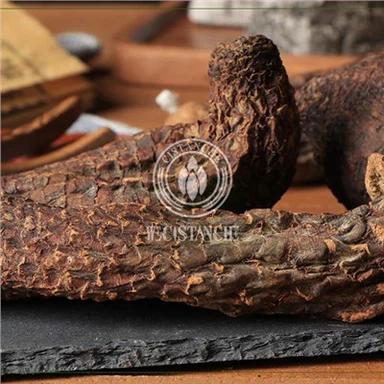
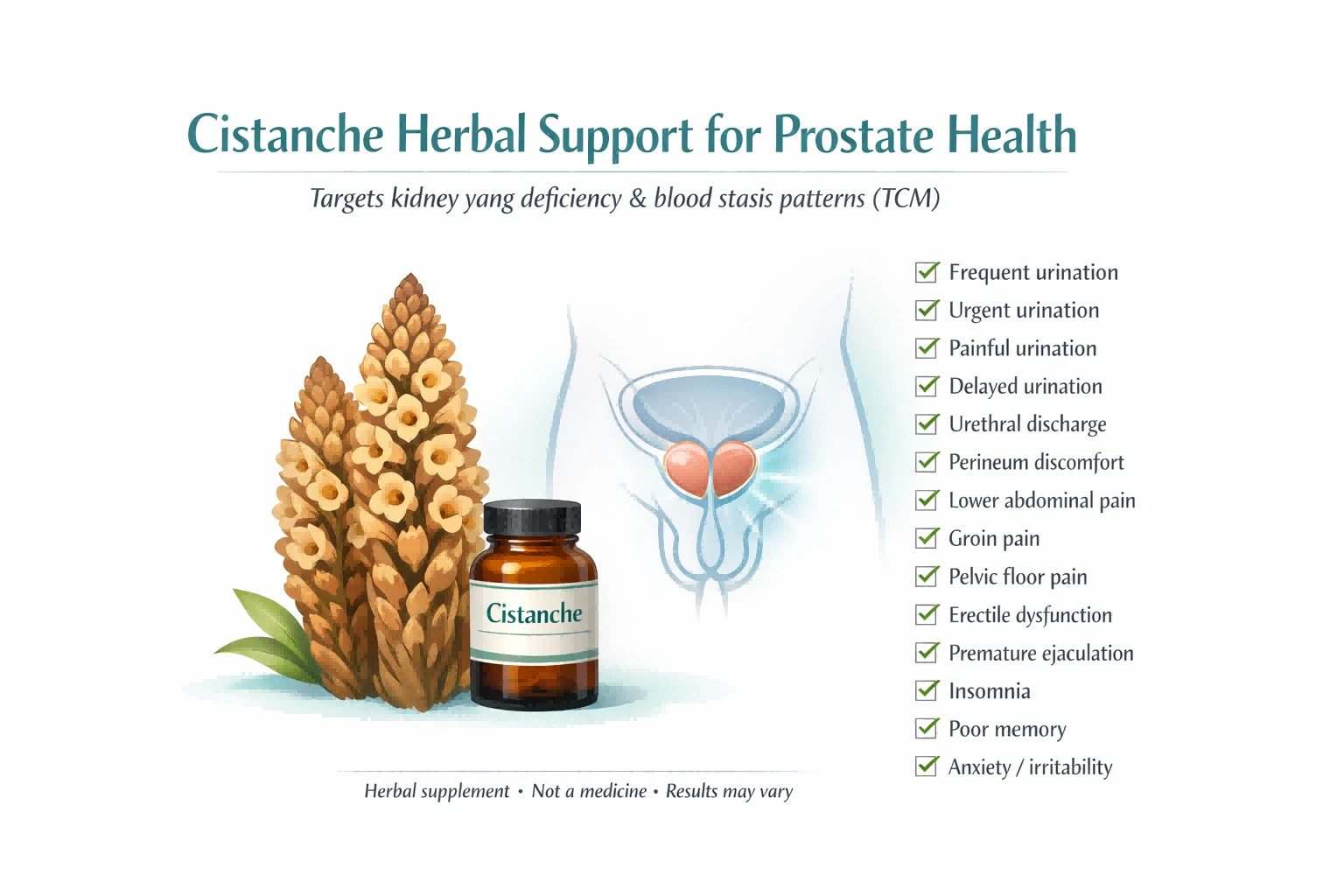
On the Wecistanche content side, Cistanche (Rou Cong Rong) is positioned as a gentle, steady tonic, often used for kidney yang support and gradual vitality support, and also traditionally for bowel dryness/constipation-more "conditioning" than "stimulation."
That positioning fits long-term male health maintenance narratives and can be framed as supportive, not acute drug-like treatment.
(Reference background: Rou Cong Rong overview article; and prostate/urinary support article emphasizing BPH symptom stages and TCM pattern differentiation.)
8.3 From factory to formula: how to communicate ingredient credibility
For an independent site (DTC or B2B), the "trust stack" typically needs:
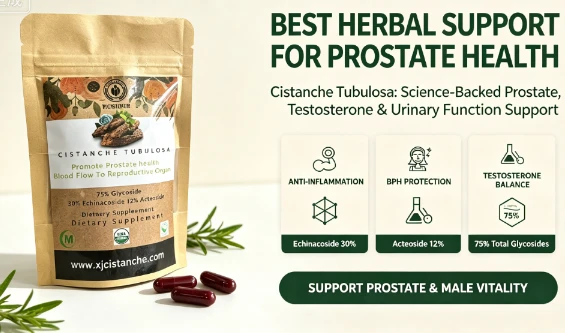
origin + actives (e.g., Hotan/Xinjiang Cistanche tubulosa; echinacoside/acteoside)
standardization and QC (GMP, HACCP, organic programs where relevant)
R&D collaborations + patents
realistic claims language (support, maintain, help) and clear safety notes
Your "About Us" content provides a brand story emphasizing an integrated supply chain, base cultivation acreage, GMP facilities, certifications, patents, and academic collaboration-these are exactly the credibility elements prostate supplement developers look for when sourcing consistent extracts.
9) Limitations (keep this in your blog for scientific honesty)
The authors note several limitations:
The castration + testosterone propionate model does not fully replicate the multi-factor clinical nature of BPH.
Absorbed-compound identification used rats, while efficacy validation used mice (species differences).
Distribution of absorbed compounds within prostate tissue wasn't directly measured.
Key pathways were not "reverse-validated" with targeted inhibition/knockdown experiments.
Translation for product developers: This is strong mechanistic evidence for a preclinical package, but it is not equivalent to human clinical proof. Use it to guide ingredient selection, standardization markers, and mechanistic storytelling-then plan human data generation.
10) Suggested blog structure on a Rou Cong Rong factory website (ready-to-publish outline)
Cistanche Health Supplement
click for more details
BPH & male urinary function: what men experience (nocturia, weak stream, urgency)
Why multi-target botanical strategies are attractive (side effects, recurrence, long-term support)
Introducing JWGF and the "kidney yang + phlegm-stasis" logic
Modern tools: UPLC–Q–Orbitrap–MS + network pharmacology (how researchers decode formulas)
What the study found: 30 blood-exposed compounds → 141 targets → PI3K/AKT, MAPK, HIF-1, AGE–RAGE
Animal validation: hormones, inflammation, oxidative stress, histology, pathway proteins
What to borrow for supplement design: marker compounds, pathway claims framing, QC strategy
Why source matters: Hotan-origin Cistanche tubulosa + manufacturing/certifications
Safety & compliance: who should consult a clinician; avoid medical claims
Next steps: formulation, standardization, pilot clinical evaluation