Kidney Function, Brain Morphology And Cognition in The Elderly: Sex Differences in The Austrian Stroke Prevention Study
Dec 22, 2023
ABSTRACT
Impaired kidney function is associated with structural brain changes and cognitive dysfunction. In the aging kidney, hemodynamic and structural alterations reduce the glomerular filtration rate (eGFR). Little is known about differences between men and women regarding decline of kidney function and brain damage. In this community-based study, we assessed associations between the eGFR, focal and diffuse brain abnormalities and cognitive functions. Sex-specific effects were analyzed by interaction terms eGFR x sex on brain structure and cognition. Interactive effects were assessed using mixed models –stratified by sex. Overall, 196 women and 129 men (median age 68 years and mean eGFR 73.8±14.9 ml/min/1.73m2 ) were included. Significant associations existed between eGFR and cortical volume (β: 1.53E-04; SE: 6.72E-05; p=0.023 for neocortex). Sex exerted a significant interactive effect. Only in men, eGFR related to cortical volumes of all lobes and of deep gray matter structures (p= 0.001 for total gray matter, p=0.0004 for neocortex). In the whole group eGFR was not associated with cognition, but men with lower eGFR performed worse on tests for executive function, which, after FDR correction, was not significant.
We conclude, that in community-dwelling middle-aged and elderly individuals, reduced eGFR relates to brain volume loss in men but not in women.


INTRODUCTION
Kidneys and brain are irrigated by short, small perforating arterioles, which auto-regulate perfusion pressure to maintain a continuous and stable high blood flow [1]. Both organs are affected by similar vascular risk factors such as age, hypertension, diabetes mellitus and smoking [2]. Individuals with chronic kidney disease (CKD) present a plethora of small vessel disease-related brain changes [1–4] with focal and diffuse structural and microstructural abnormalities [5–7]. These include lacunar strokes, white matter abnormalities and microbleeds [3, 8, 9]. Already in the 1980ies, studies described a higher incidence of brain atrophy in patients with CKD when compared to the general population [10– 13]. Both focal and diffuse brain changes are presumed to cause cognitive impairment of various degree in patients with renal dysfunction [14]. There is evidence for a sex paradox in kidney disease [15]. While women experience a higher prevalence of CKD, men are more likely to suffer kidney failure and have higher mortality rates in predialysis CKD [16, 17]. Yet, so far, there is hardly any data on sex differences of brain damage in the wake of milder kidney dysfunction.

Here, we examined the associations between eGFR and brain MRI findings in a large cohort of elderly persons without a history of strokes or dementia. We first determined if eGFR in an older community-dwelling population relates to focal and diffuse structural and microstructural brain changes as well as cognitive functions, and second, if these associations, when present, are indeed influenced by sex.
RESULTS
In total, 196 women and 129 men (median age 68 years; IQR: 55–73), with a mean eGFR of 73.8 ± 14.9 ml/min/1.73m2 were included in the study. Baseline demographics and risk factors are shown in Table 1. Cardiovascular risk factors were common. Arterial hypertension was frequent in both men and women, but diastolic blood pressure values were higher in men. Also, significantly more men were smokers and men experienced more years of education and consumed more alcoholic drinks. They had higher levels of hemoglobin, transferrin saturation, homocysteine and urea. By contrast, women had higher levels of HbA1c, HDL and cholesterol. MRI findings were comparable between men and women, except for larger normalized hippocampal volumes in women than in men (p<0.001) and higher white matter hyperintensity volumes in men than in women (Table 2).
Table 3 demonstrates the associations between eGFR and MRI findings in the total cohort. After adjustment for possible confounders and correction for multiple testing, there were no significant associations between eGFR and markers of cerebral small vessel disease including volumes of white matter hyperintensities (WMH) and peak width of skeletonized mean diffusivity (PSMD). Direct associations existed between eGFR and the volumes of the total neocortex and the cortical volumes of the parietal and occipital lobe (Table 3). EGFR was not related to cognitive functions including memory (β: -0.0035; SE: 0.0035, p=0.32), executive function (β: 0.0026, SE: 0.0023, p=0.25) and visuo-practical skills (β: -0.0008, SE: 0.0032, p=0.80) in the whole group.
Table 4 shows the interaction terms eGFR x sex on brain volume. The interactions were significant for total gray matter, the neocortex and for volumes of the frontal-, and temporal lobes (Table 4). Associations were only significant in men but not in women (Table 5). Lower eGFR in men is related to smaller brain volume in both the neocortex and deep cortical structures (Table 5). Figures 1A, 1B demonstrate scatterplots of the association between eGFR and neocortical as well as deep gray matter volumes.
The associations were linear in both sexes with a substantially steeper slope in men compared to women. As can be seen in Table 6, after adjustment for possible confounders, men with lower eGFR performed significantly worse on tests for executive function, but the association was no longer significant when correcting for multiple tests. The association was not mediated by total or lobar cortical volumes (Supplementary Table 1).

DISCUSSION
In this cross-sectional analysis of 325 community-dwelling people from the Austrian Stroke Prevention Family Study (ASPS-Fam), there were no significant associations between eGFR and vascular brain lesions, but eGFR was directly related to normalized brain volume. The association affected the cortex and sex exerted an interactive effect. Decreasing eGFR is related to smaller gray matter volume in men but not in women. In men, significant direct relationships were seen for all lobes and for deep gray matter structures. We also examined the relationship between eGFR and cognitive functioning and found no significant association in the whole group. Nonetheless, in men but not in women, reductions in eGFR were related to executive dysfunction after correction for confounding factors. This relationship was not mediated by global or lobar atrophy.
These observations were made even though 88% of our male study participants had eGFR values above 60 ml/min/1.73m2, representing a normal or only mild reduced kidney function.
Previous studies reported correlations between kidney function and brain atrophy mainly in patients with advanced CKD [11, 18, 19], thus, our study extends this finding to patients with only mildly impaired renal function. Recently, it has been shown that cystatin C was associated with cognitive performance, brain imaging pathology and decline to dementia in 90+-year-olds with a mean eGFR of 39ml/min/1.73 m2 [20]. Kidney function decreases by approximately 6ml/min/1.73m2 per decade [21]. A faster decline in men compared to women has been reported (0.55 ± 1.47 ml/min/1.73 m2 vs. −0.33 ± 1.41 ml/min/1.73 m2 per year, respectively) [22]. A large meta-analysis and a recent analysis of the Chronic Renal Insufficiency Cohort (CRIC) also described a more rapid rate of
Table 1. Demographics, risk factors and metabolic panel in the study cohort and differences between men and women.
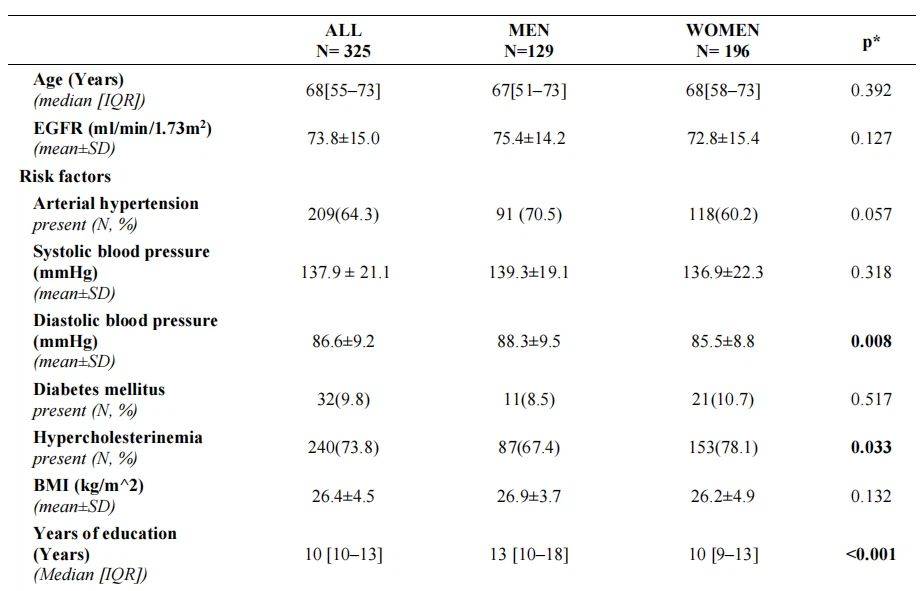
Table 3. Associations between eGFR and structural- and microstructural MRI changes.
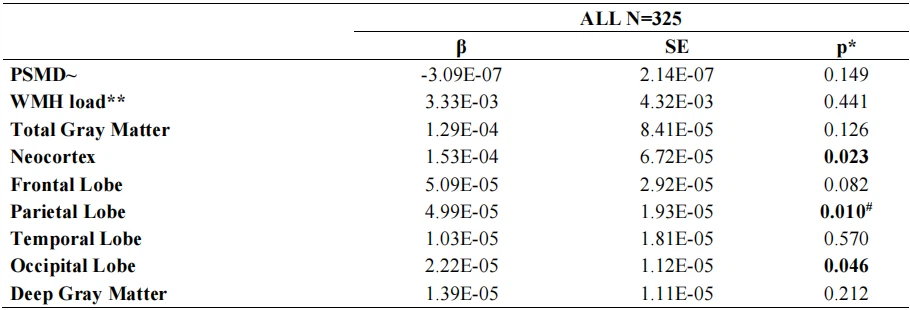
Mixed model analyses determining the association between eGFR and MRI adjusted for age, education, smoking status, alcohol, hypertension, diabetes, hypercholesterolemia, HDL, cardiac diseases, diastolic BP, homocysteine, hemoglobin, transferrin saturation and family structure. *p-value not corrected for multiple testing.
#p-value significant after false discovery rate (FDR) correction for multiple testing. For PSMD (Peak width of Skeletonized Mean Diffusivity): N(Total)=236, N(Men)=92, N(women)=144.** WMH load was natural logarithm transformed, as the variable is not normally distributed. eGFR, estimated glomerular filtration rate, Magnetic Resonance Imaging; β, regression coefficient; SE, standard error of the regression coefficient. progression and worse kidney function outcomes in male patients with CKD [23, 24]. This suggests that women might have a higher tolerability against CKD. If this also applies to kidney-related end-organ damage is yet undetermined.

Table 4. Interaction analysis for eGFR and sex on total and lobar brain volume.

Table 5. Association between eGFR and total and lobar brain volume.

In the context of our study results it is important to note that sex differences have also been reported for the age-dependent decline in the volume of cortical as well as subcortical gray matter, with faster progression in men [25]. Previously, sex-specific effects of aging on cognition have also been reported [26]. Gur et al. described that men showed a stronger age-related decline in cognitive functions including attentional deficits compared to women [26]. Accordingly, we cannot exclude that the relationship between loss of kidney function, brain volume reduction, and decline in cognition seen in our study was not causal, but rather an age-related process that develops in parallel in both organs and is more rapid in men than in women. It is of note that the association between reduced eGFR and worse performance on tests of executive functioning in men was not mediated by global or lobar brain atrophy.
Supportive Service Of Wecistanche-The largest cistanche exporter in the China:
Email:wallence.suen@wecistanche.com
Whatsapp/Tel:+86 15292862950
Shop For More Specifications Details:
https://www.xjcistanche.com/cistanche-shop
GET NATURAL ORGANIC CISTANCHE EXTRACT WITH 25% ECHINACOSIDE AND 9% ACTEOSIDE FOR KIDNEY INFECTION