

Modulation Of The Aryl Hydrocarbon Receptor Signaling Pathway Impacts On Junín Virus Replication Part 2
Jul 20, 2023
3. Results and Discussion
3.1. The AHR Pathway Is Over-Represented during JUNV Infection
The liver is one of the main targets during JUNV infection [22]. To elucidate the molecular mechanisms involved in a hepatocyte infection, we conducted an Affymetrix microarray screening to determine the differentially expressed genes in liver-derived human HepG2 cells infected with JUNV IV4454 for 24 or 48 h.
We utilized the Transcriptome Analysis Console software from ThermoFisher Scientific, Waltham, MA, USA to evaluate the differentially expressed genes in the JUNV-infected cells compared to the control (Figure 1a,b). A total of 266 and 313 differentially expressed genes were detected at 24 and 48 h pi, respectively (Figure 1a,b).

Affymetrix microarray assay (n = 3 independent experiments per condition). Host genes showing at least a 1.6-fold change in expression and a 95% probability of being expressed differentially (p = 0.05) were considered for further analysis. Genes shown in red were up-regulated, genes shown in green were down-regulated, and genes in gray showed no change in expression compared to uninfected HepG2 cells. (b) Differentially expressed genes between mock-infected and JUNV-infected HepG2 cells at 48 h pi. (c) Gene Ontology Analysis of differentially expressed genes in JUNV-infected HepG2 cells at 48 h pi. (d) Pathway Overrepresentation Analysis of JUNV-infected HepG2 cells compared to mock-infected cells showing the main signaling pathways affected during infection. The red bar highlights the AHR pathway. The dashed blue line indicates p = 0.05. p values were determined by WebGestalt software (http://www.webgestalt.org, accessed on 3 July 2020).
There is a close relationship between host genes and immunity. Host genes largely determine the development and function of a person's immune system and can affect a person's resistance to different pathogens.
Several studies have shown that certain gene mutations can lead to imbalances in the immune system. For example, some people may suffer from diseases in which the immune system overreacts, causing the immune system to attack its body tissues, such as rheumatoid, systemic lupus erythematosus, and other diseases. In addition, resistance to pathogens such as bacteria, viruses, and parasites is also associated with genetic differences. Some people are born with a more efficient immune system that clears away pathogens faster and more completely.
Research on the relationship between host genes and immunity has given us a deeper understanding of the body's defense mechanisms and has also helped us better understand the body's response to different diseases. This is of great significance for the prevention and treatment of diseases.
Therefore, we should pay attention to the significance of genetic testing, and learn and understand the differences in human genes to better protect our immune system, strengthen our physique, and build a strong body. From this point of view, we need to improve our immunity. Cistanche can significantly improve immunity, because Cistanche is rich in a variety of antioxidant substances, such as vitamin C, vitamin C, carotenoids, etc. These ingredients can scavenge free radicals and reduce oxidative stress. Stimulate and improve the resistance of the immune system.

Click cistanche tubulosa benefits
To further study the impact of JUNV on the cellular landscape, we utilized the WebGestalt software (http://www.webgestalt.org, accessed on 3 July 2020), which employs the Wikipathways database as a repository to perform a Gene Ontology Analysis (Figure 1c) and to determine which signaling pathways were differentially altered compared to control (Figure 1d).
Regarding the Gene Ontology Analysis from the differentially expressed genes, it was concluded that JUNV infection impacts the expression of genes related to RNA metabolism, host kinases, and lipid metabolism (Figure 1c). It is worth noting that these biological processes and molecular functions have been reported to be targeted by JUNV during its replication cycle [23].
Furthermore, Pathway Overrepresentation Analysis revealed that JUNV infection enriches the AHR signaling pathway at 48 h pi (Figure 1d) among many other pathways (p < 0.05). Particularly, we detected an increased expression of the AHR target gene CYP1B1, which evidences an increased activity of the AHR pathway.
Over the last few years, several studies revealed the importance of AHR as a therapeutic target during different pathological scenarios; thus, a wide variety of small compounds to modulate its activity has been developed. We decided to further study the impact of AHR modulation during in vitro JUNV infection.
3.2. Pharmacological Modulation of AHR Affects Viral Replication
To elucidate the role that AHR plays in JUNV infections, we decided to test the effects of known AHR ligands CH223191 (antagonist) and kynurenine (agonist) on in vitro infections with two different JUNV attenuated strains: IV4454 and Candid#1. Treatments and infections were performed employing Huh-7 and Vero cells. Since this last cell line cannot express and secrete interferon type I (IFN-I), its use allows determining the importance of IFN-I expression in the potential AHR mediated host–virus interplay.
Firstly, the cytotoxicity of different concentrations of both CH223291 and kynurenine was evaluated via MTT assay (Figure 2a,b) and optic microscopy observations (Figure 2c,d).
Regarding CH223191, a decrease in the cell viability and morphological alterations associated with cytotoxic effects were detected only at concentrations of 80 µM (Figure 2a,c). On the other hand, kynurenine did not induce cytotoxic effects at any concentration tested (Figure 2b,d).
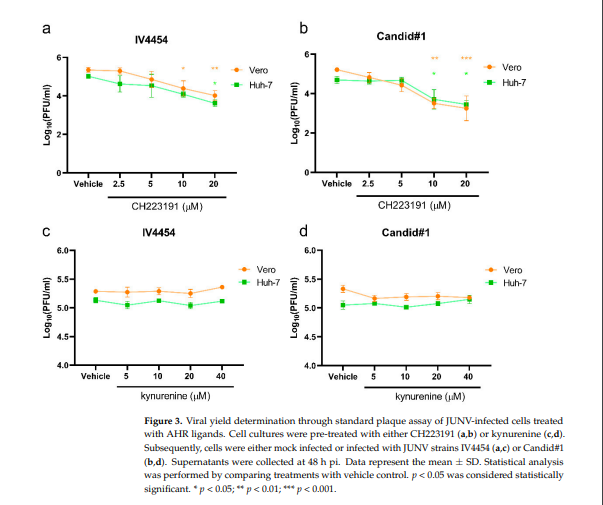
To investigate the effect of AHR pharmacological modulation during JUNV infection, cell cultures were treated with vehicle (DMSO), CH223191, or kynurenine and then infected with JUNV for 48 h to determine viral yield. Briefly, Vero and Huh-7 cells were vehicle-treated or treated with different concentrations of the small molecule CH223191 (2.5, 5 µM, 10 µM, and 20 µM) or kynurenine (5 µM, 10 µM, 20 µM, and 40 µM) prior and postJUNV infection with IV4454 and Candid#1 at an MOI of 0.5. After 48 h, the supernatants were harvested and used to infect Vero cells for the PFU assay (Figure 3).
The AHR blockade significantly reduced viral particle production in a dose–response manner, even with the lowest concentration of CH223191 tested. Importantly, this result was observed not only using both JUNV-attenuated strains but also in both infected cell lines (Vero and Huh7). The CH223191 treatment of JUNV-infected Vero and Huh-7 cells diminished the number of viral plaques by 93% and 97%, respectively (Figure 3a,b). These results strongly suggest that the AHR signaling pathway is an important cellular factor during JUNV infection (Figure 3a,b). On the other hand, the kynurenine administration before and after JUNV inoculation did not significantly change the viral titer obtained in comparison to viral control (Figure 3c,d).

All in all, the results evidenced for the first time that AHR is an important cellular factor during JUNV in vitro infection, implying a pro-viral role by facilitating the viral replication cycle.

3.3. AHR Modulation Has an Impact on JUNV Protein Expression
To further study the effects of AHR modulation on JUNV infection, we conducted an indirect immunofluorescence assay. The JUNV NP protein is the most abundant structural and functional protein within the Arenaviridae family. Thus, NP was chosen as an interesting staining target given that only a few studies reported the NP expression pattern of different JUNV attenuated strains. Our first step was to determine the NP distribution of both JUNV strains in our cellular models to compare the permissiveness of the different cell lines and the viral dissemination of both attenuated strains in these cell cultures (Figure 4).
The NP localization was exclusively cytoplasmic and exhibited a homogeneous big punctuate accumulation pattern, similar for both strains in Vero and Huh-7 cell lines (Figure 4).
Next, we evaluated by immunofluorescence the impact of the pharmacological modulation of AHR on NP expression in JUNV-infected cell cultures.
Briefly, cells were seeded over glass coverslips, pre-treated with either vehicle (DMSOCH223191 (10 uM) or kynurenine (40 uM), and then mock-infected or JUNV-infected for48 h. Afterward, cells were fixed and processed through an immunofluorescence assay(Figure 5).

The CH223191 administration remarkably decreased the number of NP-positive cells in both cell cultures and for both JUNV strains (Figure 5). These observations correlate with previous results shown in Figure 3a,b. The AHR blockade reduced not only the percentage of JUNV-infected cells but also the size of viral foci. Vero cell cultures pre-treated with CH223191 and infected with either IV4454 or Candid#1 showed a 57.14% (SD ± 7.98) and 41.17% (SD ± 9.05) reduction in foci size, respectively. In addition, Huh-7 cell cultures pre-treated with the antagonist and infected with either IV4454 or Candid#1 showed a 28.57% (SD ± 8.70) and 12.50% (SD ± 9.30) reduction in foci size, respectively. On the other hand, it was observed that the treatment with kynurenine did not alter the percentage of NP-positive cells (Figure 5), or foci size (not shown), compared to non-treated infected cells.
Furthermore, a more detailed microscopic inspection showed that viral foci were larger in infected Vero cell cultures in comparison to Huh-7-infected cell cultures. We observed that the average of JUNV-infected Vero cells per foci consisted of 35 cells, while the average of JUNV-infected Huh-7 cells per foci consisted of 6 cells. This expected observation is in line with the restricted viral environment that IFN-competent cells imposed on JUNV multiplication [24].

3.4. AHR Suppression Reduces JUNV Viral Levels
Finally, to evaluate if an AHR blockade impacts the JUNV RNA levels, Vero and Huh-7 cells were treated with either vehicle, CH223191 (10 µM) or kynurenine (40 µM), and then were mock or JUNV-infected for 48 h. Afterward, the cell monolayers were harvested and processed for RT-qPCR to monitor ahr, cyp1a1, and np RNA levels (Figure 6).
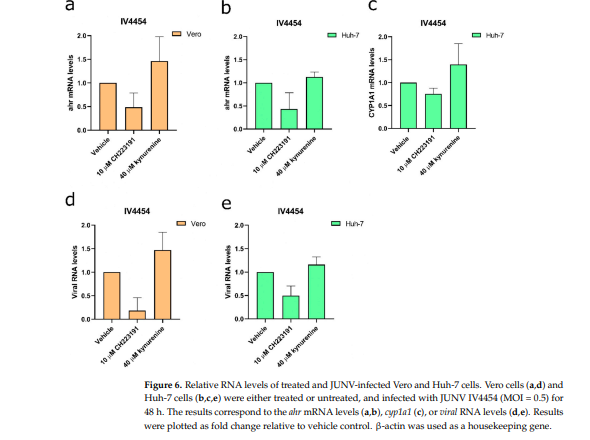
It was observed that CH223191-treated and JUNV-infected cells exhibited a trend toward lower ahr mRNA levels compared to vehicle-treated–JUNV-infected samples (Figure 6a,b). Conversely, the administration of kynurenine displayed a trend towards an enhancement of the ahr mRNA levels in JUNV-infected cells compared to vehicle-treated–JUNV-infected samples (Figure 6a,b). In line with these results, treatment with CH223191 showed a trend towards a reduction in cyp1a1 mRNA levels in Huh-7 cells, while treatment with kynurenine showed opposite effects (Figure 6c). Regarding the JUNV RNA level, it was observed that the treatment with the AHR antagonist CH223191 reduced viral RNA levels in infected cells compared to vehicle-treated–JUNV-infected samples, while kynurenine-treated and JUNV-infected cells tended an increment of the viral RNA levels (Figure 6d,e).
In this work, we showed for the first time that in vitro JUNV infection induces the activation of the AHR signaling pathway in liver-derived cell cultures. Microarray analysis data showed that the AHR signaling pathway is over-expressed in JUNV-infected cell cultures at 48 h pi.
Several studies reported that AHR activation can have a variety of effects on cell physiology, impacting proliferation and immune innate responses [6,25]. In fact, in the last decade, AHR activation has been described as having IFN modulatory activity-exerting effects on cytokine secretion [26,27]. Importantly, AHR up-regulation signaling can reduce IFN-I antiviral immune responses [28]. Regarding this, we evaluated the impact of the AHR signaling pathway modulation on non-competent and competent IFN cell cultures, such as Vero and Huh-7 cellular models, using AHR antagonist and agonist small commercial molecules during in vitro JUNV infection with two different attenuated strains.
Through different approaches, it was confirmed that AHR negative modulation via pharmacological inhibition with CH223191 had antiviral activity against JUNV. After the AHR blockade, JUNV in vitro infection was found inhibited. An important decrease in viral protein expression was observed in JUNV-infected cell cultures treated with the AHR antagonist. Furthermore, the AHR blockade diminished the extracellular infectious viral particle production of both attenuated IV4454 and Candid#1 strains of JUNV studied in this work. Moreover, a trend toward a decrease in viral RNA levels in CH223191-treated cells was observed. Interestingly, these findings were observed in both Huh-7 and Vero cell lines and showed an equivalent magnitude, suggesting that the AHR pro-viral role during JUNV infection might be independent of the IFN-I signaling pathway. These results are in line with our previous observations in other viral models [13]. More studies will be needed to elucidate which step of the JUNV replication cycle is affected by the AHR blockade.
Studies showing AHR activation by anthropogenic ligands have gained particular interest due to the growing awareness involving improper environmental exploitation and its interplay with viral infection severity [2]. Note, the habitat area covered by JUNV vector rodents comprises a large territory; however, at present, AHF only affects a restricted and confined region where mainly rural activities are undertaken [29]. Furthermore, agricultural workers are the main population at risk to suffer severe manifestations during the AHF disease. Our present work suggests that rodent/human exposure to AHR agonists might have an impact on the outcome of JUNV infection.
Although intensive efforts have been dedicated in the last decades to antiviral research against arenaviruses [30], no specific antiviral chemotherapy is currently available for the treatment of AHF and human diseases caused by other pathogenic members of Arenaviridae. Particularly, the Lassa virus (LASV) is the agent of Lassa fever (LF), which represents a serious human threat in regions of West Africa with a very high rate of mortality [31]. At present, the only alternative treatment against LF is the off-label use of the guanosine analog ribavirin, which has been demonstrated to be partially effective in LF patients only if its administration is started within 6 days of symptom onset [32,33]. Furthermore, ribavirin may induce adverse side effects limiting the recommendation of its administration only to patients at high risk. Then, there is a real demand for new effective antivirals for the therapy of arenavirus hemorrhagic fevers. AHR represents a new host target to be considered. Indeed, there are several ongoing clinical trials involving AHR inhibitors (BAY2416964, IK-175, and HP163) in the treatment of different cancers. Nevertheless, these trials are in the early stages and none focus on the antiviral potential of AHR pharmacological targeting. Noticeably, drugs directed to cell factors required in the virus multiplication cycle have regained interest in antiviral development given the chance to obtain a wide-spectrum inhibitor affecting a host target common to several human pathogens [34,35], a feature associated with AHR.
In conclusion, the combined results of the present study highlight the relevance of AHR signaling pathway modulation as a potential therapeutic target against JUNV. Future studies will be needed to implement AHR targeting therapies to overcome important challenges, such as the delivery of the AHR ligands to the desired tissues and cells to minimize possible off-target AHR modulation effects.

Author Contributions:
Conceptualization, C.C.G.; methodology, M.A.P., A.E.A.D.L. and A.B.M.; software, F.G.; validation, M.A.P., and F.G.; formal analysis, M.A.P., and M.F.T.; investigation, M.A.P., and M.F.T.; resources, E.B.D. and C.C.G.; data curation, F.G.; writing—original draft preparation, M.A.P., and M.F.T.; writing—review and editing, E.B.D. and C.C.G.; supervision, C.C.G.; project administration, C.C.G.; funding acquisition, E.B.D., and C.C.G. All authors have read and agreed to the published version of the manuscript.
Funding:
This work was funded by Universidad de Buenos Aires (UBA) (grant number 20020170100363BA) and Consejo Nacional de Investigaciones Científicas y Tecnológicas (CONICET) (grant number PIP11220170100171CO). E.B.D. and C.C.G. are members of the Research Career from CONICET; M.F.T., A.E.A.D.L., and A.B.M. are fellows from CONICET. M.A.P. is a fellow from UBA.
Institutional Review Board Statement:
Not applicable.
Informed Consent Statement:
Not applicable.
Data Availability Statement:
The data that support the findings of this study are available from the corresponding author upon reasonable request.
Acknowledgments:
We thank all members of the laboratories involved for helpful advice and discussions.

Conflicts of Interest:
The authors declare no conflict of interest. The funders had no role in the design of the study; in the collection, analyses, or interpretation of data; in the writing of the manuscript; or in the decision to publish the results.
References
1. Head, J.L.; Lawrence, B.P. The Aryl Hydrocarbon Receptor Is a Modulator of Anti-Viral Immunity. Biochem. Pharmacol. 2009, 77, 642–653. [PubMed]
2. Torti, M.F.; Giovannoni, F.; Quintana, F.J.; García, C.C. The Aryl Hydrocarbon Receptor as a Modulator of Anti-Viral Immunity. Front. Immunol. 2021, 12, 624293. [PubMed]
3. Shinde, R.; McGaha, T.L. The Aryl Hydrocarbon Receptor: Connecting Immunity to the Microenvironment. Trends Immunol. 2018, 39, 1005–1020. [PubMed]
4. Stockinger, B.; Hirota, K.; Duarte, J.; Veldhoen, M. External Influences on the Immune System via Activation of the Aryl Hydrocarbon Receptor. Semin. Immunol. 2011, 23, 99–105.
5. Rothhammer, V.; Borucki, D.M.; Tjon, E.C.; Takenaka, M.C.; Chao, C.C.; Ardura-Fabregat, A.; de Lima, K.A.; Gutiérrez-Vázquez, C.; Hewson, P.; Staszewski, O.; et al. Microglial Control of Astrocytes in Response to Microbial Metabolites. Nature 2018, 557, 724–728. [CrossRef]
6. Quintana, F.J.; Basso, A.S.; Iglesias, A.H.; Korn, T.; Farez, M.F.; Bettelli, E.; Caccamo, M.; Oukka, M.; Weiner, H.L. Control of Treg and TH17 Cell Differentiation by the Aryl Hydrocarbon Receptor. Nature 2008, 453, 65–71. [CrossRef]
7. Marshall, N.B.; Kerkvliet, N.I. Dioxin and Immune Regulation: Emerging Role of Aryl Hydrocarbon Receptor in the Generation of Regulatory T Cells. Ann. N. Y. Acad. Sci. 2010, 1183, 25–37.
8. Vogel, C.F.A.; Khan, E.M.; Leung, P.S.C.; Gershwin, M.E.; Chang, W.L.W.; Wu, D.; Haarmann-Stemmann, T.; Hoffmann, A.; Denison, M.S. Cross-Talk between Aryl Hydrocarbon Receptor and the Inflammatory Response: A Role for Nuclear Factor-KB. J. Biol. Chem. 2014, 289, 1866–1875. [CrossRef]
9. Bankoti, J.; Rase, B.; Simones, T.; Shepherd, D.M. Functional and Phenotypic Effects of AhR Activation in Inflammatory Dendritic Cells. Toxicol. Appl. Pharmacol. 2010, 246, 18–28. [CrossRef]
10. Vogel, C.F.A.; Goth, S.R.; Dong, B.; Pessah, I.N.; Matsumura, F. Aryl Hydrocarbon Receptor Signaling Mediates Expression of Indoleamine 2,3-Dioxygenase. Biochem. Biophys. Res. Commun. 2008, 375, 331–335. [CrossRef]
11. Jin, G.B.; Moore, A.J.; Head, J.L.; Neumiller, J.J.; Lawrence, B.P. Aryl Hydrocarbon Receptor Activation Reduces Dendritic Cell Function during Influenza Virus Infection. Toxicol. Sci. 2010, 116, 514–522. [CrossRef]
12. Giovannoni, F.; Bosch, I.; Polonio, C.M.; Torti, M.F.; Wheeler, M.A.; Li, Z.; Romorini, L.; Rodriguez Varela, M.S.; Rothhammer, V.; Barroso, A.; et al. AHR Is a Zika Virus-Host Factor and a Candidate Target for Antiviral Therapy. Nat. Neurosci. 2020, 23, 939–951. [CrossRef]
13. Giovannoni, F.; Li, Z.; Remes-Lenicov, F.; Dávola, M.E.; Elizalde, M.; Paletta, A.; Ashkar, A.A.; Mossman, K.L.; Dugour, A.V.; Figueroa, J.M.; et al. AHR Signaling Is Induced by Infection with Coronaviruses. Nat. Commun. 2021, 12, 5148. [CrossRef]
14. Buchmeier, M.J.; de La Torre, J.C.; Peters, C.J. Arenaviridae: The viruses and their replication. In Fields Virology, 4th ed.; Lippincott Williams & Wilkins: Philadelphia, PA, USA, 2013; pp. 1283–1303.
15. Enria, D.A.; Briggiler, A.M.; Sánchez, Z. Treatment of Argentine Hemorrhagic Fever. Antivir. Res. 2008, 78, 132–139. [CrossRef]
For more information:1950477648nn@gmail.com


