

Nc886, A Non-Coding RNA, Is A New Biomarker And Epigenetic Mediator Of Cellular Senescence in Fibroblasts
Mar 27, 2023
Abstract:
Functional studies of organisms and human models have revealed that epigenetic changes can significantly impact the process of aging. Non-coding RNA (ncRNA), one of the epigenetic regulators, plays an important role in modifying the expression of mRNAs and their proteins. It can mediate the phenotype of cells. It has been reported that nc886 (=vtRNA2-1 or pre-miR-886), a long ncRNA, can suppress tumor formation and photo-damages of keratinocytes caused by UVB. This study aimed to determine the role of nc886 in the replicative senescence of fibroblasts and determine whether substances capable of controlling nc886 expression could regulate cellular senescence. In replicative senescence fibroblasts, nc886 expression was decreased while methylated nc886 was increased.
There were changes in senescence biomarkers including SA-β-gal activity and expression of p16INK4A and p21Waf1/Cip1 in senescent cells. These findings indicate that the decrease of nc886 associated with aging is related to the cellular senescence of fibroblasts and that increasing nc886 expression has the potential to suppress cellular senescence. AbsoluTea Concentrate 2.0 (ATC) increased nc886 expression and ameliorated cellular senescence of fibroblasts by inhibiting age-related biomarkers. These results indicate that nc886 has the potential as a new target for anti-aging and that ATC can be a potent epigenetic anti-aging ingredient.
Aging is the progressive process of functional and organic decline that occurs in all individuals over time. Many factors affect aging, and various social factors, economy, disease, nutrition, heredity, environment, and mental state all play a certain role. The mechanism of aging is very complex, and the more representative aging theories mainly include cell mutation theory, DNA damage theory, mitochondrial damage theory, telomere theory, free radical theory, non-enzyme glycosylation theory, immune function change theory, and neuroendocrine aging theory. Our country is rich in traditional Chinese medicine resources, which provides a basis for us to find superior additives for delaying skin aging.
For example, in the research, it was found that Cistanche deserticola has anti-aging effects. The anti-aging effect of Cistanche deserticola is mainly attributed to the amino acids and polysaccharides in it. Amino acid is an essential nutrient for the human body, which can synthesize protein and maintain the normal metabolism of the body. In Cistanche deserticola, the content of amino acids is very high. These amino acids can provide energy for body cells and promote new metabolism, which is beneficial to the repair and renewal of cells.

Click cistanche deserticola supplement product
Keywords:
fibroblasts; replicative senescence; epigenetic regulation; nc886; green tea extract.
1. Introduction
Cellular senescence in an irreversible state following cell proliferation arrest has emerged as a potentially important contributor to tissue dysfunction and the aging of organisms [1]. Senescence is characterized by high activity of senescence-associated beta-galactosidase (SA-β-gal), increase expression of senescence biomarkers such as p16INK4A and p21Waf1/Cip1, and decreased expression of LaminB1 [2]. There are two basic types of cellular senescence: replicative senescence and stress-induced premature senescence. Replicative senescence is defined as the phenomenon when normal cells stop dividing after reaching limited numbers of divisions. It is related to chronological aging. Continuous damage accumulation can induce replicative senescence of fibroblasts, leading to the lost ability to remodel and organize the extracellular matrix (ECM). The main features of the aged dermis are a reduced amount of collagen fibers and increased production of matrix metalloproteinases (MMPs), which contribute to a thin and disorganized structure of the dermis [3,4].
Epigenetic regulatory mechanisms are key mediators of the aging process, adapting to stressors and age-related changes in the genomic and molecular environment. These epigenetic alterations occur at various levels, including massive core histone reduction, deformation of histone by post-translational modification and DNA methylation, replacement of canonical histones with histone variants, and altered expression of noncoding RNA (ncRNA) during organismal and replicative senescence [5,6]. nc886 is 101 nucleotides long ncRNA that can bind to a target protein, thus mediating the activity of the protein and controlling gene expression [7]. nc886 has also been proposed as a tumor suppressor largely inferred by its expression pattern and its genomic location on human chromosome 5q31, the locus of the tumor suppressor gene. A feature of nc886 expression is the frequent silencing of malignancies by CpG DNA methylation in the promoter region [8]. Based on previous studies, we have found that the reduction of nc886 expression caused by UVB irradiation is associated with increases of COX-2 and MMP-9 through protein kinase RNA-activated (PKR) pathway in keratinocytes and that promotion of nc886 expression can be a useful strategy to develop UVB protective materials [9,10].
Green tea has been studied as a treatment for a variety of dermatological conditions, such as acne, rosacea, psoriasis, viral warts, and even skin cancer. Phenolic compounds including gallic acid (GC) and epigallocatechin gallate (EGCG) are well-known active compounds in green tea. (-)-Epigallocatechin-3-(3”-O-methyl) gallate (3” Me-EGCG) is a unique O-methylated form of EGCG and is contained in oolong tea and green tea. In particular, Jangwon No. 3 (Amorepacific varieties of green tea) contains more 3” Me-EGCG than other varieties of green tea [11]. 3” Me-EGCG has been reported to exhibit antioxidant and photoprotective effects on keratinocytes [12]. In this study, we investigated the role of nc886 in the replicative senescence of fibroblasts and determined whether highly concentrated green tea 3” Me-EGCG preparation (AbsoluTea Concentrate 2.0) that could increase nc886 expression could improve cellular senescence.

2. Results
2.1. Chemical Profile of AbsoluTea Concentrate 2.0 (ATC)
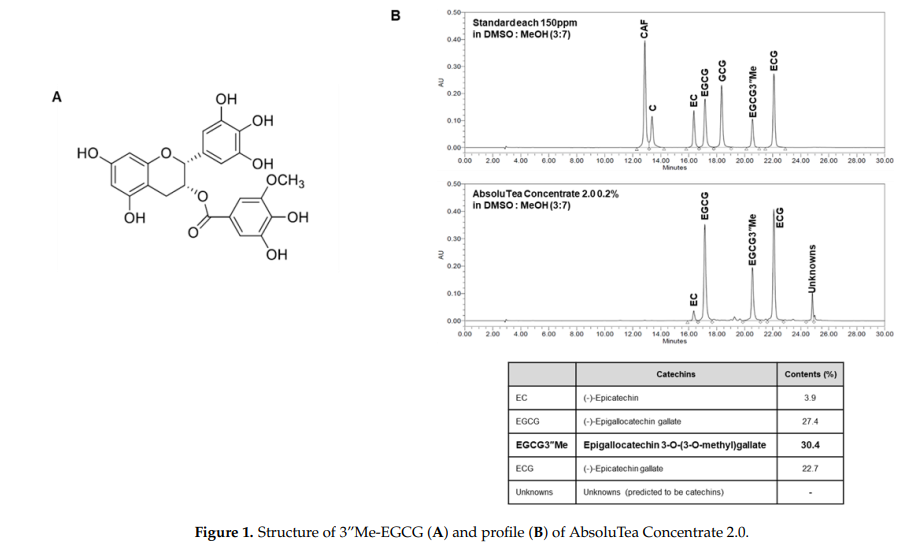
The chemical profile of AbsoluTea Concentrate 2.0 (ATC) is shown in Figure 1B. Results were obtained using HPLC for ATC prepared as described in the Method section. ATC contained 30% or more 3” Me-EGCG (Figure 1B). It is known that green tea extract does not contain 3” Me-EGCG or show a concentration of less than 6% [13,14]. Both young and senescent fibroblasts treated with ATC showed more increases in nc886 expression than those treated with 70% ethanolic extract of green tea (Supplementary Figure S1A). In addition, SA-β-gal expression levels in senescent fibroblasts treated with ATC were decreased more than in those treated with green tea extract (Supplementary Figure S1B).
2.2. nc886 Regulates Cellular Senescence of Fibroblasts
To observe the role of nc886 in the cellular senescence of fibroblasts, we used a replicative senescent model through growing and subculturing. As shown in Supplementary Figure S2, the activity of SA-β-gal and expression levels of senescent markers p16INK4A and p21Waf1/Cip1 were increased and Lamin B1 expression was decreased in senescent fibroblasts compared to young cells. Many previous studies have reported that aging is caused by oxidative stress. To confirm whether this series of oxidative stress is involved with cellular senescence, ROS levels in young (p3) and senescent fibroblasts (p30) were measured. Results showed that ROS levels were increased with aging (Supplementary Figure S2D). To observe the potential impact of nc886 on cellular senescence in fibroblasts, the nc886 gene expression level in each number of passages was determined. The level of nc886 expression was decreased with increasing passage number (Figure 2A).
It has been reported that nc886 expression is decreased with the methylation of CpG islands. To determine whether nc886 downregulation in senescent fibroblasts was mediated by methylation of nc886, a methylation-specific PCR was performed. As shown in Figure 2A, methylation of nc886 was increased with an increasing passage number (Figure 2A). This result demonstrates that the reduced expression of nc886 in a high passage number of fibroblasts is due to an increase in nc886 DNA methylation. To verify the role of nc886 in fibroblast senescence, changes in senescent markers in nc886 overexpression and knock-down models were determined. Results revealed that the group of senescent fibroblasts with nc886 overexpression showed decreased SA-beta-gal activity, decreased expression levels of p16INK4A and p21Waf1/Cip1, and increased levels of laminB1. In addition, the increase of ROS in senescent fibroblasts was decreased by nc886 overexpression (Figure 2B). Conversely, in the group of young fibroblasts with nc886 knock-down, cellular senescence was accelerated and expression levels of cellular senescent markers such as p16INK4A and p21Waf1/Cip1 were increased (Figure 2C). These results suggest that nc886 can regulate the cellular senescence of fibroblasts by regulating the expression of senescence markers (Figure 2B, C).

2.3. ATC Mitigates Cellular Senescence by Regulating nc886 Expression
Results obtained above showed that increasing nc886 expression could improve cellular senescence by mediating senescent markers. To observe the effect of ATC on nc886 expression, expression level, and methylation of nc886 in senescent fibroblasts were evaluated after treatment with ATC at a non-cytotoxic concentration (Figure 3A). As shown in Figures 3B, and C, ATC significantly increased nc886 expression and decreased methylation of nc886 in a concentration-dependent manner. This result demonstrated that the increase of nc886 expression by ATC was mediated through the inhibition of nc886 methylation. Additionally, we observed that ATC inhibited SA-β-gal activity and decreased expression levels of senescent markers p16INK4A and p21Waf1/Cip1 in senescent fibroblasts (Figure 3D, E). However, the expression of LaminB1 known to be decreased with aging was increased in senescent fibroblasts treated with ATC (Figure 3E). These results demonstrate that ATC can mitigate cellular senescence by increasing nc886 expression.

2.4. ATC Regulates Age-Related Changes of ECM and SASP
A characteristic of fibroblast senescence is that the activity of MMP-1, a component that degrades collagen, is increased, whereas collagen synthesis is decreased [15,16]. The increase of MMP-1 and the decrease of collagen were confirmed in senescent fibroblasts with high passage numbers (Figure 4A). However, ATC suppressed the expression of MMP-1 and increased collagen synthesis in senescent fibroblasts. This result indicates that ATC can improve age-related change of ECM through regulation of MMP-1 expression and collagen synthesis in senescent fibroblasts (Figure 4B). A senescence-associated secretory phenotype (SASP) in which senescent cells secrete specific pro-inflammatory factors, growth factors, and proteolytic enzymes has been reported to contribute to the onset and progression of aging-related diseases [17–19]. We observed the effect of ATC on SASP particularly pro-inflammatory cytokines such as IL-1α, IL_6, and IL-8. As shown in Figure 4C, ATC downregulated the expression levels of senescence-induced IL-1α, IL-6, and IL-8. This suggests that ATC can exert an anti-aging effect through the suppression of SASP.

3. Discussion
Senescent cells undergo characteristic morphological changes involving enlarged and often irregular nuclear and chromatin reorganization. When senescence is induced by DNA damage, replication depletion, or oncogene expression, Lamin B1 is primarily lost. Various internal or external stressors can trigger the DNA damage response (DDR) pathway to activate the p53 and/or p16INK4A pathway. p16INK4A can inactivate Cdk4/6, result in the accumulation of phosphorylated pRb, disrupt the regulation of the E2F transcription factor, and induce cell cycle arrest or senescence [20,21]. Increased production of reactive oxygen species (ROS) mostly produced by dysfunctional mitochondria can lead to cellular senescence through DNA damage and transactivation of senescence signaling pathways, including p53, p16INK4A, and p21Waf1/Cip1 [22].
In this study, we found that nc886 expression was decreased with increasing passage number and that upregulation of nc886 expression mitigated cellular senescence via the mediation of LaminB1, p16INK4A, p21Waf1/Cip1, and ROS production. nc886 is transcribed by RNA polymerase III (Pol III) and silenced by CpG DNA hypermethylation in many malignancies [8]. We observed that the expression of nc886 was decreased with methylation of CpG islands in senescent fibroblasts. This result indicates that hypermethylation of CpG islands impairs the functionality of nc886 as a suppressor of cellular senescence.
Specific gene expression pathways affected by nc886 are unclear. They are likely to include previously reported for other ncRNAs. nc886 can play critical roles in cellular senescence via directly or indirectly mediating the senescence signaling pathway at levels of chromatin structure, transcription factor activity, post-transcriptional, and posttranslational gene regulation [23]. For example, nc886 can mediate the senescent pathway of cell cycle progression. It has been reported that AK156230 as an ncRNA is associated with the induction of replicative senescence of fibroblasts through its roles in autophagy and cell cycle progression. Downregulation of AK156230 induced cells to show senescence responses by activating p53 and p21 while decreasing cyclin-dependent kinase 1 (CDK1) [24]. Senescence-associated ncRNA1 (SAL-RNA1), MALAT1, and MIAT are known as negative regulators of cellular senescence. They are decreased in senescent fibroblasts. Downregulating of these genes can lead to increases in senescence markers such as SA-β gal, p16, p21, and p53 [25]. The effect of MALAT1 on cellular senescence was achieved through the decline of oncogenic transcription factor b-Myb/Mybl2.
Although the expression of various ncRNAs is affected during senescence, only a few are functionally involved in senescence. Because localization of ncRNAs is important for understanding the mechanisms involved in function, nuclear and cytoplasmic ncRNAs are discussed separately when describing the molecular mechanisms affecting senescence [26]. The ncRNA located in the cytoplasm may function as a translation regulator through base pairing with the target mRNA [27]. ncRNA can affect protein expression levels by increasing or decreasing mRNA stability [28].
For example, during RAS-induced senescence, cytoplasmic UCA1 contributes to p16 mRNA stabilization by sequestering hnRNPA1 [29]. nc886 contains a protein kinase RNA-activated (PKR) binding site. PKR–nc886 binding can inhibit PKR activity. PKR, a cytoplasmic receptor for double-stranded RNA (dsRNA), is regulated by serine/threonine protein kinase that is activated by infection, cytokines, oxidative stress, and irradiation (including UV), leading to subsequent induction of inflammation and apoptosis [20,21] [30,31]. nc886 binds to PKR with an affinity comparable to dsRNA and prevents PKR from being activated. nc886 knockdown results in the phosphorylation of eukaryotic initiation factor 2α subunit (eIF2α) via the PKR pathway, which causes cell death and inhibits global cellular protein synthesis. It has been reported that the production of COX-2, IL-8, and MMPs by TNF-α is mediated by the PKR pathway in human chondrocytes [32]. In a previous study, we have also demonstrated that UVB-induced inflammation can be regulated through the nc886-PKR pathway in keratinocytes [10].
Moreover, PKR is related to oxidative stress-induced injury in neonatal cardiac myocytes. Inhibition of PKR protects against H2O2-induced injury by attenuating apoptosis and inflammation [33]. Inflammation and oxidative stress are major factors that induce the aging process. Thus, the PKR pathway can mediate the cellular senescence of fibroblasts induced by nc886 depletion. To elucidate the detailed regulatory mechanism involved in the effect of nc886 on the cellular senescence of fibroblasts, further studies are needed.
The antiaging effects of green tea extract have been widely reported in previous studies. The antioxidant and anti-inflammatory activities of green tea are well-known mechanisms that contribute to its anti-aging effect. In a preliminary test, we found that ATC increased nc886 expression significantly by more than 70% ethanolic extract of green tea (Supplement Figure S1A). This result suggests that concentrated catechins including 3” Me-EGCG can attribute to the upregulation of nc886 expression. To determine whether the nc886 stimulating agent could prevent cellular senescence, we observed the effect of ATC on senescent fibroblasts. ATC increased the expression of nc886 by inhibiting the level of methylation of the nc886 gene in senescent fibroblasts (Figure 3B, C). ATC also relieved cellular senescence by mediating senescent biomarkers such as SA-β-gal activity, LaminB1, p16INK4A, and p21Waf1/Cip1 (Figure 3E).
Moreover, increased MMP-1 and decreased collagen production induced by cellular senescence was restored by ATC (Figure 4B). SASP factors vary slightly depending on the type of cell and the type of aging-induced stress, they are commonly known as target genes for NF-κB that regulate pro-inflammatory cytokines such as IL-6 and IL-8. In this study, we confirmed that the increased expression of IL-1α, IL_6, and IL-8 in senescent cells was suppressed by ATC (Figure 4C). We cannot exclude the possibility that the improving effect of green tea on cellular senescence is achieved by multiple mechanisms, including nc886 regulation, anti-oxidation, and anti-inflammation. However, our results suggest that increased nc886 by ATC plays a critical role in the suppression of cellular senescence, subsequently affecting ECM production of fibroblasts.

4. Materials and Methods
4.1. Preparation of ATC
Dried green tea leaves (Camellia sinensis var. sinensis cv. Jangwon No. 3) used for the current study were obtained from tea plants grown in Dolsongi tea garden (33◦16023.900 N 126◦28058.300 E), Jeju, South Korea. Dry tea leaves (170 g) were extracted with 70% EtOH (v/v) at room temperature for 16 h. The extract was then powdered using a lyophilizer (TF10D, TEFIC BIOTECH, Xian, China). To prepare ATC, the EtOH extract was concentrated ten-fold with a rotary evaporator and loaded onto a column packed with AB-8 resin (inner diameter 5 cm, length 45 cm). Solvent elution of the column was performed with 4 times bed volume (BV) of 20%, 30%, and 100% EtOH (v/v). In this study, residual solvents in the column were removed with an air compressor before elution. The 30% EtOH eluate was concentrated twenty-fold and applied to a polyamide column (inner diameter 2.5 cm, length 40 cm). The polyamide column was eluted 5 times BV of 10% and 100% EtOH. The 100% EtOH eluate was carefully concentrated and lyophilized.
4.2. Cell Culture and Cell Treatment with ATC
Human dermal fibroblasts (HDFs) were purchased from ATCC (Manassas, VA, USA). Cell culture was conducted under controlled conditions at 37 ◦C with 5% CO2 using Dulbecco’s modified Eagle’s medium (WELGENE, Daegu, Korea) supplemented with 10% fetal bovine serum (Thermo Fisher Scientific, Waltham, MA, USA) and 1% of penicillin-streptomycin (WELGENE, Daegu, Korea). Cells were seeded into 6-well plates at a density of 2 × 10⁵ cells/plate. After reaching 60% confluence, they were treated with the indicated concentration of ATC for 72 h.
4.3. SA-β-Gal Staining and Flow Cytometry Analysis
Cells were stained using a SPiDER-β-Gal (Dojindo, Kumamoto, Japan) according to the manufacturer’s instructions. Cells were analyzed with an EVOS® FL Cell Imaging System (Thermo Fisher Scientific, Waltham, MA, USA) and a BD FACS Calibur flow cytometer (BD Biosciences, Franklin Lakes, NJ, USA).

4.4. Intracellular ROS Measurement
The production of intracellular ROS was monitored using C20,70 -dichlorodihydrofluorescein diacetate (H2DCFDA; Molecular Probes), a fluorescent ROS indicator. Cells were incubated with H2DCFDA (5 µM) for 30 min at 37 ◦C. Cell-associated fluorescence was detected with a BD FACS Calibur flow cytometer (BD Biosciences, Franklin Lakes, NJ, USA).
4.5. Real-Time PCR and Methylation-Specific PCR
Total RNA was extracted using TRIzol (Thermo Fisher Scientific, Waltham, MA, USA). Quantitative measurement of RNA was performed using an Epoch microplate spectrophotometer (BioTek, Winooski, VT, USA). cDNA was synthesized using an am-fiRivert cDNA Synthesis Platinum Master Mix (GenDEPOT, Barker, TX, USA). Genomic DNA was extracted using the AccuPrep® Genomic DNA Extraction Kit (BIONEER, Daejeon, Korea). Bisulfite conversion was conducted using the EZ DNA methylation kit (Zymo Research, CA, USA). To perform qRT-PCR, an AMPIGENE® cDNA Synthesis Kit (Enzo Life Sciences Inc., Farming-dale, NY, USA) and an ABI7500 real-time PCR system (Ambion Inc, Austin, TX, USA) were used. Primer sequences used in this study are described in Table 1.

4.6. Lactate Dehydrogenase Assay
LDH assay was used to determine the cytotoxicity by measuring lactate dehydrogenase (LDH) activity released from damaged cells. The assay was performed using an LDH Cytotoxicity WST Assay kit (Enzo life sciences, Farmingdale, NY, USA) according to the manufacturer’s instructions.
4.7. DNA Transfection for nc886 Overexpression and siRNA Transfection for nc886 Knockdown
To obtain DNA for overexpression of nc886 in cells, DNA was amplified with AccuPower® PCR PreMix (BIONEER, Daejeon, Korea) using genomic DNA of HDFs as a template and the following primers described in Table 2.

4.8. Western Blotting
Cell lysates were prepared with PRO-PREP™ Protein Extraction Solution (iNtRON Biotechnology, Gyeonggi do, Korea). Total proteins were separated with a NuPAGE electrophoresis system (Thermo Fisher Scientific, Waltham, MA, USA) and transferred to polyvinylidene difluoride (PVDF) membranes. Immunoblotting was performed using primary antibody against p16INK4A, p21Waf1/Cip1 (Cell Signaling Technology, Danvers, MA, USA), MMP1, Col1A2, and β-actin (Santa Cruz Biotechnology, Inc., Dallas, TX, USA). Scanning densitometric values of bands were analyzed using ImageJ, software version 1.52a (National Institutes of Health, Bethesda, MD, USA).
4.9. Enzyme-Linked Immunosorbent Assay
After indicated incubation, collagen (Procollagen Type I C-Peptide EIA Kit, Takara, Shiga, Japan) and MMP-1 (R&D Systems, Minneapolis, MN, USA) in culture supernatant were measured using the enzyme-linked immunosorbent assay (ELISA) kit following the manufacturer’s instructions.
4.10. Statistical Analysis
All results are presented as mean ± standard deviation (SD). Differences between the two groups were evaluated by the t-test or analysis of variance (ANOVA) using GraphPad Prism. Statistical significance was indicated as either p < 0.05 or p < 0.01.
5. Conclusions
In conclusion, regulating nc886 expression can be a potential target of cellular senescence in fibroblasts, and ATC can be a potent epigenetic anti-aging ingredient.
Author Contributions:
Conceptualization, Y.K., K.H., and E.J.; methodology Y.K., H.J., N.-H.P., and K.-S.L.; data curation, Y.K., H.J. and E.C.; investigation, Y.K., H.J., E.C., K.-S.L., N.-H.P., and E.J.; project administration, W.P., D.P., and E.J.; resources, W.P. and D.P.; supervision, D.P., and E.J.; writing— original draft, Y.K.; writing—review & editing, N.-H.P., K.H., W.P., D.P., and E.J. All authors have read and agreed to the published version of the manuscript.
Funding:
This research received no external funding.
Institutional Review Board Statement:
Not applicable
Informed Consent Statement:
Not applicable.
Data Availability Statement:
Data will be made available on request.
Conflicts of Interest:
The authors declare no conflict of interest.

References
1. Campisi, J.; d’Adda di Fagagna, F. Cellular senescence: When bad things happen to good cells. Nat. Rev. Mol. Cell Biol. 2007, 8, 729–740. [CrossRef] [PubMed]
2. Kapoor, V.K.; Dureja, J. Aging: Approaches towards its control. Drug Discov. Today Ther. Strategy. 2010, 7, 43–44. [CrossRef]
3. Fisher, G.J.; Kang, S.; Varani, J.; Bata-Csorgo, Z.; Wan, Y.; Datta, S.; Voorhees, J.J. Mechanisms of photoaging and chronological skin aging. Arch. Derm. 2002, 138, 1462–1470. [CrossRef]
4. Tigges, J.; Krutmann, J.; Fritsche, E.; Haendeler, J.; Schaal, H.; Fischer, J.W.; Kalfalah, F.; Reinke, H.; Reifenberger, G.; Stuhler, K.; et al. The hallmarks of fibroblast aging. Mech. Ageing Dev. 2014, 138, 26–44. [CrossRef]
5. Brunet, A.; Berger, S.L. Epigenetics of aging and aging-related disease. J. Gerontol. A Biol. Sci. Med. Sci. 2014, 69, S17–S20. [CrossRef] [PubMed]
6. Moskalev, A.A.; Aliper, A.M.; Smit-McBride, Z.; Buzdin, A.; Zhavoronkov, A. Genetics and epigenetics of aging and longevity. Cell Cycle 2014, 13, 1063–1077. [CrossRef] 7. Lee, K.; Kunkeaw, N.; Jeon, S.H.; Lee, I.; Johnson, B.H.; Kang, G.Y.; Bang, J.Y.; Park, H.S.; Leelayuwat, C.; Lee, Y.S. Precursor miR-886, a novel noncoding RNA repressed in cancer, associates with PKR and modulates its activity. RNA 2011, 17, 1076–1089. [CrossRef] [PubMed]
8. Park, J.L.; Lee, Y.S.; Song, M.J.; Hong, S.H.; Ahn, J.H.; Seo, E.H.; Shin, S.P.; Lee, S.J.; Johnson, B.H.; Stampfer, M.R.; et al. Epigenetic regulation of RNA polymerase III transcriptions in early breast tumorigenesis. Oncogene 2017, 36, 6793–6804. [CrossRef] [PubMed]
9. Lee, K.S.; Shin, S.; Cho, E.; Im, W.K.; Jeon, S.H.; Kim, Y.; Park, D.; Frechet, M.; Chajra, H.; Jung, E. nc886, a non-coding RNA, inhibits UVB-induced MMP-9 and COX-2 expression via the PKR pathway in human keratinocytes. Biochem. Biophys. Res. Commun. 2019, 512, 647–652. [CrossRef] [PubMed]
10. Lee, K.S.; Cho, E.; Weon, J.B.; Park, D.; Frechet, M.; Chajra, H.; Jung, E. Inhibition of UVB-Induced Inflammation by Laminaria japonica Extract via Regulation of nc886-PKR Pathway. Nutrients 2020, 12, 1958. [CrossRef]
11. Ji, H.G.; Lee, Y.R.; Lee, M.S.; Hwang, K.H.; Kim, E.H.; Park, J.S.; Hong, Y.S. Identification of epigallocatechin-3-O-(3-Omethyl)-gallate (EGCG300Me) and amino acid profiles in various tea (Camellia sinensis L.) cultivars. Data Brief. 2017, 14, 607–611. [CrossRef]
12. Kim, E.; Han, S.Y.; Hwang, K.; Kim, D.; Kim, E.M.; Hossain, M.A.; Kim, J.H.; Cho, J.Y. Antioxidant and Cytoprotective Effects of (-)-Epigallocatechin-3-(300-O-methyl) Gallate. Int. J. Mol. Sci. 2019, 20, 3993. [CrossRef]
13. Huang, L.H.; Liu, C.Y.; Wang, L.Y.; Huang, C.J.; Hsu, C.H. Effects of green tea extract on overweight and obese women with high levels of low density-lipoprotein-cholesterol (LDL-C): A randomized, double-blind, and cross-over placebo-controlled clinical trial. BMC Complement. Altern. Med. 2018, 18, 294. [CrossRef] [PubMed]
14. Soares, S.; Soares, S.; Brandao, E.; Guerreiro, C.; Mateus, N.; de Freitas, V. Oral interactions between a green tea flavanol extract and red wine anthocyanin extract using a new cell-based model: Insights on the effect of different oral epithelia. Sci. Rep. 2020, 10, 12638. [CrossRef] [PubMed]
15. Levi, N.; Papismadov, N.; Solomonov, I.; Sagi, I.; Krizhanovsky, V. The ECM path of senescence in aging: Components and modifiers. FEBS J. 2020, 287, 2636–2646. [CrossRef] [PubMed]
16. Pitozzi, V.; Mocali, A.; Laurenzana, A.; Giannoni, E.; Cifola, I.; Battaglia, C.; Chiarugi, P.; Dolara, P.; Giovannelli, L. Chronic Resveratrol Treatment Ameliorates Cell Adhesion and Mitigates the Inflammatory Phenotype in Senescent Human Fibroblasts. J. Gerontol. Ser. 2013, 68, 371–381. [CrossRef] [PubMed]
17. Coppe, J.P.; Patil, C.K.; Rodier, F.; Sun, Y.; Munoz, D.P.; Goldstein, J.; Nelson, P.S.; Desprez, P.Y.; Campisi, J. Senescence-associated secretory phenotypes reveal cell-nonautonomous functions of oncogenic RAS and the p53 tumor suppressor. PLoS Biol. 2008, 6, 2853–2868. [CrossRef]
18. Tchkonia, T.; Zhu, Y.; van Deursen, J.; Campisi, J.; Kirkland, J.L. Cellular senescence and the senescent secretory phenotype: Therapeutic opportunities. J. Clin. Investig. 2013, 123, 966–972. [CrossRef] [PubMed]
19. Munoz-Espin, D.; Serrano, M. Cellular senescence: From physiology to pathology. Nat. Rev. Mol. Cell Biol. 2014, 15, 482–496. [CrossRef]
20. Lagger, G.; O’Carroll, D.; Rembold, M.; Khier, H.; Tischler, J.; Weitzer, G.; Schuettengruber, B.; Hauser, C.; Brunmeir, R.; Jenuwein, T.; et al. An essential function of histone deacetylase 1 in proliferation control and CDK inhibitor repression. EMBO J. 2002, 21, 2672–2681. [CrossRef] [PubMed]
21. Freitas-Rodriguez, S.; Folgueras, A.R.; Lopez-Otin, C. The role of matrix metalloproteinases in aging: Tissue remodeling and beyond. Biochim. Biophys. Acta Mol. Cell Res. 2017, 1864, 2015–2025. [CrossRef]
22. Victorelli, S.; Passos, J.F. Reactive Oxygen Species Detection in Senescent Cells. Methods Mol. Biol 2019, 1896, 21–29. [PubMed]
23. Puvvula, P.K. LncRNAs Regulatory Networks in Cellular Senescence. Int. J. Mol. Sci. 2019, 20, 2615. [CrossRef] [PubMed]
24. Chen, Y.N.; Cai, M.Y.; Xu, S.; Meng, M.; Ren, X.; Yang, J.W.; Dong, Y.Q.; Liu, X.; Yang, J.M.; Xiong, X.D. Identification of the lncRNA, AK156230, as a novel regulator of cellular senescence in mouse embryonic fibroblasts. Oncotarget 2016, 7, 52673–52684. [CrossRef] [PubMed]
25. Abdelmohsen, K.; Panda, A.; Kang, M.J.; Xu, J.; Selimyan, R.; Yoon, J.H.; Martindale, J.L.; De, S.; Wood, W.H., 3rd; Becker, K.G.; et al. Senescence-associated lncRNAs: Senescence-associated long noncoding RNAs. Aging Cell 2013, 12, 890–900. [CrossRef]
26. Montes, M.; Lund, A.H. Emerging roles of lncRNAs in senescence. FEBS J. 2016, 283, 2414–2426. [CrossRef] [PubMed]
27. Carrieri, C.; Cimatti, L.; Biagioli, M.; Beugnet, A.; Zucchelli, S.; Fedele, S.; Pesce, E.; Ferrer, I.; Collavin, L.; Santoro, C.; et al. Long non-coding antisense RNA controls Uchl1 translation through an embedded SINEB2 repeat. Nature 2012, 491, 454–457. [CrossRef]
28. Kretz, M.; Siprashvili, Z.; Chu, C.; Webster, D.E.; Zehnder, A.; Qu, K.; Lee, C.S.; Flockhart, R.J.; Groff, A.F.; Chow, J.; et al. Control of somatic tissue differentiation by the long non-coding RNA TINCR. Nature 2013, 493, 231–235. [CrossRef] [PubMed]
29. Kumar, P.P.; Emechebe, U.; Smith, R.; Franklin, S.; Moore, B.; Yandell, M.; Lessnick, S.L.; Moon, A.M. Coordinated control of senescence by lncRNA and a novel T-box3 co-repressor complex. Elife 2014, 3, e02805. [CrossRef]
30. Freund, A.; Laberge, R.M.; Demaria, M.; Campisi, J. Lamin B1 loss is a senescence-associated biomarker. Mol. Biol. Cell 2012, 23, 2066–2075. [CrossRef]
31. Gal-Ben-Ari, S.; Barrera, I.; Ehrlich, M.; Rosenblum, K. PKR: A Kinase to Remember. Front. Mol. Neurosci. 2018, 11, 480. [CrossRef] [PubMed]
32. Ma, C.H.; Wu, C.H.; Jou, I.M.; Tu, Y.K.; Hung, C.H.; Hsieh, P.L.; Tsai, K.L. PKR activation causes inflammation and MMP-13 secretion in human degenerated articular chondrocytes. Redox Biol. 2018, 14, 72–81. [CrossRef] [PubMed]
33. Wang, Y.; Men, M.; Xie, B.; Shan, J.; Wang, C.; Liu, J.; Zheng, H.; Yang, W.; Xue, S.; Guo, C. Inhibition of PKR protects against H2O2 -induced injury on neonatal cardiac myocytes by attenuating apoptosis and inflammation. Sci. Rep. 2016, 6, 38753–38763. [CrossRef] [PubMed]Yuna Kim 1 , Hyanggi Ji 1 , Eunae Cho 1 , Nok-Hyun Park 2 , Kyeonghwan Hwang 2 , Wonseok Park 2 , Kwang-Soo Lee 1 , Deokhoon Park 1 and Eunsun Jung 1.
For more information:1950477648nn@gmail.com


