Optimization Of Fermentation Process For Cistanche Deserticola Powder And Evaluation Of Its Bio‑Active Constituents
Sep 30, 2026
Abstract
Cistanche deserticola, also known as desert ginseng, is a well‑known food‑medicine homologous herbal material widely applied in traditional East‑Asian tonic formulations. Phenylethanoid glycosides represented by echinacoside serve as its signature pharmacologically‑active compounds, exerting antioxidant, anti‑inflammatory and neuroprotective bio‑functions. Nevertheless, poor oral bioavailability originating from low aqueous solubility and gastrointestinal metabolic degradation severely restricts practical application efficacy of raw Cistanche deserticola powder. Microbial probiotic fermentation represents a promising bioconversion strategy to break plant cell‑wall structures, transform macromolecular substrates, enrich target phytochemicals and modify powder physicochemical properties such as porosity and surface characteristics. In this research, we screened suitable fermentation strains and optimized submerged fermentation parameters for Cistanche deserticola powder, taking echinacoside concentration as primary evaluation indicator. Furthermore, in‑vitro dissolution testing was performed to characterize dissolution behaviour of fermented herbal powder products. Experimental outcomes demonstrated that Lactobacillus plantarum was capable of significantly elevating echinacoside content in fermented matrix. Both dissolution rate and cumulative dissolution extent of echinacoside from fermented powder samples were markedly superior compared with unfermented raw material. A stable and scalable fermentation workflow was successfully established for directional enrichment of key bio‑active ingredients and improvement of dissolution performance of Cistanche deserticola powder. This study delivers critical technical support for expanding application value of Cistanche deserticola in modern functional food and dietary‑supplement markets.
Keywords: Cistanche deserticola; echinacoside; Lactobacillus plantarum; microbial fermentation; process optimization; bioavailability; in‑vitro dissolution; herbal powder
1. Introduction
Growing global consumer demand for natural plant‑derived nutraceuticals has continuously pushed research on food‑medicine homologous herbal raw materials originating from traditional Chinese medicine systems. Cistanche deserticola, an obligate holoparasitic plant growing in desert regions of Northwest China, has been documented in classical herbal literatures for its tonic effects including tonifying kidney‑yang and replenishing essence‑blood. Contemporary pharmacological investigations have validated multiple health‑promoting bioactivities of its major secondary metabolites, especially phenylethanoid glycosides (PhGs). Echinacoside and acteoside (verbascoside), two predominant PhG compounds isolated from Cistanche deserticola, possess well‑documented antioxidant, anti‑inflammatory, neuro‑protective and reproductive‑regulating effects in cellular and animal experimental models.
Even though echinacoside exhibits excellent pharmacological potential in laboratory assays, its oral application encounters prominent bioavailability bottlenecks. Existing pharmacokinetic data indicate that echinacoside suffers from low aqueous solubility, and it is vulnerable to hydrolytic decomposition under gastrointestinal pH and intestinal microbial metabolic transformation. Reported oral bioavailability value of echinacoside remains below 1.3 % in rodent models, which substantially weakens in‑vivo pharmacological potency of orally administrated raw Cistanche deserticola materials. Therefore, developing feasible processing technologies to enhance effective component content as well as dissolution property becomes a critical challenge for industrial development of Cistanche deserticola‑based functional supplements.
Herbal powder micronization is a conventional physical modification technique for Chinese herbal raw materials. By reducing particle dimension and enlarging specific surface area, pulverization treatment can improve dissolution efficiency of embedded bio‑active constituents to a limited extent. However, physical grinding alone cannot break rigid plant cell‑wall completely or carry out directional biotransformation of bound phytochemical substances trapped inside cell wall matrices.
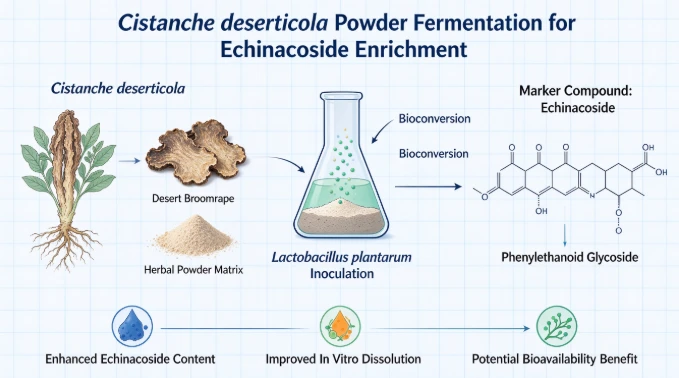
Microbial fermentation, especially lactic‑acid‑bacteria‑assisted bioprocessing, attracts extensive attention in modern herbal processing research over recent years. Probiotic fermentation can secrete complex extracellular enzyme cocktails including cellulase, hemicellulase and pectinase, which partially degrade plant cell‑wall polymeric components. Such biological degradation releases phytochemicals originally bound within cell‑wall networks. Meanwhile, microbial metabolic activities can transform macromolecular precursors, modify powder surface morphology, porosity and particle‑surface physicochemical characteristics, all of which further influence dissolution and release patterns of herbal functional ingredients. Numerous published papers have proven that lactic‑acid‑bacteria fermentation can increase total phenolic, flavonoid or glycoside content of different herbal substrates, ameliorate compound solubility, and even reduce anti‑nutritional factors or mild toxic components in plant matrices.
For Cistanche deserticola material, most existing studies still focus on extraction‑process optimization, component identification, or biological‑activity evaluation of crude extracts. Systematical exploration on directional microbial fermentation of Cistanche deserticola powder is still insufficient. It remains unclear how key fermentation parameters influence enrichment efficiency of signature marker compound echinacoside, and whether fermentative modification could improve its in‑vitro dissolution performance which closely correlates with potential oral bioavailability.
Echinacoside was selected as core target marker compound in our present work, for the reason that it is the most representative phenylethanoid glycoside constituent responsible for multiple health benefits of Cistanche deserticola. Three major research objectives were defined in this paper: first, to screen high‑efficiency microbial strains capable of enriching echinacoside in Cistanche deserticola powder matrix; second, to systematically optimize critical technological variables (inoculation volume, solid‑liquid ratio, fermentation duration, under fixed incubation temperature of 37 °C), and build stable, repeatable submerged fermentation system; third, to evaluate in‑vitro dissolution profiles of target constituent after fermentation treatment, so as to indirectly verify the potential of fermentation technology for promoting oral bioavailability of fermented Cistanche deserticola powder. Experimental outputs from this project are expected to supply innovative technical routes and fundamental laboratory evidence for developing high‑efficacy commercial powder‑form dietary‑supplement products manufactured from Cistanche deserticola.
2. Materials and Methods
2.1 Raw plant material, microbial strains and chemical reagents
Dried herbal slices of Cistanche deserticola were obtained from Shandong Hongjie Chinese Herbal Pieces Co., Ltd., batch number C397233281. The herbal slices were further pulverized into fine powder before fermentation experiments. The test strain Lactobacillus plantarum was previously isolated and preserved in the laboratory of College of Biological Science and Technology, University of Jinan. De‑Man‑Rogosa‑Sharpe (MRS) bacterial culture medium was purchased from AoBoxing Biotechnology Co., Ltd., Beijing, China. Echinacoside reference standard (HPLC purity ≥ 98 %) was sourced from Yuanye Bio‑Technology Co., Ltd., Shanghai, China. Chromatographic‑grade acetonitrile, analytical‑grade phosphoric acid and other inorganic chemical agents were supplied by Sinopharm Chemical Reagent Group Co., Ltd. Ultra‑pure water produced by laboratory water‑purification instrument was adopted for all solution preparation operations.
2.2 Bacterial activation and preparation of Lactobacillus plantarum suspension
Single bacterial colony of preserved Lactobacillus plantarum was picked from solid MRS agar plate and inoculated into sterile liquid MRS medium. Liquid bacterial culture was incubated in thermostatic shaking incubator under 37 °C, shaking speed 160 r/min for 24 h. After cultivation, bacterial suspension cell density reached approximately \(10^{8}\) CFU/mL (colony‑forming units per milliliter). The prepared bacterial suspension was temporarily stored under 4 °C refrigerator condition for subsequent fermentation inoculation work.
2.3 Establishment of submerged fermentation system for Cistanche deserticola powder
80 g of Cistanche deserticola powder raw material was weighed and transferred into one‑liter Erlenmeyer flask, mixed with purified water following mass‑to‑volume ratio of 1 : 5 (g/mL). The mixed slurry was sterilized under high‑pressure steam condition at 121 °C for 25 min. After autoclave sterilization, fermentation substrates were cooled down to ambient temperature. 6 mL pre‑prepared Lactobacillus plantarum bacterial suspension was added into experimental fermentation group; blank control group received equivalent volume of sterile deionized water instead of bacterial inoculum. Fermentation incubation proceeded under stable 37 °C environment. Sample aliquots were collected at day 3, day 4, day 5 and day 6 throughout fermentation progress. Harvested fermentation liquid samples were centrifuged at 12 000 r/min for 10 min, and supernatant fractions were collected and preserved for later HPLC quantitative determination of echinacoside concentration.
2.4 High‑performance liquid‑chromatography (HPLC) quantification of echinacoside
Agilent 1260 high‑performance liquid‑chromatography system (Agilent Technologies, Waldbronn, Germany) equipped with YMC‑Pack ODS‑A chromatographic column (5 μm particle size, column dimension 4.6 mm × 100 mm) was used for quantitative analysis of echinacoside. Mobile‑phase system consisted of solvent A: 0.2 % aqueous phosphoric‑acid solution; solvent B: chromatographic‑grade acetonitrile. Mobile‑phase gradient elution procedure was set as below: 0 min‑15 min: maintain 95 % mobile‑phase A; 15 min‑28 min: linear gradient shift from 95 % A down to 85 % A; 28 min‑45 min: linear gradient shift from 85 % A down to 80 % A; 45 min‑45.01 min: linear gradient shift from 80 % A down to 77 % A; 45.01 min‑55 min: linear gradient shift from 77 % A back to 95 % A.
Mobile‑phase flow velocity was controlled at 1.0 mL/min; column oven temperature was stabilized at 30 °C; detection ultraviolet wavelength was fixed at 280 nm; sample injection volume for each run was 30 μL. External‑standard calibration curve method was applied for calculating echinacoside concentration in fermentation supernatant samples.

2.5 Single‑factor experimental optimization of fermentation parameters
Single‑factor variable‑alternation experimental design was implemented, with echinacoside content measured from fermentation supernatant selected as primary response indicator. All fermentation incubations kept constant temperature condition at 37 °C.
Inoculation‑volume gradient test: solid‑liquid ratio was fixed as 1 : 5 (g/mL), fermentation incubation duration fixed at 4 days. Inoculation volume gradient was set: 1 mL, 3 mL, 5 mL, 7 mL, 9 mL of prepared \(10^{8}\) CFU/mL bacterial suspension, to evaluate inoculation‑volume influence on target compound accumulation.
Solid‑liquid ratio gradient test: inoculation volume was fixed as 3 mL, fermentation duration fixed as 4 days. Solid‑liquid ratio gradients included 1 : 3, 1 : 5, 1 : 8, 1 : 10, 1 : 12 (g/mL), for investigating substrate‑water proportion effects.
Fermentation‑time gradient test: inoculation volume fixed as 3 mL, optimal solid‑liquid ratio 1 : 5 (g/mL) obtained from previous tests was adopted. Fermentation time gradient covered 2 d, 3 d, 4 d, 5 d, 6 d for exploring dynamic accumulation trend of echinacoside alongside incubation time extension.
After finishing each fermentation trial, samples were centrifuged, supernatant liquid was collected and subjected to HPLC quantitative measurement of echinacoside concentration. Each experimental treatment was performed in biological triplicate.
2.6 In‑vitro dissolution assessment
Under screened optimal fermentation technological parameters, fermented Cistanche deserticola powder sample was prepared. Unfermented raw herbal powder served as negative‑control sample. In‑vitro dissolution test was carried out to compare dissolution rate and cumulative dissolution degree of echinacoside between fermented product and original raw powder material. Dissolution medium sampling time points were arranged to record dynamic release behaviour of marker compound. HPLC analysis was adopted to determine echinacoside concentration in dissolution medium at each time‑point, for calculating dissolution rate and cumulative dissolution percentage.
2.7 Statistical analysis
Experimental datasets were processed using SPSS 22.0 statistical software. One‑way analysis of variance (ANOVA) was conducted for significance comparison among different experimental groups. P < 0.05 was defined as statistically significant difference, and P < 0.01 represented extremely significant difference condition. Origin 2018 software was used for plotting experimental trend graphs. All numerical data were presented as mean value ± standard deviation.
3. Results
3.1 Preliminary fermentation comparison between experimental group and blank control group
Preliminary submerged fermentation trial results demonstrated that the experimental group inoculated with Lactobacillus plantarum achieved remarkably higher echinacoside concentration compared with non‑inoculated blank‑control group throughout sampling time‑points. Echinacoside content of bacterial‑fermented sample reached prominent statistical difference versus blank control starting from the second day of incubation (P < 0.05). The blank control group only exhibited slight spontaneous fluctuation of echinacoside concentration, without obvious enrichment phenomenon, which verified that metabolic activity of inoculated Lactobacillus plantarum contributed to directional enrichment of echinacoside inside Cistanche deserticola powder fermentation matrix.
3.2 Influence of inoculation volume on echinacoside accumulation
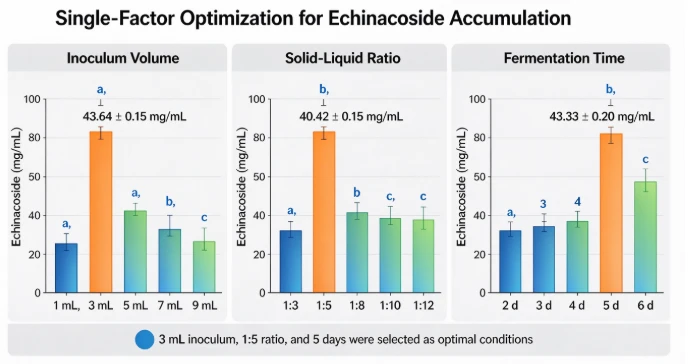
Within inoculation‑volume single‑factor experiment, echinacoside concentration rose rapidly when inoculation volume increased from 1 mL to 3 mL, reaching peak value of \(43.64\pm0.15\) mg/mL under 3 mL inoculation dosage. When inoculation volume kept increasing above 3 mL, detected echinacoside concentration displayed gradual descending tendency. Excessively high inoculation dosage would cause fierce competition for limited nutrition resources within fermentation system, disturbing metabolic balance and restraining target‑component enrichment efficiency. Therefore, 3 mL inoculation volume (bacterial density about \(10^{8}\) CFU per gram substrate matrix) was selected as optimal inoculation‑volume parameter for subsequent experiments.
3.3 Influence of solid‑liquid ratio on echinacoside accumulation
Solid‑liquid ratio single‑factor test indicated that echinacoside content arrived at maximum value \(40.42\pm0.15\) mg/mL at solid‑liquid ratio of 1 : 5 (g/mL). If solid‑liquid ratio was too high (insufficient liquid medium), substrate slurry exhibited overly high viscosity, which hampered mass transfer, bacterial proliferation and substance‑transformation reactions. When liquid proportion became excessively large (low solid‑liquid ratio), substrate nutrient concentration was overly diluted, which also reduced final enrichment level of echinacoside. Hence solid‑liquid ratio 1 : 5 (g/mL) was confirmed as the most suitable substrate‑water proportion condition.
3.4 Influence of fermentation incubation time on echinacoside accumulation
Based on above‑determined inoculation‑volume and solid‑liquid‑ratio parameters, dynamic change of echinacoside concentration over fermentation time was monitored. Echinacoside content continuously ascended and achieved maximum value \(43.33\pm0.20\) mg/mL at the 5th day of fermentation incubation. After reaching 6‑day incubation time point, measurable echinacoside concentration declined moderately, which was attributed to partial degradation of glycoside compounds caused by prolonged microbial metabolic action. Consequently, optimal fermentation incubation duration was determined as 5 days under 37 °C temperature.
Synthesizing all single‑factor optimization outputs, the comprehensive optimal submerged fermentation technological condition for Cistanche deserticola powder was summarized: inoculation volume 3 mL (approximately \(10^{8}\) CFU/g substrate), solid‑liquid ratio 1 : 5 (g/mL), constant incubation temperature at 37 °C, fermentation duration of 5 days.
3.5 In‑vitro dissolution experimental evaluation
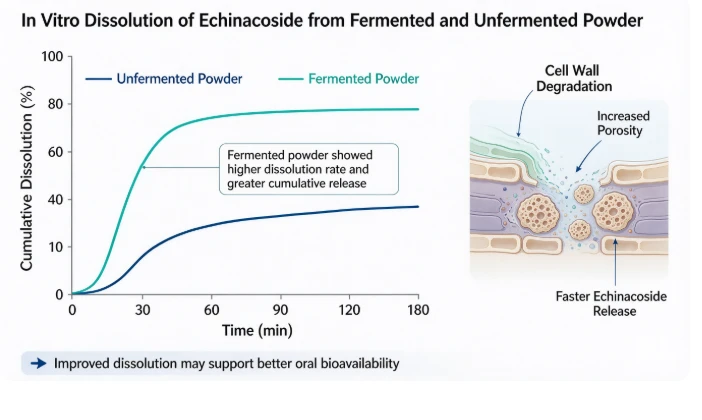
Under above‑mentioned optimal fermentation workflow, fermented Cistanche deserticola powder sample was produced for in‑vitro dissolution evaluation. Compared with unfermented raw herbal powder, fermented powder sample exhibited distinctly higher dissolution rate and higher cumulative dissolution extent for marker compound echinacoside. This observation suggested that probiotic fermentation treatment modified physicochemical properties of herbal powder matrix, and improved dissolution‑release performance of key bio‑active constituent echinacoside, implying its potential for enhancing oral bioavailability.
4. Discussion
In the present work, Lactobacillus plantarum was verified as an effective fermentation strain for directional enrichment of echinacoside within Cistanche deserticola powder substrate. According to previous published literature, lactic‑acid‑bacteria fermentation can secrete multiple hydrolytic enzymes to degrade rigid plant cell‑wall structural polymers such as cellulose and pectin, which releases phytochemical ingredients trapped inside cell‑wall networks. On the other hand, microbial metabolic transformation may convert precursor substances into target phenylethanoid glycoside products, jointly contributing to elevated echinacoside concentration in fermented supernatantPMC.
Inoculation dosage, solid‑liquid substrate‑water ratio and fermentation incubation time all exerted prominent influences on final enrichment efficiency of echinacoside. Too‑low inoculation volume leads to insufficient viable‑bacterial population, resulting in inadequate bioconversion capacity. Excessively high inoculation amount triggers fierce intra‑species nutrient competition inside fermentation system, and massive metabolic‑by‑product accumulation may accelerate partial decomposition of echinacoside glycoside molecules. Solid‑liquid ratio directly regulates system viscosity, mass‑transfer efficiency and nutrient‑concentration status. Over‑long fermentation incubation will cause secondary degradation of target glycoside compound, which explains echinacoside concentration drop after five‑day incubation in our time‑gradient experiment. Therefore, precise control over these three key process parameters is indispensable for acquiring stable high‑echinacoside fermented Cistanche deserticola powder products.
Our in‑vitro dissolution testing results demonstrated that fermented powder displayed superior dissolution‑release behaviour of echinacoside versus original unfermented raw powder. Such improvement could originate from multiple reasons: cell‑wall partial degradation induced by microbial enzymes changes powder micro‑morphology, increases particle surface porosity and specific surface area, and reduces physical barrier for ingredient dissolution. Meanwhile, microbial metabolic processes may alter powder surface chemical characteristics, which further promotes aqueous‑phase dissolution of phenylethanoid glycoside molecules. It should be emphasized that in‑vitro dissolution experiment only provides indirect evidence for bioavailability enhancement. Real in‑vivo oral bioavailability still requires further animal pharmacokinetic tests or human intervention research for solid validation.
There remain several limitations for our current investigation. This project adopted single‑factor optimization rather than response‑surface multi‑factor interaction analysis, and interactive effects between different fermentation variables have not been quantitatively assessed. Besides, we mainly focused on quantitative change of marker compound echinacoside; comprehensive metabolomics profiling for whole fermented‑powder metabolic‑profile shift was not performed in this study. Further research could adopt LC‑MS untargeted metabolomics technology to systematically reveal full‑scale metabolite variation after Lactobacillus plantarum fermentation of Cistanche deserticola powder. In addition, follow‑up work needs to carry out animal pharmacokinetic experiments to calculate actual oral bioavailability parameters of fermented Cistanche deserticola powder, and conduct pharmacological‑effect verification experiments such as antioxidant, anti‑fatigue or neuro‑protective activity evaluation.
From industrial‑application perspective, this optimized submerged fermentation process provides a feasible technical pathway for upgrading Cistanche deserticola‑related functional‑food raw‑material products. For commercial manufacturing, subsequent technical exploration needs to focus on scaling‑up verification of fermentation workflow, exploring suitable post‑fermentation drying technology (vacuum freeze‑drying or spray‑drying), evaluating storage stability of fermented finished powder products, so as to support large‑scale industrial production.
5. Conclusions
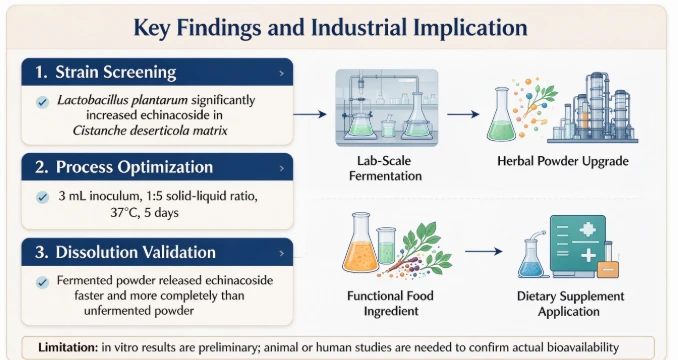
Strain‑screening experiment proved that Lactobacillus plantarum can effectively promote directional enrichment of key bio‑active marker echinacoside inside Cistanche deserticola powder fermentation matrix.
Through single‑factor variable‑alternation optimization experiment, stable submerged fermentation parameters were determined for Cistanche deserticola powder: inoculation volume 3 mL (bacterial density \(10^{8}\) CFU/g substrate), solid‑liquid ratio 1 : 5 (g/mL), incubation temperature 37 °C, fermentation time 5 days. Under these optimized conditions, echinacoside content achieved significant elevation (P < 0.01).
In‑vitro dissolution assessment indicated fermented powder sample possessed faster dissolution rate and higher cumulative dissolution degree of echinacoside compared with unfermented raw material, showing promising potential for improving oral bioavailability of Cistanche deserticola bio‑active constituents.
This study establishes a stable probiotic fermentation technology for Cistanche deserticola powder, offers new technical solution for overcoming low‑bioavailability bottleneck of raw Cistanche deserticola herbal powder, and delivers laboratory‑scale experimental foundation for developing high‑value functional‑food and dietary‑supplement products derived from Cistanche deserticola.
Acknowledgements
This research work was financially supported by Shandong Provincial Technology Innovation Guidance Project (Grant No. YDZX2024111); Key Research and Development Program of Shandong Province (Grant No. 2023TSGC041, 2023TSGC053).
Conflicts of Interest
The authors declare no conflict of interest.
References
[1] Chinese Pharmacopoeia Commission. Pharmacopoeia of the People's Republic of China (Volume I)[M]. Beijing: China Medical Science Press; 2020.
[2] Wang Y. Efficacy and mechanism research of echinacoside for spermatogenic dysfunction in rats[D]. Yanji: Yanbian University; 2020.
[3] Gulinuer Mutelifu, et al. Anti‑aging mechanism research of echinacoside[J]. Chinese Journal of Emergency in Traditional Chinese Medicine, 2020, 20(3):140‑143.
[4] Zhang N, Chen Z, Hui C, et al. Neuroprotective effects of echinacoside against MPTP‑induced neuro‑damage in mice[J]. Neuropsychiatric Disease and Treatment, 2021, 17:1779‑1792.
[5] Chen H, Wang YL. Neuro‑protective mechanism of echinacoside for spinal‑cord‑injured rats via PI3K‑Akt‑eNOS signaling pathway[J]. Chinese Journal of Modern Applied Pharmacy, 2021, 28(10): 1721‑1725.
[6] Li G, Wan B, Han L, et al. Echinacoside alleviated LPS‑induced intestinal epithelium inflammation and cell apoptosis in rat model[J]. Biomedicine & Pharmacotherapy, 2021,140:111622.
[7] Li W, Zhou J, Zhang Y, et al. Echinacoside exerts anti‑tumor activity in liver cancer cells through inhibiting mTOR/STAT3 pathway[J]. International Journal of Molecular Sciences, 2021, 22(1): 304.
[8] Wang Y, Wang F, Ma L C. Chemical constituent analysis of traditional herbal medicine before and after microbial fermentation based on LC‑MS/MS[J]. Molecules, 2022,28(1).
[9] Cao G, Xu J, et al. Microbial community succession and alkaloid substance transformation during herb fermentation by Lactobacillus plantarum[J]. Letters in Applied Microbiology, 2020,70(4):318‑325.
[10] Okamoto T, Sugimoto M, Noda S, et al. Interleukin‑8 release inhibitors generated in Artemisia princeps pampanini extract fermented with Lactobacillus plantarum SN13T[J]. Frontiers in Microbiology, 2020.