Part 1 RNA-Seq PART 1 Based De Novo Transcriptome Assembly And Gene Discovery Of Cistanche Deserticola Fleshy Stem
Mar 02, 2022
For more information please contact: Joanna.jia@wecistanche.com
Abstract
Backgrounds
Cistanche deserticola is a completely non-photosynthetic parasitic plant with great medicinal value and is mainly distributed in the desert of Northwest China. Its dried fleshy stem is a crucial tonic in traditional Chinese medicine with the role of mainly improving male sexual function and strengthening immunity, but few mechanistic studies have been conducted partly due to the lack of genomic and transcriptomic resources.

Cistanche deserticola has many effects, click here to know more
Results
In this study, we performed deep transcriptome sequencing in the fleshy stem of C. deserticola, and about 80 million reads were generated using Illumina pair-end sequencing on the HiSeq2000 platform. Using trinity assembler, we obtained 95,787 transcript sequences with transcript lengths ranging from 200bp to 15,698bp, having an average length of 950 bases and the N50 length of 1,519 bases. 63,957 transcripts were identified actively expressed with FPKM ≤ 0.5, in which 30,098 transcripts were annotated with gene descriptions or gene ontology terms by sequence similarity analyses against several public databases (Uniprot, NR, and Nt at NCBI, and KEGG). Furthermore, we identified key enzyme genes involved in the biosynthesis of lignin and phenylethanoid glycosides (PhGs) which are known to be the primary active ingredients. Four phenylalanine ammonia-lyase (PAL) genes, the first key enzyme in lignin and PhG biosynthesis, were identified based on sequences comparison and phylogenetic analysis. Two biosynthesis pathways of PhGs were also proposed for the first time.
Conclusions
In all, we completed a global analysis of the C. deserticola fleshy stem transcriptome using RNA-seq technology. A collection of enzyme genes related to the biosynthesis of lignin and phenylethanoid glycosides were identified from the assembled and annotated transcripts, and the gene family of PAL was also predicted. The sequence data from this study will provide a valuable resource for conducting future phenylethanoid glycosides biosynthesis research and functional genomic studies in this important medicinal plant.
Introduction
C. deserticola is a worldwide genus of perennial desert plants from the Orobanchaceae family, and is a completely non-photosynthetic species and usually grows underground holoparasitic plants [1]. It is parasitized on the roots of psammophyte Haloxylon ammodendron (Chenopo- diaceae) [1, 2], which mainly inhabits deserts and semi-deserts due to its high tolerance to drought and salinity [1, 3]. C. deserticola shows strong resistance to harsh environmental conditions and is mainly distributed in Northwest China [4–6], especially in Inner Mongolia, Gansu, and Xinjiang. It is considered to be an endangered wild species in recent years due to increased consumption by humans [5, 6]. C. deserticola which is often called desert ginseng is commonly known as desert-broomrape and the dried fleshy stem has been extensively used as a traditionally important tonic in China and Japan for many years [4, 7–10]. It was initially re- corded in Shen Nong Ben Cao Jing (Dictionary of Chinese Materia Medica, 1977) [11] approximately 1800 years ago and was regarded as one of the main sources of the Chinese medicinal herba Cistanche.
The extracts of C. deserticola possess a wide range of medicinal functions, especially for use in improving sexual function, tonifying the kidney, protecting the liver, aperient activity, enhancing memory, immunomodulatory, antioxidative activity, anti-inflammatory, antiviral activity, etc [7–10, 12–15]. The major bioactive components of C. deserticola are Phenylethanoid glycosides (PheGs, PhGs) [2, 9, 10, 14, 15]. To date, more than 20 phenylethanoid glycosides have been isolated from the succulent stem of C.deserticola [9, 14, 16]. Among them, acteoside and echinacoside are two main components with significant pharmacological activities [2, 16], and documented as the quality standards of C. deserticola in the Chinese pharmacopeia (2005 and 2010 editions). Three chemical components of PhGs are organic acid, saccharide, and phenylethanoid, however, the details concerning phenylethanoid biosynthetic pathways remain poorly understood in C.deserticola.
Despite the commercial and medicinal importance of C.deserticola, the genomic and transcriptomic data of this species are very limited. There are no ESTs available in the NCBI database and the complete genome information for this species remains unavailable except for the chloroplast genome sequence [1]. The limited transcriptomic data hinder the study of PhG biosynthetic mechanisms. RNA-seq technology can generate sequences of the expressed parts of the targeted genome [17] and identify genes [18] using the NGS technology platforms (such as Applied Biosystems SOLiD, Illumina HiSeq, and Roche 454). It is becoming increasingly popular in transcriptome de novo assembly [19–22], since it is a cost-effective and powerful approach with high resolution and broad dynamic range [23–25], especially since it has the advantage to explore low abundance transcripts [26]. Because of the various advantages, RNA-seq is specifically attractive for non-model organisms with limited genetic resources [27–29]. But there is no detailed research of C. deserticola transcriptome by RNA-seq.
In this study, we globally sequenced the stem transcriptome for C. deserticola using the Illumina Hiseq2000 platform and got 7.9G raw data. By assembly and annotation, we mined the genes involved in the biosynthesis of PhG and the genes responsible for entire lignin biosynthesis.
Our RNA-seq analysis generated the first C. deserticola consensus transcriptome and provided new insights into a comprehensive understanding of the medicinal value of C. deserticola. Additional- ly, the method described here can be widely applied to profile transcriptomes to facilitate the discovery of genes involved in specific medicinal components biosynthesis pathways in another medicinal plant with very limited genomic resources.

Cistanche has many functions
Materials and Methods
Plant material collection
The fresh succulent stem for C. deserticola in the excavation stage was collected from a plant base in BayanHot City of Alexa League in Inner Mongolia in northwestern China. The collecting permit was obtained from the owner (HongKui CongRong Group) of the plant base. The voucher specimen was deposited in the Core Genomic Facility at Beijing Institute of Genomics, Chinese Academy of Sciences. After cleaning, the succulent stem tissues were cut into small pieces and immediately frozen in liquid nitrogen, and then stored at -80°C until further processing.
RNA extraction, cDNA library construction, and Illumina sequencing
Total RNA was extracted from the succulent stem using TRIzol Reagent (Invitrogen Inc., California, USA) according to the manufacturer’s instruction. The resulting samples were treated with DNase I to remove any genomic DNA. Extracted RNAs were quantified using an Agilent 2100 bioanalyzer (Agilent Technologies) and checked for integrity using denaturing agarose gel electrophoresis with ethidium bromide staining. RNA samples with A260/A280 ratios between 1.9 and 2.1, RNA 28S:18S ratios higher than 1.0, and RNA integrity numbers (RINs) ≤ 8.5 were used in subsequent analyses.
The RNA-seq libraries were generated using Illumina Truseq RNA Sample Preparation Kits. Poly(A)+ RNA was isolated from total RNA using Dynal oligo(dT)25 beads according to the manufacturer’s instructions. Following purification, fragmentation buffer was added to break the mRNA into short fragments. First-strand cDNA was synthesized using these short fragments as templates, along with SuperScript III reverse transcriptase and N6 random hexamer primer. Second-strand cDNA was then synthesized using buffer, dNTPs, RNaseH, and DNA polymerase I. The resulting double-stranded cDNA was subjected to end-repair using T4 DNA polymerase, DNA polymerase I Klenow fragment, and T4 polynucleotide kinase, and ligated to adapters using T4 DNA ligase. Adaptor-ligated fragments were purified using a Quick PCR extraction kit and eluted with EB buffer. After analysis using agarose gel electrophoresis, suitable fragments were selected as templates for PCR amplification. Sequencing of the resulting cDNA library was carried out with an Illumina HiSeq 2000 system.
Transcripts de novo assembly and gene expression quantification
Raw reads generated from sequencing were cleaned by removing the adaptor sequences (ATCTCGTATGCCGTC) using the in-house method. We then carried out a stringent low-quality filtering process. Firstly, bases with Phred quality score lower than 20 would be trimmed from the 3’end of the sequence, until running into one base with a higher quality (≤20). If the length of the read was short than 50bp, it would be discarded. Secondly, reads will be further filtered by the criterion that 70% bases in one read have high-quality scores (≤20). Thirdly, only paired-end reads were used for further assembly. De novo transcript assembly was conducted using Trinity release_20130216 [30] which consisted of three successive software modules: Inchworm, Chrysalis, and Butterfly. The assembly parameters were set as below:—seqType fq—JM 300G —min_contig_length 200—CPU 20—inchworm_cpu 20—bflyCPU 20.
To quantify transcript abundance, the sequenced pair-end reads were re-aligned to the assembled transcripts using a script in Trinity [31]. Mapped reads were used for quantification by RSEM (RNA-Seq by Expectation Maximization) software [32]. Gene or isoform abundance was represented by the fragment per kilobase of transcript per million fragment mapped (FPKM) value, those transcripts with FPKM value equal to or larger than 0.05 were defined as expressed.
Functional annotation of expressed transcripts
For there are no gene annotation sets of C. deserticola except for the chloroplast genome [1]. We annotated the expressed transcripts by comparing to Genbank Nt, Genbank Nr, and TAIR10_ pep_20101214_updated datasets separately using the BLAST program (E< = 1e-20). Meanwhile, all expressed transcripts were translated into potential proteins according to ORF prediction by TransDecoder [30] and predicated for the conserved domains based on the Pfam database [33].

active ingredient acteoside in cistanche
Gene Ontology and KEGG pathway annotation
By sequence similarity alignment to Uniprot database (http://www.uniprot.org/), the Gene Ontology (GO) annotation of all assembled transcripts was obtained by using association file downloaded from (ftp://ftp.ebi.ac.uk/pub/databases/GO/goa/UNIPROT/gene_association. goa_uniprot.gz). GO terms clustering of expressed genes was conducted by using custom scripts, and we annotated genes at the fourth level for the CC, BP, and MF categories separately.
KEGG pathway information was assigned for all predicted proteins sequences using the online tool KAAS (KEGG Automatic Annotation Server) [34]. Sequences in Fasta format were submitted to KAAS request, and the resulting files of all pathways information related to C. deseticola stem transcriptome were downloaded. 13 plant organisms’ gene data sets in KEGG were used for annotation using the BBH (bi-directional best hit) method.
RT-qPCR analysis
After digestion with DNase I, approximately 5μg of total RNA was converted into first-strand cDNA via the reverse-transcription reaction with oligo(dT)15 primers and NoScript Reverse Transcription System (Promega). The cDNA products were then diluted 10-fold with nuclease-free deionized water before use as a template in real-time PCR. Specific cDNAs were amplified by the GoTaq 2-Step RT-qPCR System (Promega) in a volume of 20 ul. PCR amplification was per-formed at the annealing temperature of 60°C with the 7500 Real-Time PCR Detection System (Applied Biosystems) according to the manufacturer’s instructions. Relative transcript abundances were calculated by the comparative cycle threshold method with gene “comp10579_c0” as an internal standard, using the 7500 Manager software.
Primer pairs for RT-PCR were designed based on online software (http://primer3.ut.ee/) and are listed in S1 Dataset.
Results
RNA sequencing and de novo transcriptome assembly of C. deserticola fleshy stem
The stem of C. deserticola has been extensively used as a traditionally important tonic in China and Japan for many years. To obtain a global overview of gene expression in the C. deserticola fleshy stem, we collected C. deserticola stem samples of the same plant base in 2013 and 2014, respectively. Total RNAs were extracted and polyA+ RNAs were purified for constructing paired-end RNA-seq libraries. 79,433,734 and 86,019,176 pair-end reads corresponding to nearly 8 billion and 8.6 billion bases of the sequence were obtained using Illumina HiSeq 2000 sequencing

platform in 2013-year and 2014-year samples (Table 1). After removing adaptor sequences and filtering low-quality reads (see details in Methods), 64,831,040 high-quality pair-end reads in the 2013-year sample were used for de novo transcriptome assembly. Using Trinity sequence assembler [30], 51,719 genes and 95,787 transcript sequences were generated with transcript lengths ranging from 200 bp to 15,698 bp. The average length of assembled transcripts is 950 bases and the N50 length is 1,519 bases. The number of transcripts in different lengths revealed that 57.32% of the assembled transcript were about 500-bp or longer (Fig 1A). High-quality pair-end reads in the 2014-year sample were mapped to the assembled transcriptome. Besides, we found that the transcript number for each assembled gene varied and 69% of genes with one ex- pressed isoform while 31% of genes expressed two or more transcripts (Fig 1B).
Expression quantification and functional annotation of assembled transcripts
Gene or transcript abundance was quantified using the RSEM package, in which the sequenced reads were re-aligned to the assembled genes or transcripts sequences using Bowtie and those mapped reads were used for quantification. FPKM value for each gene or transcript was calculated, and finally, we identified 63,957 and 52,857 actively expressed transcripts (FPKM value ≤ 0.5) in C. deserticola fleshy stem samples in 2013 and 2014, respectively. 44,776 transcripts (70.01% in the 2013-year sample, 84.71% in the 2014-year sample) were commonly expressed in the two replicates, and the correlation (Pearson correlation coefficient: 0.91979) of their expression data was shown in S1 Fig. The sequencing raw data had been uploaded to the NCBI SRA database (accession numbers: SRX857402 and SRX858938). We used expressed genes identified in the 2013-year sample for further analysis. Functional annotation information for all ex- pressed transcripts was obtained using two methods. Firstly, all expressed transcripts were aligned to known nucleotide (GenBank not) and peptide sequence databases (GenBank nr and Arabidopsis peptide) separately by the BLAST algorithm. Out of 63,957 expressed transcripts,

29,220 (45.7%) were annotated and showed homology to sequences in any of the three subject databases with E-value cutoff 1e-20. Meanwhile, the candidate coding regions for all expressed transcript sequences were predicted using TransDecoder software and the longest ORFs for each transcript were used for Pfam domain search. As a result, 21,358 (33.4%) transcripts were annotated based on the Pfam database. Overall, 30,098 (47.1%) transcripts were significantly matched to known genes in the public databases by combining the two methods above. The complete expressed transcripts list with function annotation was shown in supplemental data (S2 Dataset).
We surveyed the top 20 most highly expressed transcripts (Table 2) corresponding to 18.99% of all sequencing reads, and found that most of them are genes responding to abiotic

stress stimuli. Dehydrin (DHNs), a class of hydrophilic and thermostable stress proteins with a high number of charged amino acids that belong to the Group II Late Embryogenesis Abundant (LEA) family, is the most highly expressed gene. Three different Dehyrin transcripts (comp28713_c0_seq1/2/4) were detected highly expressed in the fleshy stem which may be involved in protecting cells from damage caused by drought stress. Other stress-related genes such as heat shock protein, pathogen-related protein, and metallothionein were also found ex- pressed highly, which may be related to its severe survival environment. Additionally, some constitutive genes including 26S ribosomal RNA gene (comp22329_c2_seq1), auxin-repressed/ dormancy-associated protein (comp20999_c0_seq1), ADP-ribosylation factor (comp20499_ c0_seq1) were also highly transcribed.
Functional classification of all expressed transcripts based on Gene Ontology and KEGG databases
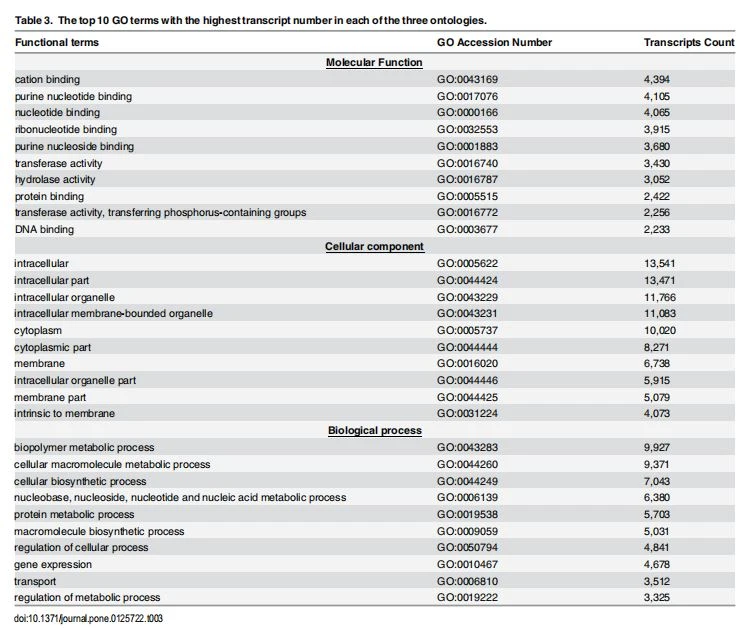
Gene Ontology (GO) annotation was obtained from the Uniprot annotation and identities association file. In total, 20,907 transcripts, accounting for 32.69% of the total expressed sequences, were assigned to 1,745 functional terms. Of the total functional GO terms, assignments to the biological process made up the majority (1,116, 63.95%) followed by cellular component (329, 18.85%) and molecular function (300, 17.20%). The assigned functions of expressed transcripts covered a broad range of GO categories, and the top 10 GO terms with the most annotated transcripts were listed in Table 3. And we provide all expressed transcripts distribution in three Gene Ontology categories (Molecular Function, Cellular Component, and biological process) in the supplemental file (S3 Dataset). GO terms related to binding functions and transferase activity was predominantly represented in the molecular function category. About the binding functions, cation binding (4,394 transcripts) represented the most abundant, followed by nucleo- tide/nucleoside binding (3,404 transcripts on average) and protein binding (2,422 transcripts). While in the transferase activity group, the most are those with transferring phosphorus-containing groups (2,256 transcripts, 65.77%). Among the cellular component category, transcripts were more located to intracellular (10,581 transcripts on average), while among the biological process category, transcripts were more involved in the biopolymer metabolic process (6,683 transcripts on average), followed by regulation of cellular process (4,841 transcripts), gene expression (4,678 transcripts) and transport (3,512 transcripts).
In order to mine genes involved in the biosynthesis of lignin and PhG, 21,358 non-redundant potential protein sequences were searched against gene sequences of 13 plant organisms in the KEGG database, and they were assigned to 275 KEGG pathways with at least 5 hits. The top 10 pathways with the most aligned sequences were listed in Table 4. Most pathways were involved in primary metabolic processes, such as amino acid or protein metabolism (ko01230, ko04141, and ko04120), carbohydrate metabolism (ko01200 and ko00500), and nucleotide or nucleoside metabolism (ko03018, ko00230, and ko00240). Besides, there are 27 secondary metabolism-related pathways (Fig 2), such as terpenoid backbone biosynthesis, phenylpropanoid biosynthesis, carotenoid biosynthesis, isoquinoline alkaloid biosynthesis, and tropane, piperidine, and pyridine alkaloid biosynthesis. These results provide further indication that active metabolic processes were underway in the C. deserticola stem tissue. All expressed transcripts associated with KEGG pathways were listed in the supplemental file (S4 Dataset). Although there are some significantly changed pathways between C. deserticola and other plants, such as rice [35] (S5 Dataset), our main goal in this study aims to reveal the whole transcriptome profile of the C. deserticola stem, and to picture the related pathways of PhGs biosynthesis which could be useful for guiding the cultivation.
Candidate genes encoding enzymes involved in the biosynthesis of lignin
Lignin is the second most abundant natural terrestrial polymer in the plant kingdom, composing up to one-third of the material found in plant cell walls [36, 37]. As an important component of cell walls, lignins help water transport, provide mechanical support and structural integrity, and defend against pathogens and herbivores [38–40]. Those roles of lignin are much valuable to support underground erective growth of C. deserticola in the desert. In this study, we presented the complete picture of lignin biosynthesis pathways in C. deserticola (Fig 3), in which the lignin monomers are biosynthesized from phenylalanine through a series of enzymatic reactions, including hydroxylation, methylation, reduction, and oxidative polymerization process. Lignin biosynthesis-related enzymes were detected for three mainly synthesized forms in vascular

tissue (p-hydroxyl-phenyl (H), guaiacyl (G) and syringyl (S) lignin) and 5-hydroxyl-guaiacyl lignin which was only identified in COMT (caffeic acid 3-O-methyltransferase, EC 2.1.1.68) deficient (such as knock-down) plants [41, 42].
Phenylalanine ammonia-lyase (PAL, EC 4.3.1.24) is the first key enzyme in the lignin biosynthesis pathway (Fig 3) which transforms phenylalanine into cinnamic acid by non-oxidative deamination [43, 44]. A total of 6,297 PALs reads were sequenced and 7 PAL transcripts were assembled in C. deserticola (Table 5). By sequence similarities comparison, we found that 4 of them (comp28550_c1_seq1/2/3/5) had more than 95% similarity with the known mRNA sequence of C. deserticola (gi|289595227|gb|ADD12041.1|), while comp28550_c1_seq4 and comp25940_c0_seq1 had 77% and 82% similarities, respectively. ORF prediction revealed 5 transcripts had potentials of encoding proteins and carried with aromatic amino acid lyase domain (PF00221.14). Among them, only the comp28550_c1_seq4 transcript could encode a complete protein sequence of 718 amino acid residues. It has been reported that PAL was encoded by a small multigene family in most plant species, such as 4 in Arabidopsis thaliana [39, 45], 5 in Populus trichocarpa [46, 47], 3 in Scutellaria baicalensis [48], and 7 Cucumis sativus [43, 49], etc. Our phylogenetic analysis suggested that there were 4 PAL encoding genes in C.deserticola and we named them CdPAL1, CdPAL2, CdPAL3, and CdPAL4, respectively (S2 Fig). 4-coumarate-CoA ligase (4CL, EC 6.2.1.12) and trans-cinnamate 4-monooxygenase (CYP73A, EC 1.14.13.11) are two enzymes responsible for transforming cinnamic acid to p- coumaroyl-CoA in two reverse orders. They are also in backbones, and their expression FPKM values are 39.57 and 51.93, respectively.


The four type lignins were biosynthesized by different pathways which were controlled by three key enzymes, cinnamoyl-CoA reductase (CCR, EC 1.2.1.44), shikimate o-hydroxycinnamic- methyltransferase (HCT, EC 2.3.1.133), and ferulate-5-hydroxylase (F5H, EC 1.14.-.-). CCR was reported as a control point of the lignins pathway [50, 51] which catalyzed X-CoA (X including p- coumaroyl, caffeoyl, feruloyl, 5-hydroxyl-feruloyl, and sinapoyl) into Y-aldehyde (Y including p-coumar, caffeoyl, coniferyl, 5-hydroxyl-coniferyl, and sinap), while HCT catalyzed p-coumar-oyl-CoA to p-coumaroyl shikimic acid/p-coumaroyl quinic acid. The two enzymes, just like a switch, regulated the biosynthesis of P-hydroxyl-phenyl lignins or the other three types of lignins.
F5H was another branch switch that regulated syringyl lignin and 5-hydroxyl-guaiacyl lignin. Other important enzymes include caffeic acid 3-O-methyltransferase (COMT, EC 2.1.1.68), caffeoyl-CoA O-methyltransferase (CCoAOMT, EC 2.1.1.104), and cinnamyl-alcohol dehydrogenase (CAD, EC 1.1.1.195) were also detected expressed. Detailed expression information was listed in Table 6. These enzyme genes identified in this study will provide a valuable resource for functional genomic studies in this important medicinal plant. 10 genes related to the lignins biosynthesis pathway in Table 6 were selected for RT-qPCR verification to confirm our RNA- seq results (Fig 4), and their high correlations (Pearson correlation coefficient: 0.90343) indicated high accuracy and reproducibility of our transcriptome analysis. S1 Dataset lists the primer sequences used in this analysis.

Cistanche has many effects
Candidate genes encoding enzymes involved in the biosynthesis of PhGs
Phenylethanoid glycosides (PhGs) are known to be the primary active ingredients in C. deserticola with activities of improving sexual potency, scavenging free radical, and anti-aging [7–10]. Three chemical components of PhGs are organic acid, saccharide, and phenyl ethanol aglycon (Fig 3). The organic acid including caffeic acid, ferulic acid, and coumaric acid are products of the phenylpropanoid biosynthesis pathway. The components of saccharides including glucose and rhamnose are products of carbohydrate metabolism pathways, such as starch and sucrose metabolism, amino sugar and nucleotide sugar metabolism, fructose and mannose metabolism, etc. However, the biosynthesis pathway of phenylethanol part is not clear yet. Here, we pro- posed two possible phenylethanol biosynthesis pathways based on our sequence data. One is the reported caffeic acid or ferulic acid pathway, also known as the cinnamic acid pathway which is similar to the lignin biosynthesis backbone pathway. Another is based on the phenylalanine metabolism pathway (Fig 3), in which the phenylalanine to phenylethanol was achieved by a known ‘Enrlich pathway’ that was first found in yeast one century ago and validated in petunia flowers [52, 53], tomato [54], and rose [55, 56]. Four enzyme genes encode aspartate/tyrosine aminotransferase, histidinolphosphate aminotransferase, and primary-amine oxidase which are responsible for the conversion of phenylalanine to phenylethanol were detected expressed in the stem of C. deserticola. The product of phenylethanol may be further oxidized by monooxygenase or methylated by methyltransferase into its derivates (phenylethanol aglycon) which took part in PhG biosynthesis. In summary, two putative biosynthesis pathways of phenylethanol aglycon were proposed for C. deserticola but still need more study in further.