Echinacoside from cistanche tubulosa effectively treat osteoporosis
Mar 08, 2022
Contact: Audrey Hu Whatsapp/hp: 0086 13880143964 Email: audrey.hu@wecistanche.com
Part Ⅰ: Efficacy And Safety Of Echinacoside in A Rat Osteopenia Model
Xiaolin Yang, 1 Fei Li, 2 Yanan Yang, 3 Jinyang Shen, 2 Run Zou, 2 Panpan Zhu, 2 Chunfeng Zhang, 2 Zhonglin Yang, 2 and Ping Li
This study aimed to investigate the efficacy and safety of Echinacoside (ECH) using an osteopenia rat model. Forty-eight 6-month-old female Sprague-Dawley rats were randomly divided into one sham-operated group (SHAM) and five OVX (ovariectomized) subgroups: SHAM with vehicle 0.5% carboxymethylcellulose sodium (0.5% CMC-Na) and OVX with vehicle (OVX), OVX with 17 estradiol (E2), and OVX with ECH (echinacoside) of graded doses (ECH (echinacoside) ECH-L, ECH -M, and ECH-H). The effects of ECH (echinacoside) and E2 on serum biochemical parameters, bone mineral density (BMD), bone biomechanical properties, bone microarchitecture, and immunohistochemistry were examined, and safety assessments were also evaluated. The results showed that ECH (echinacoside) treatments improved total femur BMD, bone microarchitecture, and biomechanical properties and decreased serum marker levels in comparison to the OVX group. Moreover, ECH (echinacoside) administration significantly increased osteoprotegerin (OPG) level, and decreased receptor activator of nuclear factor ligand (RANKL) level in serum, as well as in proximal femur. Importantly, ECH (echinacoside) treatment ameliorated the lipid parameters without the overall incidences of adverse events of the uterus and mammary gland compared to OVX and SHAM groups. This study demonstrated that administration of ECH (echinacoside) for 12 weeks can effectively and safely prevent OVX induced osteoporosis in rats via increasing the OPG/RANKL ratio.

cistanche echinacoside can treat Osteoporosis
1. Introduction
Osteoporosis is one kind of skeleton metabolic disorder characterized by reduction of bone mass and microarchitectural deterioration of bone tissue, which may result in skeletal fragility and fractures. It has already become one of the leading threats for the health of the aging population [1, 2], evidenced by an estimated prevalence of 200 million people worldwide, and the annual attendant costs, for this disease, have exceeded approximately 10 billion dollars [3, 4]. Estrogen depletion disrupts bone homeostasis, altering the differentiation and activity of osteoblasts and osteoclasts and therefore played a very important role in the initiation and development of osteoporosis and it has been shown to be a major risk factor for the development of postmenopausal osteoporosis in women [5, 6]. Estradiol esters and conjugated estrogens have strong suppressive effects on osteoporotic activities in the bone [7]. Currently, administration of bis- phosphonates and estrogen replacement therapy (ERT) are two main forms of treatment and prevention of osteoporosis and even reduce the incidence of fracture in postmenopausal osteoporosis women [8, 9]. However, bisphosphonates lead to atraumatic fracture of bone as a consequence of an adynamic state similar to that described in patients on chronic maintenance hemodialysis [10], and long-term estrogen treatments are accompanied by undesired side effects, especially the higher incidence of coronary heart disease, invasive breast cancer, stroke, pulmonary embolism, endometrial cancer, colorectal cancer, and hip fracture [11]. Thus, new effective and safe treatment strategies for osteoporosis are highly needed.
The Cistanche tubulosa (Schrenk) R. Wight (Orobanchaceae parasitic plant) is widely distributed in North Africa and Asian countries, and the stems of C. tubulosa are commonly used to treat kidney deficiency and neurodegenerative diseases as a promoting agent [12]. ECH (echinacoside) (Figure 1) is one of the major constituents of a famous traditional Chinese medicine Herba Cistanches (the stems of Cistanche deserticola, Cistanche salsa, or Cistanche tubulosa) [13]. Research demonstrated that ECH (echinacoside), as a natural polyphenolic compound, has various kinds of pharmacological activities, such as antioxidative, anti-inflammatory, neuroprotective, hepatoprotective, nitric oxide radical-scavenging [14], and vasodilative ones [15]. Currently, there are no reports available on the therapeutic effects of ECH (echinacoside) and its rescuing ECH (echinacoside) on osteoporosis in OVX rat models.

Figure 1: Chemical structure of echinacoside from cistanche tubulosa
Our previous study showed that ECH (echinacoside) can stimulate bone regeneration through increasing OPG/RANKL ratio in MC3T3-E1 cells [16]. This suggests that ECH (echinacoside) warrants further investigation. To further investigate this, we conducted experiments in an OVX rat model [17], a standard model for the investigation of morphological and ECH (echinacoside) changes after different treatments for osteoporosis. In this report, we assessed the effects of 12 weeks of ECH (echinacoside) treatments for biochemical parameters in serum, bone quality, bone microarchitecture, and immunohistochemistry, as well as safety indicators including lipid parameters, carcinoembryonic antigen (CEA), and cancer antigen 125 (CA-125) levels in serum and uterus and mammary gland histology in OVX rats. Most importantly, we first reported the effect of ECH (echinacoside) on the OPG/RANKL system by examining serum and bone OPG/RANKL levels.

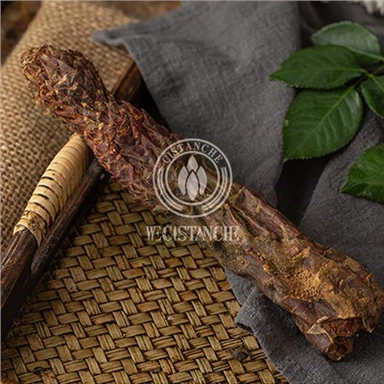
Cistanche tubulosa
2. Materials and Methods
2.1. Plant Materials and Animals.
The fresh stems of the Cistanche tubulosa (Schrenk) R. Wight, harvested in November 2010 in Xinjiang, China, were purchased from the Institute of Ecology and Geography Chinese Academy of Sciences in Xinjiang, China. The materials were identified by Professor Ping Li, School of Traditional Chinese Medicine, China Pharmaceutical University. The voucher specimen (No.02369433) has been deposited in our laboratory at China Pharmaceutical University.
All the materials were dried at room temperature to constant weight. ECH (echinacoside) was separated and purified from an ethanol extract of Cistanche tubulosa (Schenk) R. Wight by our laboratory according to a method reported previously [18] with slight modification, and its structure was confirmed by UV, IR, MS, and NMR spectroscopy. Its purity (98.5%) was determined by Agilent 1260 Series HPLC with DAD detector (Agilent Scientific, Co., USA). 17-estradiol (E2, Sigma; purity ≥ 98%) was used as a positive control.

Echinacoside from Cistanche tubulosa
2.2. Pharmaceutical Treatment.
Rats were randomly divided into six groups (8 rats in each group): sham-operated (SHAM), bilaterally ovariectomized (OVX), OVX and E2 treatment, and three other OVX and different doses of ECH (echinacoside) treatment groups. All rats were anesthetized via intraperitoneal (i.p.) injection of 300 mg/kg chloral hydrate (Sinopharm, China) and then ovariectomized at week 0 and the SHAM group underwent a sham ovariectomy. The surgical procedure was performed under aseptic conditions following the University of China Pharmaceutical University Animal Care protocol. Rats were left untreated for 4 weeks to allow for rats to recover and develop osteopenia. After 4 weeks, rats in the OVX and E2 group received daily intragastric (i.g.) administrations of E2 (50g/kg/day) for 12 weeks; the sham and OVX rats were subjected to daily intragastric administration of 0.5% CMC-Na (Sinopharm, China) as the vehicle. E2 and ECH (echinacoside) were dissolved in a vehicle of 0.5% CMC-Na, and rats in the OVX and ECH (echinacoside) groups received daily i.g. administrations of ECH (echinacoside) (ECH-L, 30 mg/kg/day; ECH-M, 90 mg/kg/day; and ECH-H, 270 mg/kg/day) for 12 weeks, respectively. Bodyweight was measured weekly, and the ECH (echinacoside) dose was adjusted accordingly.
2.3. Animal Euthanasia and Specimen Collection.
At necropsy, blood was collected from the carotid artery under general anesthesia in the early morning. The blood was allowed to clot and centrifuged at 3,000 ×g for 10 min. Serum was harvested and stored at −20∘C until used for biochemical assays. After animal euthanasia, femora were isolated for BMD, Micro-CT, and ECH (echinacoside) and immunohistochemical analysis, and mammary glands and uterus were removed, freed from fat, and fixed in sodium phosphate (PBS) 10% buffered formaldehyde solution (PH 7.4) and then stored at 4∘C until used for histological and immunohistochemical evaluation to assess the safety of ECH (echinacoside)
2.4. Effectiveness Assessment.
2.4.1. Serum Biochemical Analysis.
Alkaline phosphatase (ALP) is known to be associated with bone metabolism and differentiation of osteoblasts and its activity is one of the most common indicators of osteoblast differentiation and osteogenic properties [19]. Thus, the serum ALP level was determined using an ALP activity assay kit (Nanjing Jiancheng Bioengineering Institute; Nanjing, China). Tartrate-resistant acid phosphatase 5b (TRACP-5b), secreted by osteoclasts, correlates with bone resorption activity in abnormal bone metabolism [20]. For markers of bone resorption, TRACP-5b levels were measured with enzyme-linked immunosorbent assay (ELISA) kits (R&D Systems Inc.) in serum. Serum OPG and RANKL were also assayed with ELISA kits (R&D Systems Inc.). All of the measurements of ELISA kits were performed according to the protocols provided by the manufacturers.
2.4.2.Bone Mineral Density Measurement.
Bone mineral density (BMD) of the right total femora was measured by using Discovery W dual-energy X-ray absorptiometry (DEXA, Hologic Inc., Boston MA, USA) equipped with appropriate software (edition 13.1.2) for bone density assessment in small laboratory animals. After scanning, BMD in the right total femora was obtained for statistical analysis. The investigator performing the measurement was unaware of the treatments the rats had received.
2.5. Statistics.
All results are presented as mean ± standard deviation (SD). Statistical differences among the sham control, OVX control, and different treatment groups were analyzed using one-way analysis of variance (ANOVA) followed by a post hoc multiple comparisons using Fisher’s least significant difference (LSD) t-test. All calculations were performed using SPSS Version 15.0 for Windows (SPSS, Chicago, IL, USA). In all analyses, a P-value of <0.05 was considered to be statistically significant.

3. Results
3.1. Effectiveness Assessment
3.1.1. Serum Biochemical Analysis.
Serum ALP levels and bone turnover markers TRACP-5b were assessed at the end of treatment, OVX resulted in a significant increase in serum ALP and TRACP-5b levels compared to sham-operated groups. After Echinacoside or E2 administration, serum ALP and TRACP-5b levels were significantly reduced in all three of the Echinacoside groups or E2 group. In addition, the high dose of Echinacoside had the significantly lowest levels of 25.82% and 38.05% as compared with the OVX group (P< 0.01). All three doses of Echinacoside treatments had a similar effect as E2 in changing bone turnover markers (P< 0.05). At the end of the protocol, assays for serum OPG and RANKL levels were performed. All doses of Echinacoside treatment groups had significantly higher levels of OPG and OPG/RANKL ratios, as well as significantly lower RANKL levels than E2-treated or vehicle-treated OVX groups (Table 1). The highest levels of OPG and OPG/RANKL ratios were observed in the ECH-H (Echinacoside) treatment group, 150.14%, and 197.64%, respectively, as compared to the OVX group (P<0.01). However, no differences in RANKL levels and the OPG/RANKL ratio were observed in the E2 group, as compared with the OVX group.
3.1.2. BMD Assessment.
Results of the total femur BMD by DXA were presented in Table 2. As expected, the total femur BMD was decreased by OVX compared with the SHAM group (P< 0.01). However, All the treated groups significantly increased BMD than the OVX group after 12 weeks of treatment (P< 0.01), but no significant difference was found between treated groups. The three ECH(Echinacoside)-treated groups increased total femur BMD to 109.25%, 115.27%, and 124.53%, respectively, compared to the OVX group. E2 increased the total femur BMD to 113.82% in comparison to the OVX group.
3.1.3. Micro-computed Tomography (Micro-CT).
Micro-CT scanning is a very accurate method of measuring the vertebral architecture because it quantifies the trabecular structure in three dimensions. The quantitative results of the metaphyseal region close to the growth plate of the distal femur from Micro-CT evaluation were expressed as BV/TV, Tb. N, Tb.Sp, Tb.Th, and SMI in Table 2. Trabecular Micro-CT parameters in Table 2 showed that OVX caused significant decreases in BV/TV, Tb. N, and Tb.Th and increases in Tb.Sp and SMI (P< 0.01). Furthermore, the indices BV/TV, Tb. N, and Tb. Thin ECH-H (Echinacoside)groups were significantly higher than those in the OVX group (P< 0.01 for BV/TV, and Tb.Th, P< 0.05 for Tb.N), and ECH-H (Echinacoside)treatment significantly increased values of BV/TV by 169.23%, Tb.N by 157.73%, and Tb. Th by 148.23% compared to the OVX group. In addition, ECH-H also prevented an OVX-induced increase in the levels of Tb.Sp and SMI (P<0.01 for Tb.Sp, P< 0.05 for SMI). The preventive effects of Echinacoside on trabecular bone mass and microarchitecture deterioration are further proved by the 3D Micro-CT images (OVX group presented a notable reduction in the trabecular number and trabecular area when compared with the SHAM group. Echinacoside and E2 partially prevented OVX induced bone loss and significantly improved the trabecular bone mass and microarchitecture.
3.1.4. Three-Point Bending of Femur.
The results of the biomechanical three-point bending experiment are shown in Table 2. Significant decreases in the ultimate load, stiffness, and energy absorption were observed in the OVX group compared with the SHAM group (P< 0.01). Echinacoside treatment improved bone mEchinacosideanical strength, evidenced by increased levels of ultimate load, stiffness, and energy absorption (P<0.01 for ultimate load and energy absorption, P< 0.05 for stiffness); however, no significant difference was observed among the three ECH (Echinacoside)-treated groups. The mEchinacosideanical values of the ECH-H (Echinacoside) treated group was increased by 55.51% for ultimate load, 34.05% for stiffness, and 183.33% for energy absorption compared to the vehicle-treated OVX group (P<0.01). E2 increased ultimate load by 49.51%, stiffness by 28.63%, and energy absorption by 55.56% compared to the OVX group, respectively, but its effect on mEchinacosideanical values was less than the ECH-H (Echinacoside) group.

3.2. Safety Assessment
3.2.1. Serum Analysis.
Effects on the lipid profile are summarized. At week 12, E2 showed increases from baseline in levels of TC and TG. Three doses of ECH (Echinacoside) (ECH-L, ECH-M, and ECH-H) reduced TC and TG levels compared to OVX and SHAM groups. In addition, the ECH-H (Echinacoside) group decreased levels of TG significantly by 30.87% versus OVX (P< 0.05), or by 19.07% versus the SHAM group (P< 0.05). Moreover, the effects of ECH (Echinacoside) -L and ECH (Echinacoside)-M on TG levels were marginal. At the end of the protocol, measurements for serum CEA and CA-125 levels were collected as shown in Table 3. E2 group increased levels of CEA and CA-125 significantly by 54.38% and 59.58% versus OVX (P< 0.01), or by 49.53%, 28.87% versus SHAM group (P< 0.01). All doses of ECH (Echinacoside) administration resulted in a remarkable reduction in the serum CA-125 levels (P< 0.05) compared to the SHAM group, but Echinacoside did not show any significant effect on the serum CEA concentrations versus the SHAM group or OVX group. In addition, the ECH-H (Echinacoside)group decreased levels of CA-125 significantly by 29.31% compared to the OVX group (P<0.05), or by 42.91% versus the SHAM group (P< 0.01). All doses of Echinacoside administration resulted in a notable reduction in the serum CA-125 and CEA levels (P< 0.01) compared to the E2 group. Moreover, the ECH-H (Echinacoside) group decreased levels of CA-125 and CEA significantly by 44.30% and 64.70%, respectively, compared to the E2 group.
3.2.2. Histology and Immunohistochemistry of Uterus and Mammary Gland.
The most common adverse events of uteri and mammary glands were not observed between all the groups but not the E2 group (Table 3). E2 (50g/kg/day) administration for 12 weeks increased endometrium thickness and proliferation of mammary gland as compared to OVX or SHAM group. Furthermore, three mammary glands of CEA expression could also be detected in the E2 group by immunohistochemical analysis, but no uterus. Echinacoside treatment groups were not associated with any abnormity of the uterus and mammary gland.
References
[1]T. Nakamura, T. Matsumoto, T. Sugimoto, and M. Shiraki, “Dose-response study of denosumab on bone mineral density and bone turnover markers in Japanese postmenopausal women with osteoporosis,” Osteoporosis International, vol. 23, pp. 1131–1140, 2012.
[2]X. L. Wang, L. Z. Zhen, G. Zhang, M. S. Wong, L. Qin, and X. S. Yao, “Osteogenic effects of flavonoid aglycones from an osteoprotective fraction of Drynaria in vitro efficacy study,” Phytomedicine, vol. 18, no. 10, pp. 868–872, 2011.
[3]J. Y. Reginster and N. Burlet, “Osteoporosis: a still increasing prevalence,” Bone, vol. 38, no. 2, supplement 1, pp. S4–S9, 2006.
[4]A. Katrina and B. E. McDonald, An experimental and finite element investigation of the Echinacoside of vertebral compression fractures [Ph.D. dissertation], Queensland University of TEchinacosidenology, 2009.
[5]S. C. Manolagas, “Birth and death of bone cells: basic regulatory Echinacoside and implications for the pathogenesis and treatment of osteoporosis,” Endocrine Reviews, vol. 21, no. 2, pp. 115– 137, 2000.
[6]B. L. Riggs, S. Khosla, and L. J. Melton, “Sex steroids and the construction and conservation of the adult skeleton,” Endocrine Reviews, vol. 23, no. 3, pp. 279–302, 2002.
[7]M. Tezval, E. K. Stuermer, S. Sehmisch, et al., “Improvement of trochanteric bone quality in an osteoporosis model after short-term treatment with parathyroid hormone: a new mEchinacosideanical test for the trochanteric region of rat femur,” Osteoporosis International, vol. 21, no. 2, pp. 251–261, 2010.
[8]L. N. Li, Z. Zeng, and G. P. Cai, “Comparison of neo and naringin on proliferation and osteogenic differentiation in MC3T3-E1,” Phytomedicine, vol. 18, pp. 985–989, 2011.
[9]W. Qi, Y. B. Yan, W. Lei, Z. X. Wu, Y. Zhang, and D. Liu, “Prevention of disuse osteoporosis in rats by Cordyceps Sinensis extract,” Osteoporosis International, vol. 9, pp. 2347–2357, 2012.
[10]C. V. Odvina, J. E. Zerwekh, D. S. Rao, N. Maalouf, F. A. Gottschalk, and C. Y. C. Pak, “Severely suppressed bone turnover: a potential complication of alendronate therapy,” Journal of Clinical Endocrinology and Metabolism, vol. 90, no. 3, pp. 1294–1301, 2005.
[11]Writing group for the Women’s Health Initiative Investigators, “Risk and benefit of estrogen plus progestin in healthy postmenopausal women,” The Journal of the American Medical Association, vol. 288, pp. 321–333, 2002.
[12]H. Kobayashi, H. Oguchi, N. Takizawa, et al., “New phenylethanoid glycosides from Cistanche tubulosa,” Chemical & Pharmaceutical Bulletin, vol. 35, pp. 3309–3314, 1987.
[13]Q. Zhao, J. Gao, W. Li, and D. Cai, “Neurotrophic and neurorescue effects of Echinacoside in the subacute MPTP mouse model of Parkinson’s disease,” Brain Research, vol. 1346, pp. 224–236, 2010.
[14]C. Q. Jia, H. Shi, X. M. Wu, Y. Z. Li, J. J. Chen, and P. F. Tu, “Determination of Echinacoside in rat serum by reversed-phase high- performance liquid chromatography with ultraviolet detection and its application to pharmacokinetics and bioavailability,” Journal of Chromatography B, vol. 844, no. 2, pp. 308–313, 2006.
[15]W. J. He, T. H. Fang, X. Ma, K. Zhang, Z. Z. Ma, and P. F. Tu, “Echinacoside elicits endothelium-dependent relaxation in rat aortic rings via a NO-cGMP pathway,” Planta Medica, vol. 75, no. 13, pp. 1400–1404, 2009.
[16]F. Li, Y. N. Yang, P. P. Zhu et al., “Echinacoside promotes bone regeneration by increasing OPG/RANKL ratio in MC3T3-E1 cells,” Fitoterapia, vol. 8, pp. 1443–1450, 2012.
[17]A. Ishihara, T. Sasaki, K. Debari, et al., “Effects of ovariectomy on bone morphology in maxillae of mature rats,” Journal of Electron Microscopy, vol. 48, no. 4, pp. 465–469, 1999.
[18]L. Lei, Z. H. Song, P. F. Tu, L. J. Wu, and F. K. Chen, “Separation of Echinacoside by reversed-phase preparative high-performance liquid chromatography,” Chinese Journal of Chromatography, vol. 19, no. 3, pp. 200–202, 2001.
[19]L. Malaval, D. Modrowski, A. K. Gupta, and J. E. Aubin, “Cellular expression of bone-related proteins during in vitro osteogenesis in rat bone marrow stromal cell cultures,” Journal of Cellular Physiology, vol. 158, no. 3, pp. 555–572, 1994.
[20]W. Qi, Y. B. Yan, W. Lei, Z. X. Wu, Y. Zhang, D. Liu, et al., “Prevention of disuse osteoporosis in rats by Cordyceps Sinensis extract,” Osteoporosis International, vol. 9, pp. 2347–2357, 2012.