Part1: The Treatment Of Heart Failure in Patients With Chronic Kidney Disease: Doubts And New Developments From The Last ESC Guidelines
Jul 04, 2022
For more info. contact tina.xiang@wecistanche.com
Abstract: Patients with heart failure (HF) and associated chronic kidney disease (CKD) are a population less represented in clinical trials; additionally, subjects with more severe estimated glomerular filtration rate reduction are often excluded from large studies. In this setting, most of the data come from post hoc analyses and retrospective studies. Accordingly, in patients with advanced CKD, there are no specific studies evaluating the long-term effects of the traditional drugs commonly administered in HF. Current concerns may affect the practical approach to the traditional treatment, and in this setting, physicians are often reluctant to administer and titrate some agents acting on the renin-angiotensin-aldosterone system and the sympathetic activity. Therefore, the extensive application in different HF subtypes with wide associated conditions and different renal dysfunction etiologies remains a subject of debate. The role of novel drugs, such as angiotensin receptor blocker neprilysin inhibitors and sodium-glucose linked transporters 2 inhibitors seems to offer a new perspective in patients with CKD. Due to its protective vascular and hormonal actions, the use of these agents may be safely extended to patients with renal dysfunction in the long term. In this review, we discussed the largest trials reporting data on subjects with HF and associated CKD, while suggesting a practical stepwise algorithm to avoid renal and cardiac complications.
Keywords: heart failure; chronic kidney disease; estimated glomerular filtration rate; sodium-glucose linked transporters 2 inhibitors; treatment; angiotensin receptor blocker neprilysin inhibitors
Click here to learn about cistanche for sale
1. Introduction
The most recent HF guidelines propose a revised algorithm for the treatment of heart failure with reduced ejection fraction (HFrEF), with the"quadruple therapy" approach with the use of SGLT-2 inhibitors, angiotensin receptor blocker neprilysin inhibitors (ARN)(as a replacement of angiotensin-converting enzyme inhibitors(ACE-I) and angiotensin receptor blockers (ARBs)or in de novo HFrEF patients with the class of recommendation llb), on top on B-blockers, and mineralocorticoid receptor antagonists (MRAs), with a substantial improvement in clinical outcomes in terms of hospitalization and mortality[1]. However, renin-angiotensin system (RAAS) inhibitors, MRAs, angiotensin receptor blocker neprilysin inhibitors(ARNI), and sodium-glucose linked transporters 2 (SGLT2) inhibitors significantly impact renal function due to changes in renal physiology. These drugs reset the renal function curve, affecting the intraglomerular hydrostatic pressures-natriuresis relationship through the tubule-glomerular feedback mechanism and by contrasting the effects on the afferent and efferent glomerular arteriola induced by different agents. These effects modify the physiological filtration fraction, have different preceptorial and chemotactic repercussions on the macula densa and may impact the tubular function (Figure 1). The concomitant use of RAAS inhibitors, MRAs, and novel drugs such as SGLT2 inhibitors and ARNI may amplify the process of transitory renal impairment occurring after the early administration, resulting in the inertia of the start and up-titration of these lifesaving therapies. In most cases, renal impairment is transitory, and the kidney function tends to return to its prior conditions or remain stable in the long term [2]. However, the effect on the renal function induced by polytherapy is not being sufficiently analyzed. Therefore, HF patients with concomitant renal dysfunction are less likely to receive guideline-recommended therapies, even though this is not always justified. In this review, we reported the effects on the kidney of heart failure(HF) drugs in patients with HF and chronic kidney disease (CKD), and we suggested the correct application of these lifesaving therapies in clinical practice.


2. Clinical Characteristics of Patients with Chronic Kidney Disease and Heart Failure
Previous studies on outpatients with chronic HF showed that one of the highest prevalence among non-cardiovascular comorbidities was related to renal failure ranging from 30% to 50%[3]. The heart and kidneys were strictly related;the dysfunction of either of those organs led to the functional deterioration of the other due to various mechanisms, such as inflammation, oxidative stress, impaired hydro-saline homeostasis, and diuretic resistance [4,5]. In chronic HF, there was decreased cardiac output, predominantly due to HFrEF resulting in decreased organ perfusion. In patients with HFpEF, elevated filling pressures were the main hemodynamic feature, and decreased systolic filling resulted in inadequate stroke volume reserved, ultimately causing a decreased cardiac output. A reduction in cardiac output in patients with chronic HF has been shown to result in a decrease in renal blood flow. Additionally, in response to a diminished cardiac output, the kidney promotes mechanisms that result in water and sodium retention, ultimately causing subclinical congestion, which in turn causes further kidney dysfunction. Both in experimental settings and in patients with either chronic or acute HF, an increase in central venous pressure or abdominal pressure was associated with an increased risk of worsening renal function. In cardiorenal syndrome type 2, CKD has been observed in 45 to 63%of patients. Renal congestion, hypoperfusion, and increased right atrial pressure represent hallmarks of this clinical condition [6]. HF and CKD patients shared a poor quality of life and showed a high burden of cardiovascular(CV)risk due to several common risk factors, such as diabetes, hypertension, and coronary artery disease(CAD)[7]. Phenotyping patients with renal dysfunction remains a real challenge; the pathophysiological mechanisms and the prognostic role of renal dysfunction may differ across HFrEE, HFmrEF, and HFpEF. CKD is often associated with more severe HF conditions and stages, independently of left ventricular ejection fraction (LVEF). The relationships between CKD, older age, female sex, diabetes, and HF stage were similar in the three HF groups, but several studies demonstrated that CKD was more prevalent in heart failure with preserved ejection fraction (HFpEF)than in heart failure with mildly reduced ejection fraction (HFmrEF) and HFrEF [8,9]. Other studies showed a higher prevalence of CKD in HFrEF patients [10]. The association between HFpEF and the deterioration of renal function was independent of the presence of CKD at baseline. Renal dysfunction in HFpEF may be considered major comorbidity, with a general prognostic impact without any relation to a worse HF status: conversely, in HFrEF patients, kidney dysfunction may reflect the progression of HF, perhaps due to low cardiac output, hemodynamic hypoperfusion, and sympathetic and neurohormonal activation [11].
Among non-CV comorbidities, CKD was the disease more frequently associated with hospitalization[12]. Renal dysfunction, regardless of its definition and screening method, conferred a clinically significant risk for excess mortality in patients with HF[13]. CKD was associated with worse outcomes in all HF phenotypes; however, the literature on mortality in HFpEF and CKD shows conflicting results. In the larger meta-analyses, which included a cohort of HFpEF patients, CKD was a more powerful predictor of death [14]. Conversely, a meta-analysis of the Global Group in Chronic Heart Failure (MAGGIC) showed a lower mortality rate and a lower association between CKD and death in patients with HFpEF than in those with HFrEF [15]. This result was confirmed in the Swedish Heart Failure registry, in which the association between CKD and mortality risk was less pronounced in HFpEF patients [16].
In patients with acute heart failure (AHF), we can discern two distinct phenotypes: patients with baseline renal dysfunction, defined as CKD, and patients developing worsening renal function (WRF) during hospitalization [17]. A new classification of WRF has been proposed, according to the time frame resolution or persistence. The first clinical scenario was a patient with good renal function and the occurrence of a"pseudo" WRF during hospitalization for acute HF, which was considered secondary to the decongestion therapy. The increase of in-hospital creatinine did not usually persist after discharge, without consequences for the prognosis if the patient was well treated, with efficient decongestion at discharge. The second scenario was a patient with true WRF due to congestion (increased renal venous pressure) and hypoperfusion (reduced arterial perfusion), in which renal deterioration persisted, with an increase in creatinine also in the post-discharge period and with a higher burden of HF re-hospitalization [18]. Finally, in the third scenario, WRF could occur in the presence of CKD related to reduced cortical blood flow and chronic glomerulosclerosis with the reduced cortical wall. This subtype was common in older patients with several comorbidities, where WRF reflected the real deterioration of the renal function, with worse prognostic value. The current classification was uncompleted because it did not account for serial kidney evaluation after discharge and the severity of an effective estimated glomerular filtration rate (eGFR) impairment (Table 1).


3. Therapeutic Target and Limitations in Patients with Heart Failure and Chronic Kidney Disease
All drugs used in HF patients have potentially detrimental effects on renal function, and they expose HF patients with renal dysfunction to a greater risk of adverse renal complications, such as hyperkalemia and dialysis. Historically, data from randomized controlled trials on the effect of HF medications in HF patients and CKD were limited, due to the exclusion of patients with CKD.
The studies of left ventricular dysfunction (SOLVD) trial enrolled 36% of patients with CKD and eGFR<60 mL/min/1.73 m;33% of all patients presented a >0.5 mg/dL increase in serum creatinine; in the final analyses, the benefits on all-cause mortality were maintained across the entire CKDspectrum [19]. This finding was confirmed by the survival and ventricular enlargement (SAVE) trial, which demonstrated the improvement in survival and reduced morbidity in patients with asymptomatic left ventricular dysfunction treated with captopril vs. placebo regardless of CKD(exclusion criteria Cr>2.5 mg/dL,33%of patients with CKD). After 42 months of follow-up, the risk for death associated with renal events was a hazard ratio (HR) of 1.63 (95%CI 1.05-2.52)in the placebo group, versus HR of 1.33 (95% CI 0.81-2.21) in the captopril group (p=0.49 for interaction)[20]. Similar findings were found in the trandolapril cardiac evaluation (TRACE)study group, in which 40% of patients with post-myocardial infarct LV dysfunction had CKD. In this group, trandolapril significantly reduced the risk of CV mortality and HF progression [21]. More recently, in the NETWORK and ATLAS trials, patients with Cr>2.3 mg/dL and Cr>2.5 mg/dL were excluded, and no specific therapeutic data on advanced CKD could be extrapolated. The valsartan heart failure trial (Val-HeFT) included a higher percentage of patients with HF and CKD (58% of the entire cohort); valsartan significantly reduced the combined endpoint of mortality and morbidity and improved HF symptoms also in HF patients with CKD[22]. Notably, candesartan in heart failure assessment of reduction in mortality and morbidity (CHARM)-added and CHARM-alternative trials, which included a significant proportion of the CKD population, confirmed the previous data. However, patients with more severe CKD (creatinine>3.0 mg/dL)were excluded. In this study, a significant percentage of patients (7.1%) discontinued the therapy due to an increase in creatinine, in the absence of sufficient data regarding the permanent effect on the renal outcome [23].
The Cox proportional hazards regression models in the SOLVD trial showed that, compared to placebo, ACE-I did not reduce the decline in eGFR, which was similar in both groups. However, the study recommended avoiding the withdrawal of ACE-I in patients with low and moderate eGFR decline due to the beneficial effect on the overall CV outcome [24]. Moreover, both ACE-I and ARBs showed to significantly slow the eGFR decline in diabetes and nephropathy due to their favorable physiological effect [25](Table 2).


In patients in sinus rhythm with HF and LVEF<50%, B-blockers reduced mortality versus placebo without any deterioration in renal function over time in patients with moderate or moderate to severe renal impairment [26]. These beneficial results were lost in patients with HF and atrial fibrillation(AF)at any level of eGFR. Metoprolol was analyzed in three renal function subgroups and demonstrated an effective reduction in all-cause death and hospitalizations for worsening HIF in patients with eGFR<45 mL/min/1.73 m² and eGFR 45 to 60mL/min/1.73 m², as in those with eGFR>60 mL/min/1.73 m²【27】. Meta-analyses from the CAPRICORN(carvedilol postinfarct survival control in left ventricular dysfunction study) and COPERNICUS(carvedilol prospective randomized, cumulative survival study)studies showed that carvedilol was well tolerated in patients with and without CKD, with an increased relative incidence in the transient increase in serum creatinine, without serious adverse kidney effects and electrolyte changes in CKD patients. Carvedilol therapy reduced the composite outcome of CV mortality or HF hospitalization, without significant effects on sudden death in the presence of mild to moderate CKD[28]. Carvedilol reduced morbidity and mortality in dialyzed patients with dilated cardiomyopathy [29]. Current contrasting findings show that the use of B-blockers in dialysis or in patients with severe kidney deterioration needs to be further investigated (Table 3).



Historically, MRAs were considered contraindicated in patients with renal dysfunction, due to the higher risk of hyperkalemia. The beneficial effect of both spironolactone and eplerenone on the outcomes of HF patients has recently extended to those with renal dysfunction; however, no trials focused on the effects of MRAs on the renal outcome and related mortality in patients with HF and eGFR<30mL/min/1.73m2 [30]. A recently published secondary analysis of the eplerenone in mild patients hospitalized and a survival study in heart failure (EMPHASIS-HF) examined the beneficial and adverse effects of eplerenone on renal function. Even though patients with an eGFR<50 mL/min/1.73m2 were assigned lower target doses of eplerenone (25 mg versus 50 mg), the drug showed a beneficial effect on the outcome versus placebo; however, patients with eGFR 30-49mL/min/1.73m² experienced higher incidences of hyperkalemia, renal failure, and drug discontinuation [31]Patients with moderate renal dysfunction should be monitored closely after the initiation of an MRAs, with frequent K analyses and a slower up-titration of therapy, due to the higher risk of hyperkalemia and the potential arrhythmic and renal consequences. MRAs treatment did not affect renal function in subjects without evidence of HF; finerenone, a non-steroidal selective MRA, resulted in a lower risk of CKD progression and CV events than placebo in patients with CKD and type two diabetes [32]. The aforementioned data reinforced the use of MRAs in patients with either HF and mild to moderate CKD, or in patients with high CV risk associated with renal dysfunction, but a larger use in more advanced HF and CKD stages was not extensively carried out, and it deserves specific analyses.
In patients with HF, the beneficial effect of ARNI showed several physiological mechanisms, including the increase in intracellular cyclic GMP that counteracts the constrictive effects of the tubule-glomerular feedback on the afferent arteriole. In a retrospective analysis of the Prospective comparison of ARNI with ACE-i to determine the impact on global mortality and morbidity in heart failure (PARADIGM-HF) trial, sacubitril and valsartan improved CV outcomes and led to a slower rate of eGFR decline versus enalapril (difference of 0.4 mL/min/1.73 m² per year). The relative risk reduction associated with sacubitril and valsartan was similar in patients with and without renal dysfunction, despite causing a modest increase in the urinary albumin to creatinine ratio[33]. The extent of the benefit was larger in patients with diabetes than in those without [34]. This effect was also confirmed in HFpEF patients, in whom sacubitril and valsartan reduced the risk of a ≥50% reduction in eGFR, end-stage renal disease, or death from the renal cause, and slowed the decline in eGFR during the follow-up versus valsartan. The renal benefits were more evident in patients with LVEF between 30-60%; however, the entire population enrolled in the study experienced an eGFR reduction of 1.8 mL/min/1.73 m² per year in the sacubitril and valsartan group, versus 2.4mL/min/1.73m²per year in the RAAS inhibitors group, regardless of theLVEF[35].
SGLT-2 co-transporters are mainly located in the renal proximal convoluted tubule; by inhibiting Na+ and glucose reabsorption, SGLT-2 inhibitors promote glucosuria and natriuresis and reduce extracellular fluid and plasma volume. These effects reduced the left ventricular afterload and preload and decreased blood pressure and arterial stiffness while improving the subject-endocardial blood flow [36]. The renal hemodynamic effects of SGLT-2 inhibition were ascribable to the reduction in intra-glomerular pressure. The effect of SGLT-2 to counterbalance glomerular hypertension and hyperfiltration was crucial in type two diabetes mellitus(T2DM), where hyperglycemia leads to renal Na+ reabsorption, causing an afferent renal vasodilatory response through the tubuloglomerular feedback [37]Empaglifozin improves the diabetic kidney disease by alleviating mitochondrial fission via AMPK/SP1/PGAM5 pathway [38,39]. With all these favorable effects, SGLT-2 inhibitors led to nephron protection and reduced the progression of diabetic nephropathy. Moreover, sodium-hydrogen exchanger 3 (NHE3) is expressed in the proximal tubule and exchanges Na+ into the cell with proton export [40]. NHE3 increases the expression of SGLT-2 in the nephron membrane, leading to sympathetic/RAAS activation and acidosis. The restoration of Na+ homeostasis depends also on the inhibition of renal NHE3 by SGLT-2 inhibitors. Finally, in a meta-analysis of randomized controlled trials, SGLT-2 decreased albuminuria, slowing the progression of microalbuminuria to macroalbuminuria and reducing the risk of end-stage renal disease.
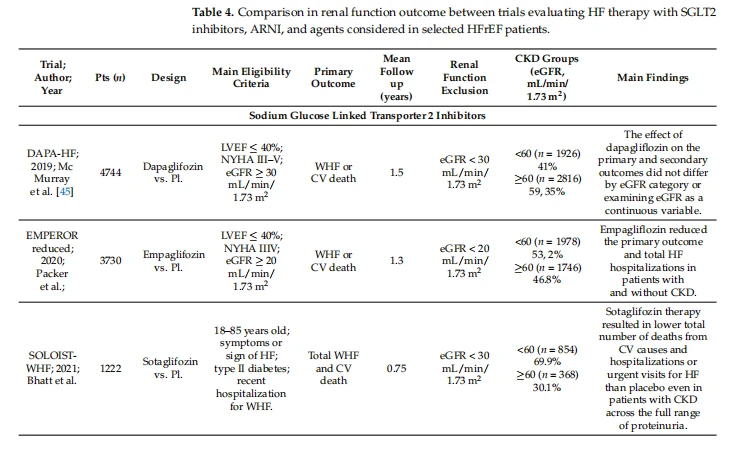
In recent years, landmark trials established the CV benefits and renal outcomes of SGLT-2 inhibitors in the HFrEF population. The empagliflozin outcome trial in patients with chronic heart failure and a reduced ejection fraction (EMPEROR-Reduced)showed that empagliflozin reduced both CV death and HF hospitalization in patients with HFrEF, despite OMT. The trial included patients with eGFR higher than 20 mL/min/1.73 m, and 48% of the subjects enrolled had an eGFR<60 mL/min/1.73 m². Empagliflozin reduced the primary outcome and the total number of HF hospitalizations in patients with and without CKD, and had the beneficial effect of reducing the decline of renal function, regardless of the severity of renal function at baseline [43]. The analyses of the CREDENCE (canagliflozin and renal events in diabetes with established nephropathy clinical evaluation)trial showed the effects of canagliflozin in reducing the incidence of kidney-related adverse events in patients with T2DM and CKD[44]. Moreover, the dapagliflozin and prevention of adverse outcomes in heart failure (DAPA-HF) trial included 41%of patients with eGFR<60 mL/min/1.73 m² and excluded those with eGFR<25 mL/min/1.73 m². The results of the trial showed that the benefits of dapagliflozin on morbidity and mortality in HFrEF did not differ by eGFR category or by examining eGFR as a continuous variable, with a significantly slower rate of decline in eGFR, regardless of the presence of diabetes [46]. In the DAPA-CKD(dapagliflozin and prevention of adverse outcomes in chronic kidney disease) trial, properly designed for patients with CKD, dapagliflozin significantly reduced the decline in eGFR, the end-stage kidney disease, or death from renal or CV causes [47](Table 4).

In clinical practice, as demonstrated in several trials, the initiation of SGLT-2inhibitors was associated with an initially mild drop of egg rover in the first weeks. This decrease in eGFR was reversible, and the renal function gradually returned to its baseline levels, with a stabilization of the renal function during the follow-up. The initial mild drop in eGFR should not lead to premature discontinuation of the SGLT-2 inhibitors treatment.
Recently, novel therapies in HFrEF have been proposed. The vericiguat global study in subjects with heart failure with reduced ejection fraction (VICTORIA) trial demonstrated the effect of vericiguat, a soluble guanylate cyclase stimulator, in reducing the primary composite outcome of CV death or HF hospitalization. For the first time in HF therapies, the study included patients with eGFR higher than 15 mL/min/1.73 m²2; the beneficial effects of vericiguat were consistent across the entire range of eGFR, irrespectively of WRF [48].
The use of hydralazine and isosorbide dinitrate (H-ISDN) in HFrEF is rarely used in clinical practice. However, treatment with H-ISDN was recommended in the last guidelines for HFrEF patients who are intolerant to RAAS inhibitors, and in African-American HFrEF patients who are symptomatic despite optimal neurohumoral therapy. The treatment with H-ISDNis safe in patients with CKD. However, in a recent trial, H-ISDN on top of standard medical therapy did not improve exercise capacity in patients with cardiorenal syndrome and HFrEF [49]. These findings are in agreement with real-world data on a large cohort of HFpEF and HFmrEF patients enrolled in the Swedish Heart Failure Registry where patients in the sub-group analyses with HF and CKD(eGFR 30-59 mL/min/1.73 m²and eGFR<30 mL/min/1.73 m²)benefitted from nitrate administration.