Planting And Processing Technology Of Cistanche Deserticola
Oct 10, 2023
Cistanche deserticola, also known as Cistanche deserticola, Dayun deserticola, or Chagan Gaoyao (Mongolian), is a perennial parasitic herbaceous plant in the Araceae family. Traditional Chinese medicine uses whole herbs as medicine, with a slightly warm nature, a sweet and salty taste, and various health functions. Planting Cistanche deserticola can not only supply the medicinal market but also increase farmers' income, which has good development prospects.

Effects of Cistanche-Immprove kidney function
1、 Planting techniques

Planting of Cistanche deserticola
1. Site selection and preparation.
Choose sandy or semi-desert areas where the soil is neutral or acidic, with sufficient sunlight, less rainfall, good drainage, and a large temperature difference between day and night. Desert areas with concentrated natural Haloxylon ammo dendron forests can be used for the enclosure to prevent grazing by cattle, sheep, and camels, watering, and fertilizing to protect and strengthen the host. It is also possible to cultivate artificial Haloxylon ammodendron forests, collect Haloxylon ammodendron seeds in autumn, and sow and raise seedlings in the spring. Seedlings emerge 1-3 days after seed sowing and are planted 1-2 years later with a row spacing of 1-1.5 meters. After 2-3 years of planting, they grow vigorously and can be inoculated with Cistanche deserticola. Haloxylon ammodendron forest can also be live broadcast, but attention should be paid to wind prevention, water conservation, and seedling protection.
2. Sowing.
Dig a seedbed on the east or southeast side of the wild Haloxylon ammodendron, with a distance of 50-80 centimeters and varying sizes of seedbeds, ranging from 1-2 meters in length, 1 meter in width, and 50-80 centimeters in depth. Alternatively, dig a large seedbed ditch in a densely populated area, surround many host plants, and sow the seeds on the seedbed. Apply fertilizers such as camel manure and sheep manure, and cover the soil with 30-40 centimeters. Leave a ditch or seedbed pit above for watering. The artificial Haloxylon ammodendron forest grows neatly and in rows, and can be used as a seedbed by opening ditches on both sides of the plant. After sowing, keep the seedbed moist and induce the host roots to extend onto the seedbed. Sowing in spring or autumn, in the second year, some of the seedbeds are parasitized by Cistanche deserticola, with a few unearthed for growth, and most of them are unearthed within 2-4 years of sowing, blooming, and fruiting.
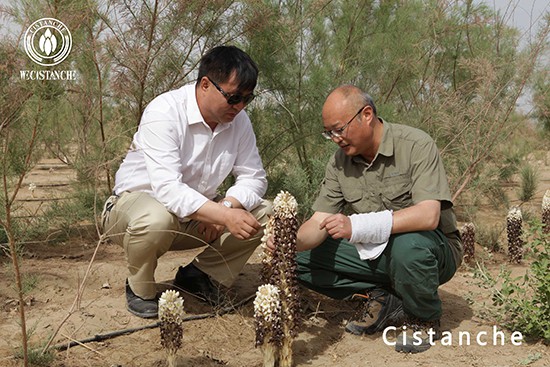
Professor Cistanche Research on the Growth of Cistanche deserticola
3. Field management.
In the desert, the wind is strong and the host root is often exposed by the wind. It is important to cultivate soil or surround the host root with branches to prevent wind damage. The seedbed should be watered regularly to protect the wall and remove other plants. When Cistanche deserticola blooms in May, artificial pollination should be carried out to improve seed setting rate
4. Disease and pest control.
Fusarium oxysporum powdery mildew was treated with B0-10 biological agent 300-fold solution, 50% Garenon 500-fold solution, 20% Shibaoling 300-fold solution, and 70% methyltobuzin 800-1000-fold solution. Haloxylon ammodendron root rot was treated with 50% carbendazim 600-fold solution, 10% genle 1000-fold solution, and 15% chlorpyrifos 1000-fold solution. Seed flies were sprayed with 1.8% avermectin 3000 times solution, 5% Yitaibao 2000 times solution, and 40.7% Lessben 1000-1500 times solution.
Large sand rats and other rodents use zinc phosphide, rodents, and bromarone to make poison baits, which are spread in areas where mice frequently move and lure them to feed.

Superman herbs cistanche
2、 Harvesting and processing
1. Harvesting.
Harvest can be done in both spring and autumn seasons, with the best harvest being from April to May. In early spring, Cistanche deserticola absorbs melted ice and snow water and grows rapidly, so it can be harvested from April to May.
2. Processing.
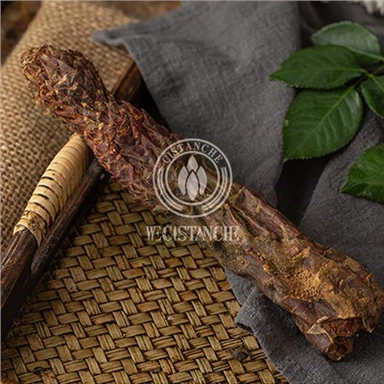
After harvesting in spring, half buried in sand and half exposed to the sun to dry, it becomes sweet cistanche.

cistanche tea
Click here to view Cistanche deserticola tea products
【Ask for more】 Email:cindy.xue@wecistanche.com / Whats App: 0086 18599088692 / Wechat: 18599088692
2.1 Air drying. During the day, spread the deserts on the sand and cover them in piles at night to prevent the temperature difference between day and night from freezing and damaging the cistanche. After drying, the color is good and the quality is high.
2.2 Salinization. Put the individual into a salt lake and marinate for 1-3 years, or dig a pit of 50cm x 50cm x 120cm on the ground. Use a plastic bag of equal size and no leakage to put it in. When the temperature drops to 0 ℃ for the cultivation and processing of Cistanche deserticola, put the deserticola into the bag and use local unprocessed soil salt to prepare 40% saline water for pickling. In March of the following year, take it out and air dry, and it is called Salty Cloud.
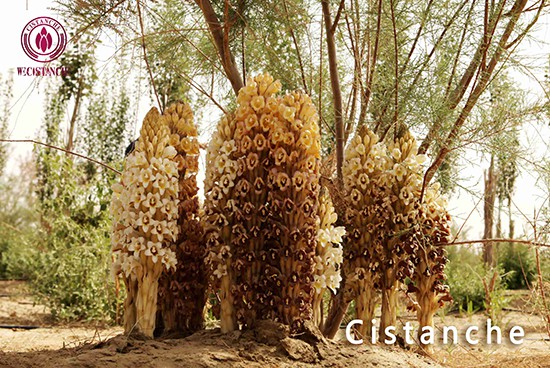
Cistanche tubulosa
2.3 Cellar storage. Dig a pit below the critical line of the permafrost layer, bury fresh cistanches in the soil when the weather is cold, and take them out the following year to dry in the sun. Seed retention should include both Haloxylon ammodendron seeds and Cistanche deserticola seeds. It is advisable to choose seeds that are large, plump, and free from pests and diseases, dry them in the sun, remove impurities, and store them for future use.
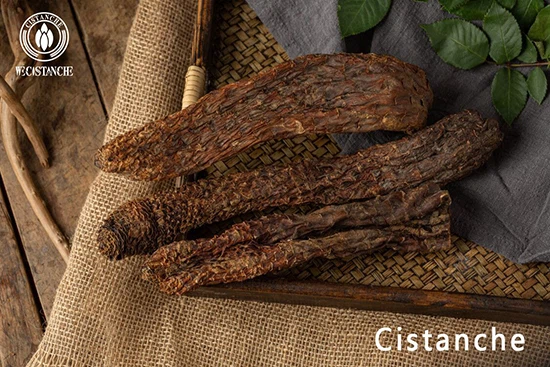
Desert living cistanche tubulosa