Prognostic Signature Of Chronic Kidney Disease in Advanced Age: Secondary Analysis From The InGAH Study With One-Year Follow-Up Ⅱ
Jan 02, 2024
3. Results
3.1. CKD, Frailty, and Long-Term Prognosis According to KDIGO
The clinical and demographic characteristics of the study population are shown in Table 1, as well as according to KDIGO in Table 2. Mean age was 77.5 (SD 6.1) years, and 133 patients (36%) were female. Based on the MPI score at admission, 21% of the patients were frail and 56% were frail. In the whole patient sample, higher age (p < 0.001), lower education length (p = 0.006), higher LHS (p = 0.002) and more falls (p = 0.009) in the previous 12 months, higher GC (p < 0.001) and use of home services (p < 0.001), higher number of Geriatric Syndromes (GS) (p < 0.001) and lower number of Geriatric Resources (GR) (p < 0.001) were significantly associated with a higher MPI score, indicating a higher frailty grade and poorer overall prognosis (Table 1). The BMI was significantly lower in in patients with a higher KDIGO stage (p = 0.012, Table 2). The analysis of laboratory parameters showed a strong association with frailty as assessed by the MPI value with lower total protein serum levels (p = 0.007) on admission, lower serum albumin levels on admission and discharge (p < 0.001, Figure 3), as well as with higher serum C-reactive protein (CRP) levels at admission (p = 0.016) and discharge (p < 0.020). After adjusting for age, gender, KDIGO-G stage and MNA-SF, serum albumin was still significantly associated with the MPI score (p = 0.006). Additionally, patients with a higher KDIGO G-stage showed significantly lower Albumin (p = 0.049, Table 2).

Figure 3. Albumin at admission according to MPI group. ◦ marks statistical outliers
In total, 75% of MPI-1 group patients, 61% of MPI-2 and 25% of MPI-3 (p = 0.001) were alive at 12 months FU, with an ROC area for one-year all-cause mortality of 0.71 (95% CI, 0.64–0.76, Figure 4a). Especially in the Kaplan–Meier curve for CKD patients with hypoalbuminemia (albumin < 35 g/dL), the one-year survival was significantly different according to MPI group, with a higher MPI showing significantly higher mortality (p < 0.001, survival for hypoalbuminemia patients with MPI-1: 82%, MPI-2 50%, MPI-3: 24%; Figure 5b). Hypoalbuminaemia was independently associated with the MPI (p = 0.002) but not with KDIGO G-stage (p = 0.086) adjusted for age, gender and each other.
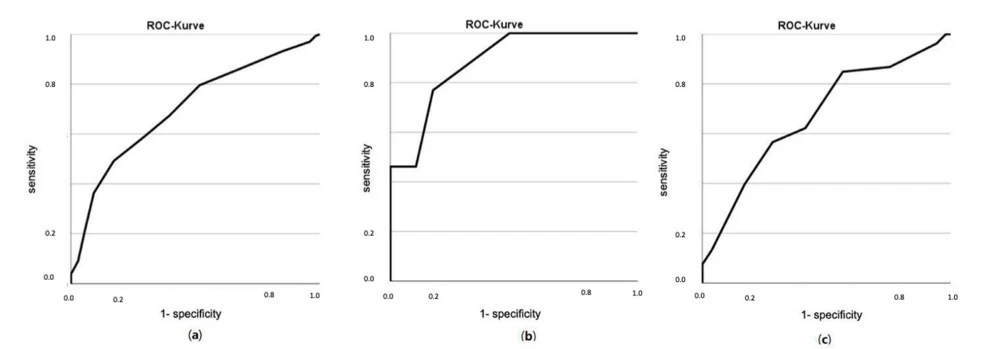
Figure 4. AUC area for one-year all-cause mortality. (a) All CKD patients with 0.71 (95% CI, 0.64–0.76); (b) KTR patients with 0.88 (95% CI, 0.78–0.98); (c) RRT patients with 0.67 (95% CI, 0.57–0.7

Figure 5. Cumulative Kaplan–Meier survival after 12 months in CKD patients according to MPI, compared to patients without hypoalbuminemia ((a), on the left) and with hypoalbuminemia ((b), on the right)
MPI values were significantly associated with KDIGO G-stages, with a higher MPI being associated with a higher KDIGO G-stage (p = 0.003, Table 2). Patients belonging to KDIGO stage G5 showed a significantly lower number of GR (p = 0.006) compared to patients with lower KDIGO G-stages. Polypharmacy was significantly more prevalent in higher KDIGO G-stages (p < 0.001). Rehospitalization rates 6 (p = 0.038) and 12 months (p < 0.001) after initial evaluation were significantly associated with KDIGO G-stage, as well as GC after 6 (p < 0.001) and 12 months (p = 0.003). Mortality rates after 12 months were significantly higher in higher KDIGO G-stages (p < 0.001)


Supportive Service Of Wecistanche-The largest cistanche exporter in the China:
Email:wallence.suen@wecistanche.com
Whatsapp/Tel:+86 15292862950
Shop For More Specifications Details:
https://www.xjcistanche.com/cistanche-shop
CLICK HERE TO GET NATURAL ORGANIC CISTANCHE EXTRACT WITH 25% ECHINACOSIDE AND 9% ACTEOSIDE FOR KIDNEY INFECTION
3.2. RRT Group:
HD US. PDA total of 138 patients (37%, Table 3) received RRT, of which 11 patients (8%) underwent it. Most patients (82%) undergoing PD lived together with relatives. Receiving RRIp = 0.181, Table 1) or which kind of RRT (p = 0.457, Table 3) was not significantly associated with MPI score. A higher CIRS-Score was significantly associated with HD compared to PD (5.6 vs. 4.5,p = 0.026 adjusted for MPI). PD patients had significantly more emotional resources (p = 0.045) and less sensorial impairment (p = 0.019). At discharge, the MPI of PD patients was significantly lower, even when adjusted for MPI at admission and compared to HD patients (0.41 vs. 0.54, p = 0.021).
After one year, 50% of the RRT patient group was still alive, showing no significant difference in mortality in different RRT groups (p = 0.691). In total, 95% of RRT patients were rehospitalised during the FU period. More HD patients had a GC after 12 months compared to PD patients (73% vs. 25%, p = 0.083), although this effect was not statistically significant. The ROC area for one-year all-cause mortality according to MPI was 0.67 for patients undergoing RRT (95% CI, 0.57–0.78, p = 0.002, Figure 4c).

3.3. KTR vs. RRT
Forty-four patients (12%, Table 4) of the sample were KTR. The mean time since kidney transplantation was 7.7 years (SD 8.0), with 51% deceased donors and 35% living donors (14% missing information).
Compared to patients undergoing HD-RRT, KTR patients were significantly younger (p < 0.001). KTR patients had experienced significantly fewer falls (p = 0.014) and had significantly lower GC (p = 0.031) than RRT patients. The MPI value was significantly lower in KTR compared to RRT patients (0.52 vs. 0.43, p = 0.028, Table 4)
After 12 months of follow-up, 71% of KTR were still alive, compared to 49% of RRT patients, although this effect did not remain significantly different after adjusting for age and MPI (p = 0.395). KTR showed significantly less GC (p = 0.015) and a significantly lower rehospitalization rate (p = 0.019) after 12 months compared to RRT patients. The Kaplan–Meier analysis for the cumulative survival time showed a significant difference between the MPI groups; all KTR in group MPI-1 survived, 50% of those survived in the MPI-2 group and none of those belonging to the MPI-3 group survived (p < 0.001, adjusted for age, Figure 6). The AUC for one-year all-cause mortality was 0.88 (95% CI, 0.78–0.98, Figure 4b).

Figure 6. Cumulative Kaplan–Meier survival after 12 months in KTR patients according to MPI.
3.4. CKD KDIGO
G4-5 Patients: No-RRT vs. HD-RRT Of the 201 patients with KDIGO G4-5, 52 (26%, Table 5) had not received any form of RRT (no-RRT). No-RRT patients were significantly younger than RRT recipients (p = 0.027). Compared to patients receiving HD-RRT, the LHS of no-RRT patients was significantly lower (12.0 vs. 20.4 days, p = 0.003). In addition, no-RRT patients showed a tendency to better MPI values compared to patients with HD-RRT (MPI 0.47 vs. 0.53, p = 0.052), as well as significantly less GS (p = 0.044) and a significantly higher BMI (p = 0.046). Regarding survival after 3 6 and 12 months, there was no significant difference between groups (p = 0.137, Figure 7b, no-RRT: 62%, HD-RRT: 45%). However, no-RRT patients showed a significantly lower prevalence of GC after 12 months (p = 0.003) compared to HD-RRT patients. Again, mortality rates were significantly associated with MPI values in no-RRT patients (p < 0.001, survival after 12 months: MPI-1: 94%, MPI-2: 56%, MPI-3: 20%, Figure 7a). Mortality risk was also associated with hypoalbuminemia (p = 0.028, survival after 12 months: hypoalbuminemia: 37%, no hypoalbuminemia: 89%, Figure 7c).

Figure 7. Cumulative Kaplan–Meier survival after 12 months in patients with KDIGO stage G4–5 without receiving renal replacement therapy (RRT) according to their MPI group at admission (a, on the left), according to whether they receive RRT or not (b, in the middle) and patients with KDIGO stage G4-5 without RRT according to hypoalbuminaemia ((c), on the right). (a) Patients with G4/5 and no dialysis according to MPI. (b) Patients with G4/5 according to chronic dialysis. (c) Patients with G4/5 and no dialysis according to hypoalbuminemia.

4. Discussion
This secondary analysis from a relatively large prospective evaluation of older patients delivered several relevant observations that should be highlighted. First, the multidimensional prognostic and frailty signature of CKD patients is strongly associated with the KDIGO-based classification of renal impairment independent of age and gender. The MPI as a comprehensive prognostic tool (32] has been previously shown to improve the predictive value of GFR for outcomes of CKD patients (15,451. Taking into consideration the MPI in its newly established role of comprehensive frailty index [30,31l, its association with KDIGO can be discussed in the context of existing data on the association between higher frailty levels and higher KDIGO stage (44). However, so far, previous studies linking CKD and frailty have only taken physical frailty into account 27,46l, whereas the MPIis a feasible tool considering several factors, beyond organ illness, massively influencing prognosis functions, mobility, cognition, nutrition, social aspects, multimorbidity and polypharmacy. The MPI shows that only a multidimensional consideration of the frailty makes it possible to map the prognosis. All eight domains of the MPI are, therefore, rated equally in the index. Of note, accordingly with the known high prevalence of physical frailty in CKD, in our sample, multidimensional--not physical -prefrailty and frailty affect 77% of CKD patients, which is the large majority, also reflecting the strong, well-established multifactoriality of both conditions (47). Of note, it is being increasingly shown that multidimensional frailty indices are able to more accurately capture outcome risks of older patients compared to monodimensional phenotypes (48,49)As the KDIGO guidelines recommend routinely the prognosis of CKD patients using risk prediction instruments (50], currently, there are no uniform assessment standards or prognosis instruments for older patients, and thus, the MPI might represent a feasible instrument for this purpose.
In this context, it is worth mentioning that a lower education length (p = 0.006, Table 1)was significantly associated with a higher MPI score. Frailty risk is associated to lower social class in childhood 1511 and further studies might be directed at exploring specific factors of social inequalities associated to frailty in CKD to improve multidimensional early interventions.
Second, the present analysis reveals for the first time a profile of higher MPI-CKD patients. These more often chronologically older patients are frequently male, although the percentage of female patients increases across MPI groups, in agreement with data on the general frail population [52]. Of note in this context, while CKD is in general more prevalent in female than male patients, in our population, men are more represented, likely due to the known fact that men are more often affected by severe CKD stages, receive RRT more often than women and are, therefore, more often hospitalized [53]. In addition to being more often an older male person, the high MPI-CKD profile includes having fewer education years (p = 0.006), higher LHS (p = 0.002), more falls in the previous year (p = 0.009), higher nursing needs and home services (p < 0.001) and lower circulating levels of total proteins (p = 0.007) and albumin (p < 0.001) at admission than the low MPI-CKD profile (Table 1). The more frequent presence of heart disease, dementia, depression and peripheral artery disease in MPI-2 and -3 group patients than in MPI-1 group patients was shown to be independent of age, gender and KDIGO, suggesting a predominant prognostic feature of these comorbidities beyond CKD severity.

To complete this picture, the high MPI-CKD profile is at high risk of mortality. Compared to Pilotto et al. [45], the one-year mortality rate in our sample was roughly twice as high for each MPI class (MPI-1 25% vs. 12%, MPI-2 39% vs. 21%, MPI-3 75% vs. 38%), which may be due to the different setting of a university hospital Nephrology unit with acutely very ill patients in need of high-performance medicine compared to a geriatric unit. Overall, however, the heterogeneity of aging with a comparable ROC area for MPI and one-year all-cause mortality of 0.71 (95% CI, 0.64–0.76) vs. 0.70 (95% CI, 0.66–0.73) [45] could also be confirmed in our analysis (Figure 4a).
A similar view of the results obtained in the present analysis discloses the profile of high KDIGO stage carrier: higher rehospitalization rates, (p < 0.001), higher nursing needs (p = 0.003) and mortality risk (p < 0.001) up to 12 months after hospital discharge with respect to lower KDIGO stage patients. The independence of these results from MPI is indicative of the strong impact of the CKD on the patients' trajectories beyond their overall health status. Indeed, the a significantly increased risk of physical frailty and mortality in older CKD patients [7,11,14,17,27,46,47,54,55]. However, the current KDIGO guidelines from 2012 do not take age into account when classifying the severity of CKD, although current research shows that from an age of about 45 years, the eGFR physiologically decreases by ~0.88 mL/min/1.73 m2/year [56]. This is particularly important because at the moment kidney aging is not relevantly differentiated from kidney disease, just as the severity of CKD in old age may be overestimated. Therefore, more and more scientists are calling for the CKD definition and also the KDIGO guidelines to include age-specific thresholds for GFR [57]. This could help prevent overdiagnosis and, thus, overtreatment for older people-but for younger patients, this could also enable earlier diagnosis at a time when preventing CKD is still possible.
A third main finding from the present analysis is that hypoalbuminemia and a high MPI score were independently significantly associated (p < 0.001). Previous reports of a "metabolic signature" of MPI in older, multimorbid patients [58,59] appear to be present in patients with CKD and especially ESRD. In our sample, especially for CKD patients with hypoalbuminemia, the MPI showed a high prediction for survival time (p < 0.001). As shown in Table 1, the MPI score was significantly associated with serum albumin levels (p < 0.001) independent of age, gender and KDIGO stage and this significance increased in the further model adjusted also for MNA (p = 0.006). Due to the cross-sectional nature of the observed association between frailty and hypoalbuminemia, it is not possible by means of the present analysis to disclose the causal or epiphenomenal role of poor albumin levels in frailty with or without CKD. Hypoalbuminaemia represents a signal of malnutrition [60] and is directly associated with the likelihood of developing frailty conditions [61]. Protein-energy wasting (PEW) is known to be a common problem in patients with CKD and is known to be associated with adverse clinical outcomes, especially in individuals receiving maintenance RRT [62]. However, since hypoalbuminemia is also associated with sarcopenia, the latter may hinder food intake through reduced mobility, with the consequence of a poor, protein-deficient, diet. The higher rate of depression in CKD patients shown in our analysis (Table 1) and the associated loss of appetite could also be a modulating factor [63]. This could lead to a vicious cycle of lower albumin, poor nutrition and higher frailty in older CKD patients, who are already at risk of deranged homeostasis with negative body composition alterations, and they can act synergistically to cause an increased risk of mortality [64]. As aging and CKD are associated with systemic inflammation [65,66], it would also be interesting to investigate the association between inflammation markers (for example hs-CRP, IL-6, TNF, lipid peroxides and anti-oxidants) and the progression of frailty and CKD in a further prospective study. Although it has not been inequitably proved in studies yet, it is possible that nutritional interventions slow disease progression independently [67]. As there are no large randomized clinical trials that have tested the effectiveness of nutritional interventions on mortality and morbidity of CKD patients, further studies seem necessary to show the relationship between prognosis and nutrition, in particular to what extent the prognosis can be influenced by possible interventions to improve the prognosis, such as low-protein diet [68], chronic administration of nutritional supplementation [62] or amino-acid mixtures (particularly those enriched in branched-chain amino acids) [69].
In our analysis, patients in a late CKD stage (KDIGO G4-5) without dialysis (conservative therapy, no-RRT) had a comparable 12-month survival, a significantly lower rehospitalization rate, a higher albumin level and a lower one MPI frailty compared to a patient on HD-RRT. These results might point out that at least two collectives of patients are combined in KDIGO stage 5: patients who have an urgent medical need to initiate dialysis have no other choice than to initiate RRT to prevent further, potentially lethal harm. On the other hand, patients who have a highly reduced, but rather stable kidney function might benefit from a conservative treatment, including regular nephrological controls, to initiate RRT based on sole calculations of the GFR, since RRT itself is associated with various complications. However, even in KDIGO G5 there is a difference in frailty between with and without dialysis-this is one of the important results here. Thus, the MPI could both be used as an aid in clinical decision-making as to whether dialysis therapy should be started (of course together with clinical parameters), and it could possibly also help for the decision of whether PD or HD is chosen.
KTR patients had a significantly lower MPI than RRT patients (p = 0.028). Whether this prognostic significance of the MPI also applies to older KTR patients has not yet been shown. More and more studies show that kidney transplantation, even in older age (>65 years), has a strong beneficial influence on survival and quality of life of patients, especially compared to RRT patients, who have a strongly increased risk of frailty and sarcopenia and an increased mortality risk [70–73]. According to the literature, frailty status changes after kidney transplantation; it initially worsens directly after transplantation and then ameliorates-transplanted patients were most likely to show improvements in their physiological reserve, suggesting that pretransplant frailty is not an irreversible state of low physiological reserve [74]. In the present 12-month follow-up period, a significant association was found in the survival of transplanted patients and their MPI groups (p < 0.001, Figure 6); indeed, the MPI was strongly associated with one-year all-cause mortality with an ROC area of 0.88 (95% CI, 0.78–0.98). There is no current standard for selecting older patients for a transplant that contains a CGA, but it can be assumed that the examiner unconsciously uses the criteria of the CGA to decide, so that a selection bias (MPI-1 patients may be selected for a KTR more often) cannot be ruled out. With an MPI assessment, an additional criterion might be established that helps in the difficult decision of whether to add an older patient on the deceased donor waiting list, as well as whether to adds an early warning system in the follow-up of transplanted patients. Thus far, few examples are given in the literature where frailty instruments or a CGA are used to assess outcomes or immediate post-operative complications before transplantation [75]. To assess individual benefits of renal transplantation, a CGA with prognosis calculation like the MPI seems to be a suitable tool [76] and should even become part of the clinical routine for patients on the deceased donor waiting list or for patients who want to be admitted.
There are several limitations of this study. First, this was a secondary, retrospective analysis of a prospective study cohort that was not recruited for this question; however, we could benefit from a very well-characterized cohort, especially with very accurately raised nephrological parameters. A second limitation is that this study was a cross-sectional study, although we had a one-year follow-up period; especially the nephrological parameters were only collected at one specific point of time.
The association between frailty status and multiple adverse outcomes suggests that exercise-based interventions to improve physical function and mobility may have far-reaching benefits in older adults with kidney disease [77]. Further studies, especially translational trials, are needed to characterize the relationship between kidney disease and frailty even better, and they are most important to identify opportunities to intervene. Physicians should fully disclose the risks of CKD and opportunities for treatment to patients of all ages and evaluate and manage cases according to the level of risk, even if this is challenging. Addressing healthy aging might make renal aging-associated frailty more preventable than inevitable.
5. Conclusions
This secondary analysis shows a multidimensional prognostic of signature for MPI frailty in CKD patients, which is strongly associated with the KDIGO G-stages. These findings indicate that an MPI assessment should be used in older CKD patients to determine the prognosis. Displaying the overall importance of nutrition in the frailty cascade of CKD patients, in this study malnutrition, and in particular hypoalbuminemia, were indicative of a poor prognosis and were associated with higher frailty-nutritional interventions, therefore, seem to be of enormous importance in CKD patients.
Furthermore, the initiation of RRT in CKD G4-5 and the kind of RRT showed in this study significant profiles according to MPI frailty and prognosis. Patients with CKD G4-5 might have, in some parts, better outcomes with conventional therapy, so that the decision to initiate RRT should be carefully considered. In addition, we showed that KTR patients had a significantly lower frailty compared to patients receiving RRT. These findings could indicate that an MPI assessment for RRT or KTR therapy decision making in older ESDR patients could be of outstanding importance, especially in order to avoid misjudgements due to advanced age.
Author Contributions: Conceptualisation, A.M.M., L.P., M.P.B. and M.C.P.; Methodology, A.M.M., M.C.P. and I.B.; Software, A.M.M., L.P. and A.H.; Formal Analysis A.M.M., L.P., A.H. and I.B.; Investigation, A.M.M., L.P. and A.H.; Data Curation, A.M.M. and L.P.; Writing-Original Draft Preparation, A.M.M. and L.P.; Writing-Review and Editing, M.C.P., I.B., M.P.B., T.B. and C.K.; Visualisation, A.M.M. and L.P.; Supervision, M.C.P.; Project Administration, M.C.P. All authors have read and agreed to the published version of the manuscript.
Funding: This research received no external funding.
Institutional Review Board Statement: The study was conducted according to the guidelines of the Declaration of Helsinki and approved by the Ethics Committee of the University Hospital of cologne (EK 16-213, 18 August 2016).
References
1. Fang, Y.; Gong, A.Y.; Haller, S.T.; Dworkin, L.D.; Liu, Z.; Gong, R. The ageing kidney: Molecular mechanisms and clinical implications. Ageing Res. Rev. 2020, 63, 101151. [CrossRef] [PubMed]
2. Long, D.A.; Mu, W.; Price, K.L.; Johnson, R.J. Blood vessels and the aging kidney. Nephron Exp. Nephrol. 2005, 101, e95–e99. [CrossRef] [PubMed]
3. Braun, F.; Brinkkötter, P.T. Rückgang der Nierenfunktion im Alter. Z. Gerontol. Geriatr. 2016, 49, 469–476. [CrossRef] [PubMed]
4. O'Sullivan, E.D.; Hughes, J.; Ferenbach, D.A. Renal Aging: Causes and Consequences. J. Am. Soc. Nephrol. 2017, 28, 407–420. [CrossRef] [PubMed]
5. Levey, A.S.; Coresh, J. Chronic kidney disease. Lancet 2012, 379, 165–180. [CrossRef]
6. Benzing, T.; Salant, D. Insights into Glomerular Filtration and Albuminuria. N. Engl. J. Med. 2021, 384, 1437–1446. [CrossRef]
7. Levin, A.; Stevens, P.E.; Bilous, R.W.; Coresh, J.; De Francisco, A.L.; De Jong, P.E.; Griffith, K.E.; Hemmelgarn, B.R.; Iseki, K.; Lamb, E.J. Kidney Disease: Improving Global Outcomes (KDIGO) CKD Work Group. KDIGO 2012 clinical practice guideline for the evaluation and management of chronic kidney disease. Kidney Int. Suppl. 2013, 3, 1–150.
8. World Health Organization. World Report on Ageing and Health; World Health Organization: Geneva, Switzerland, 2015.
9. Saran, R.; Robinson, B.; Abbott, K.C.; Agodoa, L.Y.C.; Bhave, N.; Bragg-Gresham, J.; Balkrishnan, R.; Dietrich, X.; Eckard, A.; Eggers, P.W.; et al. US Renal Data System 2017 Annual Data Report: Epidemiology of Kidney Disease in the United States. Am. J. Kidney Dis. 2018, 71, A7. [CrossRef]
10. St Peter, W.L.; Khan, S.S.; Ebben, J.P.; Pereira, B.J.; Collins, A.J. Chronic kidney disease: The distribution of health care dollars. Kidney Int. 2004, 66, 313–321. [CrossRef]