Research On The Best Way To Take Cistanche-Cistanche Extract,Health Supplyment, Cistanche Food
Apr 24, 2022
Author: LI Yang,QIN Yadi,BUBIAJIAER Hayilati,YAO Jun,YUAN Jie,YOU Lin
(1. School of Pharmacy, Xinjiang Medical University, Urumqi 830011;2. Xinjiang Second Medical College,Klamayi 834000;3. Hotan Dichen Pharmaceuticas & Biotech Co., Ltd., Hotan 848000)
Abstract:
Objective: To establish a method for identification and determination of four phenylethanol glycosides (echinacoside,tubuloside A,acteoside,isoacteoside) in cistanche pieces, its extracts and related healthy foods by TLC and QAMS.
Method:
(1)TLC: Four phenyl ethanol glycosides were identified by TLC with polyamide film as the stationary phase and chloroform-methanol-acetic acid-water (1.5∶2∶1∶7) as the developing solvent. The spot was detected under ultraviolet light at 365 nm.
(2)Using echinacoside as an internal reference, the relative correction factors for tubuloside A,acetonide, and isoacteoside were used to calculate the content of each component. The calculation results of QAMS method were compared with the values of external standard method.
Result:The TLC spots of 4 phenylethanol glycosides (echinacoside,tubuloside A,acteoside, and isoacteoside) in cistanche decoction pieces,extracts,and functional foods were all clear with good separation, strong specific moderate Rf value. The reproducibility of tubuloside A,acteoside, and isoacteoside relative correction factors was good, and no obvious difference between the two methods.
Conclusion: The method established in this study is simple, accurate,and reproducible. It can provide a reference for the quality control of effective components of cistanche decoction pieces, extracts and functional foods.
Keywords:cistanche; decoction pieces ; related products;phenethyl alcohol glycosides; TLC; QAMS
Cistanche deserticola Y. C. Ma. is a perennial parasitic herb of the family Orobanchaceae. It is used as medicine with dry fleshy stems with scaly leaves. Cistanche was first published in the "Shenlong Materia Medica" and was listed as a top grade. It is sweet in taste, warm in nature, salty, and belongs to the kidney and large intestine meridians. It has the effects of moistening the intestines and laxatives, invigorating kidney yang and benefiting essence and blood. It is mainly produced in Xinjiang, Ningxia, Inner Mongolia, Qinghai, Gansu, and other arid regions of northwest China. The main chemical components of Cistanche are phenylethanoid glycosides, iridoids, lignans, alkaloids, monoterpenes, sugars, volatile oils, and inorganic trace elements. Among them, phenylethanoid glycosides (Phys) are one of the main pharmacological components, which have pharmacological activities such as antioxidant, neuroprotection, antiviral, immunity enhancement, antifatigue, and memory enhancement and immunity enhancement.
Cistanche Extract Benefits:
Cistanche Extract is made from dry enzyme-inactivated tablets of Cistanche, which are extracted and separated. It has been exported to Japan, South Korea, Malaysia, and other overseas markets, and is widely used in health care products, cosmetics, and pharmaceutical industries. The health care product processed from Cistanche extract as raw material has the dual health care functions of relieving physical fatigue and improving immunity. At present, there is a lack of corresponding control standards for the quality evaluation of active ingredients of Cistanche extract and health care products, and it is difficult to ensure the quality and safety of processing and market sales. Echinacea and verbascoside are the index components for identification and content determination under the item of Cistanche Tubulosa in the 2020 edition of the Chinese Pharmacopoeia. In addition, Cistanche Tubulosa also contains other phenylethanoid glycosides, such as tuberosin A, salidroside, isoverbasin, cistancheoside C, cistancheoside D, auriroside, 2′-acetylverbasin, etc. Different degrees of antioxidant and neuroprotective effects. It is difficult to comprehensively and accurately evaluate its quality by only using echinacoside and verbascoside as detection indicators. It was reported in the literature that the contents of ductaloside A and isaveraside in Cistanche and Cistanche were also higher, reaching 0.29%, 0.21%, 0.06%, and 0.10%, respectively.

Click here to know more cistanche benefits
In this paper, TLC identification of 4 phenylethanoid glycosides (echinacoside, tuberoside A, verbascoside, isorrascoside) in decoction pieces of Cistanche Tubulosa and related products (extracts, health products) and high-performance liquid chromatography (HPLC) were established. The evaluation method (HPLC-QAMS) content determination method provides a reference for further improving the quality evaluation method of Cistanche Tubulosa.
1 Material and methods of choosing the best way to take Cistanche
1.1 Instruments and Reagents
Shimadzu LC-20AT High Performance Liquid Chromatograph; Shimadzu LC-20AB High Performance Liquid Chromatograph; Agilent1260 High Performance Liquid Chromatograph; Analytical Balance (AB135-S, Mettler Toledo1o Company); KQ-500DE Ultrasonic Cleaner
(KQ-500DE, Kunshan Ultrasonic Instrument Co., Ltd.); Semi-automatic spotting instrument (CAMAG, Switzerland).
(1) Commercially available decoction pieces of Cistanche (S1, S2: Cistanche deserticola, origin in Alxa, Xinjiang; S3, S4: CistancheTunulosa, origin Xinjiang): purchased from Wecistanche Co. Ltd.; Alcohol extraction of enzyme dry tablets, S6: water extraction of enzyme-inactivated dry tablets, S7: enzyme-inactivated dry tablets alcohol extraction with resin), and health products (S8) are provided by Xinjiang Hetian Dichen Biotechnology Co., Ltd.
(2) Echinacea reference substance (batch number: S-003-01904003, purity: ≥ 98%), tuberosin A (batch number: G-066-11812016, purity: ≥ 98%), verbascoside (batch number: ≥ 98%) M-011-02103019, purity: ≥ 98%), isaveraside (batch number: Y-073-11803024, purity: ≥ 98%): Beijing Yingleike Technology Development Co., Ltd.
(3) Methanol, acetonitrile, and formic acid were chromatographically pure; chloroform and glacial acetic acid were analytically pure; water was ultrapure water;
1.2 Experimental method
1.2.1 Identification by thin layer chromatography
1.2.1.1 Preparation of the test solution Take the test powder (0.5g of Cistanche decoction pieces, 0.2g of Cistanche extract, 0.5g of health product), add 20mL of 50% methanol, ultrasonically treat it for 15min and filter.
The filtrate was concentrated to 2 mL, passed through a 0.45 μm microporous membrane, and used as the test solution.
1.2.1.2 Preparation of reference substance solution Precisely weigh 10 mg of echinacoside, vasoside A, verbascoside, and isorrascoside reference substance, add 50% methanol to dissolve and dilute to a volume of 10 mL
bottle, as a reference standard single standard stock solution. Precisely measure about 2 mL of the single-standard stock solution of each reference substance, add 50% methanol to the same 10 mL volumetric flask, and pass through a 0.45 μm microporous membrane as a mixed reference solution.
1.2.1.3 Preparation of negative sample solution Weigh other medicinal materials other than Cistanche according to the prescription of the health product, and operate according to the same method for the preparation of the test solution to prepare the negative sample solution.
1.2.2 Content Determination by One-Test-Multiple-Assessment Method
1.2.2.1 Chromatographic conditions Column: INERTSIL ODS-3 (250mm×4.6mm, 5μm); mobile phase: acetonitrile (A)-0.1% formic acid solution (B), gradient elution (0 ~ 12min, 17% ~ 20% A; 12~30min, 20%~22%A; 30~35min, 22%~17%A); Detection wavelength: 330nm; Flow rate: 1.0mL · min-1; Column temperature: 30℃; Injection volume: 10μL .
1.2.2.2 Preparation of reference substance solution Take about 10 mg of echinacoside, tuberosin A, verbascoside, and isorrascoside reference substance each, accurately weigh them, and place them in 10 mL volumetric flasks, respectively, using 50%
Dissolve methanol and make up to the mark, shake well to obtain the single standard stock solution of reference substance with concentrations of 1.008, 1.011, 1.012 and 1.012 mg·mL-1, respectively. Precisely measure an appropriate amount of the single-standard stock solution of each reference substance, put it in the same 10mL volumetric flask, add 50% methanol to the mark, shake well, and prepare a mixture with a concentration of 201.60, 50.55, 101.20, 50.60μg·mL-1 The reference solution was passed through a 0.45μm microporous membrane.
1.2.2.3 Preparation of the test solution
① Cistanche decoction pieces test solution: weigh about 1.0g of Cistanche decoction pieces powder (passed through a No. 4 sieve), accurately weigh, accurately add 25mL of 50% methanol, shake well, weigh, and ultrasonically (power 250w, frequency 35kHz) 40min, let it cool, weigh again, supplement the reduced weight with 50% methanol, shake well, filter through filter paper, and take the filtrate to pass through a 0.45 μm microporous membrane.
②The solution of Cistanche extract for testing: take the powder of Cistanche extract (S5: alcohol-extracted enzyme-inactivated dry flakes, S6: water-extracted enzyme-inactivated dry flakes, S7: alcohol-extracted enzyme-inactivated dry flakes with resin) about 0.2 g. Precisely weigh and prepare the test solution of Cistanche extract according to the method under "①". ③Health care product test solution: Take 10 health care products, accurately weigh them, grind them finely, calculate the average tablet weight, accurately weigh 1 tablet (about 0.5g), and prepare the health care products according to the method under "①". Test solution.

2 Results and Analysis of choosing the best Cistanche
1.1 Instruments and Reagents
2.1 Identification by thin-layer chromatography
According to the thin-layer chromatography (General Rule 0502) test, draw 2 μL of the reference substance single standard solution, mixed reference substance solution, test solution, and negative sample solution, respectively, and point them on the same polyacrylamide solution.
On the amine film plate, use chloroform-methanol-glacial acetic acid-water (1.5:2:1:7) as the developing agent, develop, take out, dry, and inspect under ultraviolet light (365nm). Results The test substance showed fluorescent spots of the same color at the corresponding position on the chromatogram of the reference substance, and there was no interference when negative, as shown in Figure 1.

Figure 1 TLC chromatograms of cistanche pieces, extract, health products
Note: From left to right are echinacoside, tuberoside A, verbascoside, isaveraside, mixed reference substance, decoction pieces of Cistanche (S1 ~ S4), extract of Cistanche (S5 ~ S7), health care products (S8), negative samples of health products (S8)
2.2 Content Determination by One-Test-Multiple-Assessment Method
2.2.1 Specificity test
Take 10 μL of each of the mixed reference solution and the test solution, and inject and analyze according to the chromatographic conditions under 1.2.2.1. The resolution between the target peak and the adjacent components in the reference solution and the test solution is greater than 1.5, and the specificity is good. , and the chromatogram is shown in Figure 2.
2.2.2 Investigation of Linear Relationship
Precisely draw 0.5, 1, 2.5, 5, and 10 mL of the mixed reference solution under "1.2.1.2", put them in 10 mL volumetric flasks, make up to the mark with 50% methanol, and shake well to obtain a series of concentration mixtures.
Combine the reference solution, accurately pipette 10 μL respectively, and inject samples according to the chromatographic conditions under “1.2.2.1” to measure the peak area. for
Sit vertically, draw a regression curve, and calculate a linear regression. The results showed that r were all greater than 0.9993, and the four phenethyl glycosides showed a good linear relationship with the peak area within the corresponding linear range, as shown in Table 1.
Figure 2 HPLC spectrum of reference substance and sample substance


1. echinacoside;2. Tubuloside A;3. Acteoside;4. Isoacteoside
Note:
A. Chromatogram of mixed reference substance;
B. Chromatogram of Cistanche Docation pieces;
C. Chromatogram of Cistanche extract;
D. Chromatogram of health supplement
Table 1 Results of 4 components linear relationship

2.2.3 Precision test
Accurately pipette 10 μL of the mixed reference solution under “1.2.1.2”, inject and measure 6 times continuously according to the chromatographic conditions under “1.2.2.1”, record the peak area and calculate its RSD. Results The RSDs of the peak areas of echinacoside, tuberosin A, verbascoside, and isoverascoside were 0.79%, 1.24%, 0.59%, and 0.42%, respectively (n=6), indicating that the precision of the instrument was good.
2.2.4 Repeatability test
Take 6 copies of the same batch of test powders (S3, S6, S8), accurately weigh them, prepare the test solution according to "1.2.1.3", measure according to the chromatographic conditions under "1.2.2.1", and record Peak area, the content of the 4 components and their RSDs were calculated. The results are shown in Table 2, indicating that the method has good reproducibility.
Table 2 Repetitive tests

2.2.5 Stability test
Precisely draw 10 μL of the test solution (S3, S6, S8), measure according to the chromatographic conditions under "1.2.2.1", and inject samples at 0, 2, 4, 6, 8, 12, and 24h respectively for measurement. Results The RSDs (n=7) of the peak areas of echinacoside, analoside A, verascoside, and isaveraside in sample (S3) were 1.28%, 1.82%, 1.52% and 1.56%, respectively. The RSDs (n=7) of the peak areas of the four components in the sample (S8) were 1.38%, 1.57%, 1.73% and 2.49%, respectively, and the RSDs (n=7) of the peak areas of the four components in the sample (S8) were 1.63%, 0.92%, 1.85% and 2.24%, indicating that the test solution is stable within 24h.
2.2.6 Recovery test
Weigh 9 powders of the test product (S3, S6, S8) with known content, accurately weigh, and prepare the test solution according to the method under "1.2.2.3". Proportionally add a certain amount of the reference solution of the four components, inject and measure according to the chromatographic conditions under "1.2.2.1", record the peak area, calculate the recovery rate and its RSD, and the results are shown in Table 3.
Table 3 Results of sample recovery rates (n=3)

2.2.7 Relative correction factor calculation
The relative correction factor is calculated by the multi-point correction method, according to the formula fi/s=fi/fs=(Wi×AS)/(WS×Ai), where fi/s is the relative correction factor between the component to be tested and the internal reference, Ai, AS are the peak areas of the component to be measured and the internal reference, respectively, and Wi and WS are the amounts of the component to be measured and the internal reference, respectively.
Using echinacoside as the internal reference, take 1, 2, 5, 10, 15, 20, and 30 μL of the mixed reference solution to convert into the injection volume, and inject and measure according to the chromatographic conditions under "1.2.2.1". Measure the relative correction factor (fi/s) of ductoside A (B), verbascoside (C), isaveraside (D) and internal reference echinacoside (A), and take the average value as the relative correction for quantification The RSD of the relative correction factor calculated at 7 points was investigated. The results showed that the RSD of the relative correction factor of the three tested components and the internal reference echinacoside were all less than 3%, as shown in Table 4.
Table 4 Relative correction factors (fi/s) of 3 components and echinacoside internal reference
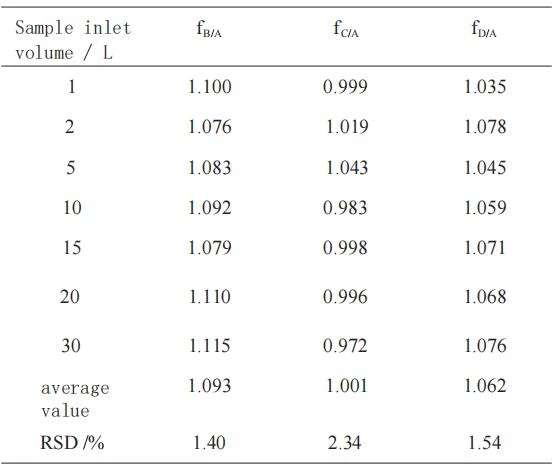
Note: A: Echinacea, B: Tuberoside A, C: Verbasin, D: Isaveraside
2.2.8 Reproducibility of relative correction factors
Three high-performance liquid chromatographs, Shimadzu LC-20AT, Shimadzu LC-20AB, Agilent1260 and INERTSILODS-3 (250mm×4.6mm, 5μm), XBridgeC18 were investigated respectively.

The effects of three chromatographic columns (250mm×4.6mm, 5μm) and Agilent C18 (250mm×4.6mm, 5μm) on the relative correction factor, and calculating the RSD, the results are all less than 3%, indicating that the established relative correction factor in different high-efficiency liquids. The phase chromatograph and different chromatographic columns were reproducible, the results are shown in Table 5
Table 5 Relative correction factors (fi/s) of 3 components and echinacoside by different instruments and different HPLC columns
| instrument | chromatographic column | F b/a | F c/a | F d/a |

Note: A: Echinacea, B: Tuberoside A, C: Verbasin, D: Isaveraside
2.2.9 Positioning of chromatographic peaks of components to be measured
According to the retention time obtained under "2.2.8", calculate the relative retention value of the component to be tested and the internal reference echinacoside (ri/s= tRi/tRs, where tRi and tRs are the retention time) and its RSD. Results The RSDs of the relative retention values of the components to be tested were all less than 5%, indicating that the relative retention values were stable and could be used for the location of the chromatographic peaks of the components to be tested. The results are shown in Table 6.
2.2.10 Comparison of measurement results between one test and multiple evaluation method and external standard method
Precisely weigh each batch of samples, prepare the test solution according to the item "1.2.1.3", accurately draw 10 μL of the mixed reference solution and the test solution, and inject the samples according to the chromatographic conditions under "1.2.2.1". , record the peak areas of the four components, and use the external standard method and the established one-measurement-multiple-evaluation method (Wi=fi/s×Ws×Ai/As) to calculate the contents of the four components respectively. The results are shown in Table 7. SPSS 26.0 software was used to analyze the results of the two methods by t test, P > 0.05, indicating that there was no significant difference between the content measured by the external standard method and the content calculated by the one-test, multiple-evaluation method, indicating that the one-measurement and multiple-evaluation method can be used for Cistanche deserticola decoction pieces , quality control research of active ingredients in extracts and health products.
Table 6 The relative retention values (ri/s) of 3 components and echinacoside by different instruments and different HPLC columns

Note: A: Echinacea, B: Tuberoside A, C: Verbasin, D: Isaveraside
3 Conclusion of choosing the best way to take Cistanche
In order to improve the efficiency of identification and the diversity of identification methods, this test added two components, ductoside A and isaveraside, on the basis of the identification test under the item of Cistanche deserticola in the 2020 edition of the Chinese Pharmacopoeia. The development conditions of the Pharmacopoeia were used: methanol. - Glacial acetic acid - water = 2:1:7, it was found that the separation degree of echinacoside and tuberoside A could not meet the requirements, and the screening test of stationary phase and developing agent was carried out respectively.
Using polyamide film plate, silica gel G thin-layer plate, silica gel H thin-layer plate as stationary phase, acetone-methanol-glacial acetic acid-water=1:2:1:7, methanol-glacial acetic acid-water=4:1: 5. Ethyl acetate:ethanol=6:4, n-butanol-ethanol-water=4:1:5, trichloromethane-methanol-glacial acetic acid-water=1.5:2:1:7 Results Using polyamide film plate as the stationary phase, chloroform-methanol-glacial acetic acid-water=1.5∶2∶1∶7, the spots were clear, the separation was good, the Rf value was moderate, and the repeatability was good. Quick and accurate characterization of ingredients. The one-measurement-multiple-evaluation method is a multi-index synchronous quality control method, which is mainly used in the determination of similar structural components in a single traditional Chinese medicine. The four components measured in this experiment have similar structures and similar maximum absorption wavelengths (Echinacea glycosides at 330nm, tuberoside A331nm, verbascoside 330nm, isorrascoside 327nm), so this method can be used. Using echinacoside as the internal reference, the established calibration factor has good reproducibility in different chromatographic systems and chromatographic columns, and there is no significant difference between the content results of the one-measurement-multiple-evaluation method and the external standard method, indicating that the method is feasible and accurate, and it can be used in the reference substance. If it is difficult to obtain or expensive, it can achieve multiple indicators of Cistanche deserticola
The ingredients are determined simultaneously.
Table 7 Content of each components (%,n=3)

In conclusion, the establishment of a method for the identification of four phenylethanoid glycosides in Cistanche by TLC and the determination of the content in one test with multiple evaluations is accurate, reliable, simple, rapid, and highly feasible. It has practical scientific significance and application value.