Research Progress On Chemical Composition And Pharmacological Effects Of Jichuan Decoction And Prediction Of Quality Markers .
Oct 16, 2024
Abstract: Jichuan decoction was first published in Zhang Jiebin's Jingyue Quanshu, which is a classic prescription for the treatment of constipation, which has pharmacological effects such as promoting smooth muscle excitation, regulating water metabolism, regulating neurotransmitters, and maintaining intestinal environmental homeostasis to treat constipation, and is often used in the treatment of functional and senile constipation in clinical practice. Based on the summary of the chemical composition and pharmacological effects of Jichuan decoction, combined with the "five principles" of quality markers of traditional Chinese medicine, this paper predicts that ferulic acid, echinacoside, verbascoside, ferulic acid, naringin, neohesperidin, liminoid, caffeic acid, and butyl peptidyl lactone can be used as quality markers for Jichuan decoction, and establish relevant preparation quality standards for Jichuan decoction.
Keywords:Jichuan decoction; Quality markers; Chemical composition; Clinical application;Pharmachologic effect

TREATMENT OF CONSTIPATION NEW HERB CISTANCHE
Jichuan Decoction is one of the classic prescriptions, which was first recorded in the Complete Works of Jingyue by Zhang Jiebin. Later generations also recorded in the Re-edited Popular Treatise on Febrile Diseases that "Jichuan Decoction focuses on the liver and kidneys. The kidneys are responsible for defecation and urination, so the main ingredients are Cistanche and Achyranthes bidentata to nourish the kidney yin and relieve constipation. The liver is responsible for dredging and purging, so the auxiliary ingredients are Angelica sinensis and Citrus aurantium, which are pungent and moisten the liver yin, and bitter and purify the liver qi. The magic is that Cimicifuga euphratica can raise the clear qi to transport to the spleen, while Alisma orientalis can lower the turbid qi to transport to the bladder, and Cimicifuga and Achyranthes bidentata can assist in moistening and purging[1]." This explains that Jichuan Decoction has the characteristics of "draining while tonifying, and raising while descending". This prescription is mainly used to treat kidney yang deficiency, deficiency of essence and fluid, constipation, clear and long urination, soreness of the waist and knees, dizziness, pale tongue with white fur, and slow pulse. Jichuan Decoction is composed of six herbs: Angelica sinensis, Achyranthes bidentata, Cistanche deserticola, Alisma orientalis, Cimicifuga euphratica, and Citrus aurantium[2]. Jichuanjian is a basic prescription for treating constipation. In recent years, modern research on Jichuanjian has made great progress. To better exert its therapeutic effect, this paper summarizes its chemical composition and pharmacological effects, and analyzes and predicts the quality markers of Jichuanjian in combination with the five principles of quality markers (Q-Marker), providing a basis for the quality control of Jichuanjian preparations.
1 Chemical composition
1.1 Analysis of the chemical composition of single herbs
1.1.1 Angelica
The main components of Angelica include volatile oils[3], phenols, organic acids[4], polysaccharides[5], flavonoids, and other compounds. Zhang Qingqing[4] used ultra-high performance liquid chromatography-quadrupole-time of flight tandem mass spectrometry to identify and infer 72 compounds from Angelica, including 55 phenols, 13 organic acids , and 4 other compounds, mainly including ZZ-ibutilide libutilideA, 3-butyl-(3H)-isobenzofuranone, etc. Meng Ying[6] detected four components, namely ferulic acid, ibutilide, ibutilide, and libutilide from Angelica medicinal materials and Angelica decoction pieces. Lu Chenna[7] conducted content determination on Chinese angelica root and its decoction pieces and found that different batches of Chinese angelica root powder contained ingredients such as ferulic acid, chlorogenic acid, ligusticolide H, ligusticolide, libutilideand butylphthalide.

1.1.2 Achyranthes bidentate
The main chemical components of Achyranthes bidentata include phenylethanol glycosides, polysaccharides, alkaloids, ferulate ketones , and other ingredients[8]. Teng Li[9] used silica gel column chromatography, high-performance liquid chromatography, and other chromatographic methods to separate and purify the chemical components of Rhizoma Cynomorii and identified 15 chemical components including 3, 5-dimethoxy-benzyl alcohol-4-O-β-D-glucopyranoside, diacylglycerol 2,4,6-trimethoxyphenol-1-O-β-D-pyranoglucoside, lakeside pyrocatechol-1-O-β-D-glucopyr-anoside, tinotuberide, isoscopoletin-β-D-glucoside, 6, 7-7-dimethoxy coumarincyasterone, and 25-epi-28-epi-cyasterone.
Xu Zhipin[10] studied the aerial parts of Achyranthes bidentata and isolated and identified 21 compounds, including glycosides, amides, phenolic acids, etc. The main components were haploperoside A, 1′-O-benzyl-α-L-rhamnopyranosyl-(1→6)-β-D-pyranoglucoside, caffeic acid, trans-ferulic acid, etc. Li Jianpeng[11] used quadrupole-electrostatic field ion trap technology to analyze and determine the contents of 8 components in Achyranthes bidentata, including β-ecdysterone, 225-R-aldosterone ginsenoside R0, oleanolic acid-3-O-β-D-glucuronide, and ginsenoside I.

1.1.3 Cistanche deserticola
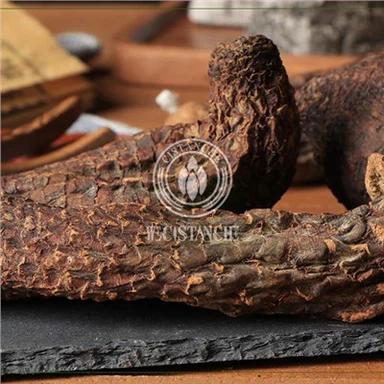
Cistanche deserticola contains a variety of chemical components, mainly phenylethanol glycosides[12][13], iridoids, lignans[15] and their glycosides, sugars[14], etc. Song Qingqing[15] separated more than 70 phenylethanol glycosides, 26 iridoids, and 16 lignans through mass spectrometry analysis, as well as other components such as benzyl alcohol glycosides, phenolic glycosides, sterols, and alkaloids. Wang Liwei[16] used reversed-phase silica gel chromatography and HPLC to separate and purify sugar compounds such as 2-acetyl-3-rhamnosyl-4-caffeoylglucose and 2,6-dimethyllotan-1,8-diol dglucoside In addition to sugar compounds, there are also adenosine, p-hydroxycoumari ,and β-sitosterol. Some studies have also separated a variety of amino acids such as leucine and lysine and organicacacids and chemicall components such as chlorogenic acid and caffeic acid[17]18].
1.1.4 Alisma Orientalis
The main components of Alisma Orientalis are triterpenes[19] and sesquiterpenes[21], and the secondary chemical components include diterpenes, volatile oils, nitrogen-containing compounds, phenylpropan oid ,and others[20]. Zhu Huaichang et al.[21] isolated and identified 15 compounds from the water extract of Alisma Orientalis, including β-D-fructofuranose, β-D-ethylfructofuranoside, 5-hydroxymethylfurfural, sucrose, raffinose, stachyose, verbascoside, and mannotriose, including 8 sugars, 2 sesquiterpenes and triterpenes substituted with a carbonyl group at position 16. Wu Shuangshuang et al.[22] used UPLC-MS to detect 8 triterpenoid components in Alisma Orientalis, including alisamol A, alisamol B, alisamol F, and 23-acetyl alisamol B.
1.1.5 Cimicifuga
The main chemical components of Cimicifuga include triterpenes and their glycosides[23], phenolic acids, chromones a, volatile oils[24]. Chen Liyi[25] sorted out the "Chinese Pharmacopoeia" in the past 20 years and found that there were a total of 542 compounds isolated from the original varieties of Cimicifuga, including 380 triterpenes and their glycosides, 77 phenolic acids, 12 chromones, and 73 other compounds. Hao Yimeng et al.[26] conducted a systematic study on the chemical components of the n-butanol extract of Cimicifuga dahurica and isolated and identified 11 compounds including alopecuquinone, 3-hydroxymegastigmasta-5, quercetin 3-O-β-D-galactoside, northern cimicifuga, caffeic acid, cimicifuga, and icariin B2. Lu Qing et al. [27] used macroporous adsorption resin to separate 20 compounds from the rhizomes of Cimicifuga dahurica, including 5-hydroxy-2-methoxybenzoic acid, benzoic acid-4-O-β-D-glucoside, ferulic acid-4-O-β-D-glucoside, sinapinic acid-4-O-β-D-glucoside, and syringaresinol as the main components.
1.1.6 Citrus aurantium The main components of Citrus aurantium include flavonoids [28], alkaloids, coumarins, limonin, and cyclopeptides [29]. Liu Xinyuan et al. [30] separated and identified 16 compounds from the methanol extract of Citrus aurantium, including pyrrolezanthine-6-methylether, 3-hydroxy-4-methoxybenzoic acid methyl ester, 3-hydroxy-4-methoxybenzoic acid, hesperidin, and naringin, which are 8 flavonoids, 6 benzene ring derivatives, 1 coumarin, and one furan derivative. Wei Feiting et al. [31] used UPLC-TOF/MS and GC-MS techniques to analyze the methanol extract and volatile oil of Citrus aurantium and identified and inferred 214 chemical components, including D-limonene, β-linalool, piperidine carboxylic acid, N-methyltyramine abscisic acid, (2S)-6''-O-acetoxyprunin, isovitexin, etc. The study found [32] that the processing of Citrus aurantium produced in Hunan had a significant impact on the content of components with high content of rutin, naringin, hesperidin, neohesperidin, and citrus glycosides.

1.2 Analysis of compound chemical components
The purpose of studying the chemical components of Chinese medicine ccompoundsis to explain the material basis of the efficacy of Chinese medicine. Some scholars have separated and identified the chemical components of Jichuan Jian. Shi CChongqinget al. [33] used HPLC to establish the characteristic spectrum of Jthe ichuan Jian material standard, screened out 18 common characteristic peaks, and identified 7 characteristic peak components including caffeic acid, echinacoside, ferulic acid, iis ferulicacid, verbascoside, naringin, and neohesperidin. Cao Ningning [34] used HPLC combined with CA and PLS-DA to perform fingerprint analysis on 15 batches of Jichuan Jian material standards,and identified echinacoside, neohesperidin, libutilide naringin, ferulic acid, iis ferulicacid, verbascoside ,and other components. Through the above studies, it was found that the quality of Jichuan Jian material standard is relatively stable and can reflect the main components of Jichuan Jian. The determination of quality markers provides a scientific method and an important guarantee for the multi-index quality control of Chinese medicine compound preparations.