Role Of Defensins in Tumor Biology Part 1
May 25, 2023
Abstract:
Defensins have long been considered merely antimicrobial peptides. Throughout the years, more immune-related functions have been discovered for both the α-defensin and β-defensin subfamilies. This review provides insights into the role of defensins in tumor immunity. Since defensins are present and differentially expressed in certain cancer types, researchers started to unravel their role in the tumor microenvironment. The human neutrophil peptides have been demonstrated to be directly oncolytic by permeabilizing the cell membrane. Further, defensins can inflict DNA damage and induce apoptosis of tumor cells. In the tumor microenvironment, defensins can act as chemoattractants for subsets of immune cells, such as T cells, immature dendritic cells, monocytes, and mast cells.
Additionally, by activating the targeted leukocytes, defensins generate pro-inflammatory signals. Moreover, immuno-adjuvant effects have been reported in a variety of models. Therefore, the action of defensins reaches beyond their direct antimicrobial effect, i.e., the lysis of microbes invading the mucosal surfaces. By causing an increase in pro-inflammatory signaling events, cell lysis (generating antigens), and attraction and activation of antigen-presenting cells, defensins could have a relevant role in activating the adaptive immune system and generating anti-tumor immunity, and could thus contribute to the success of immune therapy.
Targeting white blood cells is a new approach in the treatment of cancer and immune diseases, which can activate the immune system and thus enhance immunity. Targeted leukocyte therapy is to selectively activate immune cells such as T cells, B cells, and natural killer cells, and guide them to attack cancer cells or foreign bodies in the body, to achieve the purpose of treatment.
The key to targeting white blood cell therapy is to stimulate the immune system's response and take appropriate measures to ensure that it has minimal impact on the cells being attacked. During this process, immune cells are fired up and release cytokines and catalysts, chemicals that activate the response of other immune cells, leading to increased inflammation in the body, which boosts immunity.
Therefore, targeted leukocyte therapy can activate the body's immune system, enhance immunity, and cooperate with the body's immune system to produce better therapeutic effects. It can be seen that we need to pay special attention to the improvement of immunity. Cistanche can significantly improve immunity. Meat ash contains various biologically active components, such as polysaccharides, two mushrooms, Huang Li, etc. These ingredients can stimulate the immune system of Various types of cells, and increase their immune activity.

Click health benefits of cistanche
Keywords:
defensins; tumor biology; immune cells.
1. Introduction
Defensins are a family of small cationic peptides containing six cysteine residues connected via three intramolecular disulfide bonds, with a central β-sheet dominating their structure [1,2]. Three subfamilies have been discovered. Lehrer and colleagues identified the first mammalian α-defensins from rabbit granulocytes in 1984. Later, in 1985, they reported the first human defensin sequences, which they initially referred to as antibiotic peptides derived from neutrophils or human neutrophil peptides (HNPs) [3,4]. They also introduced the term ‘defensins’ for the highly related peptides HNP-1 to 3, based on their antibacterial, antiviral, and antifungal properties empowering the host defense [4].
Later, HNP-4 was discovered, with the same cysteine backbone as the other myeloid HNPs, but with a slightly different sequence and significantly more hydrophobic amino acids [5]. Only about 2% of the total neutrophil defensin content is HNP-4, which is probably the reason it was overlooked during the discovery of the first three HNPs [6]. Not all mammals have leukocytic α-defensins, as these have only been reported in primates, rabbits, and some other rodent species [2].
In this regard, it is important to note that mice lack neutrophil αdefensins [7]. Consequently, researching the role of neutrophil defensins in murine models is only possible in transgenic mice. However, murine intestinal Paneth cells produce αdefensins, which are also referred to as crypts [8]. Similar to neutrophil defensins, enteric crypts have antimicrobial properties, but the murine crypts largely outnumber the group of four human myeloid defensins [9,10]. Around the time of the discovery of the mouse crypts, two α-defensins were also found to be secreted by human Paneth cells: human defensin 5 and human defensin 6 (HD-5 and HD-6), sharing properties with the myeloid α-defensins [11,12]. HD-5 and HD-6 conclude the group of the six-known human α-defensins.

The next subfamily that was identified was the β-defensins. Even though their name suggests that those arose after the α-defensins, β-defensins are much older on an evolutionary scale, since α-defensin genes (DEFA) descend from β-defensin genes (DEFB) and both families seem to have evolved from a common pre-mammalian defensin gene [13,14]. Human β-defensins are also more numerous, as almost 40 human β-defensin genes have been identified [15,16]. Interestingly, β-defensins were first detected in the tracheal mucosa of cows [17], and additional β-defensins were purified from bovine neutrophils [18]. It was in 1995, ten years after the first description of α-defensins in humans, that the first human β-defensin was isolated: the human β-defensin-1 or hBD-1 [19]. Since then, more β-defensins have been discovered, and these are all expressed in epithelial and/or mucosal tissues providing antimicrobial protection at sites that are almost continuously in contact with microorganisms [16].
The next subfamily that was identified was the β-defensins. Even though their name suggests that those arose after the α-defensins, β-defensins are much older on an evolutionary scale, since α-defensin genes (DEFA) descend from β-defensin genes (DEFB) and both families seem to have evolved from a common pre-mammalian defensin gene [13,14]. Human β-defensins are also more numerous, as almost 40 human β-defensin genes have been identified [15,16]. Interestingly, β-defensins were first detected in the tracheal mucosa of cows [17], and additional β-defensins were purified from bovine neutrophils [18]. It was in 1995, ten years after the first description of α-defensins in humans, that the first human β-defensin was isolated: the human β-defensin-1 or hBD-1 [19]. Since then, more β-defensins have been discovered, and these are all expressed in epithelial and/or mucosal tissues providing antimicrobial protection at sites that are almost continuously in contact with microorganisms [16].
In general, the structure of human defensins is characterized by a triple-stranded antiparallel β-sheet, held in place by three disulfide bonds [1,21,22] (Figure 1). In αdefensins these disulfide bonds are formed between cysteine residues 1–6, 2–4, and 3–5, while in β-defensins this is between cysteine residues 1–5, 2–4 and 3–6, resulting in a slightly different structure [2].
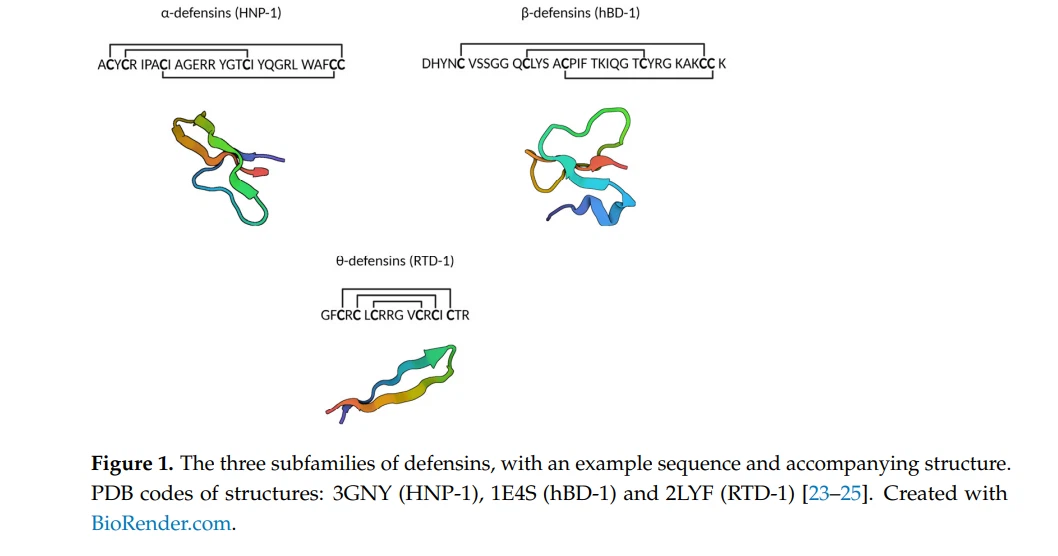
Soon after their discovery, it was concluded that defensins act primarily as antimicrobials, but even at the time, it was suggested that defensins may also play a role in inflammation, tissue injury, and other processes [26].
Currently, defensins are included in the alarmin family. Alarmins have been thoroughly studied in the context of their role as first-line defenders protecting the host. They are proteins or peptides that act as initiators of a diverse range of immune-related processes [27]. They belong to the broader family of DAMPs (damage-associated molecular patterns) and can be subdivided based on their origin: some are granule-derived, such as defensins, cathelicidin, and eosinophil-derived neurotoxin; some have a nuclear origin, such as high mobility group box 1; and some originate from the cytoplasm, e.g., the heat shock proteins [27]. Most granule-derived alarmins are also known as antimicrobial peptides or AMPs, and this subgroup includes defensins.
In normal circumstances, the innate and adaptive immune systems work together to protect us from non-self threats, such as bacteria and viruses. However, although cancer originates from ‘self’ cells, our immune system can recognize and kill malignant cells due to their altered antigenic composition and biological behavior [28,29]. The genetic instability of cancer cells is the primary source of tumor-specific antigens [29]. In addition, epigenetic abnormalities, changing gene expression, also play an important role in cancer and may cause transcription of genes normally restricted to fetal development during adult life [29,30]. Besides being antigenic, many tumors try to escape from the immune system by creating an immune-suppressive environment.
It is therefore clear that the interplay between the immune system and tumor cells is complex, and with the rise of immunotherapy, the importance of anti-tumor immunity and possible immune escape should not be overlooked. Here we summarize the potential roles of defensins in the tumor microenvironment (TME), as more and more evidence indicates immune-related functions beyond simple antimicrobial activity.

2. Direct Effect on Tumor Cells
First, similarly to their antimicrobial effect, α-defensins may have a direct cytotoxic effect on tumor cells. The possible mechanisms of action vary from direct physical interactions with the membrane to the activation of cell death pathways (Figure 2). HNP-1 to 3 induced cell death in A549 cells and Jurkat T-cells associated with mitochondrial injury and other unspecified pathways, with signs of caspase-3/-7 activation [31,32]. Additionally, HNP-1 accumulated in the endoplasmic reticulum before the caspase-3 activation in A549 cells [33]. When recombinant HNP-1 was expressed in A549 cells, it caused significant growth inhibition due to a (probably similar) apoptotic mechanism triggered by the intracellular HNP-1. This anti-tumor activity was also proven in vivo, as tumor cell apoptosis, decreased microvessel density, and increased lymphocyte infiltration were seen in mice treated with a eukaryotic expression plasmid encoding HNP-1 [34].
In a biomechanical study with PC-3 cells, Gaspar and colleagues showcased the cytotoxicity of HNP-1, which caused morphological modifications associated with membrane permeabilization [35]. They suggested a two-step cell injury process: first, the membrane is permeabilized allowing HNPs to enter the cell, and next DNA damage occurs, as HNPs can induce single-strand DNA breaks [35,36]. Depending on the defensin concentration, membrane disruption can be caused by the dimerization of HNP-1, where the hydrophobic side of the dimer faces the lipid chains of the membrane while the polar side forms an aqueous pore, causing cell leakage [37]. The relative ‘selectivity’ of HNPs for cancer cell membranes can be explained by the enrichment in phosphatidylserine in cancer cell membranes, making those more anionic and increasing the chance of interaction with the cationic HNPs [35,38]. High local concentrations of HNP-1 (≥10 µg/mL) also exerted cytotoxic effects on keratinocytes, primary epithelial cells, and fibroblasts [39,40].
Similarly, exposure of oral squamous cell carcinoma cells to high concentrations of HNP-1 resulted in an oncolytic effect [41]. αdefensins purified from neutrophils also showed a synergistic anti-tumoral effect when administered with the antibiotic, nisin, by inducing apoptosis on the prostate (PC-3) and colorectal cancer (HCT-116) cell lines [42]. Not only are the neutrophil-derived defensins cytotoxic, but α-defensin 5, which is mainly expressed in Paneth cells, affects tumor cell viability. Colon cancer cell proliferation and colony formation capacity was significantly decreased by DEFA5 overexpression. In nude mice, overexpression of this gene suppressed tumor growth. The mechanisms behind its tumor suppressive effect involve phosphoinositide 3-kinase, as DEFA5 binds directly to its signaling complex, leading to delayed cell growth and metastasis [43]. Interestingly, hBD-1 can alter human epidermal growth factor receptor 2 (HER2) signal transduction and urine-derived hBD-1 was able to suppress bladder cancer growth [44].
In human hepatocellular carcinoma (HCC) cell lines, the expression of hBD-1 is dramatically downregulated, and rescuing its expression effectively suppresses cell proliferation and colony-forming ability. When tested in a nude mouse hepatocellular carcinoma model, hBD-1 expression inhibited tumor growth by inducing protein degradation and endoplasmic reticulum (ER) stress, and this subsequently activated the c-Jun N-terminal kinase (JNK) pathway, which mediated the inhibitory effect of hBD-1 [45]. Furthermore, hBD-2 and -3 were reported to contain an oncolytic motif that binds to phosphatidylinositol 4,5-bisphosphate. This interaction is critical for mediating cytolysis of tumor cells, and experiments with hBD-2 showed that the defensin killed tumor cells via acute lytic cell death instead of apoptosis [46,47]. Other research confirmed this, as A549 adenocarcinoma cells treated with hBD-3 displayed immediate cell membrane damage.

Furthermore, Defb14, the mouse homolog of hBD-3, was able to significantly diminish tumor growth of Lewis lung carcinoma in mice when continuously infused [48]. hBD-5 also showed promising in vivo anti-cancer efficacy in a 1,2-dimethylhydrazine-induced colon cancer model. A decrease in tumor parameters, aberrant crypt foci, and an increase in apoptosis rate were observed, concomitantly with tumor infiltration by neutrophilic granulocytes. Colons of hBD-5-treated mice even revealed a restoration of the normal architecture. hBD-5 binds more to cancerous cells, due to the altered fluidity of their cellular membranes, ultimately not affecting healthy host cells [49]. Even though θ-defensins are only found in certain Old-World monkey species, their tumor cell-killing capacities cannot be ignored. Serine-rich θ-defensin analogs showed more cytotoxicity toward breast cancer cell lines than towards normal mammary epithelial cells.

More importantly, the analogs had a synergistic effect on cisplatin and doxorubicin hydrochloride treatment of a triple-negative breast cancer cell line [50]. Not only animals have antimicrobial peptides. PvD1 is an example of a defensin-like antimicrobial peptide found in the common bean plant (Phaseolus vulgaris), which also seems to have some direct anti-cancer activity [51,52]. The peptide had a different effect on normal compared to tumor cells, as it was able to reach the interior of breast tumor cells and induce apoptotic events. Similar to other defensins, PvD1 interacts with membranes and sometimes causes disruptions. In addition, PvD1 modulated cell-to-cell adhesion. This could be an interesting way to prevent cancer cell adhesion to healthy tissue and suppress metastatic spreading [52].
For more information:1950477648nn@gmail.com