Study On The Flash Extraction Process Of Echinaside And Piloside From Cistanche Deserticola
Mar 16, 2023
Liu Yaowei 1, Su Zihao 2
1. Inner Mongolia Shibo Health Service Industry Investment Management Co., Ltd., Ordos 017000, Inner Mongolia; Southern Medical University, Guangzhou, Guangdong 510515
[Abstract]
In this paper, the extraction process of Echinacoside and Acteoside from Cistanche deserticola was studied. The extraction process of active components from Cistanche deserticola was optimized, and the polysaccharide from Cistanche deserticola was purified; Physical and chemical properties of a refined polysaccharide from Cistanche deserticola, the establishment of plant atlas of Cistanche deserticola; The random amplified DNA polymorphism (RAPD) fingerprints of Cistanche deserticola were introduced in detail. The flash extraction method for extracting Echinacoside and Acteoside from Cistanche deserticola is simple, high extraction rate that is short and time-consuming, and energy saving, which can provide a basis for the development of new drugs and industrial production of echinacea and poolside, and has better promotion value.
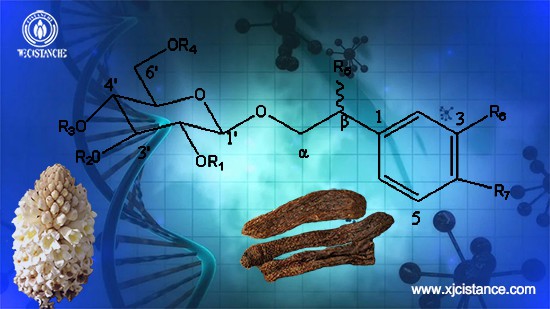
Main chemical constituents of Cistanche deserticola—Phenylethanol glycoside

Main chemical constituents of Cistanche deserticola—Echinacoside

Main chemical constituents of Cistanche deserticola—Acteoside
[Key words]Cistanche deserticola; Echinacoside; Acteoside; Flash extraction process; Process study
[Chinese Library Classification No.] TQ914 [Document identification code] A [Article No.] 2096-5249 (2020) 23-0027-02
Cistanche deserticola ma,known as "desert ginseng", is a kind of substance with a very complex chemical composition, which is classified as a multi-component complex system. The variety of its medicinal materials is very rare, and it is difficult to store, produce, or process to some extent, which is the focus of the current research staff of Cistanche deserticola. The drug Cistanche deserticola, role is the result of the joint efforts of many components, and each chemical component cannot be ignored. However, the effective component of this drug is still an unclear topic, and how the effective component plays its role is not clear. Therefore, many studies on this drug are often conducted on its whole or individual chemical components. If relevant staff want to effectively develop the forward research of traditional Chinese medicine, they need to start from the perspective of quality control and establish and improve the standard system of quality control of modern cistanche deserticola. The most common evaluation method for the quality stability of Cistanche deserticola is fingerprint analysis technology, which can provide comprehensive information to better evaluate the quality of medicinal materials by reflecting the type and quantity of chemical components in Cistanche deserticola.

Click here to view Cistanche Extract products
【Ask for more】 Email: xue122522@foxmail.com / Whats App: 0086 18599088692 / Wechat: 18599088692
1. Experimental method
1.1 Selection of extraction methods of Cistanche deserticola
The experimenter accurately weighed 3 dry and powdered sections of Cistanche deserticola 10.0g with a balance. First of all, extract 100g of purified water. The first portion of powdered Cistanche deserticola needs to be effectively extracted by the reflux method. In the actual operation process, ensure that the number of reflux extraction is 2 and that each extraction operation is controlled at about 2h.
The second powder of Cistanche deserticola needs to be effectively extracted by cold immersion method. After extraction, the relevant staff needs to put it in a room temperature environment, block all the light, and completely soak it, and the soaking time is controlled at 2 days [1].
The third powder of Cistanche deserticola needs to be effectively extracted by ultrasonic method for the internal cost of its medicinal materials. In the actual operation process, ultrasonic extraction is selected twice, and the extraction time of each time is controlled at 1h. Then, through the correct operation of the polysaccharide content determination method, the processed three-part powdered Cistanche deserticola was reasonably analyzed and compared as a whole, and the results were analyzed and compared. The most suitable extraction method was selected from different extraction methods according to the actual needs.
1.2 Investigation of the extraction process
When investigating the actual extraction process, the relevant staff needs to effectively take out the dried prepared Chinese herb cistanche slices, and then use petroleum ether at 60 ℃~90 ℃ for reflux extraction. During the reflux extraction, it is necessary to ensure that the volume content of petroleum ether is 10 times the volume of the dried prepared Cistanche deserticola slices. During reflux extraction, it is necessary to strictly control the length of reflux extraction, preferably at 2h/time. After refluxing extraction, the relevant staff needs to filter out the petroleum ether, and then dry the prepared Cistanche deserticola slices, and then refluxed them with ethanol. During refluxing extraction, it is necessary to ensure that the volume content of ether is 10 times the volume of the dried prepared Cistanche deserticola slices and that the content of ether is 80%. During reflux extraction, it is necessary to strictly control the duration of reflux extraction, preferably at 2h/time, for a total of two times. After reflux extraction, filter the remaining Cistanche deserticola residue [2].

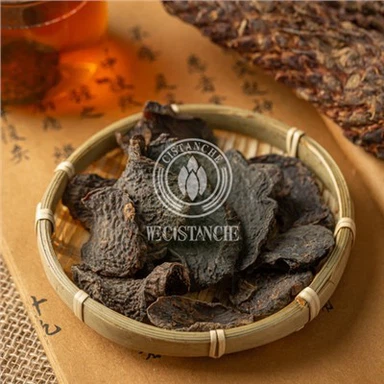
Cistanche deserticola slices
The relevant staff will extract the dried Cistanche deserticola residue with distilled water reflux. After reflux extraction, the filtrate will be combined for processing, and then it will be concentrated by rotary evaporation. Then, the relevant staff needs to set the concentration of ethanol as a variable and select different concentrations of ether to soak the dried filter residue. During the soaking, it is necessary to ensure that the volume content of ether is 5 times the volume of dried Cistanche deserticola, and the indoor temperature of ether and the temperature of ether are 4 ℃. After standing overnight, the relevant staff reasonably constructed the centrifuge to effectively collect the precipitated polysaccharides. After the collected polysaccharides are dried in a vacuum, they become the crude polysaccharides of Cistanche deserticola.
1.3 Determination of polysaccharide content
The content of polysaccharides in Cistanche deserticola was determined by the phenol-sulfuric acid method [3].
2 .Experimental method for establishing the liquid phase fingerprint of Cistanche deserticola

"Desert ginseng"Cistanche deserticola
2.1 Preparation of test solution
Relevant staff used a balance to accurately weigh 1.0g of dried and powdered Cistanche deserticola slices. First, add methanol to 1.0g dry and powdery Cistanche deserticola slices, and the volume of methanol is controlled at 50mL. Then use ultrasonic extraction to extract the solution. At this time, it is necessary to control the time of ultrasonic extraction, which should be controlled at 30 minutes. During the extraction process, relevant staff needs to use methanol solution in time to supplement the weight. After 30min, the relevant staff will take 5mL of the extracted filtrate and evaporate it completely. Continue to add sufficient methanol solution to the container, and after complete dissolution, transfer the solution to a 10mL volumetric flask. Relevant staff add methanol solution until the solution height reaches the scale of the volumetric flask, and stop adding methanol solution. The relevant staff used a 0.45 µ m microporous membrane to effectively filter the solution, save the solution and prepare it for standby.
2.2 HPLC-UV chromatographic conditions
Relevant staff have extensively consulted relevant literature and data, and the results show that the test can be optimized, compared, and screened by chromatographic conditions, and the final combination can well define the chromatographic conditions: chromatographic column Kromasil (250 × 4.6 mm, 5 µ m), the total analysis time is set at 90 min, the injection volume is 10 µ l, the mobile phase is 0.5% acetic acid water (B) and acetonitrile (A) gradient elution, the flow rate is controlled at 1.0 mL/min, the detection wavelength is 310 nm, and the column temperature is 28 ℃ [4].
2.3 Methodology investigation
The results are effectively verified by precision experiment, repeatability experiment, and stability experiment.
3 .Summary

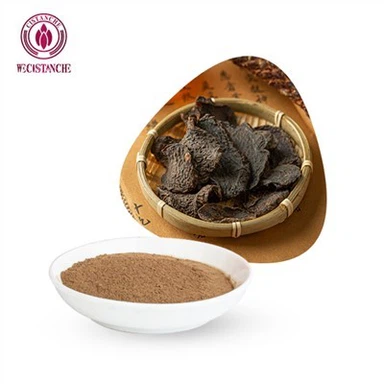
Cistanche powder
In this paper, a combination of multiple-column chromatography was used to effectively separate and purify the crude polysaccharide of Cistanche deserticola. At the same time, the relevant staff also used modern analytical techniques to determine its physical and chemical properties. The experimental process and results provide a reference for the staff to study the quality control of Cistanche deserticola. The HPLC-DNA fingerprint of Cistanche deserticola was established, and the similarity evaluation and cluster analysis were carried out to provide a reference for the scientific identification and quality standard of Cistanche deserticola.
reference
[1] Chu Qiao, Xi Xingjun, Yang Li. Study on the flash extraction process of echinacoside and piloside in Cistanche deserticola [J]. Food Research and Development, 2015,36 (16): 49-52
[2] Wang Qian, Wang Qizhi, Shi Weijing, et al. Comparison between response surface method and orthogonal design method to optimize the flash extraction process of total flavonoids from hollyhock [J]. Journal of Anhui University of Science and Technology, 2015,29 (05): 24-31
[3] Zhou Kang, Liu Yanze, Wang Zhongbo, et al. Optimization of flash extraction process of asiaticoside and comparative study of different extraction methods [J]. Chinese Journal of Traditional Chinese Medicine, 2011,36 (23): 3265-3267
[4] Dong Jieqiong, Wang Yimin, Li Jianxia, et al. The effect of hormone induction and abiotic stress on the content of resveratrol in the root of Polygonum cuspidatum and the optimization of the flash extraction process of resveratrol in the root of Polygonum cuspidatum [J]. Food Industry Science and Technology, 2016,37 (21): 210-215. Introduction to the author: Liu Yaowei (1961.7 -), male, this department, research direction: large health and old-age integrated industry; Su Zihao (1996.8 -), male, undergraduate, research direction: biomedical engineering.