Study On The Influencing Factors Of Farmers And Herdsmen's Willingness To Plant Cistanche in Alex, Xinjiang, China
Apr 13, 2022
Study on the influencing factors of farmers and herdsmen's willingness to plant Cistanche
in Alex, Xinjiang, China
Authors :
School of Economics and Management, Inner Mongolia Agricultural University
Abstract: As the decision makers and beneficiaries of cistanche planting behavior, whether farmers and herdsmen further expand planting is not only related to their own economic benefits, but also directly related to the sustainable development of the meat mugwort industry and the sand environment. Based on the survey data of 372 farmers and herdsmen in Alxa League, Inner Mongolia, the main producing area of mugwort, the binary Logisti model and intermediary effect model were selected to effectively analyze the influence of government policies and benefit cognition on farmers and herdsmen to expand the planting of cistanche.
The results show that:
1) planting subsidies, training times and policy satisfaction positively affect the willingness of farmers and herdsmen to expand meat mugwort planting.
2) The cognition of economic, social and ecological benefits has a positive intermediary role in the influence of training times and policy satisfaction on farmers and herdsmen's willingness to expand planting.
3) Education level, operation form, average per cost and expected price positively affect the willingness of farmers and herdsmen to expand the recommendation of cistanche, while the age of farmers and herdsmen has a negative impact.
Key words: cistanche; willingness to plant; government policy; benefit cognition, benefits of cistanche,cistanche deserticola benefits
1 Materials and research methods
1. 1 Data sources
The Alxa League, Inner Mongolia, the main producing area of Cistanche deserticola, was used as the research area. As of the end of 2020, the league has completed 723.3% of the artificial planting of Haloxylon. 050,000 mu, inoculated with Cistanche 134. 050,000 mu, with an annual output of more than 1,600 tons of dried Cistanche, which is quite representative. From December 2019 to January 2020, the main planting areas of Cistanche Alxa were selected: Alxa Left Banner (Jilantai Town, Wuliji Sumu, Yingen Sumu), Alxa Right
3 flags (Tamusu Bragg Sum) and Ejina Banner (Dongfeng Town, Wenduer Tu Sum), 3 flags, and 6 Sumu, 385 farmers and herdsmen conducted one-on-one inspections.

Site visit and complete the questionnaire. After sorting, 372 valid questionnaires can be used for empirical analysis, and the effective rate is 96.6%. 62%
1. 2 Variable Description and Descriptive Statistics
Based on the theory of producer decision-making behavior, the relationship between the expansion of Cistanche deserticola cultivation area and the price is considered. According to the equilibrium price theory of supply and demand, the arc elasticity formula is used to reflect the sensitivity of expanding the planting area.
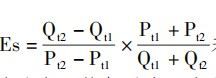
Among them, Q is the average annual yield of Cistanche; P is the average price per kilogram of dried Cistanche in the year; t is the year, representing the actual survey data from 2017 to 2019.
The calculation shows that the price elasticity of supply of Cistanche is 0 on average. 68, that is, the supply of Cistanche is inelastic, and the impact of price changes on changes in the planting area of Cistanche is relatively small. Therefore, this paper selects variables from multiple perspectives and comprehensively analyzes the key factors affecting farmers' and herdsmen's willingness to expand Cistanche cultivation.
1.2.1 Dependent variable
The dependent variable is whether farmers and herdsmen are willing to expand the planting area of cistanche. As shown in Table 1,283 of the 372 farmers and herdsmen were willing to expand cistanche planting, accounting for 76.08% of the total; 89 were unwilling to expand the planting area of cistanche, accounting for 23.92%.
Table1 Distribution of Distillation of sample farers and herdsmen's willingness to expand planting of Cisanche desirous
1.2.2 Core variables
Clodendron-cistanche planting has a typical positive externality, which needs the promotion and influence of government policies. According to the existing research and actual research , it is concluded that the main policy forms of incentive in the study area include direct financial and physical subsidies for cistanche cultivation, professional and technical training to indirectly improve the self-development ability of farmers and herdsmen, policy publicity, mechanization service, and other policies.
At the same time, farmers and herdsmen evaluate the effect of relevant policies is directly related to their planting enthusiasm ".Therefore, the government policy is finally measured from four dimensions of planting subsidy, policy awareness, policy satisfaction and training times.
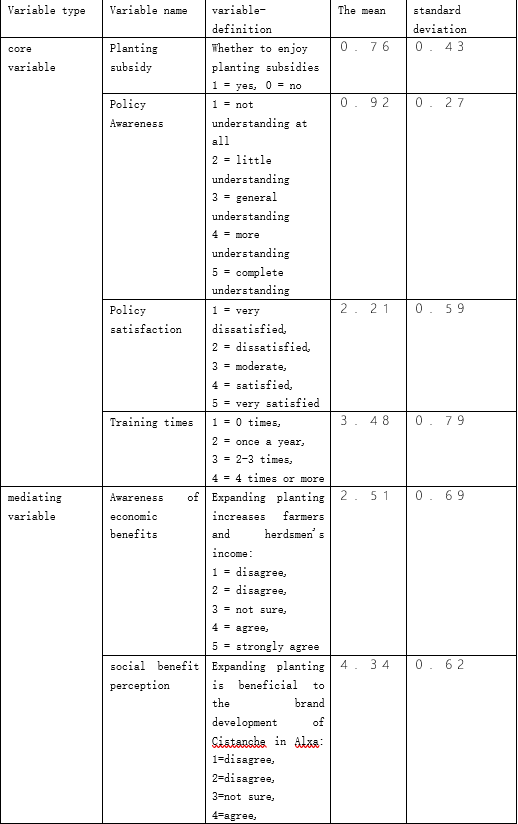
According to descriptive statistics, the average value is 0.92,2.21,3.48 and 2.51 respectively. It can be seen that the annual technical training provided by the government is about three times, and the awareness of farmers and herdsmen of the policy, the actual policy subsidies actually enjoyed and the average policy satisfaction are relatively low, which needs to be further improved.
1.2.3 Intermediation variables
According to the theory of planned behavior, the expansion behavior of farmers and herdsmen is mainly influenced by their attitudes and cognitive behaviors. Reference existing research..., finally choose "expand planting can increase farmers income", "expand planting is beneficial to alxa cistanche extract brand development", "expand planting to local desertification control" three issues, never agree to assign 1-5 points, according to the farmers and herdsmen to expand cistanche planting economy, social Meeting, the actual cognitive score of ecological benefits.
Table 2 shows that the average cognition of farmers and herdsmen on economic, social, and ecological benefits was 4.34,4.12,3.54.
Table 2 variables description and descriptive statistical analysis, respectively.


Note:
1 square kilometer = 1500 acres
1USD = 6.36 China Yuan
①Considering the planting period of Haloxylon and Cistanche deserticola, the planting area mentioned here is the area of Haloxylon ammonium forest suitable for grafting Cistanche deserticola
②The total cost of planting Cistanche deserticola includes the planting cost of Haloxylon ammodendron, the cost of inoculation of Cistanche deserticola, and the cost of later management and maintenance.
It shows that farmers and herdsmen are most sensitive to the economic benefits of expanding Cistanche cultivation. However, farmers and herdsmen have relatively low awareness of the ecological benefits of Cistanche cultivation, which may affect their subjective initiative.
1. 2. 4 Control variables
Among the control variables, the characteristics of farmers and herdsmen include age, education level, main labor force, and the ratio of Cistanche deserticola to household income. Table 2 shows that the average age of the head of the household is about 44 years old, the education level is generally not high, the average labor force per household is 2, and the income from Cistanche deserticola accounts for 78% of the household income on average. Among the planting characteristics, the planting area, cost per mu, and management form were selected as control variables. Among them, the average planting area of Cistanche deserticola is about 2451 mu, the average annual cost per mu is about 17 yuan, and the average value of the operating form is 1.1. 94. The degree of organization is relatively low. In the future, the promotion of farmers and herdsmen to participate in various forms of planting may further expand the planting area. The average values of expected price, sales method, and sales difficulty in the market sales characteristics are 2.56, 1.36, and 3.93, respectively. It shows that the future sales prospects of Cistanche are good, but the diversity of sales channels needs to be strengthened.
1.3 Model Construction
To study the influence of government policies and benefit cognition on farmers and herdsmen's willingness to expand Cistanche cultivation, take farmers' willingness to expand cultivation as the dependent variable, "willing" takes the value of 1, "unwilling" takes the value of 0, which is a binary variable. Therefore, the binary Logistic model is used for analysis, and its type can be expressed as:

Among them, P represents the probability of farmers and herdsmen to expand the planting area, 1-P represents the probability that farmers and herdsmen do not expand the planting area, X is each factor that affects the farmers and herdsmen to expand the planting area, α is a constant term, and b is the coefficient of X. ε is the random error term.
Use the mediation effect model to test that the independent variable X affects the dependent variable Y by affecting the mediating variable M. The specific model settings are as follows:

In (2) to (4): Yi is the situation of farmers and herdsmen expanding the cultivation of Cistanche, Mi is the awareness of farmers and herdsmen on the benefits of expanding the cultivation of Cistanche, Xi is the government policy variable, X∗i is the control variable, α0, α1 , β0 , β1 , Υ0 , and Υ1 are estimated coefficients, and ε1 , ε2 , and ε3 are random disturbance terms. Specifically: Equation (2) examines the direct impact of government policies on farmers and herdsmen’s willingness to expand Cistanche cultivation; Equations (3) and (4) test whether government policies affect farmers’ and herdsmen’s awareness of the benefits of expanding Cistanche cultivation, and then Affect its expansion of planting behavior.
2 Results and analysis
The multicollinearity among the variables was tested by the variance inflation factor (VIF), and the results showed that the VIFs were all less than 10, indicating that there was no multicollinearity problem. Use Stata14. 0 for binary logistic regression, and on this basis, the nonparametric percentile Bootstrap method [12] was used to analyze the mediating effect of benefit cognition on government policies and farmers and herdsmen expanding Cistanche cultivation behavior.
2.1 (Model regression result 1) Based on formula (2), models 1, 2, 3, and 4 were used to analyze the impact of government policies and control variables on farmers and herdsmen's willingness to expand Cistanche cultivation, and the results in Table 3 were obtained.
The planting subsidy and policy satisfaction in the government policy passed the test at a significant level of 5% respectively, and had a positive impact on the willingness to expand the cultivation of Cistanche deserticola. It shows that a certain form of policy subsidy can be used as transfer income to make up for the cost of Cistanche cultivation and enhance the enthusiasm of farmers and herdsmen to expand cultivation.
At the 1% significant level, the number of training has a positive effect on the willingness to expand planting. Combined with field research, it was found that in addition to training farmers and herdsmen on basic planting techniques and solving practical problems such as rodent damage to improve the survival rate of inoculation, the local government will also analyze the external market conditions of Cistanche, so that farmers and herdsmen can correctly understand the development prospects of Cistanche Thereby stimulating the enthusiasm for expanding planting.
Among the control variables, age negatively affects farmers and herdsmen's willingness to expand planting, that is, the older the farmers and herdsmen, the lower the enthusiasm for expanding Cistanche cultivation;
The educational level, management form, cost per mu, and expected price are positively affecting the willingness of farmers and herdsmen to expand Cistanche deserticola. (2) Based on Equation (3), analyze the impact of government policies on farmers and herdsmen’s cognition of economic benefits (Model 5), social benefit cognition (Model 6), and ecological benefit cognition (Model 7), as shown in Table 3.
Planting subsidies have a positive impact on economic benefit cognition at the 1% significant level, but social benefit cognition and ecological benefit cognition have not passed the significance test. It shows that after farmers and herdsmen receive planting subsidies, the first thing they perceive is the economic benefits realized after expanding planting, which reflects the profit-seeking nature of farmers and herdsmen.
The influence of policy satisfaction on the cognition of economic, social and ecological benefits respectively passed a significant influence of 5% and the coefficient was positive.
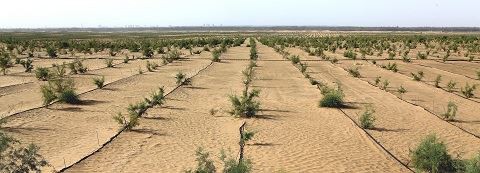
It shows that the study area guides farmers and herdsmen to participate in the ecological construction of the sandy area through effective policies, develops the characteristic ecological industry in the sandy area, and improves the economic, social and ecological benefits. Therefore, the higher the satisfaction of farmers and herdsmen with the implementation of the policy, the more they can perceive the overall welfare achieved by expanding the cultivation of Cistanche deserticola.
Table 3 Analysis of the impact of government policies on farmers and herdsmen's willingness to expand planting and benefit perception


The number of training positively affects farmers and herdsmen's cognition of economic benefits, social benefits and ecological benefits, but there are also some differences, and the significance levels are 1%, 5%, and 10%, respectively. It may be because the local government is gradually changing traditional planting methods and improving planting efficiency through technical training, and to a certain extent, it is also strengthening farmers and herdsmen to a certain extent. strength.
Table4 Test on the intermediary effect of benefit cognition


(3) Based on Equation (4), the influence of government policies and benefit cognition on farmers' and herdsmen's willingness to expand Cistanche cultivation was analyzed, and the regression results of models 8, 9 and 10 were obtained respectively. detailed analysis
See Table 4. Farmers and herdsmen's cognition of economic, social and ecological benefits to expand their planting willingness has a positive impact, indicating that farmers and herdsmen are more inclined to expand the cultivation of Cistanche as the farmers and herdsmen have a deeper understanding of the overall welfare brought by the cultivation of Cistanche. Among them, the economic benefit perception is significant at the 1% level. It shows that farmers and herdsmen realize that the higher the comparative benefit of expanding Cistanche cultivation, the greater the probability of further expanding the cultivation.
The social benefit cognition is significant at the 5% level because the farmers and herdsmen as "social people" clearly realize that since "Cistanche Alxa" obtained the geographical indication in 2012, the brand effect is obvious and the social benefit is significant. Therefore, the higher the awareness of farmers and herdsmen on the social benefits achieved by expanding Cistanche cultivation, the more willing they are to participate in the industrialization of Cistanche, that is, expanding Cistanche cultivation.
Ecological benefit perception was significant at the 5% level. It shows that when farmers and herdsmen agree that expanding Cistanche cultivation is beneficial to local desertification control, their subjective initiative is higher and they tend to expand cultivation. It may be because farmers and herdsmen have obvious costs to expand Cistanche cultivation, but the realized ecological benefits are cyclical and uncertain, so the degree of ecological benefit cognition is directly related to farmers and herdsmen's profit expectations and enthusiasm for expanding cultivation.
2.2 Test results of the mediating effect of government policies through bias correction
Bootstrap was used to test the mediation effect. It can be seen from Table 5 that the positive effect of training times on farmers' and herdsmen's willingness to expand Cistanche cultivation can be achieved through the mediating effect of cognition of economic, social, and ecological benefits. Explain that different forms of government training can improve farmers and herdsmen
Cognition of the benefits of expanding Cistanche cultivation, and then deepening the understanding of the importance of developing ecological industries in sandy areas, that is, further expanding Cistanche cultivation. Policy satisfaction indirectly affects farmers' and herdsmen's cognition of economic, social and ecological benefits achieved by expanding Cistanche cultivation, and the mediating effect values are 0.131, 0.068, and 0.102, respectively. The higher the evaluation, the more conducive to a comprehensive understanding of the comprehensive benefits of Cistanche cultivation, thereby enhancing the enthusiasm for expanding Cistanche cultivation. Planting subsidies directly affect farmers and herdsmen's perception of the economic benefits of expanding Cistanche cultivation, which in turn affects their willingness to expand planting.
3 Discussion
Combined with the theory of producer decision-making behavior and existing research, farmers and herdsmen's planting willingness is mostly affected and restricted by the price mechanism[13-14]. Through the calculation of supply elasticity formula, it was found that the supply of Cistanche deserticola lacked elasticity and was less affected by price changes. Therefore, according to the significant positive externalities of Cistanche cultivation and the theory of planned behavior, the key factors affecting farmers and herdsmen's willingness to expand Cistanche cultivation were analyzed from the perspective of government policy and benefit cognition.
Planting subsidies have a significant positive effect on farmers and herdsmen's willingness to expand Cistanche cultivation. This phenomenon may be related to the cost-benefit theory. Planting subsidies reduce the cost and risk of increasing the planting area, thus directly affecting the enthusiasm of farmers and herdsmen to expand Cistanche cultivation.
Policy satisfaction positively affects farmers and herdsmen's willingness to expand Cistanche cultivation, and enhances their enthusiasm for expanding cultivation by improving farmers' and herdsmen's benefit cognition level. The higher the policy satisfaction, the more trust the farmers and herdsmen have in the government, and thus they will respond more positively to the relevant policies focusing on the industrialization of Cistanche and expand the cultivation. On the other hand, farmers and herdsmen's high evaluation of the policy will also make them subjectively and clearly perceive the economic, social and ecological benefits achieved by increasing the planting area of Cistanche deserticola, and are more willing to expand the planting.
The number of trainings can not only directly affect the willingness of farmers and herdsmen to expand the cultivation of Cistanche deserticola, but also improve their awareness of benefits, thereby enhancing the willingness to expand the cultivation. The reason may be that while the government provides relevant technical training services, it also conveys the social driving function and green ecological development concept of the development of the Cistanche industry to farmers and herdsmen, improves farmers and herdsmen’s long-term welfare awareness of expanding Cistanche cultivation, and encourages them to further increase cultivation. area.
The business model and cost per mu have a significant positive impact on the willingness of farmers and herdsmen to expand Cistanche cultivation. Combined with field research and analysis, it may be because small-scale planting by households is affected by information asymmetry, it is difficult to fully understand the planting technology and market information of Cistanche deserticola, and it is more inclined to maintain the status quo. Moreover, the difference in the cost of planting Cistanche is mainly due to the later management costs, while the "cared for" Cistanche has obvious economic benefits, and farmers and herdsmen are more willing to expand planting. In the future, it is necessary to pay attention to cultivating new business models, enrich the training content, realize scientific planting, promote the quality and efficiency of Cistanche deserticola supply, and improve market competitiveness.
To sum up, based on the sand industry concept, the article quantitatively analyzes how to coordinate the relationship between policies, benefits, and farmers and herdsmen's planting willingness, and basically finds the coordinated development mechanism among the three. Increase the income of regional farmers and herdsmen on the basis of ensuring the ecological environment of the sandy area and rationally utilizing the resources of the sandy area. Provide a theoretical basis for the government to set up policy incentives and formulate policies for the development of Cistanche deserticola. However, due to the differences in the basic conditions of Cistanche cultivation among different farmers and herdsmen, the selection of variables is not perfect. In addition, the results of farmers and herdsmen's ultimate expansion of Cistanche cultivation need to be further studied in the future.

(click here for buy cistanche)
4 Conclusion
Based on the field survey data of 372 farmers and herdsmen in 6 hematoxylin and herdsmen households in Alxa, Inner Mongolia, the mediation effect model was used to study the influence of government policies and benefit cognition on farmers and herdsmen's willingness to expand Cistanche cultivation, and the following conclusions were drawn:
(1) Planting subsidies, training times, and policy satisfaction have a significant positive impact on farmers and herdsmen's willingness to expand Cistanche cultivation.
(2) The cognition of economic, social and ecological benefits has indirect effects on the influence of training times and policy satisfaction on farmers and herdsmen's willingness to expand Cistanche cultivation. That is to say, the government can improve the awareness level of farmers and herdsmen on the economic, social and ecological benefits of expanding Cistanche cultivation, and increase their willingness to expand cultivation by increasing the number of trainings and improving policy satisfaction.
(3) Compared with the family-based growers, the farmers and herdsmen participating in the cooperative or enterprise cooperation are more willing to expand the cultivation of Cistanche deserticola. In addition, the younger the farmers and herdsmen, the higher the level of education, the higher the cost per mu of input, and the higher the expected price of Cistanche, the more inclined they are to expand the cultivation of Cistanche.
(4) 76. 08% of farmers and herdsmen are willing to further expand Cistanche cultivation. Based on the premise of rational economic man, it is concluded that the total income obtained by farmers and herdsmen investing family resources in Cistanche cultivation is greater than other management decisions, which can promote farmers and herdsmen to increase their income.
Don’t forget that Cistanche extract tends to improve bodybuilding, meaning there’s nothing wrong with skipping it during hot and humid days. Don’t worry about not maximizing its benefits – you won’t lose them just because you skipped a day or two to avoid considerable discomfort.