Thanaka (H. Crenulata, N. Crenulata, L. Acidissima L.): A Systematic Review Of Its Chemical, Biological Properties And Cosmeceutical Applications Part 1
Jul 11, 2023
Abstract: Thanaka (H. crenulate, N. crenulate, L. acidissima L.) is a common tree in Southeast Asia used by the people of Myanmar to create their distinctive face makeup meant for daily sun protection and skincare. Moreover, it is used as a traditional remedy to treat various diseases since it can also be applied as an insect repellent. In this systematic review, the chemical and biological properties of Thanaka have been summarised from 18 articles obtained from the Scopus database. Various extracts of Thanaka comprise a significant number of bioactive compounds that include antioxidant, anti-aging, anti-inflammatory, anti-melanogenic, and anti-microbial properties. More importantly, Thanaka exhibits low cytotoxicity toward human cell lines. The use of natural plant materials with various beneficial biological activities have been commonly replacing artificial chemicals for health and environmental reasons as natural plant materials offer advantages such as antioxidant, and antibacterial qualities while providing essential nourishment to the skin. This review serves as a reference for the research, development, and commercialization of Thanaka skincare products, in particular, sunscreen. Natural sunscreens have attracted enormous interest as a potential replacement for sun protection products made using synthetic chemicals such as oxybenzone that would cause health issues and damage to the environment.
Glycoside of cistanche can also increase the activity of SOD in heart and liver tissues, and significantly reduce the content of lipofuscin and MDA in each tissue, effectively scavenging various reactive oxygen radicals (OH-, H₂O₂, etc.) and protecting against DNA damage caused by OH-radicals. Cistanche phenylethanoid glycosides have a strong scavenging ability of free radicals, a higher reducing ability than vitamin C, improve the activity of SOD in sperm suspension, reduce the content of MDA, and have a certain protective effect on sperm membrane function. Cistanche polysaccharides can enhance the activity of SOD and GSH-Px in erythrocytes and lung tissues of experimentally senescent mice caused by D-galactose, as well as reduce the content of MDA and collagen in lung and plasma, and increase the content of elastin, have a good scavenging effect on DPPH, prolong the time of hypoxia in senescent mice, improve the activity of SOD in serum, and delay the physiological degeneration of lung in experimentally senescent mice With cellular morphological degeneration, experiments have shown that Cistanche has the good antioxidant ability and has the potential to be a drug to prevent and treat skin aging diseases. At the same time, echinacoside in Cistanche has a significant ability to scavenge DPPH free radicals and has the ability to scavenge reactive oxygen species and prevent free radical-induced collagen degradation, and also has a good repair effect on thymine free radical anion damage.

Click on Where Can I Buy Cistanche
【For more info:george.deng@wecistanche.com / WhatApp:86 13632399501】
Keywords: natural product; natural sunscreen; green sunscreen; sunblock; Hesperethusa crenulata; Naringi crenulata; Limonia acidissima L.
1. Introduction
Thanaka is a common tree that can be found around Southeast Asia. Scientific names of Thanaka include Hesperethusa crenulata (syn. Naringi crenulata) and Limonia acidissima L. It is native to the Republic of Myanmar, India, Malaysia, Sri Lanka, Java, and Pakistan. Common names include Thanaka to the Burmese and Belinggai in Malaysia. The Thanaka tree was first described by Talbot (1909) as “a spinous, glabrous, small tree” with straight thorns, smooth leaf stalk, with 5–7 leaflets where the edge of the leaf is crenulate (minutely scalloped). The leaflets are also described as non-scented when crushed. The fruits are oblong, with black, smooth textured rind, with red/purplish-tinged flesh. Thanaka is a small tree that can grow to a height of 10 m, commonly grown on dry hills or in dry jungles. The stem is light yellow, with a yellowish-grey, smooth and corky bark.

Thanaka tree is unique to the people of Myanmar where the yellowish powder ground from the tree bark has been used as traditional skincare and cosmetic product for over 2000 years. The earliest written evidence of the use of Thanaka in Myanmar can be found in a 14th-century poem written by King Razadarit’s companion and in 15th-century literature works of Shin Manaratthasara, a Burmese monk-poet. Artifact evidence of the kayak pin (round stone slab) was found after an earthquake in 1930 in the ruins of Shwemawdaw Pagoda. Kyauk pin (round stone slab) is traditionally used to grind Thanaka bark powder and it was said to belong to the daughter of King Bayinnaug that ruled in the 15th century. Meanwhile, some believe that the history of Thanaka may date back more than 2000 years ago when the legendary queen of Peikthano, Queen Phantwar loved Thanaka. Peikthano is an ancient Pyu city and according to historians, the Pyu people intermarried with Sino-Tibetan migrants and subsequently became a part of the Burman ethnicity [1]. The legend of Queen Phantwar is always a favorite children’s bedtime story in Myanmar.
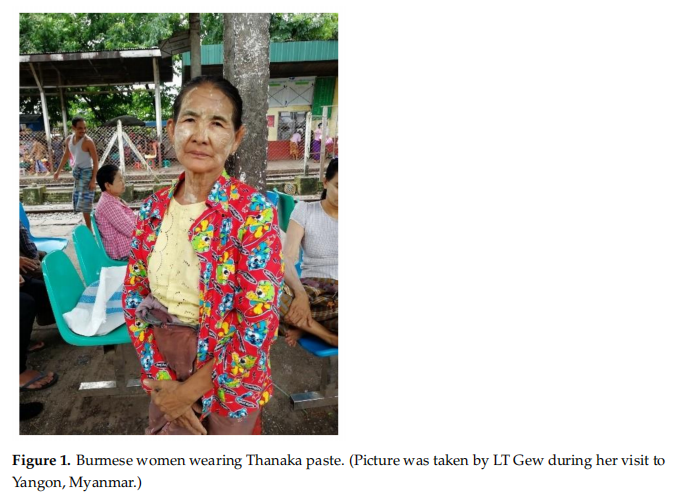
In Myanmar, the use of Thanaka bark powder is a part of their unique culture and the people are proud to wear the Thanaka paste made by mixing the Thanaka powder with water. The Burmese would grind the bark powder by using a kayak pin with water to form a paste that gives a cooling sensation and a sandalwood-like fragrance. As an old Asian proverb goes: “The world’s most beautiful women have a Thai smile, Indian eyes, and Burmese skin”. The Burmese have indeed been known for their beautiful skin and people believed that it is due to the benefits of wearing Thanaka paste as a traditional skin conditioner, which is thought to prevent acne, smoothen the skin as well as provide sun protection. Additionally, the Thanaka paste has also been used as a mosquito repellent. In addition, to skin conditioning, the Burmese women also wear the Thanaka paste as makeup by drawing floral patterns as the paste would dry and remain as solid yellowish crusts after the liquid is absorbed into the skin (Figure 1).
Various chemical and biological studies have been performed on the bark, leaf, fruit, and seed of Thanaka from 1971 until the present time. Nayar, Sutar, and Bhan (1971) and Nayar and Bhan (1972) identified an alkaloid 4-methoxy-1-methyl-2-quinolone(I), two coumarins suberin and parmesan from the petrol extracts of H. crenulata [2,3]. Meanwhile, Joo et al. (2004) also found parmesan in the methanol/chloroform (1:1) extract of Thanaka which comprises UV-absorbing chromophores that could absorb a wide range of UV-A radiation found in the chemical structure of parmesan [4]. Kim et al. (2008) found 3 tyramine derivatives, acidissimina A, acidissimina B, and acidissimina B epoxide, and 2 phenolic compounds, oxirane-(3,5-dimethoxy-4-hydroxy-phenyl)-methanol and oxirane-(3,4,5-tri methoxy-phenyl)-methanol in ethyl acetate extract of L. acidissima [5].
Based on the previous studies mentioned, polyphenol contents are commonly found in various Thanaka extracts. Polyphenol is a common class of non-volatile secondary plant metabolite used throughout the years for their potential health benefits which, depending on their chemical structures, may provide antioxidant, anti-inflammatory, and anti-carcinogenic properties that could help in the prevention of diseases. Among the sub-classes of polyphenols, coumarin is found to be commonly present in Thanaka extracts. Coumarin, or 2H-1-benzopyran-2-one, is part of a large class of phenolic substances made from fused α-pyrone rings and benzene [6]. At least 1300 different coumarins have been identified. These natural coumarins can be classified into six types, mainly simple coumarins, furanocoumarins, dihydrofuranocoumarins, pyranocoumarins, phenylcoumarins and bicoumarins [7]. Coumarins are characterized by UV-light absorption, which results in a characteristic blue fluorescent that is also photosensitive, easily altered by natural light [7,8]. Coumarins are also ascribed to many pharmacological activities such as anti-inflammatory, anti-microbial, anti-clotting, hypotensive, and anti-cancer [7]. Thus, coumarins are used in many medicinal applications. Moreover, coumarin has a sweet odor that is similar to newly mown hay, resulting in its use in perfume formulations since 1882 [7]. Coumarins are also used in the formulations of skin care products such as aftershave lotions, cleansing products, moisturizers, and sunscreen products.

In this review, the chemical and biological properties of Thanaka and its cosmeceutical applications have been summarised. The use of natural plant materials with various beneficial biological activities is now a trend in replacing artificial chemicals for the regulation of health and environmental matters as natural plant materials offer advantages such as antioxidant, and antibacterial qualities and provide essential nourishment to the skin. This review will serve as a reference for the development of skin care products containing Thanaka, particularly, sunscreen. Natural sunscreens have attracted enormous interest as the replacement of sun protection products made using synthetic chemicals such as oxybenzone that would not only cause health issues but also damage the environment such as water pollution and coral reef destruction.
2. Methods
This systematic review was conducted based on the Preferred Reporting Items for Systematic Review and Meta-Analyses (PRISMA) standard [9]. The guidelines helped in the selection of related and necessary information and enabled the evaluation and examination of the quality and meticulousness of the review.
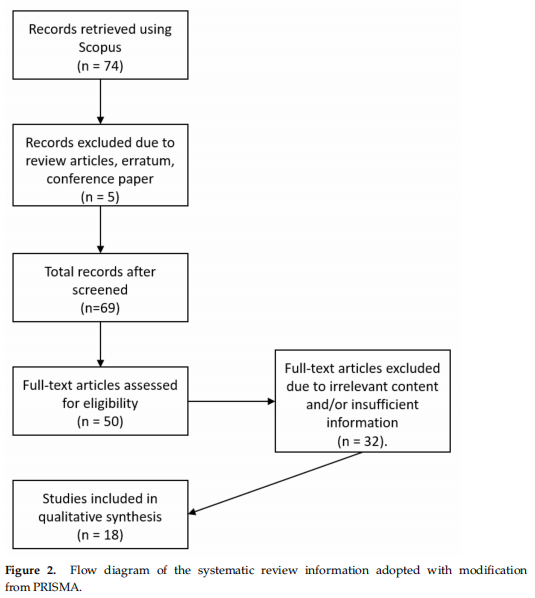
Resourcing of articles was conducted through the Scopus database in June 2020. The first stage of the systematic review process included the identification of keywords, followed by the searching process for related terms based on encyclopedias and past research. In this case, the keywords used for this review were based on the common and scientific names of the plant of interest to perform a detailed review covering most aspects of this plant, using the search string as shown in Table 1. The contemporary result successfully retrieved a total of 74 records from the Scopus database.

Screening of the records was conducted to select suitable references. In this case, no duplication occurred hence the 74 records were further screened based on several inclusion and exclusion criteria. The first criterion was the article type which focused on primary source research articles. Hence, publications in the form of review, erratum, and conference proceedings were excluded and, in this case, a total of five articles were excluded. It is worth mentioning that the systematic review only focused on articles published in English, while there was no limitation placed on the timeline due to the few publications retrieved. Most importantly, articles with full-text access were selected. Articles retrieved from the Scopus search were downloaded as full-texts through search engines such as Lancaster University OneSearch, Google Scholar, Elsevier, and ResearchGate. Overall, a total of 50 articles were selected for the eligibility screening process.
For eligibility screening, the title, abstract, and the main contents of all 50 articles were examined thoroughly to ensure that relevant and sufficient information fit the objectives of the review. Hence, 32 articles were excluded. Out of the 32 articles that were excluded, 14 articles were not relevant to the topic in this manuscript and 13 articles had insufficient information on Thanaka. Ultimately, the remaining 18 articles were selected for the qualitative synthesis as shown in Figure 2. The information tabulated in Table 4 was obtained through Google search engines and the websites of the companies that manufacture Thanaka products in Southeast Asia.
3. Chemical Constituents and Phytochemical Screening of Thanaka
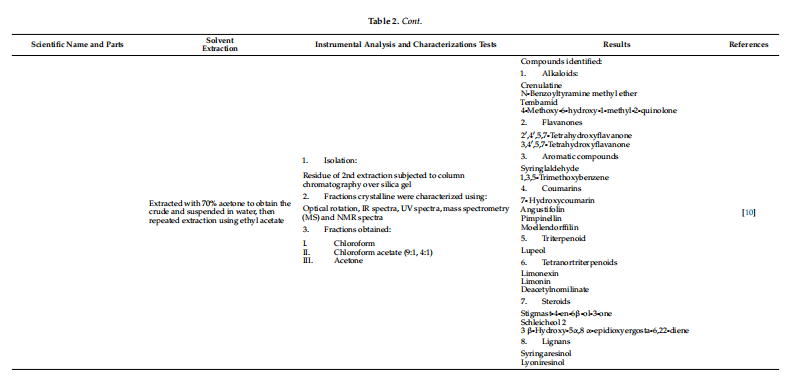
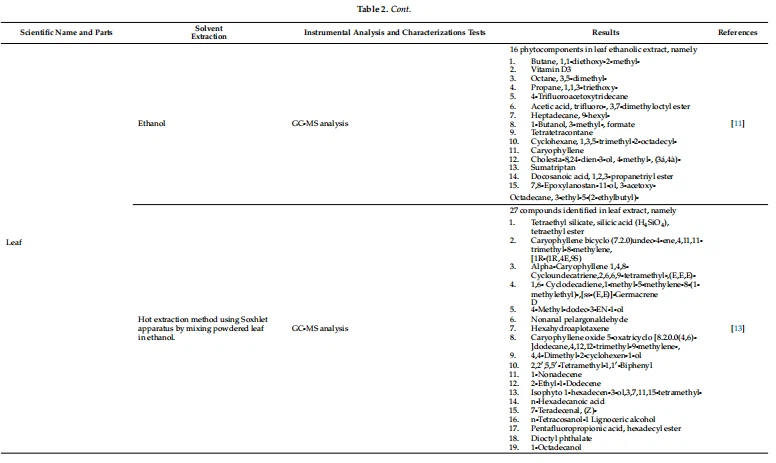
Table 2 showed the chemical constituents and phytochemical analysis of Thanaka. In 1971, Nayar et al. found that the alkaloid, 4-methoxy-1-methyl-2-quinolone, from the Thanaka stem bark petroleum extract, could be purified through chromatography on neutral alumina and crystallized for molecular structure identification using nuclear magnetic resonance (NMR) [2]. Later in 1972, Nayar and Bhan used the same method as Nayar et al. 1971 and identified sitosterol in the petrol fraction, suberin, and 7- methoxy-6-(2,3-epoxy-6-methylbutyl) coumarin from petro-benzene (19:1) fraction, as well as 4-methoxy-1-methyl-2-quinolone, parmesan and suberenol from petrol-benzene (9:1) fraction [3]. Niu et al. (2001) extracted Thanaka stem bark powder using 70% acetone, crude resuspended in water, and repeated extraction with ethyl acetate, followed by column chromatography over silica gel to form a fraction of chloroform, chloroform acetate (9:1 and 4:1) and acetone. Then, crystalline from the eluted fractions were characterized through optical rotation, IR spectra, UV spectra, mass spectrometry (MS), and NMR, to determine 21 bioactive compounds in Thanaka stem bark: alkaloids (crenulate, n-benzoyl tyramine methyl ether, tembamid, 4-Methoxy-6-hydroxy-1-methyl-2-quinolone), flavanones (20,40,5,7-Tetrahydroxyflavanone, 3,40,5,7-Tetrahydroxyflavanone), aromatic compounds (syringaldehyde, 1,3,5-trimethoxybenzene), coumarins (7-hydroxycoumarin, angustifolin, impaneling, moellendorffilin), triterpenoid (lupeol), tetranortriterpenoids (limonin, limonin, deacetylnomilinate), steroids (stigmast-4-en-6β-ol-3-one, schleicheol 2, 3 β-hydroxy-5α,8 α-epidioxyergosta-6,22-diene) and lignans (syringaresinol, lyoniresinol) [10]. In 2004, Joo et al. 2004 extracted Thanaka bark using methanol and chloroform (1:1, v/v) solvent, purified through silica gel chromatography, eluted with chloroform followed by thin-layer chromatography (TLC) with 40:1 (v/v) of chloroform and methanol and further purified with silica gel chromatography [4]. The second TLC was carried out to obtain the fraction with the strongest fluorescence spots. The fraction chosen was further purified using high-performance liquid chromatography (HPLC) to obtain the final dried crystallized active compound for mass spectrometry (MS) analysis. Joo et al. (2004) characterized the active compound as parmesan and identified that its structure was able to absorb a wide range of UV-A radiation [4]. Kim et al. (2008) conducted repeated column chromatography on ethyl acetate extracts of Thanaka bark and found 3 tyramine derivatives (acidissimina A, acidissimina B, and acidissimina B epoxide) and two phenolic compounds (oxirane-(3,5-dimethoxy-4-hydroxy-phenyl)-methanol and oxirane-(3,4,5- tri methoxy-phenyl)-methanol) [5]. Sarada et al. (2011) identified 20 bioactive compounds (listed in Table 2) found in Thanaka stem bark ethanol extract, meanwhile,16 bioactive compounds (listed in Table 2) in Thanaka leaf ethanol extract through Gas chromatography Mass spectrometry (GC-MS), with 5 compounds in common including 3,5-dimethyl-Octane, 1,1,3-tri ethoxy-Propane, 3-ethyl-5-(2-ethyl butyl)-Octadecane, 9-hexyl-Heptadecane, and 1,3,5-trimethyl-2-octadecyl-cyclohexane) [11]. Sampathkumar and Ramakrishnan (2012) identified 27 compounds (listed in Table 2) through GC-MS from Thanaka leaf ethanol extract prepared by hot extraction method using Soxhlet apparatus [12].

Some researchers conducted phytochemical analysis on the Thanaka extracts before mass spectrometry analysis or chromatography profiling. Sampathkumar and Ramakrishnan (2012b) conducted phytochemical analysis on the stem, bark, and leaf of Thanaka extracted with ethanol and reported that the ethanolic leaf extract results in the presence of proteins, lipids, phenols, tannins, flavonoids, saponins, and quinones, while the ethanolic stem extract contains proteins, lipids, phenols, carbohydrate, reducing sugar, tannin, flavonoid, saponin, and alkaloids; the ethanolic bark extract also reportedly contained almost the same contents as the stem extract except there was no alkaloid determined while triterpenoid and quinone were present in the bark extract [13]. Sampathkumar and Ramakrishnan (2012) then profiled the extracts of stem, bark, and leaf using high-performance thin-layer chromatography (HPTLC) and observed 10 peaks with Rf values in the range of 0.08 to 0.65 in stem ethanol extract; 8 peaks with Rf values in the range of 0.07 to 0.63 in bark ethanol extract; and 8 peaks with Rf values in the range of 0.09 to 0.49 in leaf ethanol extract. Pratheeba et al. (2019) reported that the phytochemical components of Thanaka leaf extracted with different solvents that varied between the hexane (non-polar) extract possess alkaloids, quinones, and carbohydrates while ethyl acetate (slightly polar) extracts possess only saponins and carbohydrates. While methanol (polar) and acetone (polar) possess similar components (phenols, alkaloids, saponins, tannins, and carbohydrates) methanol extract possesses extra components of proteins and flavonoids. They then conducted GC-MS analysis on the Thanaka fruit acetone extract and identified 8 compounds as listed in Table 2 [14]. Meanwhile, Vasant and Narasimhacharya (2013) conducted a phytochemical analysis on petroleum ether extracts of Thanaka fruit and reported fibers (47 g/kg), phytosterols (38.7 g/kg), polyphenols (67.4 g/kg), flavonoids (0.6 g/kg), saponins (0.18 g/kg) and ascorbic acid (0.54 g/kg), however, they did not conduct any further MS analysis or profiling as their main objectives were to observe the regulating effects of Thanaka fruit in fluoride-induced hyperglycemia and hyperlipidemia [15]. Coincidentally, Pandavadra and Chanda (2014) also conducted only phytochemical analysis without further MS analysis or profiling on the crude powder of Thanaka stem bark and leaf, reporting that the Thanaka crude stem bark powder contained alkaloids, flavonoids, cardiac glycosides, triterpenes, and steroids while the Thanaka crude leaf powder contained alkaloids, flavonoids, tannins, cardiac glycosides, triterpenes and steroids [16].
Among all the chromatography results, one common compound (Caryophyllene) was found in studies carried out by Sarada et al. (2011) and Pratheeba et al. (2019). However, the biological functions of the identified compounds in Table 2 were not discussed and investigated by the respective authors.





【For more info:george.deng@wecistanche.com / WhatApp:86 13632399501】