The Detection Methods Of Circulating Exosomal PD-L1
Mar 31, 2022
Contact: joanna.jia@wecistanche.com / WhatsApp: 008618081934791
There is still a lack of accepted and mainstream methods for the detection of circulating exosomal PD-L1. Traditional exosome detection methods such as enzyme-linked immunosorbent assay (ELISA) and flow analysis can be used to detect PD-L1 in circulating exosomes, and ELISA is currently the most commonly used method. ELISA method can quantitatively detect the content of PD-L1 in circulating exosomes and is easy to operate. Flow cytometry can be used to quantitatively detect circulating exosomal PD-L1 in large samples, but it requires high detection equipment. With the in-depth research on exosomes, the detection methods of exosomal proteins and nucleic acids are also enriched and developed, and some new methods have been introduced into the field of PD-L1 detection in circulating exosomes (Figure).
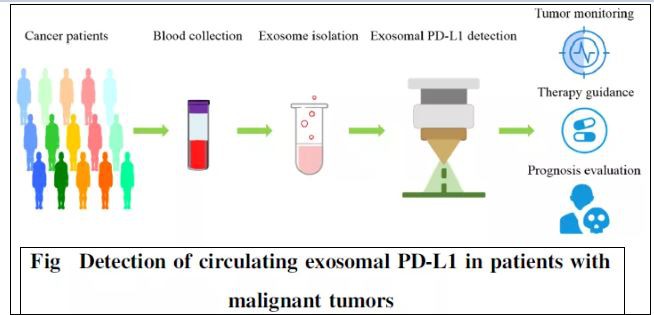
Detection of circulating exosomal PD-L1
1. Digital PCR
Due to the small amount of nucleic acid contained in exosomes, it is difficult for conventional detection methods to accurately detect their gene copy numbers. Digital PCR technology is a nucleic acid detection method with extremely high sensitivity and absolute quantification. Its sensitivity can reach the level of a single nucleic acid molecule, so it has advantages in detecting the nucleic acid content of exosomes. The researchers used digital PCR technology to accurately quantitatively analyze the PD-L1 mRNA copy number in plasma exosomes of patients with melanoma and non-small cell lung cancer and revealed the relationship between the plasma exosomal PD-L1 mRNA copy number and anti-PD1 Correlation between treatment effects. The introduction of digital PCR technology has significantly improved the detection ability of exosomal PD-L1 mRNA, which is of great significance to the research of exosomal PD-L1. However, there may be inconsistencies between the content of exosomal PD-L1 mRNA and the expression of PD-L1 protein. Therefore, the detection of exosomal PD-L1 mRNA alone may have certain defects, which need further research and clarification.

Anti-cancer desert cistanche benefits from cistanche extract
2. ELISA
ELISA is a traditional immunological analysis method, which is often used to detect small molecular proteins in plasma or culture medium. It has high sensitivity and can be quantitatively analyzed. ELISA can also be used to detect exosomal PD-L1 protein and can achieve quantitative detection of large batches of samples. The PD-L1 protein detection kit based on the principle of the ELISA method has also been applied to the quantitative detection of plasma exosomal PD-L1 protein. Chen et al. constructed an exosomal PD-L1 protein detection system based on the principle of ELISA, which was used for the detection of exosomal PD-L1 protein derived from cell culture medium or plasma. The linear detection range was 0.2-12.0 ng/mL. ELISA is a good method for detecting exosomal PD-L1 protein, which is easy to quantitatively detect and has good repeatability. However, due to the presence of free PD-L1 protein in plasma, it will interfere with its accuracy. Therefore, this method detects circulation. The sensitivity and specificity of exosomal PD-L1 protein still need to be further explored.

Herba cistanche root: anti-cancer
3. Flow analysis method
Flow cytometry is often used to type and count cells or other biological particles suspended in liquid, so this method has also been introduced into exosome detection and counting. THEODORAKIS et al. first used chromatography to initially separate exosomes in the plasma of head and neck cancer patients and then used flow analysis to detect and count PD-L1-positive exosomes. The PD-L1 protein expression was expressed as fluorescence intensity. The results show that the method has good reproducibility in detecting exosomal PD-L1 protein, and its intra-individual variation is 7% when multiple parallel assays are performed on a single patient sample. At the same time, in order to verify the accuracy of the method, the researchers used confocal fluorescence analysis as the reference method for the detection of the exosomal PD-L1 protein. Three samples were tested in parallel, and the results were compared, and it was found that the results of flow cytometry and confocal fluorescence analysis were highly consistent, indicating that flow cytometry was an accurate method for quantitative analysis of exosomal PD-L1. In addition, LUX et al. also successfully detected the expression of exosomal PD-L1 and c-Met proteins in the serum of pancreatic cancer patients by flow cytometry, but the performance of the detection method needs to be further studied. At present, flow analyzers specially used for exosome detection have also been launched, such as the Apogee ultra-sensitive nano-flow analyzer, which is more suitable for exosome protein detection than traditional flow analyzers.

The benefit of cistanche tubulosa extract supplement: anti-tumor and cancer
4. Surface-Enhanced Raman Scattering Technology
Surface-enhanced Raman scattering (SERS) is a highly sensitive fingerprint spectroscopy technique that has been widely used in biomedical fields. At present, scholars have used SERS technology to detect exosomal PD-L1 protein. The researchers first used TiO2-modified magnetic beads to non-specifically adsorb exosomes in plasma, and then used SERS probes linked to PD-L1 antibodies to modify gold nanoparticles, and then incubate the exosome samples with gold nanoparticles. It forms a magnetic bead-exosome-gold nanoparticle complex structure, and finally uses a magnetic field to enrich and separate the complex, and then place on a laser confocal Raman spectrometer for detection, so as to realize the detection of PD-L1 positive exosomes. Body content detection. This method has high detection sensitivity, and its lowest detection limit can reach 1 PD-L1+ exosome/μL plasma. In addition, the researchers used this method to detect a group of samples with different concentrations. The results showed that the SERS intensity was linearly related to the logarithm of the concentration of exosome samples, indicating that the detection method has good stability and can be directly used in plasma. Detect exosomes without an additional exosome isolation step. At present, there are few studies on the direct application of SERS technology to the detection of exosomal PD-L1 protein, but the research on the application of SERS technology to the detection of other exosomes has been carried out, which also has an important reference for the detection of exosomal PD-L1 protein value.

Desertliving cistanche growing situation
5. HOLMES-ExoPD-L1 method
The HOLMES-ExoPD-L1 method is a novel detection method of the exosomal PD-L1 protein. In this method, a new MJ5C aptamer targeting PD-L1 protein was designed, which can efficiently bind PD-L1 protein on the exosome membrane and is not interfered with by PD-L1 protein glycosylation. In this method, the fluorescently labeled MJ5C aptamer and exosomes were first co-incubated in a thin capillary to bind to each other, and the infrared laser was focused into the thin capillary to form a micron-scale temperature gradient. The thermophoresis rates of the free MJ5C aptamer and exosomal MJ5C aptamer complexes were significantly different, and the thermophoretic depletion of the free aptamer was faster than that of the exosome-aptamer complex. separated out. Therefore, under the action of excitation light, the content of exosomal PD-L1 protein can be determined by detecting the fluorescence intensity of fluorescently labeled aptamers. The method has high sensitivity and a detection limit of 17.6 pg/mL. In addition, it also has the advantages of less sample volume and short detection time. It is a highly original method for the detection of exosomal PD-L1 protein, which is very important for the development of new The exosomal PD-L1 protein detection method has enlightening value.

Anti-tumor: cistanche supplement
Exosomal PD-L1 has broad application prospects in the field of malignant tumor immunotherapy and has become one of the hotspots in the field of exosome research. Compared with the detection of tissue PD-L1 expression, the detection of circulating exosomal PD-L1 is easier to obtain specimens and carry out real-time detection, while avoiding the problem of tissue heterogeneity caused by pathological sampling; exosomal PD-L1 also leads to tumor immunity. It is an important cause of escape and is related to the progression of malignant tumors, and may become an important indicator for disease assessment and prognosis prediction. In addition, plasma exosomal PD-L1 levels are also expected to be used to screen patients suitable for anti-PD-L1 immunotherapy and predict their response to treatment. However, there is still a lack of recognized and effective methods for the detection of circulating exosomes PD-L1. It is necessary to establish an ideal circulating exosome with simple or no separation, less sample demand, high sensitivity, good repeatability, and less susceptible detection signals. A method for the detection of PD-L1 in vivo. The detection method of circulating exosomal PD-L1 still needs further in-depth research, but it is believed that with the development and application of new detection methods in the future, circulating exosomal PD-L1 will be able to better guide anti-PD1 immunotherapy and be used in the diagnosis and treatment of malignant tumors. play a more important role.