Cistanche tubulosa better or Desert Cistanche?
Mar 04, 2022
For more information:ali.ma@wecistanche.com
Cistanche, as a well-known tonic traditional Chinese medicine, was first recorded in the "Shen Nong's Materia Medica", listed as the top grade, one of the rare Chinese medicinal materials in Northwest China, and is known as the "desert ginseng".

Cistanche
Click to Cistanche in Urdu products
Cistanche is parasitic all year round in the arid desert zone of -20~50°c. The very harsh living environment has created the excellent efficacy of Cistanche. Due to the unique bio-code constraints and the strict requirements on the ecological environment and natural climate conditions, only the Hetian, China, Pakistan, India, and Bangladesh are adjacent to the same latitude area, which is most suitable for the natural growth of Cistanche tubulosa, with the highest content of active ingredients and the most prominent medicinal value.

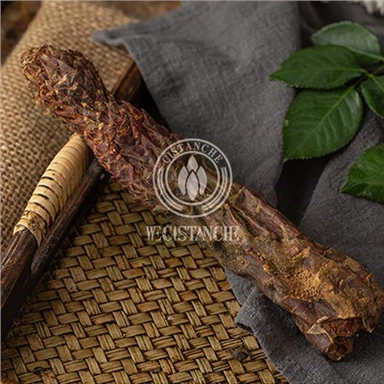
Cistanche tubulosa
China is recognized as the main producing area of Cistanche in the world. The origin of Cistanche tubulosa is an outstanding representative. It has been edible and used as medicine for more than two thousand years. It accounts for 85% of the world and 90% of China. At present, the output of wild Cistanche tubulosa is 500 tons.

The cistanche deserticola in Alashan, Inner Mongolia, also grows in the desert and has strong drought resistance, but its nutritional value and functional components are not as high as Cistanche tubulosa. Cistanche tubulosa grows on the southern edge of the Taklimakan Desert and parasitizes on the roots of tamarisk. The growth environment is harsher than that of cistanche deserticola. It is also easier for the body to absorb. At present, only two technological breakthroughs in the artificial cultivation of Cistanche have been achieved in China. Among them, Cistanche tubulosa, which is naturally distributed in the southern edge of the Taklimakan Desert with Hotan as the center, has a content of effective functional components that is 5 to 10 times higher than that of Cistanche deserticola, whether grown naturally or artificially.

fresh Cistanche tubulosa