The First Tonic Herb For Autumn And Winter: Cistanche
Oct 15, 2026
In Chinese health culture, the year moves in four rhythms: spring grows, summer expands, autumn gathers, and winter stores. Tonic therapy is never about aggressive heating. It is about following the season and slowly restoring the body's yang, essence, and fluids.
If one herb had to lead the autumn–winter warming tonics, it would be Cistanche-Rou Cong Rong, the "desert ginseng."

The villagers of Hotan Village in Xinjiang are digging and harvesting Cistanche tubulosa
It is nothing like aconite or cinnamon: harsh, fast, and fiery. It is not ginseng or deer antler either: expensive, strong, and sometimes too lifting. Cistanche grows in the desert. It absorbs the stillness of wind and sand and the thickness of earth qi. It tonifies without being violent, warms without being dry, and moistens without causing leakage. As Bencao Huiyan puts it: "It nourishes the Gate of Life, enriches kidney qi, and supplements essence-blood… warm but not hot, tonifying but not harsh, warming but not drying, slippery but not leaking. That is why it is called Congrong-'composed, unhurried.'"
That single word-composed-makes Cistanche the easiest warming tonic for ordinary people, and the safest one for long-term use.
1. Why Tonic Therapy in Autumn and Winter-and Why Cistanche First
Autumn is dry. The lung and defensive qi suffer first: dry throat, dry skin, dry stools. Then winter arrives, ruled by cold. The body's yang moves inward. The kidney is the "root of storage." Winter is exactly when kidney yang and kidney essence should be protected and replenished.

But modern people are rarely "simply yang-deficient":
Air conditioning and iced drinks in summer damage spleen yang.
Late nights drain kidney essence.
Sitting all day weakens the lower back.
With age, intestinal fluids decline, and constipation appears.
Hands and feet are cold, yet the mouth is dry, the mind restless, sleep shallow.
If you reach straight for deer antler, sea horse, or aconite, you may "add fuel to the fire": mouth ulcers, sore throat, insomnia, worse constipation.
Cistanche solves this elegantly. It enters the kidney and large intestine. It warms kidney yang and nourishes essence-blood on one side, and moistens intestinal dryness and moves the bowels on the other. Yang is supplemented without injuring yin; moisture is supplied without causing diarrhea. For today's pattern-"yang deficiency with dryness, kidney deficiency with constipation, middle-aged exhaustion"-it fits almost perfectly.

Old physicians say:
In winter tonification, the fear is not that the supplement fails to enter, but that it enters too violently. Cistanche is the herb that opens the door, then quietly carries the provisions inside.
2. What Cistanche Is: "Composed" Growth from the Desert
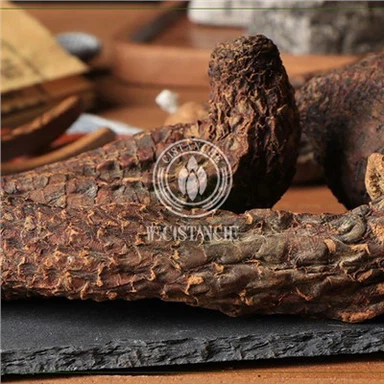
Cistanche is an Orobanchaceae plant. The medicinal part is the dried, scaly, fleshy stem. It grows mainly in Inner Mongolia's Alashan region, Xinjiang, Gansu, and Qinghai, parasitizing the roots of desert shrubs such as Haloxylon (saxaul) and Tamarix.

Chinese herb cistanche
Its folk names tell the story:
Da Yun: "great useful herb," the name most northern households know.
Di Jing: "earth essence."
Desert ginseng: not from deep mountains, yet able to revive the weak and aged, without the upward, qi-lifting edge of ginseng.
Shennong Bencao Jing placed it among the "superior herbs":
"It governs the five fatigues and seven injuries, tonifies the center, relieves cold-heat pain in the genitals, nourishes the five viscera, strengthens yin, boosts essence-qi, increases fertility, and, taken long, lightens the body."
From Han to Qing, Cistanche was the ballast of kidney-tonifying formulas. Jichuan Jian uses it for kidney-deficiency constipation. Roucongrong Wan uses it to consolidate the root. Formulas such as Wuzi Yanzong Wan often include it.
Its genius lies in "balanced tonification":
Yang tonics are usually drying; Cistanche is warm yet moist. Blood tonics often stagnate; Cistanche nourishes yet moves. Laxatives usually purge; Cistanche moistens and descends.
That is why the elderly can use it, postpartum women can use it, sedentary office workers can use it, and even people who are yang-deficient yet easily get "internal heat" can often use it.
3. What Cistanche Does in Traditional Chinese Medicine
1. Tonifies Kidney Yang-Not "Lighting a Fire," but "Adding Dry Wood"

Effects of cistanche-improve kidney function
Click here to view Cistanche for Kidney disease products
【Ask for more】 Email:cindy.xue@wecistanche.com / WhatsApp: 0086 18599088692 / WeChat: 18599088692
Kidney yang is the fire under the cauldron. When it is weak:
the lower back and knees feel sore and cold;
the limbs are chilly;
nighttime urination increases;
energy drops;
libido declines;
men develop erectile weakness or premature ejaculation;
women develop a cold womb, delayed periods, or infertility.
Cistanche warms kidney yang, but not like chili that makes you flush and sweat. It is more like adding dry wood to the stove and closing the ash door, so warmth rises slowly from the Gate of Life.
It does not treat acute fire. It treats long-standing cold, fatigue, and deficiency.
2. Nourishes Essence and Blood-So You Age a Little More Slowly

Effects of cistanche-improve kidney function
Essence and blood are the body's foundation. When essence is insufficient: hair turns white early, memory fades, ears ring, bones soften. When blood is insufficient: the face pales, the heart palpitates, menstruation scants.
Cistanche is sweet, salty, and warm. It enters the kidney and blood level. It fills essence, nourishes blood, and moistens dryness. The ancients said it "strengthens yin, boosts essence-qi, and increases offspring." Modern pharmacology finds phenylethanoid glycosides-echinacoside and acteoside-polysaccharides, betaine, amino acids, and trace minerals, with anti-fatigue, antioxidant, immune-modulating, and cognition-supporting effects.
For middle-aged and elderly people, it does not make you hyper. It holds up the baseline: walking feels easier, the lower back stops aching, daytime fog lifts, nighttime waking lessens.
3. Moistens the Intestines-Its Most Underrated Skill

Effects of cistanche-treat constipation
Chinese medicine says: "The kidney governs the two excretions" and "the kidney governs the five fluids." When the kidney is deficient, intestinal fluid also dries. Stools become hard to pass-especially in the elderly, after childbirth, after illness, or in people who sit too much.
This kind of constipation has a signature:
the stool is not rock-hard, but passing it is exhausting;
it comes with a sore lumbar region, cold sensitivity, shortness of breath;
urine is clear and copious;
rhubarb or senna makes it worse after the effect wears off.
Cistanche works by "adding fluid to move the boat": when kidney water is sufficient, intestinal fluid returns, and the boat floats. Jichuan Jian from Jingyue Quanshu pairs Cistanche with angelica, achyranthes, alisma, cimicifuga, and aurantium to treat kidney-deficiency constipation. It does not blast the bowels. It does not damage the righteous qi. It is the correct logic for "deficient-person constipation."
4. How to Use It in Autumn and Winter: From Pharmacy to Kitchen
Cistanche is rare among warming tonics: it is both medicinal and culinary. You do not have to start with a prescription. Start with the kitchen.
1. Cistanche Mutton Congee-Entry-Level Tonic for Cold Bodies

Stewed Cistanche tubulosa soup
Formula: Cistanche 15–30 g, mutton 150 g, japonica rice 100 g, shredded ginger, scallion white, salt.Method: Decoct Cistanche to make herbal liquid. Blanch sliced mutton. Cook rice in the Cistanche liquid; add mutton near the end with ginger and scallion, simmer 10 minutes, and season. Best for: cold hands and feet, sore cold lower back, morning constipation from cold, pale dull complexion. Avoid: sore throat, bitter taste, red tongue with yellow coat, diarrhea.
This congee comes from desert-border living: Cistanche resolves dryness of the sands, mutton warms the Gate of Life, rice protects the stomach. Yang is warmed without kidnapping yin.
2. Cistanche Black-Silk Chicken Soup-For the Middle-Aged, Postpartum, and Overworked
Formula: Cistanche 20 g, half black-skinned chicken, Chinese yam 30 g, goji 10 g, red dates 3, ginger 3 slices.Method: Blanch the chicken. Simmer all ingredients in 2 L of water for 90 minutes. Salt to taste.Best for: low energy, sore back, poor memory, dry hair, scanty periods, unfinished postpartum recovery.Key point: black chicken nourishes yin-blood; Cistanche warms kidney essence; yam secures the spleen; goji nourishes liver-kidney. The design is "seek yang within yin"-less likely to cause fire.

Chinese medicinal materials such as cistanche
3. Cistanche Black-Sesame Congee-Moisten Bowels, Nourish Hair
Formula: Cistanche 10 g, toasted black sesame 15 g, rice 100 g, a few goji.Method: Decoct Cistanche, cook rice in the liquid, stir in sesame, add goji near the end.Best for: elderly constipation, intestinal dryness, premature gray hair, dry skin, autumn–winter thirst.Caution: loose stools? Skip sesame. Diabetes? Skip sugar.
4. Cistanche Medicated Wine-The Northern "Winter-Storing Liquor"

Cistanche wine
Formula: Cistanche 100 g, goji 50 g, Cynomorium 50 g, ~40° baijiu 4 L.Method: Clean and dry herbs, seal in jar, drink after two weeks; 10–20 ml a day, never with water.Best for: kidney-yang deficiency, cold joints, weak lumbar and knees, chill-sensitive elders. Do not: hypertension, liver disease, gout, yin-deficiency fire, menstruation, pregnancy, breastfeeding.
5. Cistanche Honey Tea-Light Office Tonic
Steep 5–8 g sliced Cistanche in warm water for 10–15 minutes; add honey when lukewarm. Good for sitting, screen strain, sluggish bowels, afternoon fog.No honey if diabetic. No tea if diarrhea.
5. Who Should Use It-and Who Must Not
Good candidates

Effects of cistanche-Improve Kidney Function
Kidney-yang deficiency: cold lower back, chills, frequent night urine, low vitality.
Essence-blood deficiency: premature aging, tinnitus, gray hair, poor memory.
Kidney-deficiency constipation: elderly, postpartum, chronic illness, sedentary life.
Fertility support phase: common supporting herb in men's and women's formulas.
Autumn–winter subhealth: easy fatigue, easy colds, slow recovery.
Avoid or use with caution
Yin deficiency with fire: flushing, night sweats, dry sore throat, red tongue, little coat.
Excess-heat constipation: hard stools, abdominal pain, foul breath, yellow coat.
Spleen deficiency diarrhea: supplements trigger looseness.
Cold/flu/fever stage: clear the exterior first.
Pregnancy/lactation: not toxic, but moistening and descending-needs professional guidance.
Children: usually not for tonification; constipation must be patterned first.
Hypertension, anticoagulants, antihypertensives: possible interactions; ask a doctor.
One line to remember:
Cold, deficient, dry, constipated → Cistanche fits. Hot, fiery, diarrheal, externally invaded → Cistanche waits.
6. Dosage and Quality: Bigger Is Not Better

Cistanche tubulosa slice
Common ranges:
Decoction: 10–15 g.
Congee/soup: 10–20 g.
Medicated wine: follow formula; do not keep adding more.
Very large doses-50 g and above-may cause nausea, diarrhea, and gastric discomfort.
Buying tips:
Species: Cistanche deserticola and Cistanche tubulosa are pharmacopoeial.
Origin: Alashan, southern Xinjiang, Hexi Corridor are respected.
Appearance: flattened cylindrical stem, imbricate scales, soft, flexible body, brown surface, sweet-slightly-bitter taste.
Fresh-dried vs salt-cured: "sweet Da Yun" suits food therapy; salt-cured is salty-reduce added salt.
Wine-prepared Cistanche: stronger at warming kidney yang, less likely to loosen the bowels.
Avoid mold, insect holes, harsh throat sensation, or something that tastes like pickled vegetable.
7. What Modern Research Confirms

Main Chemical Constituents of Cistanche tubulosa
The ancients spoke of "nourishing essence-blood, moistening the intestine, slowing aging." Modern pharmacology keeps confirming it:
Phenylethanoid glycosides (echinacoside, acteoside): antioxidant, neuroprotective, cognition-supporting.
Polysaccharides: immune modulation, anti-fatigue, gut microbiota balance.
Betaine: methyl donor, liver support.
Laxative mechanism: increases intestinal fluid, promotes peristalsis, regulates aquaporins-unlike stimulant laxatives that can damage enteric nerves.
Fatigue/recovery: some trials suggest better muscle recovery and lower fatigue markers.
Bone and aging: in kidney-tonifying formulas with eucommia, teasel, and drynaria, useful for osteoporosis and lumbar-knee degeneration.
But be honest: Cistanche will not make you twenty years younger overnight. Its value is slow, stable, durable-like patching a leaking pot, then filling it drop by drop.
8. The Right Order of Winter Tonics: Cistanche Is the Opening, Not the Whole Book
Most tonic failures are not about bad herbs. They are about wrong order.
Settle the spleen first: greasy tongue coat, dampness, bloating? Use tangerine peel, poria, yam, barley first.
Clear leftover pathogenic factors: sore throat, cough, low fever, mouth ulcer? Do not tonify.
Balanced tonification: Cistanche, goji, yam, walnut, black sesame, mutton, longan-step by step.
Deep tonification after winter solstice: deer-horn glue, tortoise-plastron glue, donkey-hide gelatin, sea cucumber-only with professional guidance.
Cistanche belongs to step three. It does not steal the show. It catches the herbs that come after it.
9. Three Lines to Remember
Autumn gathers, winter stores; tonify only after the gate is clear. Warm yang without dryness-Cistanche is the most composed.Sore back, cold limbs, stubborn dry stools: Cistanche congee beats reckless ginseng-horns.
Ginseng and antler are precious, but not always right. Cistanche is quiet. Yet it writes the four characters "tonify without harshness" almost perfectly.
On a snowy night, a bowl of Cistanche mutton congee says more than any slogan:
Kidney yang rises, the intestine is moist, the lower back warms, and the person becomes composed again.
10. Appendix: Home Cistanche Recipes for Autumn–Winter

|
Recipe |
Composition |
Action |
Frequency |
|
Cistanche Mutton Congee |
Cistanche 15–30g + mutton + rice |
Warm kidney yang, warm lumbar |
2×/week |
|
Cistanche Black-Silk Chicken Soup |
Cistanche 20g + black chicken + yam + goji |
Nourish essence-blood, anti-fatigue |
1×/week |
|
Cistanche Black-Sesame Congee |
Cistanche 10g + sesame 15g + rice |
Moisten intestine, nourish hair |
every other day |
|
Cistanche Honey Tea |
Cistanche slices 5–8g + honey |
Light tonic, soften stools |
small cup daily |
|
Cistanche Goji Wine |
Cistanche 100g + goji 50g + 4L liquor |
Warm kidney, strengthen lumbar/knees |
small cup in winter |