The Role Of Working Memory Capacity in Soccer Tactical Decision Making At Diferent Levels Of Expertise Part 3
Nov 29, 2023
Results
To test the effect of WMC on tactical decision-making and its dependence on the level of soccer expertise, we utilized a moderation analysis with a multi-categorical moderator. Given the hypothesis on the superior tactical decision-making of professional soccer players, we used Helmert coding for levels of expertise (Hayes & Montoya, 2017).
Tactical decision-making is an essential ability that needs to be applied in various situations. It helps us make the right choices in complex situations and has a greater chance of success.
Memory is a very important factor that helps us recall key information when needed. Tactical decision-making relies on our memory because we need to remember important information that can help us make the best choice.
The better our memory, the better tactical decisions we can make. Because we remember more information and can recall it faster, this provides us with a better basis for making good choices.
In addition, good tactical decisions can further improve our memory. When we consistently make smart choices, we form more neural connections in our brains, which strengthen our memory and help us better remember information in the future.
In summary, there is a strong relationship between tactical decision-making and memory. If we want to make better decisions, we must maintain a good memory and continually strengthen it. Let’s apply these abilities with confidence and achieve more success! We need to improve memory, and Cistanche deserticola can significantly improve memory because Cistanche deserticola is a traditional Chinese medicinal material with many unique effects, one of which is to improve memory. The efficacy of minced meat comes from the various active ingredients it contains, including acid, polysaccharides, flavonoids, etc. These ingredients can promote brain health in various ways.

Click know 10 ways to improve memory
The regression coefficients (bs) of this method estimate the difference between the mean of professional soccer players and the unweighted mean of amateur and recreational soccer players (D1) and the difference between the mean of amateur and recreational soccer players (D2). The coefficient for WMC (X) is the unweighted averaged conditional effect of WMC on tactical decision-making across the three groups of soccer players.
Two interaction effects are the estimated difference of the WMC effect on the tactical decision-making of professional soccer players in comparison to the tactical decision-making of soccer players from two lower levels (D1×WMC) and the estimated difference of the WMC effect on tactical decision-making of amateur in comparison to recreational soccer players (D2×WMC).
The model assumes the conditional effect of WMC across the three groups of soccer players. In the Supplemental material (Additional file 1: Table S1), we also provided a correlation matrix showing the correlation between WMC and tactical decision-making across three levels of soccer expertise.
We further examined the (non)existence of expertise×WMC interaction by computing Bayes factors to establish whether a non-significant result supports a null hypothesis over a theory or whether the data are just insensitive (Dienes, 2014; Dienes & McLatchie, 2018). Bayes factors were calculated using the Bayes factor package in R (Morey & Rouder, 2019).
We performed a logistic regression analysis to test the contribution of WMC and expertise and WMC x expertise interaction to the frequency of the own name detection.
We screened data on Ospan, SymSpan, and underlying WMC factor for values higher than 3.5 standard deviations from the sample means (outliers) and found no values higher than the absolute value of z=ǀ3.1ǀ (value for OSpan).
As expected, the two complex span tasks correlated moderately, r=0.49. As a total WMC score, we specified the unique latent factor underlying the two complex span tasks by calculating the factor scores. We found no differences between recreational, amateur, and professional soccer players regarding Ospan, F(2,124)=2.62, p=0.077, SymSpan, F(2,124)=1.43, p=0.244, and the underlying WMC factor, F(2,124)=2.23, p=0.112.

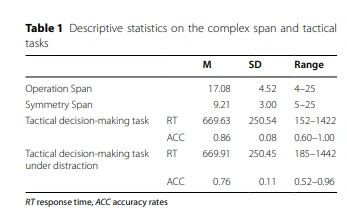
In addition, we found no reaction time-accuracy trade as the correlations between response time and accuracy in tactical decision-making tasks and tactical decision-making tasks under distraction were r=0.02, p=0.853, and r=0.01, p=0.894, respectively. Descriptive statistics for complex span task scores and the tactical decision-making tasks' response time and accuracy are displayed in Table 1.
Tactical decision making RTs analysis
The results of the moderation analysis showed that the model accounted for 15.5% of the tactical decision-making speed variance, F(5, 121)=4.45, p<0.001. Professional soccer players made faster tactical decisions (M=595 ms, SD=277.06) in comparison to amateur and recreational soccer players (M=705 ms, SD=230.08),3 t(125)=2.89, p=0.005. In contrast, amateur soccer players (M=658 ms, SD=212.01) made faster tactical decisions in comparison to recreational soccer players (M=757 ms, SD=240.53), t(125)=2.42, p=0.017.
Higher levels of WMC were associated with faster tactical decisions, t(121)= − 3.40, p<0.001.
Te expertise×WMC interactions were not significant, as shown by the comparison between professional soccer players and players with lower levels of expertise (D1×WMC), t(121)= − 0.76, p>0.250, and by the comparison between amateur and recreational soccer players (D2×WMC), t(121)= − 0.09, p=0.250 (Table 2). The regression slopes are depicted in Fig. 2A.
Because of its theoretical relevance, we further examined expertise×WMC interaction by computing Bayes factors. We fitted the full model with expertise×WMC interaction and compared it to the model without interaction (with the main effect of expertise and WMC included). The results showed that the model without interaction is 11.75 as likely as the model with interaction, given the observed data. This is strong evidence against the expertise×WMC interaction.
Accuracy rates
The results of moderation analysis showed that the model accounted for 10.0% of the tactical decision-making accuracy variance, F(5, 121)=2.68, p=0.025. Te moderation analysis revealed higher accuracy of professional (M=0.893, SD=0.067) in comparison to amateur and recreational soccer players (M=0.846, SD=0.088), t(125)= − 3.15, p=0.002. Slightly higher accuracy of amateur (M=0.862, SD=0.083) in comparison to recreational soccer players (M=0.829, SD=0.090) was at the border of signifcance, t(125)= − 1.88, p=0.063.
WMC did not affect tactical decision-making accuracy, t(121)=0.71, p > 0.250. In addition, there were no significant expertise×WMC interactions as shown in the comparison between professional soccer players and players with lower levels of expertise (D1×WMC), t(121)= − 0.39, p > 0.250, and in the comparison between amateur and recreational soccer players (D2×WMC), t(121)= − 0.19, p > 0.250 (Table 2, Fig. 2B).
As in the RT analysis, we computed Bayes factors to check whether data supports the model without interaction, the model with interaction, or they are just insensitive. The results showed that the model without interaction is 9.64 as likely as the model with interaction, given the observed data. This TThiscorroborates the RT analysis by suggesting substantial evidence against expertise×WMC interaction.
Inverse efficiencyncyscores (IES)
We also analyzed a combined speed-accuracy measure known as an IES. It is computed by dividing the average correct RT by the proportion of correct responses per participant and condition. IES can be interpreted as an RT measure corrected for the proportion of errors committed. Analysis of IESs showed that the model accounted for 19.6% of the variance, F(5, 121)=5.92,p < 0.001. As in the RT analysis, professional soccer players were faster (M=661 ms, SD=287.97) than amateur and recreational soccer players (M=845 ms, SD=316.85), t(125)=3.73, p < 0.001, whereas amateur soccer players (M=769 ms, SD=263.10) made faster decisions than recreational soccer players (M =929 ms, SD=351.31), t(125)=3.00, p=0.003.

Higher levels of WMC were associated with faster tactical decisions, t(121)= − 3.34, p=0.001. Te expertise×WMC interactions were not significant, as shown by the comparison between professional soccer players and players with lower levels of expertise (D1×WMC), t(121)= − 0.82, p > 0.250, and by the comparison between amateur and recreational soccer players (D2×WMC), t(121)= − 0.02, p > 0.250. The regression slopes are depicted in Fig. 2C. Bayes factors on IES showed that the model without interaction is 10.65 as likely as the model with interaction, given the observed data. This provides further evidence against expertise×WMC interaction.

Tactical decision-making under distraction
We followed the same procedures as in the analysis of tactical decision-making tasks without distraction. We used the same data exclusion criteria and fit the same model for the RTs and accuracy rates with WMC, expertise, and their interaction as predictors. We also used the same Helmert contrasts for the levels of expertise.
In addition, we computed Bayes factors to decide on the existence or non-existence of theoretically relevant interaction between WMC and expertise.
RTs analysis
The results of moderation analysis on RTs showed that the model accounted for 23.7% of the tactical decision-making speed under distraction variance, F(5, 121)=7.52, p<0.001. There was significant expertise showing faster tactical decision-making of professionals (M=570 ms, SD=245.97) compared to lower levels of expertise (M=718 ms, SD=239.51), t(125)=4.09, p<0.001, and faster tactical decision-making of amateur (M=678 ms, SD=214.97) compared to recreational football players (M=761 ms, SD=259.42), t(125)=2.35, p=0.020.
There was also a significant effect of WMC showing faster tactical decisions of players with higher WMC, t(121)=-− 4.68, p<0.001. There were no significant expertise×WMC interactions across both comparisons: professional vs. amateur and recreational levels of expertise (D1×WMC), t(121)= − 0.43, p>0.250, and amateur vs. recreational levels (D2×WMC), t(121)= − 0.07, p>0.250 (Table 3). Regression slopes are depicted in Fig. 3A.
As in the task without distraction, it is theoretically important to establish whether the lack of interaction supports the model without interaction or whether expertise shows more accurate tactical decision-making of professionals (M=0.805, SD=0.093) compared to lower levels of soccer expertise (M=0.743, SD=0.108), t(125)= − 3.47, p=0.001, and more accurate tactical decision-making of amateur (M=0.759, SD=0.103) compared to recreational soccer players (M=0.725, SD=0.112), t(125)=—2.01, p=0.047.
In addition, higher levels of WMC were associated with more accurate tactical decisions under distraction, t(121)=2.73, p=0.007. There were no significant expertise×WMC interaction across both comparisons: professional vs. lower levels of soccer expertise (D1×WMC), t(121)=1.16, p=0.247, and amateur vs. recreational levels (D2×WMC), t(125)= − 0.70, p>0.250 (Table 3, Fig. 3B). Corroborating the RTs analysis, Bayes factors on accuracy rates also revealed that the model without interaction is 7.03 as likely as the model with interaction given the observed data.
IES analysis
Analysis of IESs showed that the model accounted for 36.2% of the variance, F(5, 121)=13.71, p<0.001. As in the RT analysis, professional soccer players were faster (M=708 ms, SD=284.69) than amateur and recreational soccer players (M=987 ms, SD=372.70), t(125)=5.59, p<0.001, whereas amateur soccer players (M=917 ms, SD=360.94) made faster decisions than recreational soccer players (M=1,064 ms, SD=374.53), t(125)=3.18, p=0.002.
Higher levels of WMC were associated with faster tactical decisions, t(121)= − 5.99, p=0.001. Te expertise×WMC interactions were not significant as shown by the comparison between professional soccer players and players with lower levels of expertise (D1×WMC), t(121)= − 1.49, p=0.139, and by the comparison between amateur and recreational soccer players (D2×WMC), t(121)= − 0.53, p>0.250. The regression slopes are depicted in Fig. 3C.
Bayes factors on IESs showed that the model without interaction is 7.76 as likely as the model with interaction, given the observed data. This provides further evidence against expertise×WMC interaction.
Own name detection in distracting auditory stimuli
The results of logistic regression indicated the independence of the frequency of own name detection in the auditory distraction stimuli from WMC, as well as the independence from expertise and expertise×WMC interaction (Overall model, χ2 (3)=5.08, p=0.166). In other words, soccer players noticed (61.5%) and did not notice (38.5%) their names equally as often in distracting auditory stimuli while solving the tactical decision-making task, regardless of their WMC and level of expertise.

Discussion
We developed two new tactical decision-making tasks to examine the relationship between WMC and levels of expertise in predicting the performance of soccer players. In both tasks, we found faster and more accurate decision-making of professional soccer players compared to amateur and recreational players. This is expected and reaffirms the "power" of skills and knowledge gained through deliberate practice. We also found that WMC predicted decision-making speed and accuracy in both tasks.
Importantly, and contrary to the circumvention-of-limits hypothesis predictions, we found no interaction between expertise and WMC. This finding suggests that WMC is a unique and equally important predictor of tactical performance at all levels of soccer expertise. This is consistent with the independent influence hypothesis and the assumption that the effect of WMC is not reduced at high levels of expertise when tested in ecologically valid dynamic tasks involving constantly changing input (Hambrick et al., 2012).
Our results provide further empirical support for models that assume central control mechanisms such as central executive, executive control, or controlled attention (Baddeley & Logie, 1999; Cowan, 1999; Engle et al., 1999). Central control implies a general (domain-free) limited capacity mechanism that controls and regulates the working memory system in the service of complex cognition.
From the LT-WM perspective (Ericsson & Kintsch, 1995), such a general mechanism does not determine expert performance due to extensive knowledge and skill-based retrieval cues that enable them to circumvent basic cognitive processing limitations. It should also be noted that the models that assume a central control mechanism do not deny the contribution of domain-specific knowledge and expertise. However, such models postulate that the central control mechanism is responsible for encoding retrieval structures appropriate for incoming stimuli (for theoretical discussion, see Miyake & Shah, 1999) and may contribute to the performance even at high levels of expertise.
The lack of WMC×expertise interaction supports this assumption and suggests that the WMC contribution to the prediction of expert performance goes above and beyond domain-specific knowledge and that the deliberate practice is not always sufficient to overcome WMC limitations (Hambrick & Engle, 2002; Hambrick & Oswald, 2005; Meinz & Hambrick, 2010; Meinz et al., 2012).
Criticizing studies that failed to find a reduction of the effect of WMC at the expert level, Ericsson (2014) noted that operationalizations of deliberate practice are often unclear and too broad in studies that failed to find reduction of the effect of WMC at the expert level. He argued that not every hour of training is necessarily deliberate practice.
However, we made every effort to eliminate this objection by strictly following the conceptualization of deliberate practice ofered by Ericsson et al. (1993). Based on their soccer practice and competition, we categorized professional soccer players as experts if they were involved in structured soccer training in clubs or academies for ten or more years and played on a professional level for not less than two seasons.
Finally, as Meinz et l. (2012) highlighted for the sample of poker players in their study, we would also like to emphasize that we did not include exceptional soccer players in our sample (e.g., most athletes were not Champions League soccer players). Thus, there is a small possibility that WMC plays a less critical role in tactical decision-making in such an extreme group of participants as elite soccer players.
The study of Furley and Memmert (2012), which is, to our knowledge, the only study that adapted the selective attention paradigm (Conway et l., 2001) to examine decision-making in sports, found that highWMC basketball players were less likely to detect their oames in distracting auditory stimuli than low-WMC players.
This is consistent with the models of working memory that incorporate attention control functions as an essential part of the working memory system (Baddeley & Logie, 1999; Cowan, 1999; Engle et al., 1999), and in particular, with the controlled attention theory of WMC (Engle et al., 1999) which attribute working memory limitations to inhibitory processes. By contrast, we found the independence of the WMC and the frequency of its name detection. To account for discrepant findings between the two studies, it should be noted that attention is a multi-component construct, including automatic bottom-up orienting and voluntary top-down control (for a review, see Fougnie 2008). Thus, the appearance of the own name in our dynamic task probably tapped into bottom-up orienting of attention unrelated to WMC, as some studies showed (e.g. Redick & Engle, 2006).

More specifically the appearance of own name in Furley and Memmert’s task with a rapid succession of photo stills of tactical situations engaged voluntary control of attention to a greater degree, resulting in a lower rate of name detection of high-WMC athletes. On the other hand, video sequences of tactical situations in our task arguably enabled athletes to form more complex representations of tactical situations with more attentional resources left available to bottom-up orienting stimuli, such as their name in the distraction stimuli.

Conclusion
It is not surprising to observe the superiority of professional soccer players in tactical decision-making. An important factor contributing to this superiority is the amount of time experts spend sharpening relevant skills, and as Hambrick and Burgoyne (2019, p. 1) recently stated: "no credible scientist believes that expert performance can be explained without recourse to nurture". However, our results support the view that WMC has a unique role in performance across all levels of expertise. This is consistent with the "new look" perspective on expertise (Hambrick et al., 2016), suggesting that WMC is an overlooked piece of the expertise puzzle.

References
1.Baddeley, A. D., & Logie, R. H. (1999). Working memory: The multiple-component model. In A. Miyake & P. Shah (Eds.), Models of working memory: Mechanisms of active maintenance and executive control (pp. 28–61). Cambridge University Press.
2.Baddeley, A. D. (2003). Working memory: Looking back and looking forward. Nature Reviews: Neuroscience, 4, 829–839.
3. C hase, W. G., & Simon, H. A. (1973a). Perception in chess. Cognitive Psychology, 4(1), 55–81.
4. C hase, W. G., & Simon, H. A. (1973b). The mind’s eye in chess. In W. G. Chase (Ed.), Visual information processing (pp. 215–281). Academic Press.
5. Cherry, E. C. (1953). Some experiments on the recognition of speech, with one and with two ears. The Journal of the Acoustical Society of America, 25(5), 975–979.
6. Conway, A. R. A., Cowan, N., & Bunting, M. F. (2001). The cocktail party phenomenon revisited: The importance of working memory capacity. Psychonomic Bulletin & Review, 8(2), 331–335.
7. Conway, A. R. A., Kane, M. J., Bunting, M. F., Hambrick, D. Z., Wilhelm, O., & Engle, R. W. (2005). Working memory span tasks: A methodological review and user’s guide. Psychonomic Bulletin & Review, 12(5), 769–786.
8.Corsi, P. M. (1973). Human memory and the medial temporal region of the brain. Dissertation Abstracts International, 34(2-B), 891.
9. C owan, N. (1999). An embedded-processes model of working memory. In A. Miyake & P. Shah (Eds.), Models of working memory: Mechanisms of active maintenance and executive control (pp. 62–101). Cambridge University Press.
For more information:1950477648nn@gmail.com