The Whitening Effect Of Cistanche Tubulosa - The Natural Brightening Code Of Desert Ginseng
Aug 07, 2026
The pursuit of white skin by Eastern women has a long history; as the ancient saying goes, 'One white covers up a hundred uglinesses.' From ancient lead powder application to modern various whitening essences, human beings have never stopped exploring whitening. However, many chemically synthesized whitening agents often come with skin irritation, allergies, and even more serious side effects while pursuing quick results. In this context, safe, mild, and efficient natural plant-based whitening ingredients have become a hot topic in the field of cosmetics research and development.

Cistanche tubulosa, a parasitic plant that grows deep in the desert, has been used in traditional Chinese medicine for over two thousand years. The "Shennong Bencao Jing" records its ancient descriptions of "light body after long-term consumption", "pleasing color", "tonifying essence, blackening face, and fatigue", which actually touch on the efficacy of Cistanche tubulosa in improving skin color and delaying aging. With the advancement of modern separation and analysis techniques and molecular biology methods, researchers have gradually uncovered the scientific veil of the whitening effect of Cistanche tubulosa - its rich active ingredients such as phenylethanolic glycosides and polysaccharides exhibit synergistic whitening effects in multiple dimensions such as inhibiting tyrosinase, clearing free radicals, and protecting against ultraviolet radiation.
The main active ingredients of Cistanche tubulosa
To understand the whitening effect of Cistanche tubulosa, it is necessary first to recognize the diversity of its chemical components. Research has shown that Cistanche tubulosa contains over 100 identified non-volatile components, mainly including the following categories:
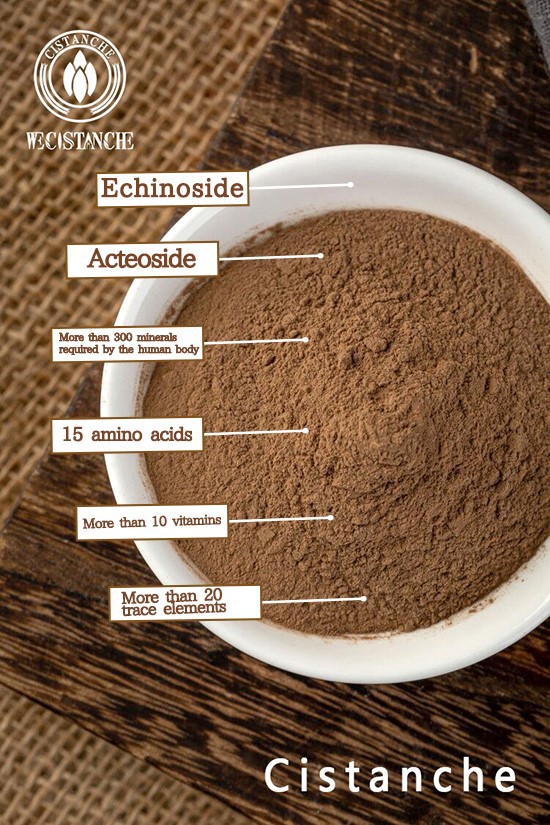
Main Chemical Constituents of Cistanche tubulosa
Phenylethanoid Glycosides
Phenylethanolic glycosides are the core active ingredient group of Cistanche tubulosa. Currently, more than 30 monomeric components have been isolated from plants of the Cistanche genus, among which echinacoside and verbascoside are the most important. These two are also considered key indicator components for quality control of Cistanche tubulosa medicinal materials. The molecular structure of phenylethanoid glycosides contains multiple benzene rings and conjugated systems, which endow them with strong antioxidant capacity and UV absorption properties. More importantly, the phenolic hydroxyl groups contained in its structure are the key pharmacophores that inhibit tyrosinase activity.

Phenylethanol glycoside is the main active component of Cistanche tubulosa
Polysaccharides
Cistanche polysaccharides are composed of various monosaccharides and have a strong ability to scavenge DPPH free radicals. Research has shown that neutral polysaccharides have a scavenging rate of 91.73% against DPPH free radicals at a concentration of 2.0 mg/mL, with a half maximal inhibitory concentration (IC50) of only 0.383 mg/mL. Polysaccharides not only participate in antioxidant activities, but also have good moisturizing and immune regulatory functions.
Other active ingredients
In addition to the two main components mentioned above, Cistanche tubulosa also contains various trace elements such as cyclohexene ether glycosides, lignans, flavonoids, alkaloids, amino acids, as well as zinc and iron. Among them, sweet dew alcohol, betaine, and allantoin are common moisturizing ingredients; The phenolic hydroxyl structures in flavonoids and polyphenols bind to water through hydrogen bonds, further enhancing their moisturizing effect. These ingredients together form the material basis for the skincare benefits of Cistanche tubulosa.
The mechanism of the whitening effect of Cistanche tubulosa
Melanin is the most important factor determining human skin color. The synthesis process is centered around melanocytes in the basal layer of the epidermis, and tyrosinase is the key rate-limiting enzyme in this process. When melanin synthesis is too strong, it can lead to pigmentation skin problems such as freckles, melasma, and age spots. The whitening effect of Cistanche tubulosa is achieved through a synergistic mechanism of multiple targets and pathways, as follows:
Inhibition of tyrosinase activity - blocking melanin production from the source

Benefits of Cistanche tubulosa- inhibit tyrosinase expression
Click here to purchase Cistanche antioxidant supplements
【Ask for more】 Email:cindy.xue@wecistanche.com / WhatsApp: 0086 18599088692 / WeChat: 18599088692
This is the core scientific basis for the whitening effect of Cistanche tubulosa. The research conducted by Yang Jianhua's team found that the total phenylethanol glycosides of Cistanche tubulosa with a purity of 48.2% can effectively inhibit the activity of tyrosinase, with a competitive reversible inhibition effect. In subsequent studies, the inhibitory effect of phenylethanol total glycosides with a purity increased to 87.6% on tyrosinase was superior to that of the classic whitening agent arbutin, with an IC50 of 716.51 μ g/mL. Experimental data show that when the total concentration of phenylethanol glycosides is 400 μ g/mL, the inhibition rate of melanin production in human epidermal melanocytes is as high as 31.43%, which is comparable to arbutin.
Of particular note is that when the total glycoside concentration of Cistanche tubulosa increases to 1.5 mg/mL, its inhibitory effect on tyrosinase activity is stronger than that of arbutin. In the comparison of individual components, the effect of verbascoside on reducing melanin synthesis is even significantly better than that of the positive control arbutin group. The study also found that the inhibitory ability of phenylethanolic glycosides on melanin is closely related to the number of phenolic hydroxyl groups and aglycones, the position and steric hindrance of phenolic hydroxyl groups, and the substituents on the glycosyl alcohol group of the parent ribose group.
In addition, the study by YANG et al. showed that the inhibition rate of tyrosinase activity by 10 mg/mL extract of Cistanche tubulosa was as high as 78.5%, further confirming the strong potential of Cistanche tubulosa as a natural whitening agent.
Clearing free radicals - a dual approach of antioxidant and whitening

Desert living cistanche-Antioxidant
Oxidative stress is an important driver of skin pigmentation and aging. The antioxidant capacity of phenylethanolic acid glycosides in Cistanche tubulosa is extremely outstanding - studies have shown that its antioxidant capacity is 15 times higher than that of Baixueqi wine, 8 times higher than that of lycopene, and 85 times higher than that of vitamins. This powerful antioxidant capacity helps with whitening through multiple pathways:
Firstly, the extract of Cistanche tubulosa can significantly enhance the activity of superoxide dismutase (SOD) and glutathione peroxidase (GSH Px), and improve the endogenous antioxidant defense system of the skin itself. Secondly, its polysaccharide components have significant scavenging ability against DPPH free radicals, which can reduce oxidative damage to skin cells caused by free radicals. By clearing excess reactive oxygen species (ROS), Cistanche tubulosa effectively reduces oxidative stress on melanocytes, indirectly reducing abnormal melanin production.
Absorbing UV rays - a natural sunscreen barrier
The molecular structure of phenylethanoid glycosides in Cistanche tubulosa contains multiple conjugated systems. UV scanning revealed strong absorption in the wavelength range of 280-380 nm, with maximum absorption wavelengths of 281 nm and 333 nm, respectively. This spectral characteristic enables it to effectively absorb medium-wave ultraviolet (UVB) and some long-wave ultraviolet (UVA) radiation, acting as a natural "broad-spectrum sunscreen".
More importantly, phenylethanolic acid not only "intercepts" ultraviolet radiation on the skin surface, but also repairs DNA damage caused by ultraviolet radiation and reduces cell apoptosis within cells. This dual mechanism of "external prevention and internal repair" gives Cistanche tubulosa a unique advantage in preventing UV-induced pigmentation (i.e., tanning). Research has confirmed that sunscreen containing 1% or 2% phenylethanolic acid has no adverse reactions and has good stability and photoprotective effects.

Benefits of cistanche tubulosa-inhibit tyrosinase expression
Anti-inflammatory and Soothing - Cutting off the Inflammatory Pathway of Pigmentation
There is a close correlation between skin inflammation and pigmentation. Inflammatory factors such as tumor necrosis factor alpha (TNF - α) and interleukins (IL-6, IL-8) can stimulate melanocyte activation and promote melanin synthesis. The phenylethanoid glycosides in Cistanche tubulosa have significant in vitro anti-inflammatory activity, which can inhibit the release of these pro-inflammatory factors, thereby reducing post-inflammatory pigmentation (PIH).
The application of fermentation technology further enhances the stability and efficiency of the anti-inflammatory activity of Cistanche tubulosa. After fermentation with foodborne strains such as fermented fruit mother, the cytotoxicity of Cistanche tubulosa extract is significantly reduced, and its skin irritation is greatly reduced, making it more suitable for daily care of sensitive skin and barrier-damaged skin. Its antioxidant and anti-inflammatory effects form a dual synergy, fundamentally alleviating oxidative stress-induced skin redness and pigmentation.

What does cistanche do-anti-inflammatory
Improving microcirculation - skin brightening effect from the inside out
According to traditional Chinese medicine theory, Cistanche tubulosa can nourish kidney yang, benefit essence and blood, and improve skin yellowing and lack of luster caused by insufficient qi and blood. Modern pharmacology has found that its phenylethanolic glycoside component has the effect of dilating peripheral blood vessels, promoting microcirculation of skin capillaries, increasing oxygen and nutrient supply to epidermal cells, and accelerating the excretion of metabolic waste. This mechanism provides a scientific explanation for the "pleasing color" effect of Cistanche tubulosa from the perspective of "improving dull skin tone".
Collaborative Whitening - Frontier Exploration of Compound Strategies
The whitening effect of a single ingredient often has a ceiling, while the combination of ingredients with different mechanisms of action may produce a synergistic effect of "1+1>2". In recent years, exciting progress has been made in this direction of research.
The synergistic anti-pigmentation effect of phenylethanolic glycoside from Cistanche tubulosa and glycyrrhizin
Guanggancao Ding is known as the "whitening gold" and is a flavonoid component in Guangguo licorice, which has a strong inhibitory effect on tyrosinase activity. The latest research has found that the combination of Cistanche tubulosa phenylethanolic glycoside and glycyrrhizin can synergistically combat skin pigmentation from multiple dimensions and targets: full band protection against ultraviolet radiation, synergistic inhibition of tyrosinase activity and melanin production, reduction of free radicals and inflammatory factors, reduction of skin inflammation and oxidative stress levels, and regulation of melanin production and transport. This combination strategy perfectly embodies the compatibility concept of traditional Chinese medicine's "strengthening the spleen and benefiting the kidneys, clearing heat and detoxifying" - Cistanche tubulosa supplements kidney yang and benefits essence and blood, while licorice glycyrrhiza supplements the spleen and tonifies qi, clearing heat and detoxifying, and the two work together to enhance efficiency.
Breakthrough in Transdermal Delivery Technology
There is an inherent application challenge for phenylethanolic glycosides - poor solubility and low transdermal absorption rate. The Yang Jianhua team successfully solved this bottleneck by utilizing microemulsion technology and transporter technology, significantly improving the transdermal absorption efficiency of phenylethanolic acid, paving the way for its practical application in whitening cosmetics.
The current application status of Cistanche tubulosa in cosmetics
At present, the development and application of Cistanche tubulosa in the field of cosmetics have gradually begun. Its efficacy covers multiple dimensions such as whitening, anti-aging, sun protection, anti-inflammatory, moisturizing, antibacterial, and radiation protection, making it a "versatile" skincare plant material.

Cistanche facial mask
In terms of whitening products:
The whitening and anti-aging cosmetics containing extracts of Cistanche tubulosa have obtained patent protection for an invention. This type of product achieves comprehensive skin improvement by reducing skin melanin content, increasing skin brightness, and enhancing skin elasticity.
In terms of moisturizing products:
The extract of Cistanche tubulosa has excellent water-holding capacity. Experimental data show that applying 30% alcohol extract of Cistanche tubulosa to the skin can significantly reduce water evaporation. Its polysaccharide components, along with sweet dew alcohol, betaine, and allantoin, jointly construct a long-lasting moisturizing system.
In terms of sunscreen products:
The UV absorption characteristics of phenylethanolic acid at 280-380 nm make it an ideal natural sunscreen enhancer.
In terms of antibacterial and anti-corrosion properties:
Cistanche polysaccharides have inhibitory effects on various bacteria and fungi, and can be used as natural preservatives to reduce the amount of chemically synthesized preservatives in cosmetics and improve product safety.
Domestic enterprises such as Dongfang Yuansen have developed multiple effective raw materials containing extracts of Cistanche tubulosa, marking the transition of this traditional Chinese medicine from the laboratory to the consumer's dressing table.
From the ancient record of "Yue Se" in the "Shennong Bencao Jing" to the data curve of precise inhibition of tyrosinase activity in modern laboratories, Cistanche tubulosa has crossed two thousand years and is re-entering people's vision with a new scientific outlook. Its phenylethanolic glycosides have constructed a complete and sophisticated whitening system through multiple mechanisms such as inhibiting tyrosinase, clearing free radicals, absorbing ultraviolet radiation, anti-inflammatory and soothing, and improving microcirculation.
What is even more exciting is that with the continuous breakthroughs in fermentation technology, microemulsion delivery technology, and compounding strategies, the whitening potential of Cistanche tubulosa, the "desert ginseng", is being accelerated. In the future, we have reason to believe that at the intersection of science and tradition, Cistanche tubulosa will shine even brighter in the field of natural skincare, providing a safer, more efficient, and milder choice for people pursuing health and whitening.
References
[1] Yang Jianhua, wait Study on the inhibitory effect of total phenylethanol glycosides from Cistanche tubulosa on tyrosinase activity [J]. Chinese Journal of Pharmacy
[2] YANG J H, et al. Inhibitory effects of phenylethanoid glycosides from Cistanche on melanogenesis[J].
[3] Guo Qiaoli, wait Study on the antioxidant activity of polysaccharides from Cistanche tubulosa [J]. Food Science
[4] Wang Xiaoqin, wait. The inhibitory effect of polysaccharides from Cistanche tubulosa on various microorganisms [J]. Chinese Journal of Traditional Chinese Medicine
[5] Process optimization and activity evaluation of extract from Cistanche tubulosa [J]. Food Industry Science and Technology, 2024
[6] Sister Hao, wait Research progress on the application of Cistanche tubulosa in cosmetics [J]. China's daily chemical industry
[7] Zhao Yi, wait Whitening and anti-aging cosmetics containing extracts of Cistanche tubulosa and their preparation method: CN105534732A [P]
[8] Study on the synergistic anti-skin pigmentation effect of Cistanche tubulosa phenylethanolic glycoside glycyrrhizin [J]. Fine Chemicals, 2024
[9] Najeeb U, et al. Antimicrobial activity of Cistanche tubulosa extracts[J]. Journal of Ethnopharmacology.