There Are About 10 Million Alzheimer's Patients in China. These Misunderstandings Need To Be Understood
Apr 21, 2022
Forgetting relatives around you, going out and not being able to find your way home, and even changing your temperament... In China, there are about 10 million elderly people who are suffering from this kind of pain. Every September 21st is World Alzheimer's Day, also known as "World Alzheimer's Day". How much do you know about this disease?
Every 3 seconds, there is an Alzheimer's patient in the world
Alzheimer's disease is often called Alzheimer's disease. Due to the stigma brought by the name, many patients and their families refuse to seek medical treatment and are reluctant to talk about Alzheimer's disease. However, the "World Alzheimer's Disease 2018 Report" released by the Alzheimer's Disease International (ADI) shows that every 3 seconds, there is a dementia patient in the world. There are at least 50 million dementia patients worldwide. By 2050, that number is expected to reach 152 million. Among them, about 60-70% are Alzheimer's patients. In China, this group is also very large. There are currently about 10 million Alzheimer's patients in China, and it is expected that by 2050, there will be more than 40 million Alzheimer's patients in China, more than the total population of Canada.

Click Cistanches herba and citrus bioflavonoids for Anti Alzheimer's disease
Alzheimer's is a disease
What is Alzheimer's disease?
In fact, Alzheimer's disease is a progressive cognitive decline caused by brain injury or disease, and the magnitude of this decline is much higher than the progression of normal aging. Senile cognitive impairment, commonly known as "dementia", has many classifications, including Alzheimer's disease, frontotemporal dementia, vascular dementia, Lewy body dementia, prion disease, etc. Among them, Alzheimer's disease accounted for the main part. The cognitive decline caused by the above-mentioned dementias is irreversible. Many people believe that symptoms such as memory impairment in the early stages of Alzheimer's disease are a natural consequence of aging and that there is no need to see a doctor. But in fact, in the decades of Alzheimer's disease development, cognitive dysfunction, movement disorder, daily living ability disorder, and even death occur one after another. Early diagnosis and early treatment are very important. "Some people think that 'old confusion' is a natural phenomenon. This is a misunderstanding. Memory decline is divided into physiological and pathological, and the latter needs attention." said Sun Yongan, chief physician of the Department of Neurology at Peking University First Hospital. Sun Yongan emphasized that if something is forgotten can be recalled after being reminded, and it can be classified as physiological memory decline, but if it cannot be recalled after repeated reminders, it is necessary to be alert to pathological memory decline.
What are the symptoms of Alzheimer's disease to be aware of?
So, what are the specific symptoms of Alzheimer's disease? Zhang Nan, a professor of neurology at the General Hospital of Tianjin Medical University, summed it up as follows:
Memory changes that affect everyday life
Difficulty planning things or solving problems
Difficulty performing familiar tasks at home, at work, or during leisure activities
Confusion about time or place
Difficulty understanding visual images and spatial relationships
New difficulties with the use of words in speaking or writing
Objects are misplaced and lose the ability to look back and redo
Deterioration or weakening of judgment
Quitting work or social activities
Changes in mood and personality
Doctors suggest that when the above symptoms appear, attention should be paid, and if they occur repeatedly, they should go to the hospital for examination in time.

What are the risk factors for Alzheimer's disease?
What are the risk factors for Alzheimer's disease? Usually, doctors divide it into two categories: uncontrollable factors and controllable factors. Among them, uncontrollable factors include age, genes, family history, etc. "The prevalence rate increases with age. The prevalence rate of people over 65 years old is more than 3%, and it is higher internationally. In general, it is about 3% to 7%. Over 85 years old Yes, about 50%." Zhang Nan said. In addition, controllable factors include diabetes, midlife hypertension, midlife obesity, reduced physical activity, depression, smoking, and low educational level. But these are preventable.
Is Alzheimer's disease treatable?
"Alzheimer's disease is actually preventable. By preventing hypertension, abdominal obesity, hearing loss, diabetes, and other diseases, and taking more aerobic exercise and other measures, the incidence of dementia can be reduced by 1/3." Sun Yongan Said that because many people do not know, and do not understand, delays the opportunity for early diagnosis and early treatment. In terms of treatment, the treatment of Alzheimer's disease includes drug therapy and non-drug therapy. Among them, drug treatments include cholinesterase inhibitors, NMDA receptor antagonists, etc., and non-drug treatments include cognitive training, aerobic exercise, light therapy, electrical/magnetic stimulation therapy, and the like. "Currently drugs cannot cure Alzheimer's disease, but taking drugs can effectively help delay the progression of the disease and greatly improve the quality of life of patients. The earlier the diagnosis and treatment, the better the effect." Sun Yongan said.
Alzheimer's patients need more attention and understanding
As of 2018, China's elderly population over the age of 60 accounted for 17.9% of the country's total population, and in the future, the population aged 65 and over will become the fastest-growing age group. However, the age of 65 is also the peak period for Alzheimer's disease. The rapidly growing elderly population and the heavy care burden are urgent problems that the current society has to face. However, in China, Alzheimer's disease still faces the "three lows" - low awareness, low medical treatment rate, and lower proportion of receiving treatment. Alzheimer's disease patients are often forgotten, ignored, and misunderstood by society. In addition, due to the influence of the traditional concept of "filial piety", at present, China is still dominated by family-based pensions. The "Report of the International Alzheimer's Disease Association" pointed out that the family-based pension model to a certain extent conceals the seriousness of Alzheimer's disease in China, while family caregivers are tired of 24-hour uninterrupted care, and the physical and mental long-term Under enormous pressure, there is a shortage of social support resources, and the needs for standardized and standardized clinical diagnosis and treatment and humanized care and rehabilitation are far from being met. Some people say that there is nothing more terrifying than death than being forgotten by loved ones. Although the existing medical technology cannot completely cure the disease, it may be more important for those patients with Alzheimer's disease and their families to have a more objective understanding of the disease and to give them understanding and support.
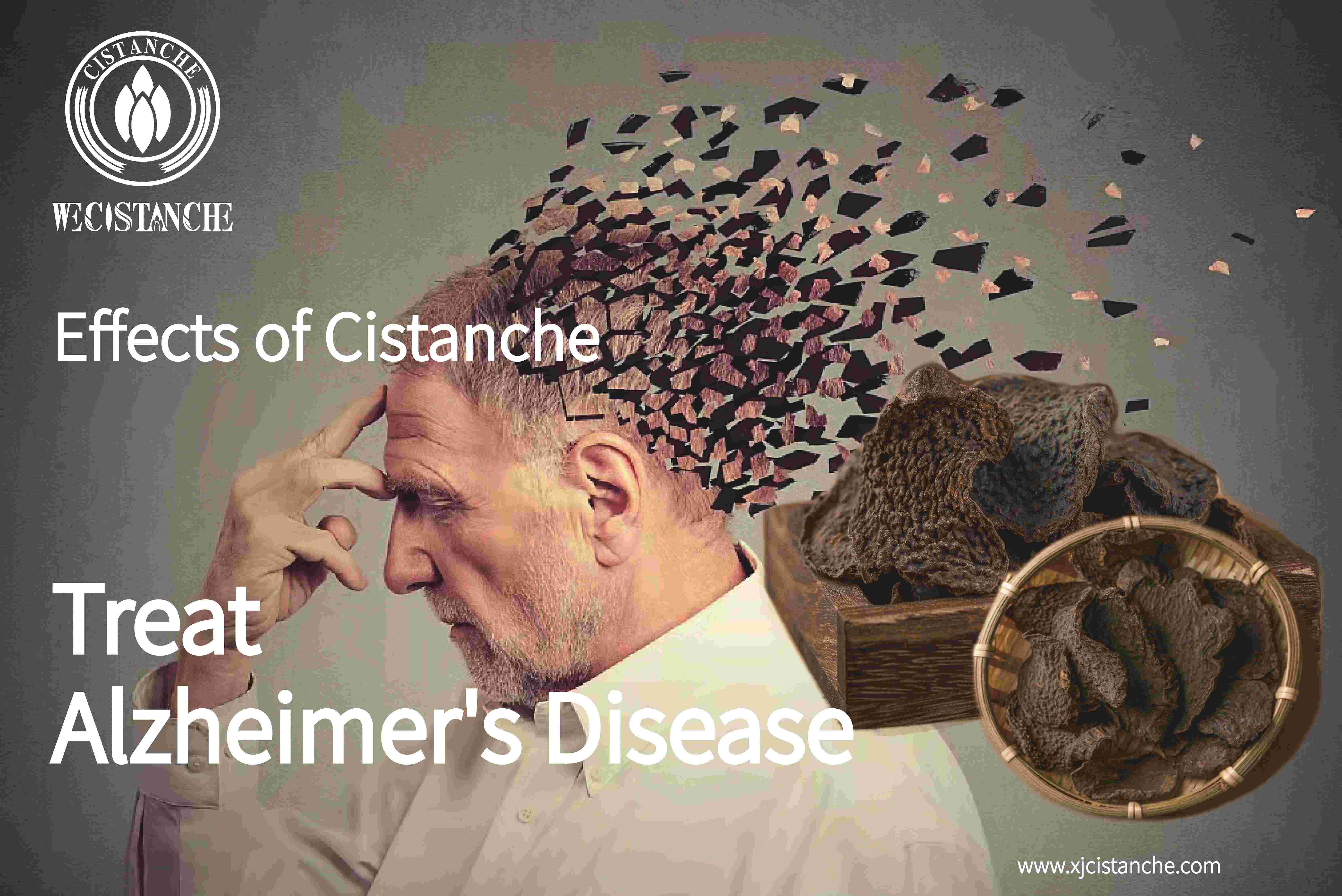
The best herb for Alzheimer's disease
Cistanche herb can increase the protein expression levels of nicotinic acetylcholine receptor (nAChR) α3 and α7 receptor subunits in SH-SY5Y cells, and resist the levels of α3 and α7 receptor subunits caused by Aβ25-35. The reduction of Aβ can reduce the cell damage and the increase lipid peroxidation level caused by Aβ; it can also promote the axon growth of pheochromocytoma (PC12) cells in patients with Alzheimer's disease, and increase the brain of patients with Alzheimer's disease. The level of nerve growth factor (NGF) in glioma (Giiomas, C6) cells, as well as the hippocampal axon growth, neuronal differentiation, and synapse formation in the hippocampus of patients with Alzheimer’s disease, can stimulate Alzheimer's The secretion of NGF in the cerebral cortex and hippocampus of patients with Alzheimer's disease significantly improves the learning and memory.
For more information: Ali.ma@wecistanche.com