Total Glycosides Of Cistanche Deserticola Promote Neurological Function Recovery By Inducing Neurovascular Regeneration Via Nrf- 2/Keap-1 Pathway in MCAO/R Rats-Ⅰ
Apr 18, 2024
INTRODUCTION
Strokes are considered to be a major cause of death and disability in the world. Nearly 87% of all stroke cases are triggered by ischemic stroke. Currently, the most effective agent and the only FDA-approved drug used for ischemic stroke treatment is recombinant tissue plasminogen activator. However, a large amount of stroke patients fail to respond to this drug, owing to its narrow therapeutic time window and a serious risk of hemorrhagic complications. A major challenge of thrombolytic treatment is ischemia/reperfusion (I/R) injury, which is considered a main cause of brain injury and function destruction. Reperfusion after cerebral ischemia increases the risk of a brain hemorrhage while leading to neurovascular injury and producing excessive reactive oxygen species (ROS) which damage the blood-brain barrier. Several studies have confirmed that the disruption of the BBB is a major cause of the pathogenesis of ischemic stroke.
NATURAL CISTANCHE TUBULOSA FOR THE TREATMENT ISCHEMIC STROKE PHGS75% ECH 30% ACT 12%
The BBB consists mainly of endothelial cells, pericytes, astrocytes, neurons, and the basement membranes. The core components of the BBB are cerebral microvascular endothelial cells that are joined by tight junctions, thus restricting exogenous molecules into the brain. The pathological alterations of tight junctions-particularly occludin, claudin-5, and zonula occludens-1 (ZO-1)-significantly affect the BBB function during an ischemic stroke, especially barrier permeability. During I/R periods, excessive ROS is one of the main factors leading to the direct damage of brain neurons. ROS overproduction leads to the degradation of certain junctions and BBB disruption, which results in exogenous molecules entering the brain through the BBB, leading to brain damage aggravation. Therefore, protection of the BBB by anti-oxidants has been regarded as a potential way to prevent reperfusion injury.
Besides the breakdown of the BBB, I/R can result in neurovascular injury and neuronal death. During a stroke, increased neuronal cell death may result from oxidative stress and numerous studies have shown that ROS aggravates stroke severity and neurological damage. Although clinical trials have not gotten satisfactory results, neuroprotection is still a promising strategy for treatment of acute ischemic stroke. Thus, finding effective neuroprotection drugs to treat strokes is a benefit for stroke patients.
Traditional Chinese medicine (TCM) takes measures to intervene against the body's internal imbalance. Owing to the complex pathogenesis of ischemic strokes, the multifactorial effect of TCM and its active constituents play a critical role in the treatment of strokes. Cistanche deserticola Y. C. Ma, widespread in arid or semi-arid areas throughout Mongolia and Northwest China, has been a widely used TCM herb for the treatment of various diseases such as forgetfulness and depression for more than 1,000 years in China. Modern pharmacological studies indicated that the crude extracts from C. deserticola showed multiple pharmacological activities, such as enhancing learning and memory function, neuroprotection, immunity, antioxidant, anti-aging, and antifatigue effects. Chemical analysis of C. deserticola showed that its main constituents include phenylethanoid glycosides, iridoid glycosides, polysaccharides, and oligosaccharides. However, the active components of C. deserticola for brain protection are not very clear.
The neuroprotective property of C. deserticola implies its therapeutic potential in cognitive-related illnesses such as stroke and depression, as well as Alzheimer's disease. However, research on the impact of C. deserticola on strokes, including its active components and action mechanisms, is very limited. In the current work, we explored the protective effect of three extracts from C. deserticola, total glycosides (TGs, phenylethanoid glycosides, and other glycosides), polysaccharides (PSs), and oligosaccharides (OSs) on cerebral I/R injuries. Our findings may contribute to the accurate clinical application of C. deserticola and provide a candidate agent for ischemic stroke therapy.
MATERIALS AND METHODS
Chemicals and Reagents
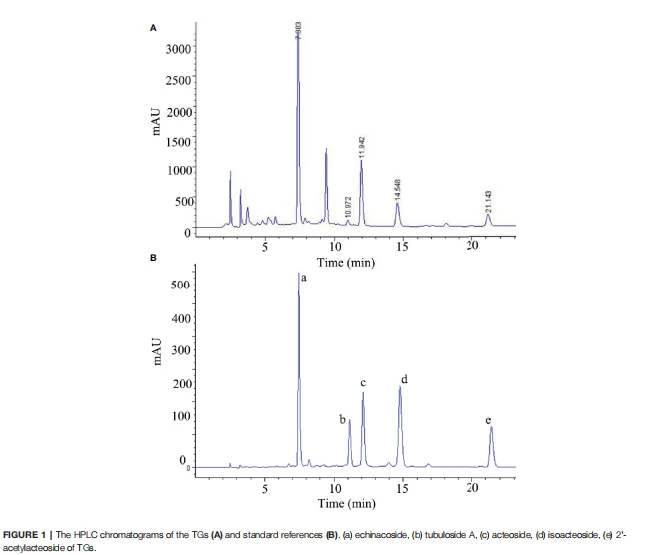
The stems of Cistanche deserticola were purchased from Alashan, Inner Mongolia, and identified by one of the authors (P.-F. Tu). TGs, PSs, and OSs were prepared according to our previously reported method. Quantitative analysis of TGs was performed by high-performance liquid chromatography (HPLC) as previously described, and its chromatogram is shown in Figure 1. The main components of TGs are echinacoside, tubuloside A, acteoside, isoacteoside, and 2'-acetylacteoside; their contents are 163.05 mg/g, 4.125 mg/g, 41.66 mg/g, 22.655 mg/g, and 12.045 mg/g, respectively. The contents of PSs and OSs are 69.42% and 65.24%, respectively, as determined by HPLC and the phenol–sulfuric acid analysis, respectively.

NATURAL CISTANCHE TUBULOSA FOR TREATING ISCHEMIC STROKE PHGS75% ECH 30% ACT 12%
The standard references of echinacoside (A0282), tubuloside A (A0942), acteoside (A0280), isoacteoside (A0281), and 2'- acetylacteoside (A0943) were purchased from Chengdu Must Biotechnology. The purities of all standards are more than 98%. Nissl stain H&E kits were bought from Boster. Edaravone (T0407-1) was bought from Target Mol (Shanghai, China). Rabbit anti-rat MAP-2 (ab32454), Nrf-2 (ab31163), PDGFRb (ab32570), Keap-1 (ab66620), and mouse anti-rat CD31 (ab24590) were purchased from Abcam Inc. Rabbit anti-rat Claudin5 (BS1069), ZO-1 (BS9802M), and Occludin (BS72035) were bought from Bioworld Technology. Cell Signaling Technology Inc. (Boston, MA, USA) was the source of rabbit anti-rat Synapsin-1 (SYN,5297T), PSD95 (3450T), a-Smooth Muscle Actin (a-SMA,19245T). GAPDH (HRP-60004) was purchased from Proteintech Group, Inc.Secondary antibodies were supplied by Zhongshan Golden Bridge Biotechnology (Beijing, China). Hoechst 33258 was obtained from Beyotime.
Animals
Sprague-Dawley rats (male, weighing 250–300g) were obtained from Vital River Laboratory Animal Technology and housed in an airconditioned room kept on a 12 h light/dark cycle. All animal experiments were performed by the animal research ARRIVE guidelines, and approved by the Institutional Animal Care and Use Committee of Peking University Health Science Center.
Animal Experimental Protocols
The rats were subjected to MCAO/R, as previously described (Wang et al., 2018). Briefly, the left common carotid artery (CCA), external carotid artery (ECA), and internal carotid artery (ICA) were exposed, and a 3-0 nylon monofilament suture was inserted from the ECA into the ICA until reaching the middle cerebral artery (MCA). After 1.5 h of MCA occlusion, reperfusion was simulated by removing the filament. During the surgical procedure, the body temperature of all rats was maintained at 37.0°C. Drug
Administration
The rats were randomly separated into six groups using the SPSS software version 22.0 as described: normal group (NOR); model group (MOD); edaravone group (positive drug, 6 mL/kg, EDI); TGs group (280 mg/kg, TGs); PSs group (280 mg/kg, PSs), and OSs group (280 mg/kg, OSs). TGs, PSs, and OSs were administrated once a day after MCAO/R for 14 days. The NOR and MOD groups were treated with normal saline. The animal numbers are shown in Table 1.

Measurement of Weight and Modified Neurological Deficit Scores (mNSS)
Body weight was monitored on the 14th day using an ADVENTURE™ Digital Scale (OHAUS, New Jersey, USA). The mNSS was assessed according to the method described by FJ Wang (Wang et al., 2018), with minor revisions.
2, 3, 5-Triphenyltetrazolium Chloride (TTC) Staining
Infarct volume was measured as described previously. In brief, the brains were sectioned into seven equally spaced coronal blocks (2 mm). These sections were stained with 2% TTC at 37°C for 15 min. Infarct volume (%) = (ipsilateral ischemic hemisphere volume −contralateral ischemic hemisphere volume)/contralateral ischemic hemisphere volume × 100.
Nissl and H&E Staining
The rats were deeply anesthetized, and the whole brain was then rapidly removed from the skull fixed using 4% paraformaldehyde embedded in paraffin wax and sectioned into slices of 7 µm thickness. The sections were stained with Nissl and H&E. In this study, six random 200 × 200 µm fields were captured in each tissue specimen with a light microscope. The number of Nissl's bodies was counted with IPP software version 6.0.
Evans Blue Assay
Rats were injected with 2% EB after MCAO/R. Two hours later, the rats were anesthetized and the whole brain was then rapidly removed and homogenized in acetone. The supernatants were analyzed at 620 nm by an 800 TS absorbance reader.
Measurement of the Activities of Catalase (CAT), Superoxide Dismutase (SOD), Malondialdehyde (MDA), and Glutathione Peroxidase (GSH-Px)
All serum samples were centrifuged at 4,000 × rpm for 15 min at 4°C and then analyzed to detect the activities of MDA, CAT, SOD, and GSH-Px following the manufacturer's instructions.
Western Blotting Analysis
Brain tissues (100 mg) collected from each rat were homogenized and lysed in RIPA lysis buffer and then analyzed to detect the protein concentration using a BCA kit. Tissue total proteins were loaded on 10% SDS-PAGE gels and transferred onto a nitrocellulose membrane. The membrane was blocked using 5% skim milk, then incubated overnight with primary antibodies at 4°C. The membrane was then incubated with a secondary antibody. Western blot analysis was analyzed using Kodak Digital Imaging System.
Immunofluorescent Analysis
Immunofluorescence staining for CD31, a-SMA, ZO-1, claudin5, occludin, PDGFRb, SYN, PSD95, MAP-2, Nrf-2 and Keap-1 were performed. Primary antibodies against Nrf-2, CD31, a-SMA, ZO-1, claudin5, occludin, PDGFRb, SYN, PSD95, MAP-2 and Keap-1 were diluted to 1:200 and 1:100, respectively. The secondary antibodies of Alexa Flur 488 mouse anti-rabbit IgG and rhodamine (TRITC) goat anti-rabbit IgG were both diluted to 1:200. The nuclei were stained by Hoechst 33258. Images were captured using Vectra® Polaris™ Automated Quantitative Pathology Imaging System (PerkinElmer, USA). The protein expression was analyzed using IPP software version 6.0. Statistical Analysis
All data were described as mean ± SD. SPSS software version 22.0 was performed for statistical analysis. One-way ANOVA was used when comparing different groups. P < 0.05 was considered to be the statistical difference.

NATURAL CISTANCHE TUBULOSA FOR ANTI-ISCHEMIC DISEASE PHGS75% ECH 30% ACT 12%
RESULTS
TGs Increase Body Weight and Reduce Brain Damages in MCAO/R Rats
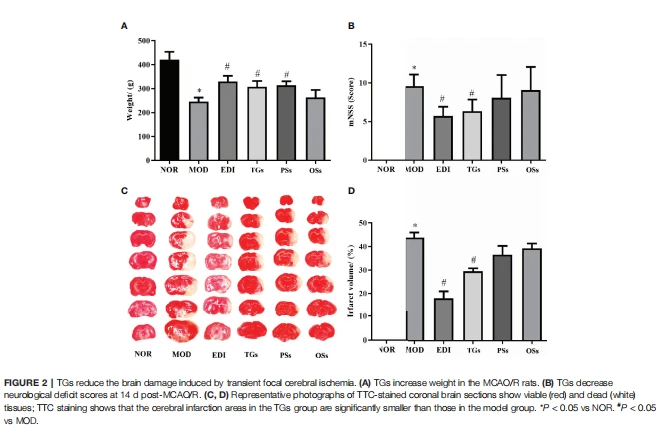
After 14 days of cure with TGs, PSs, Oss, and EDI, the body weights, neurological deficits, and infarct volumes of I/R rats were evaluated. The results showed that the body weights in the MOD group were greatly decreased, while the decreased weights in TGs, PSs, and EDI groups were increased (Figure 2A). Neurological deficit scores were substantially lowered by EDI and TGs (Figure 2B). The brain slices in NOR group rats were deep red and there were no infarctions, while the rats of the MOD group showed a large ipsilateral cerebral infarction. After TGs treatment, the infarct volumes were significantly reduced (Figures 2C, D). The PSs and OSs treatment showed no obvious effect on the above indexes. The above data showed that TGs could markedly alleviate the I/R-induced cerebral injury, but PSs and OSs could not.
TGs Ameliorate Histopathological Damage in MCAO/R Rats
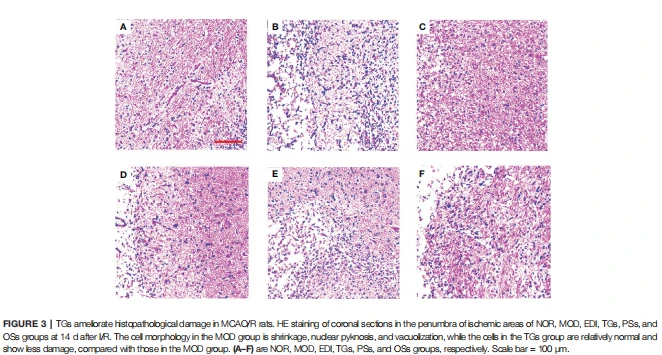
To determine some of the effects of TGs, PSs, and OSs treatment on histopathological damage, H&E staining was done to reveal pathological damage. The histomorphological structures of brains in the NOR group were arranged regularly. The morphology changes in the TGs groups were slighter than those in the MOD group. However, the PSs and OSs treatment groups showed no significant amelioration of the morphology changes (Figure 3).
TGs Attenuate Neuronal Injury After I/R-Induced Rats
Nissl staining showed the histopathological changes of neurons in the penumbra of the ischemic area. As shown in Figure 4, the normal neurons had a clear nucleolus and intact structure. In the MOD group, the neurons had enlarged intercellular spaces. The nissl bodies disappeared, shrunken and deeply stained. However, these changes were rarely observed in the EDI, TGs, and PS groups. These results illustrated that TGs and PSs could significantly attenuate ischemia/reperfusion-induced neuronal injury.
TGs Attenuate BBB Disruption After I/R-Treated Rats
Evans blue assay is a classical method for researching the change of BBB permeability. The experiment results showed that increased Evans blue was observed in the MOD group, while there was significantly decreased Evans blue in the TGs and EDI-treated rats. Moreover, there was no significant difference between PSs and OSs therapy groups (Figure 5). These results suggested that TGs could significantly attenuate BBB disruption.
TGs Promote Angiogenesis in I/R Injured Rats
More recent studies show that angiogenesis plays a critical role in neurological functional recovery and prognostic outcomes after acute ischemic stroke (Yuen et al., 2015). To evaluate the effects of TGs, PSs, and OSs on angiogenesis, the CD31 and a-SMA were used to quantify the capillary numbers. Immunofluorescence staining showed that the MOD group caused a remarkable decrease in the expressions of CD31 (Figures 6A, B) and a-SMA (Figures 6C, D) in the penumbra of ischemic areas of I/R rats, in comparison with the normal rats. This result illustrated that I/R could cause vascular damage in the cortex penumbra of ischemic hemispheres. However, the TGs and EDI treatment remarkably increased capillary density, angiogenesis, and arteriogenesis as indicated by increased expressions of CD31 and a-SMA. These results suggest that TGs could promote angiogenesis in the ischemic penumbra of I/R rats, but the PSs and OSs could not.
TGs Increase Expression of Tight Junction Proteins in I/R Injured Rats
BBB disruption can elevate brain water content and tissue swelling, leading to brain injury. Tight junction proteins are important structural components of the BBB. To test whether TGs, PSs, and OSs treatment after stroke might influence BBB integrity, the expressions of ZO-1, claudin-5, and occludin were performed by immunofluorescence analysis. The results indicated that the expressions of claudin-5, occludin, and ZO-1 were visibly decreased in the MOD group. However, they substantially increased after 14 days of its administration. PSs and OSs groups showed no significant changes in these protein expressions (Figure 7). These data indicated that the TGs can regulate tight junction protein expressions and probably maintain BBB integrity after I/R injury.
TGs Increase Pericyte Coverage on Capillaries in I/R Injured Rats
Pericyte coverage on capillaries plays a critical role in maintaining BBB integrity. Thus, we tested whether pericyte coverage could be increased by TGs, PSs, and OSs treatment. Immunofluorescence intensity analysis results showed that both PDGFRb and CD31 expressions were dramatically decreased in the MOD group. Administration of TGs to the I/R rats significantly recovered or even increased the expression intensities of the PDGFRb and CD31, but no difference was observed in the PSs and OSs treatment groups (Figure 8). Thus, treatment of TGs could significantly increase pericyte coverage. These findings further confirmed that TGs can maintain the integrity of BBB after I/R.

NATURAL CISTANCHE TUBULOSA FOR PREVENTING ISCHEMIC STROKE PHGS75% ECH 30% ACT 12%