Types And Characteristics Of Cistanche Deserticola
Jun 06, 2024
Cistanche Hoffmg.Et Link is a perennial herbaceous parasitic plant of the Oroban. chaceae family, with over 20 species worldwide. It is now widely believed that there are four varieties of the genus Cistanche in China, namely Cistanche deserticola Y.C.Ma, C.salsa (C.A. Mey.) G.Beck, C.Tubulosa (Schenk) R.Wight, C.sinensis G.Beck, and C.salsa (C.A. Mev.) G.Beck, Var. albiofora P.F.Tu et Z.C.Lou. Some scholars also believe there are 7 species and 1 variety of plants in the genus Cistanche distributed in China. They think that in addition to Cistanche deserticola Y.C.Ma, C.salsa (C.A. Mey.) G.Beck, C.Tubulosa (Schenk) R.Wight, C.sinensis G.Beck, and C.salsa (C.A. Mev.) G.Beck, Var. albiofora P.F.Tu et Z.C. Lou, in China, there are also Cistanche deserticola (C.A.Mev.) G.Beck, C.F.Tu et Z. Lou, which are distributed in China. Stanche ambigua (Bge) GBeck, Cistanche fissa (C.A.Mey) G. Beck, and Cistanche mongolica G. Beck are limited due to their small distribution, making it difficult to collect corresponding specimens and samples in the field.

cistanche
1. C. tubulosa: Calyx tube-shaped, 5-lobed at the top, lobes long ovate triangular or lanceolate, corolla tube-shaped funnel-shaped, purple-tinged, filaments densely covered with yellow-white villous hairs, anthers ovate, densely covered with yellow-white villous hairs, base blunt and round, without a small pointed tip. It is distributed in the southern part of Xinjiang (Tarim Basin and its outer edge) and is parasitic on the roots of Tamarix plants.

cistanche tubulosa benefits and side effects
2. Salted Cistanche deserticola (C.salsa): The corolla is cylindrical and bell-shaped, with 5 shallow lobes at the top and nearly circular lobes; There is no ring of long hairs near the base of the corolla tube, only the base of the filament is covered with long hairs. The base of the pharmacy is pointed. The length of all bracts in an inflorescence is approximately half of that of a flower. The obvious difference from Cistanche deserticola lies in the length of the bracts. The lower half of all thin segments of the inflorescence of Cistanche deserticola are longer, equal, or slightly longer than the flowers. Distributed in western Inner Mongolia, Ningxia, Gansu, Qinghai, and northern Xinjiang.
3. C. sinensis: Calyx bell-shaped, lobes linear or oblong-lanceolate, corolla tube with a circle of long pubescence near the base of stamens. Distributed in western Inner Mongolia, Ningxia, Qinghai, Gansu, and eastern Xinjiang, it is an endemic species of China.
Observing and dissecting the type specimen (Liu Jianzhong, Sun Yujin 215) designated for the publication of the new species of Cistanche deserticola in Lanzhou at that time and stored in the Plant Specimen Museum of Lanzhou University, it was found that there were variations in the calyx structure and the number and morphology of calyx lobes on the same plant and inflorescence. Most flowers had 4 deeply lobed sepals, and the lobes were nearly equal in size. Only a few flowers had 5 deeply lobed sepals, which merged into Cistanche deserticola C.sinensis
4. Desert Cistanche (C. deserticola): When this species was first published as a new species, it was compared with the Mediterranean region's (C. tinctoria) as a similar species. The distinguishing feature of Cistanche deserticola is that the calyx is 5-lobed, and the base of the corolla tube has no villous hairs. Researchers have observed multiple times in the field and found that it is similar to the morphological characteristics of C. ambigua, both of which parasitize on the roots of Haloxylon plants and have thick fleshy stems; The corolla tubes are all light yellow to yellow, and the corolla lobes (eaves) are all light purple. The characteristic that distinguishes it from Cistanche deserticola is the absence of cotton hairs on the sepals. Cistanche deserticola is distributed in western Inner Mongolia, northern Xinjiang, and southwestern Mongolia, and its distribution area also partially intersects with Cistanche deserticola. Therefore, it is necessary to further investigate the relationship between Cistanche deserticola and Cistanche deserticola.

Cistanche deserticola Y.C.Ma
5. C. fissa: This species is also known as small cistanche. It is a type of Cistanche that parasitizes the roots of the Nanophyton erinaceum in the family Chenopodiaceae. It is recorded that this species is distributed in Kazakhstan and the foothills of the Altay Mount Taishan Mountains in Russia. In 1992, Professor Liu Yingxin recorded the distribution of this species in the Demon Mountain of Urumqi City, Xinjiang, China in the third volume of the Flora of the Desert in China. After consulting the specimens of Liu Yingxin and Yang Xilin from the Institute of Environment and Engineering in the Cold and Dry Regions of the Chinese Academy of Sciences, as well as the specimens of Li Jun 875002 from the Plant Specimen Museum of Xinjiang University, researchers found that they had all been mistakenly identified as Salted Cistanche deserticola (C.salsa). Salted Cistanche deserticola has 5-lobed sepals, nearly equal in size, and a rounded and blunt apex. The sepals of the deeply split Cistanche deserticola are deeply split into 4-5 lobes, with the latter one appearing sharp-toothed or missing; The remaining lobes are larger, two are blunt, two are pointed, and hairy. After identification and analysis, combined with the results of field investigations, it is believed that the specimens of Liu Yingxin, Yang Xilin 79360, and Li Jun 875002 from the Plant Specimen Museum of Xinjiang University are all C. fissa, further confirming the distribution of this species in China.
6. C. ambigua: The type specimen was collected from the Kum Desert in Central Asia. After multiple field observations, the morphological characteristics of C. ambigua and C. deserticola are similar, both have thick fleshy stems and are parasitic on the roots of Haloxylon plants. The corolla tubes are all light yellow to yellow, and the corolla lobes (eaves) are all light purple. But the difference between the two is that the scales of Cistanche deserticola are longer, the scales are pointed at the top, and the sepals are densely covered with cotton wool. Cistanche deserticola is distributed in the deserts of countries such as the Caucasus, Armenia, Kazakhstan, Iran, and southwestern Mongolia. Distributed in the Junggar Desert in northern Xinjiang, China.
Click here to view Cistanche deserticola tea products
【Ask for more】 Email:cindy.xue@wecistanche.com / Whats App: 0086 18599088692 / Wechat: 18599088692
7. Red flowered Cistanche (C. Mongolia): The type specimen is produced in the Kriya region of the Kunlun Mountains in southern Xinjiang, China. The specimen was collected by N. Przewalsky and was collected by G Beck used the word "Mongolia" in their naming and described it as distributed in the western part of Mongolia, causing some confusion. In 1958, Novopokr. and Tzvel. suggested in Volume 23 of the Flora of the Soviet Union that this species may be Cistanche deserticola, but they were not certain, so the Flora of China was treated as a questionable species. According to the original description, some of the morphological features of C. mongolia and C. tubulosa are very similar (both anthers are oval-shaped, without small pointed heads). The most obvious difference between the two is that the corolla of C. deserticola is pink (light rose color) to white, without blue purple lobes (eaves); The corolla is 3.5-4.5 centimeters long, and the flower diameter reaches 2.8-3 centimeters during flowering; Its host is Artemisia plants, not Tamarix plants, so it is significantly different from Cistanche deserticola. In 1974, a journalist from the Ethnic Pictorial News Agency took photos of this plant, which was found in the Gobi Desert rather than in the desert. We believe that this species is likely to exist and is an independent species. The 69 volumes of the Flora of China, published in 1990, also provide descriptions of suspected species. For this purpose, researchers specifically consulted and dissected specimens from the Plant Specimen Museum of the Northwest Plateau Institute of Biology, Chinese Academy of Sciences (Wu Yuhu No. 870098) and specimens from Wu Sugong, Wu Yuhu, and Fei Yong No. 4623), and determined that it is the Red Flower Cistanche (C. Mongolia). It has been confirmed that this species is not distributed in the Mongolian Plateau.
8. A variant of Cistanche salsa (C.A. Mey.) G. Beck, also known as White Flower Salt Cistanche (D.A. Mey) G. Beck var. albiflora P.F.Tu et Z.C. Lou);
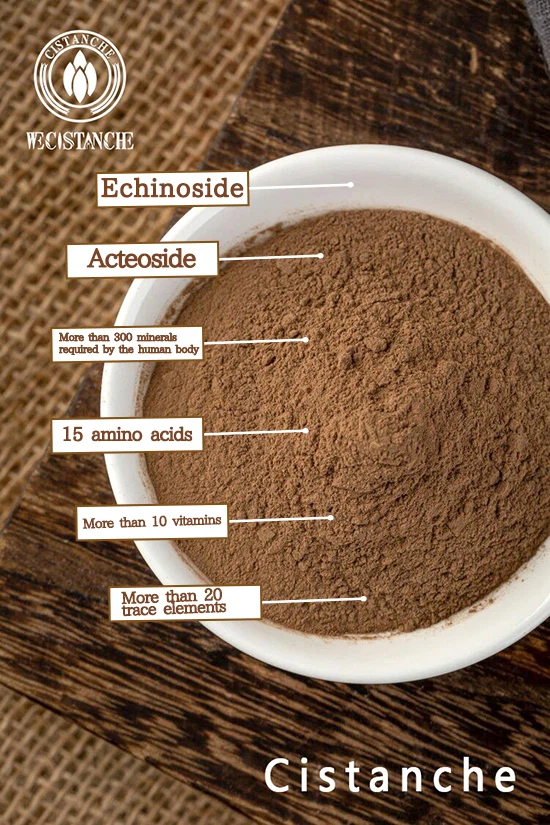
Main Chemical Constituents of Cistanche deserticola
C. salsa. var. albiflora: Parasitic on the roots of plants in the genus Kalidium. The difference from the original variety is that the upper part of the stem and the inflorescence axis are white. The bracts are l-17mm long and 4-6mm wide, with no hair on the outside and long soft hairs on the edges; Bracts, bracts, and sepals are all white; The corolla lobes are white. Produced in Ningxia (Yanchi). Born near salt lakes in desert areas. The chemical composition and preliminary pharmacological activity of this variant and the original variant were compared by thin-layer chromatography, and the two were consistent. Due to its distinct taxonomic characteristics, this variant can be retained.