What To Look For When Buying Cistanche Extract
Nov 02, 2026
1. Regulatory Specifications: Whether It May Be Used At All
This group is the most frequently skipped and the most capable of ruining a project. No matter how high the assay, a material whose botanical origin falls outside the permitted list cannot be sold.
1.1 Only two species are official; the rest are adulterants
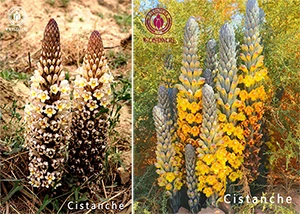
The Chinese Pharmacopoeia defines the drug as the dried fleshy stem, bearing scale leaves, of Cistanche deserticola Y. C. Ma (commonly called desert cistanche) or Cistanche tubulosa (Schrenk) Wight (commonly called Xinjiang cistanche). The latter was admitted to the pharmacopoeia in the 2005 edition. The genus in China comprises four species and one variety. Cistanche salsa, Cistanche salsa var. albiflora and Cistanche sinensis are not official, and Boschniakia rossica is a separate regional substitute rather than a pharmacopoeial article.
1.2 The food-use line: only the desert species is listed
Announcement No. 9 of 2023, issued by the National Health Commission and the State Administration for Market Regulation, added nine substances, including Cistanche, to the catalogue of materials traditionally used both as food and as Chinese medicinals. The catalogue entry reads Cistanche (desert), with the Latin name Cistanche deserticola Y. C. Ma and the part given as the fleshy stem.

Cistanche deserticola Y.C.Ma
1.3 Evidence of lawful sourcing
Wild Cistanche is a Class II nationally protected wild plant in China and has been listed under the Convention on International Trade in Endangered Species. Today Cistanche tubulosa is cultivated mainly in southern Xinjiang, while Cistanche deserticola is inoculated and cultivated at scale in Inner Mongolia, Gansu and Ningxia. Purchasers should require documentation of the cultivation base or harvest source, and proof of artificial cultivation, to avoid exposure to illegal wild collection.
2. Identity and Authenticity: Origin and Cross-Section Reveal Adulteration
Adulteration is a real and measured risk in this botanical. In a nationwide sampling of Cistanche decoction pieces, eleven of twelve batches that failed morphological examination were Cistanche sinensis, and one further batch was adulterated with it, giving an adulteration rate near eighteen percent.
Table 1 Identification points for official species and common adulterants
|
Species |
Status |
Vascular bundle pattern on cut surface |
Other distinguishing features |
|
Cistanche deserticola |
Official; listed in the food catalogue |
Dot-like bundles arranged in a deeply wavy ring |
Flattened cylindrical and slightly curved; densely covered with imbricate fleshy scale leaves; heavy, hard, slightly flexible; faint odor, sweet then slightly bitter; about five bundles in the scale leaf |
|
Cistanche tubulosa |
Official since 2005 |
Dot-like bundles scattered across the whole cut surface |
Flattened fusiform or irregular, often twisted; hard and inelastic, granular fracture; produced mainly in southern Xinjiang |
|
Cistanche salsa |
Not official (regional use in Xinjiang and Inner Mongolia) |
Shallow wavy ring, hard to distinguish from the official species |
Thinner scale leaves; slightly salty and bitter; about ten bundles in the scale leaf |
|
Cistanche sinensis |
Not official; frequent in sampling failures |
Subpolygonal arrangement |
Slender; thicker scale leaves, four to six per whorl; pale yellow bundles on the cut surface |
|
Boschniakia rossica |
Regional substitute, not pharmacopoeial |
Not applicable |
Single erect slender stem with the spicate inflorescence left on the apex; easily separated from the official species |
Once the material has been extracted, the sliced morphology no longer exists, and morphological identification fails. At that point, the following should be relied upon:
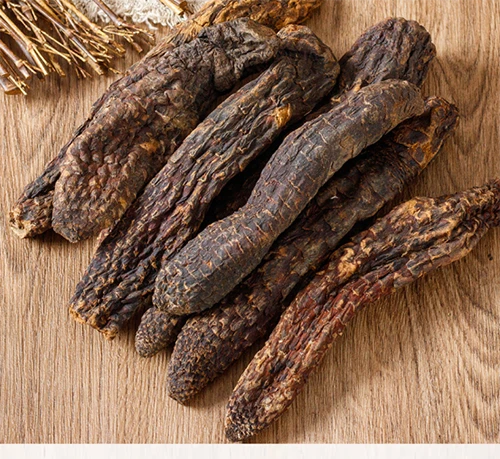
Cistanche tubulosa (Schrenk) Wight
Characteristic chemical markers: 2'-acetylacteoside distinguishes Cistanche deserticola from Cistanche tubulosa; the presence of poliumoside and 2'-acetylpoliumoside indicates Cistanche sinensis and signals adulteration.
HPLC fingerprint or characteristic chromatogram: requires a profile compared against a reference crude drug, not merely the quantitation of two peaks.
Thin-layer identification: using echinacoside and acteoside as reference substances, as a minimum level of identity control.
3. Core Assay Specifications: Two Compounds and Their Passing Lines
3.1 Statutory limits
Under the Cistanche monograph of the Chinese Pharmacopoeia, determined by HPLC and calculated on the dried basis, Cistanche deserticola must contain not less than 0.30 percent of the combined amount of echinacoside and acteoside, while Cistanche tubulosa must contain not less than 1.5 percent.

Main Chemical Constituents of Cistanche tubulosa
3.2 Methodological details worth checking on a certificate
Table 2 Pharmacopoeial HPLC conditions and how to read results
|
Item |
Stipulated condition |
Where acceptance goes wrong |
|
Column |
Octadecylsilane bonded silica |
Retention times shift between brands; judge on resolution, not on absolute times |
|
Mobile phase |
Methanol and 0.1 percent formic acid, gradient elution |
Results from an acetonitrile system, used in some granule standards, are not directly comparable |
|
Detection wavelength |
330 nm |
This is the characteristic absorbance of phenylethanoid glycosides; a shifted wavelength distorts results |
|
System suitability |
Not fewer than 3000 theoretical plates for the echinacoside peak |
A report that omits this leaves the method's reliability in doubt |
|
Sample preparation |
50 percent methanol, 30 minutes standing, 40 minutes sonication at 250 W and 35 kHz |
Incomplete extraction underestimates content; power and time are real variables |
|
Basis of calculation |
Calculated on the dried basis |
A result not corrected for moisture will read low; check that the basis is stated |
3.3 How to read commercial extract specifications
Table 3 Common specification labels and how to interpret them
|
Label |
Meaning |
Typical method |
Risk and interpretation |
|
10:1, 20:1, 30:1 |
Concentration ratio, kilograms of crude drug per kilogram of extract |
Usually no assay, a process description only |
Implies nothing about active content; cannot be used to compare quotations and should never be the sole criterion |
|
Total glycosides 20 to 85 percent |
Total phenylethanoid glycosides |
UV spectrophotometry |
UV measures total absorbance against a single reference and is inflated by co-occurring phenolics; values run systematically above HPLC sums |
|
Echinacoside 5 to 80 percent |
A single constituent |
HPLC |
Most reliable, but reflects one compound; should be read together with acteoside |
|
Acteoside 10 to 95 percent |
A single constituent |
HPLC |
At the top of the range the material approaches a chemical reference standard; confirm it is still genuinely an extract |
|
Total glycosides 40 percent plus echinacoside 10 percent |
Combined declaration |
UV and HPLC together |
The better practice, as the two methods cross-check each other |
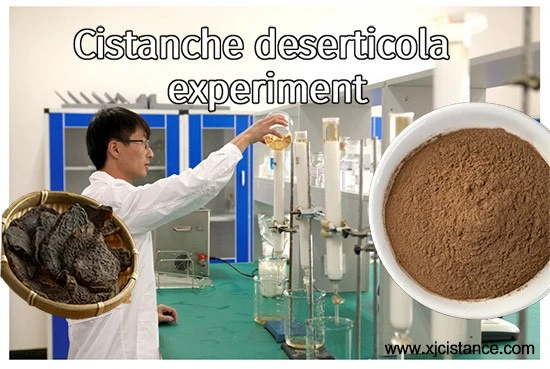
Cistanche tubulosa experiment
4. Synergy Specifications: The Half That Standards Ignore and Research Confirms
This is the category this article most wants to emphasize. Work on antidepressant activity has shown clearly that neither the abundant phenylethanoid glycosides nor the scarce iridoid glycosides work well alone; only the combination produces a significant effect. Tracking two glycosides alone discards half the picture systematically.
Table 4 Additional constituents worth including in internal specifications
|
Compound class |
Representative substances |
Why it matters |
Suggested form of specification |
|
Phenylethanoid glycosides |
Echinacoside, acteoside, isoacteoside, tubuloside A and B, 2'-acetylacteoside |
Recognized as the core active class and the statutory markers |
Quantify two markers by HPLC; control the ratio of remaining peaks in a characteristic chromatogram |
|
Iridoid glycosides |
8-epiloganic acid, geniposidic acid, 8-epideoxyloganic acid |
Synergize with phenylethanoid glycosides in antidepressant models; rank high in spectrum-effect work on diabetic kidney disease |
Quantify one or two representative peaks by HPLC or UPLC-MS |
|
Polysaccharides |
Cistanche deserticola polysaccharides |
Immunomodulation and laxation; improve diabetic nephropathy through gut microbiota and inhibition of TLR4/NF-kB |
Crude polysaccharide by the phenol-sulfuric acid method; regional standards commonly require not less than 3.0 percent |
|
Oligosaccharides and betaine |
Betaine, oligosaccharides |
Betaine resembles choline and probably acts as a cholinomimetic, an important part of the laxative mechanism; content rises after wine processing |
Betaine by HPLC; regional standards commonly require not less than 1.5 percent |
|
Sugar alcohols |
Mannitol |
Characteristic of Cistanche deserticola; useful as a secondary check on botanical origin and adulteration |
Regional standards require mannitol not less than 6.0 percent |
|
Lignans |
Pinoresinol and related compounds |
Potential contributors to antioxidant and antitumor activity |
Research stage; observe as fingerprint peaks for now |
Regional and group standards have already moved in this direction. A group standard from Alxa requires a combined echinacoside and acteoside content of not less than 0.5 percent, crude polysaccharide not less than 3.0 percent, and betaine not less than 1.5 percent. An Inner Mongolia regional standard additionally requires protein not less than 10.0 percent, mannitol not less than 6.0 percent, and extractives not less than 45.0 percent. Such multi-dimensional criteria describe real quality far better than two glycosides alone and deserve a place in internal specifications.

Cistanche tubulosa extract
Click here to view Cistanche Tubulosa Extract Natural Supplement Powder
【Ask for more】 Email:cindy.xue@wecistanche.com / WhatsApp: 0086 18599088692 / WeChat: 18599088692
5. Routine Physicochemical Specifications
Table 5 Routine physicochemical parameters across crude drug, food material and extract
|
Parameter |
Pharmacopoeia (crude drug) |
Regional or group standards (food material) |
Additional points for extracts |
|
Moisture |
Not more than 10.0 percent |
Slices not more than 10.0 percent; powder not more than 5.0 percent |
Extracts are hygroscopic; not more than 5.0 percent is advisable, and moisture is also the basis for the dried-basis calculation of assay |
|
Total ash |
Not more than 8.0 percent |
Not more than 8.0 percent |
High values suggest soil, inorganic matter or incompletely washed rhizosphere material from the host plant |
|
Extractives |
Cold maceration in dilute ethanol: not less than 35.0 percent for deserticola, 25.0 percent for tubulosa |
Not less than 45.0 percent in some standards |
For extracts, water-soluble extractives may be substituted; note that the pharmacopoeial limits differ by species |
|
Acid-insoluble ash |
Not listed separately |
Not specified |
Recommended as an internal control because it reflects silicate soil contamination more specifically |
|
Particle size |
Not applicable |
Powder must pass entirely through a 180 micrometer sieve |
Commercial powders are commonly 80 to 100 mesh; spray-dried powders should also be assessed for flow and bulk density |
|
Appearance and color |
Not applicable |
Yellow-brown to brown, uniform, free of mold |
State whether spray drying or vacuum drying was used; abnormal color suggests overheating or oxidation |
|
Water solubility |
Not applicable |
Not specified |
For beverage applications, require full solubility in water and absence of heavy sediment after cold dissolution |
6. Safety Specifications: Limits Depend on Intended Use
These items must be checked one by one, and they are the ones most often copied across from an unrelated document. Limits differ between standards according to product category and jurisdiction.
Table 6 Contaminant and residue limits compared
|
Item |
Food catalogue (Announcement No. 9, 2023) |
Gansu DBS 62/009 |
Alxa group standard |
Inner Mongolia DB15/T 2360 |
|
Lead |
Not more than 1.0 mg/kg |
Not more than 0.9 mg/kg |
Not more than 0.8 mg/kg |
Not more than 1.0 mg/kg |
|
Cadmium |
Not more than 0.5 mg/kg |
Not more than 0.4 mg/kg |
Not more than 0.5 mg/kg |
Not more than 0.2 mg/kg |
|
Total arsenic |
Not more than 0.5 mg/kg |
Not more than 0.4 mg/kg |
Not more than 0.5 mg/kg |
Not more than 0.5 mg/kg |
|
Total mercury |
Not more than 0.1 mg/kg |
Not more than 0.1 mg/kg |
Not more than 0.1 mg/kg |
Not more than 0.2 mg/kg |
|
Sulfur dioxide residue |
Not more than 400 mg/kg |
Not more than 100 mg/kg |
Not specified |
Not specified |
|
Aflatoxin B1 |
Not specified |
Not more than 10.0 micrograms/kg |
Not specified |
Not more than 5.0 micrograms/kg |
|
Pesticide residues |
Must meet the relevant provisions of the Ministry of Agriculture and Rural Affairs |
Must meet GB 2763 |
Not specified |
Trichlorfon 0.01, carbendazim 0.1, phoxim 0.05, deltamethrin 0.01, omethoate 0.01, all in mg/kg |
Beyond these, an extract requires items that crude drug standards do not cover but which are critical for extracts:
Residual solvents: most commercial material is extracted with ethanol and water; control ethanol and any other organic solvent according to GB 5009.262 or an internal limit. Where macroporous adsorption resin is used for purification, resin residues such as benzene and styrene derivatives must also be addressed.
Microbiology: aerobic plate count, coliforms, mold and yeast, and pathogens including Salmonella and Staphylococcus aureus; edible powders are commonly required to meet GB 7101.
Other elements: shipments to the European Union, the United States, and other markets require additional testing against the destination's regulations and pesticide lists.
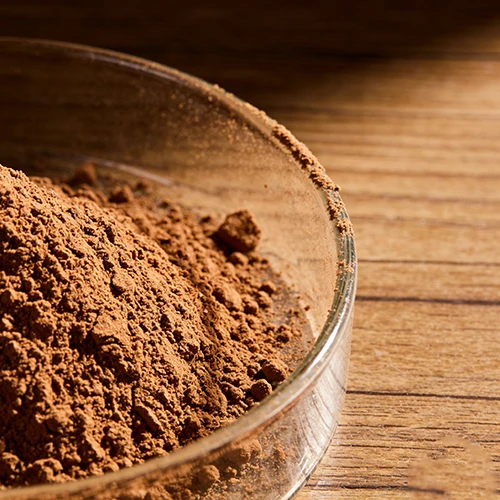
cistanche powder
7. Processing and Process Specifications: Raw, Wine-Processed and Drying
Whether the starting material is raw or wine-processed determines the chemical profile and the direction of activity. This is a point that extract specifications almost never address, but that purchasers must raise.
Table 7 Differences between raw and wine-processed material
|
Dimension |
Raw Cistanche |
Wine-processed Cistanche |
|
Polysaccharide fraction |
Retains the original profile |
Content decreases after steaming with wine |
|
Oligosaccharides and betaine |
Baseline level |
Betaine content rises markedly |
|
Phenylethanoid glycosides |
Echinacoside and acteoside at original levels |
Dissolution improves, but echinacoside and acteoside fall somewhat after steaming while isoacteoside rises |
|
Direction of use |
Stronger lubricating action; preferred for constipation from fluid depletion |
Stronger kidney-supplementing and yang-assisting action; used for impotence, lumbar pain and infertility |
|
Research evidence |
Reference material |
Total glycosides from processed material outperformed raw material in restoring HPT axis function, regulating folate and amino acid pathways, and optimizing microbial structure |
Drying matters just as much. Cistanche contains glycoside-hydrolyzing enzymes, and if drying is handled poorly, the phenylethanoid glycosides may be hydrolyzed, and content may fall significantly. Purchasers should confirm with the supplier:
Harvest season: dug when the shoot has just emerged in spring or before the ground freezes in autumn, with the stem tip removed, as the pharmacopoeia specifies.
Enzyme deactivation: whether steaming, hot-air drying, or pretreatment before slicing was used to inactivate hydrolytic enzymes.
Extraction and concentration temperature: phenylethanoid glycosides are heat-sensitive and degrade under prolonged high-temperature concentration.
Drying process: spray drying and vacuum drying differ in their effects on color, solubility, and constituent retention.
8. Documentation and Stability: Fixing the Specifications
However carefully specifications are written, they cannot be enforced at acceptance unless they are fixed in contracts and documents. The following should be requested and agreed:
Table 8 Supplier documentation checklist
|
Document |
Required content |
What to check |
|
Certificate of analysis |
Lot number, Latin binomial of the botanical, part extracted, extraction solvent, specification, HPLC assay, moisture, ash, heavy metals, microbiology, and the standard numbers the testing follows |
Whether standard numbers are cited; whether the assay is stated on a dried basis |
|
HPLC characteristic chromatogram or fingerprint |
Original chromatogram with the echinacoside and acteoside peaks marked, plus a reference crude drug chromatogram |
Similarity against the reference crude drug; look for an anomalous single sharp peak suggesting an added marker compound |
|
Proof of origin and place of production |
Cultivation base, host plant, harvest year, evidence of artificial cultivation |
For food use, confirm the species is Cistanche deserticola |
|
Process description |
Extraction solvent, solid-to-liquid ratio, number of extractions, concentration and drying methods, whether macroporous resin is used |
If resin purification is involved, add resin residue testing |
|
Stability and shelf life |
Accelerated and long-term data, storage conditions |
Commercial shelf life is commonly 24 months; confirm it rests on measured data |
|
Qualification documents |
Manufacturing licence, traceability records, third-party re-test reports |
Where necessary, send blind samples for independent re-testing |
9. Selection by Application: Which Specifications Matter Most
Table 9 Priority of specifications by intended use
|
Application |
Priority |
Second priority |
May be relaxed |
|
Pharmaceuticals and dispensing granules |
Full pharmacopoeial compliance including assay, moisture, ash and extractives; botanical origin and processing specification |
Consistency of the characteristic chromatogram; granules must also meet the general requirements for granules and an extractives limit, commonly not less than 20.0 percent |
Particle fineness |
|
Health foods and solid beverages |
Botanical origin as Cistanche deserticola under the food catalogue; heavy metals, pesticide residues, microbiology and sulfur dioxide |
Combined echinacoside and acteoside; betaine and crude polysaccharide |
Ratio-style extract labelling |
|
Functional foods for bowel function |
Oligosaccharides and betaine; crude polysaccharide; moisture and microbiology |
Combined echinacoside and acteoside |
Total glycosides by UV |
|
Products for cognition or mood |
Accurate HPLC quantitation of echinacoside and acteoside; characteristic chromatogram |
Representative iridoid glycoside peaks as evidence of synergy; residual solvents |
Crude polysaccharide, which can remain an internal control |
|
Export-oriented material |
Destination pesticide and heavy metal lists; solvent and resin residues |
Complete certificate of analysis and traceability; third-party re-test |
Items specific to domestic regional standards |
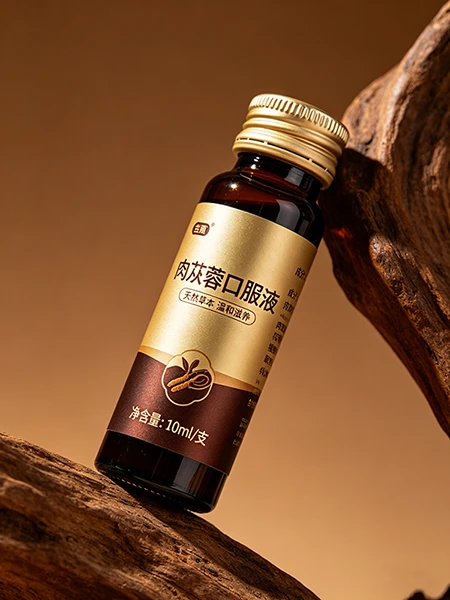
Cistanche Oral Liquid
Four of the most common purchasing traps
Trap one: judging by ratio alone. A 10:1 label describes a concentration multiple and has no necessary relationship to active content. Two products both labelled 10:1 may differ several-fold in echinacoside.
Trap two: UV total glycosides presented as HPLC assay. UV values are systematically higher and do not distinguish individual compounds. Specify the method at the quotation stage; otherwise, a lower price is merely a smaller number.
Trap three: spiking to manufacture an assay. When the two glycoside peaks are abnormally tall while the rest of the profile is flat and the fingerprint no longer resembles the reference crude drug, suspect an added marker compound. The characteristic chromatogram is the tool that exposes this.
Trap four: mixed or mislabelled botanical origin. Substituting Cistanche tubulosa for Cistanche deserticola, or the reverse. Because the food catalogue covers only the desert species, a mislabelled origin becomes a compliance problem immediately.
Closing: From Two Peaks Toward a Complete Profile
Current standards compress the quality of Cistanche into two peaks, echinacoside and acteoside. Two decades ago that was progress, because it gave this botanical its first quantifiable threshold. Measured against today's evidence, however, the same compression has become a constraint: it cannot detect differences in the compounds that act synergistically, and it cannot stop the practice of manufacturing an assay by spiking.
For purchasing and quality control, the executable path is nevertheless clear. Use the statutory parameters as the floor, covering assay, moisture, ash, extractives, heavy metals and pesticide residues. Layer multi-constituent criteria above them, spanning phenylethanoid glycosides, iridoid glycosides, polysaccharides, betaine and mannitol. Use the characteristic chromatogram as the anti-counterfeiting tool. Close the loop with documentation and independent re-testing. Only when these four layers are stacked together has a lot of Cistanche extract actually been seen for what it is.
Principal Source Documents
[1] Chinese Pharmacopoeia Commission. Pharmacopoeia of the People's Republic of China, 2020 edition, Volume I. Beijing: China Medical Science Press, 2020 (Cistanche monograph: source, description, tests, extractives, assay).
[2] Announcement No. 9 of 2023, National Health Commission and State Administration for Market Regulation, on the addition of nine substances including Codonopsis and Cistanche to the catalogue of materials traditionally used both as food and as Chinese medicinals.
[3] Gansu Provincial Food Safety Local Standard DBS 62/009, Food Safety Local Standard: Cistanche.
[4] Inner Mongolia Autonomous Region Local Standard DB15/T 2360-2021.
[5] Group Standard T/NMSP.MZB01.43-2024, Alxa Desert Cistanche Slices and Edible Cistanche Powder.
[6] Xinjiang Uygur Autonomous Region Drug Administration. Draft standard for Cistanche dispensing granules (Xinjiang Chinese medicine dispensing granule standards).
[7] Guangdong Provincial Drug Administration. Standard for Cistanche dispensing granules.
[8] National Institutes for Food and Drug Control. Method for the assay of Cistanche in Kanggu Zengsheng Tablets.
[9] Beijing University of Chinese Medicine. Desert Ginseng: Cistanche (botanical origin and identification of adulterants).
[10] Analysis of a nationwide sampling inspection of Cistanche decoction pieces (morphological identification and adulteration).