A Comparative Study Of Anti-aging Properties And Mechanism: Resveratrol And Caloric Restriction
May 15, 2023
ABSTRACT
Resveratrol and caloric restriction (CR) are powerful therapeutic options for anti-aging. Here, their comparative effect on longevity-associated gene silencing information regulator (SIRT1) was evaluated in vitro and in vivo. IMR-90 cells treated with 2,2’-azobis (2-amidinopropane) dihydrochloride (AAPH) were applied to establish a cellular senescence model, and rats treated with D-galactose (D-gal) were used as an aging animal model. Resveratrol and CR exhibited similar anti-aging activities, evidenced by inhibiting senescence and apoptosis and restoring cognitive impairment and oxidative damage. Moreover, they could up-regulate telomerase (TE) activity, increase expressions of SIRT1, forkhead box 3a (Foxo3a), an active regulator of SIRT1 (AROS) and Hu antigen R (HuR ), but decrease p53 and deleted in breast cancer 1 (DBC1) levels. However, 10 μM resveratrol in vitro and the high dose group in vivo showed relatively stronger activities of anti-aging and stimulating SIRT1 levels than CR. In conclusion, resveratrol and CR showed similar anti-aging activities on SIRT1 signaling, implicating the potential of resveratrol as a CR mimetic.
Click Here To Know Cistanche Herbal Treatment For Anti-Aging
INTRODUCTION
Improvements in health care have helped raise human life expectancy in recent decades, and the elderly population is thus increasing significantly. Unfortunately, this still means increasing periods of poor health or disability. Currently, a variety of aging-related diseases are emerging as the greatest health threats in most developed countries. Although it is not yet possible to modify our genetic background, various anti-aging strategies are currently emerged as healthy lifestyles and therapeutic interventions, aiming to reduce the incidence of risk factors of poor health [1].
CR, decreased calorie intake without malnutrition, is one of the most robust interventions that increase lifespan in model organisms from yeast to primates [2]. It could protect against the deterioration of biological functions, reducing the incidence and delaying the onset of multiple age-related diseases. The mechanism by which CR prolongs lifespan involves retardation of growth, reduction of body fat, delaying neuroendocrine or immunologic changes, increase in DNA repair capacities, altered gene expression, enhanced apoptosis, reduction of body temperature and depression of metabolic rate, and amelioration of oxidative stress [3]. The anti-aging effect of CR has been strongly associated with an increased level and activation of members of the sirtuin family, and also related to other molecular signaling pathways, including peroxisome proliferator-activated receptor G coactivator- 1α (PGC-1α), adenosine monophosphate-activated protein kinase (AMPK), insulin/insulin growth factor-1, and target of rapamycin [1, 4]. However, most people would not comply with such a rigorous dietary program, particularly in the long term. Therefore, recent research is increasingly aimed at determining the feasibility and efficacy of natural and/or pharmacological CR mimetic molecules/ treatments without decreasing food consumption [5].
Resveratrol is a plant polyphenol commonly found in various plants, including the skin of grapes, berries, and peanuts. Interestingly, the incorporation of resveratrol into dietary supplements or foods may be a powerful therapeutic option for anti-aging, and several reports indicate that resveratrol treatment produces beneficial effects similar to those of CR [6], implicating the potential of resveratrol as a CR mimetic [4]. Recently, it has been demonstrated that resveratrol extends the lifespan through significantly increasing SIRT1 activity, resulting in the increase of SIRT1 affinity for both NAD+ and the acetylated substrate [7, 8], which is also responsible for the longevity caused by CR. Although resveratrol and CR have been widely studied for their potential health benefits, little is known about their comparative effects. In this study we compared the anti-aging effect of resveratrol and CR in vivo and in vitro by detecting SIRT1 pathway.
RESULTS
Resveratrol and CR decreased senescence-associated β-galactosidase (SA β-gal) staining in AAPH-treated IMR-90 cells
Taking advantage of an AAPH-induced senescence model of IMR-90 cells, we tested the possible effect on SA-β-gal staining. As shown in Figure 1, the AAPH-treated cells displayed more widely and strongly positive staining than did in control cells, and the positive staining in control cells was relatively scarce. Resveratrol (5 μM, 10 μM, and 20 μM) or CR treatment was found to afford markedly protections in AAPH-induced senescence. Moreover, comparing the effect of resveratrol with CR, cells treated with 10 μM resveratrol displayed relatively less often SA-β-Gal positive staining than CR treatment. Thus, these results suggested that 10 μM resveratrol more efficiently inhibited AAPH-induced senescence than CR.
Scanning electron microscopy analysis of IMR- 90 cells
Scanning electron microscopy investigation provided some new details on the structure of the AAPH-treated cells (Figure 2). Normal IMR-90 appeared as fully spread cells with a typical fusiform shape. Most of the cells contained two tapering processes and exhibited few blebs. AAPH-treated cells displayed an enlarged and flattened morphology with numerous of blebs. At variance, scanning electron microscopy observation of IMR-90 samples treated with resveratrol or CR after AAPH administration clearly indicated that, although some blebs could be detected, the normal fusiform shape was generally maintained together with fully spread.

Resveratrol and CR decreased apoptosis in AAPH-treated IMR-90 cells
Phosphatidylserine on the surface of cells, considered as the hallmark of apoptosis in the early phase, was determined by PI/Annexin V staining assay (Figure 3). The apoptotic cells compose of both early apoptotic cells stained with Annexin-V-FITC and late apoptotic or necrotic cells stained with Annexin-V-FITC and PI. The population of apoptotic cells was increasing significantly in AAPH group (34.54%), compared with the negative group (7.32%). Whereas resveratrol (5 μM, 10 μM and 20 μM) or CR treatment was found to decrease apoptosis in AAPH-induced IMR-90 cells. In addition, 10 μM resveratrol treatment (11.58%) more efficiently decreased AAPH-induced apoptosis than CR treatment (16.78%).
Change of general appearance and body weight
During the entire experiment process, the aging model rats were received D-gal at dose of 200 mg/kg each day and general appearance was observed. Compared with that of normal control rats, the rats in D-gal model group gradually became apathetic, dull and slow in response; the hair of model group ones gradually lost elasticity and became brittle; the skin became thin, inelastic and sagged little by little. However, simultaneous treatment resveratrol or CR with D-gal in rats showed a reversal of changes above, as compared with the D-gal group. There was no difference in body weight between experimental groups within the period of treatment, except for CR group with almost no weight increase during the experiment (Figure 4).
Resveratrol and CR improved the spatial learning and memory of SD rats
We assessed the spatial learning and memory ability of the rats by performing the Morris water maze test. As shown in Figure 5, all five groups were able to learn the task successfully, as evidenced by gradually reduced escape latency and increased swimming speed in the 4 days of place navigation phase. Analyzed by the two-way ANOVA method, significant differences were shown both in mean escape latency and swimming speed between training days (F(3,138) = 41.660, P < 0.01; F(3,138) = 10.013, P < 0.01, respectively) and between treatments (F(4,46) = 36.762, P < 0.01; F(4,46) = 20.102, P < 0.01, respectively) but no interaction between the factors day and treatment (F(12,138) = 0.846, P > 0.05; F(12,138) = 1.084, P > 0.05, respectively). The escape latency in the D-gal group was markedly longer than that in the control group (P < 0.01) (Post-hoc analysis, Figure 5A). Meanwhile, the rats in the resveratrol + D-gal group or CR + D-gal group showed a reversal of the aforementioned changes in escape latency compared with D-gal group (P < 0.01) (Figure 5A), and notably shortened the escape latency to similar levels with the control group. Similar results were obtained for the swim speed of rats (Figure 5B), and rats in the resveratrol + D-gal group and CR + D-gal group displayed remarkable increases of the swim speed as compared with D-gal group (P < 0.01). However, rats in high dose of resveratrol + D-gal group displayed relatively longer escape latency and lower swim speed compared to the CR + D-gal group.

Figure 1: Resveratrol and caloric restriction decreases SA-β-gal staining in AAPH-treated IMR-90 cells. AAPH-induced IMR- 90 cells were treated with caloric restriction (CR) or resveratrol (RES) at the indicated concentration for 2 days. The magnification was 20×.

Figure 2: Scanning electron microscopy analysis of IMR-90 cells. AAPH-induced IMR-90 cells were treated with caloric restriction (CR) or resveratrol (RES) at the indicated concentration for 2 days. The magnification was 6000×.

Figure 3: Resveratrol (RES) and caloric restriction (CR) decreased apoptosis in AAPH-treated IMR-90 cells. Cells were stained with Annexin V-FITC/PI and analyzed by flow cytometry. The FL1 channel was used to detect annexin-V-FITC staining and the FL2 channel was for PI staining
In the spatial probe phase (Figures 5C and 5D), it could be seen that there were remarkable reductions of platform crossings in the D-gal group compared to that in the control group (P < 0.01). Interestingly, the mean number of times the rats crossed the platform was significantly improved after administrating with resveratrol or CR, compared with that of the D-gal group (P < 0.01). However, rats in high doses of the resveratrol + D-gal group crossed over the platform more frequently than those in the CR + D-gal group.
These results indicated that aging model rats had impairments in spatial learning and memory, while the treatment of resveratrol or CR could restore the age-related cognitive impairment caused by D-gal administration. Moreover, aging model rats treated with a high dose of resveratrol showed relatively more effective on behavior than those treated with CR.

Effect of resveratrol and CR on SOD, T-AOC, MDA, and lipofuscin levels in aging rats
The SOD, T-AOC, MDA and lipofuscin levels in rats were evaluated to confirm whether the anti-aging effects of resveratrol and CR were mediated by alleviating the oxidative stress caused by D-gal administration. Table 1 shows the levels of SOD, T-AOC and MDA in serum, liver and brain in normal and aging rats. Exposure to D-gal significantly decreased the SOD and T-AOC levels but increased the MDA level in serum, liver and brain as compared with the control group (P < 0.05). Simultaneous treatment of resveratrol or CR with D-gal in rats caused a decrease in the activity of MDA level but increased SOD and T-AOC levels as compared with the D-gal group. However, compared with CR treatment, the results showed that the administration high dose of resveratrol was relatively superior.

Figure 4: Effect of resveratrol and caloric restriction on the body weight of D-gal-treated rats during the experiment. All values were expressed as means ± SD. NG, negative control group; MG, model control group; RESL, low dose of resveratrol group; RESH, high dose of resveratrol group; CR, caloric restriction group.

Figure 5: Effect of resveratrol and caloric restriction on the behavior of D-gal treated rats with Morris water maze. (A) Comparison of latencies to the platform during 4 training days. Each mouse was subjected to 4 trials per day. (B) Comparison of swimming speed during 4 training days. (C) Comparison of numbers of crossing-over platforms where the platform was removed for probe trial. (D) The typical swimming track in the probe trial. All values were expressed as means ± SD. * P < 0.05, **P < 0.01 compared with negative control group; # P < 0.05, ##P < 0.01 compared with model control group. NG, negative control group; MG, model control group; RESL, low dose of resveratrol group; RESH, high dose of resveratrol group; CR, caloric restriction group.
Table 1: Antioxidants status in the tissue and blood of rats in each group

Note: Values were the mean ± SD. * P < 0.05, **P < 0.01 compared with control group (all groups); # P < 0.05, ##P < 0.01 compared with model group (CR group and RES group); ∆P < 0.05, ∆∆P < 0.01 compared with CR group (RES group). NG, negative control group; MG, model control group; RESL, low dose of resveratrol group; RESH, high dose of resveratrol group; CR, caloric restriction group.
s relatively superior. Lipofuscin accumulation is one of the most consistent features of brain aging. As shown in Figure 6, D-gal-treated rats showed a significant increase of lipofuscin level compared with the control group (P < 0.01). However, resveratrol and CR treatment decreased lipofuscin accumulation in the cerebral cortex of aging rats in comparison to D-gal-treated rats (P < 0.01). Moreover, there were no differences between the resveratrol + D-gal group and CR + D-gal group (P > 0.05).

Resveratrol and CR up-regulated telomerase activity in aging rats
We evaluated the effect of resveratrol and CR on telomerase activity in liver and brain tissues (Figure 7). Our results showed that treatment had no significant effect on the telomerase activity in liver tissues (P > 0.05). However, the telomerase activity was reduced in the D-gal administration group compared with the control (P < 0.05). Meanwhile, resveratrol or CR could up-regulate telomerase activity in the D-gal administration plus resveratrol or CR treatment group. Moreover, there were no differences between the resveratrol group and the CR group (P > 0.05).
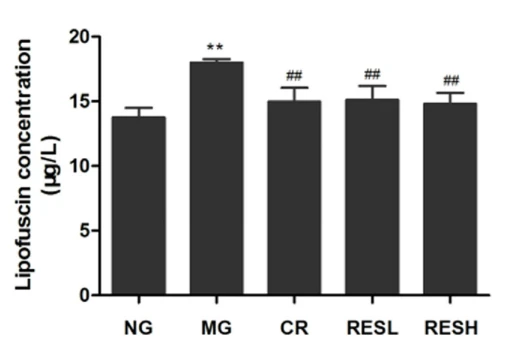
Figure 6: Effect of resveratrol and caloric restriction on lipofuscin level of aging rats. All values were expressed as means ± SD. * P < 0.05 compared with negative control group; # P < 0.05 compared with model control group. NG, negative control group; MG, model control group; RESL, low dose of resveratrol group; RESH, high dose of resveratrol group; CR, caloric restriction group.
Resveratrol and CR increased AAPH-induced SIRT1 mRNA expression To explore the role of SIRT1 in the treatment effects of resveratrol and CR, the expression levels of SIRT1 mRNA in IMR-90 cells and tissues were examined by quantitative real-time RT-PCR. The results demonstrated that the expression of SIRT1 mRNA in IMR-90 cells was significantly reduced by AAPH. Resveratrol and CR could efficiently recover SIRT1 mRNA expression levels in AAPH-treated cells, and 10 μM resveratrol was the optimal concentration to stimulate the expression of SIRT1 mRNA in IMR-90 cells (P < 0.01; Figure 8)