A Promising Ultra-Small Unilamellar Carrier System For Enhanced Skin Delivery Of α-Mangostin As An Anti-Age-Spot Serum Part 2
Jul 07, 2023
3.4. Characterization of the Optimum Base USUC Formula
Glycoside of cistanche can also increase the activity of SOD in heart and liver tissues, and significantly reduce the content of lipofuscin and MDA in each tissue, effectively scavenging various reactive oxygen radicals (OH-, H₂O₂, etc.) and protecting against DNA damage caused by OH-radicals. Cistanche phenylethanoid glycosides have a solid scavenging ability of free radicals, a higher reducing ability than vitamin C, improve the activity of SOD in sperm suspension, reduce the content of MDA, and have a certain protective effect on sperm membrane function. Cistanche polysaccharides can enhance the activity of SOD and GSH-Px in erythrocytes and lung tissues of experimentally senescent mice caused by D-galactose, as well as reduce the content of MDA and collagen in lung and plasma, and increase the content of elastin, have a good scavenging effect on DPPH, prolong the time of hypoxia in senescent mice, improve the activity of SOD in serum, and delay the physiological degeneration of lung in experimentally senescent mice With cellular morphological degeneration, experiments have shown that Cistanche has the good antioxidant ability and has the potential to be a drug to prevent and treat skin aging diseases. At the same time, echinacoside in Cistanche has a significant ability to scavenge DPPH free radicals and has the ability to scavenge reactive oxygen species and prevent free radical-induced collagen degradation, and also has a good repair effect on thymine free radical anion damage.

Click on cistanche para que serve
【For more info:george.deng@wecistanche.com / WhatApp:86 13632399501】
Eight formulae (F1; F3; F9; F12; F25; F28, the optimum USUC base, and the α- mangosteen-loaded USUC), with droplet sizes < 40 nm, were evaluated (Table 4). There were no changes in color, smell, or homogeneity during the 8-week storage at room temperature (Figure 3). Physical stability was confirmed with the freeze-and-thaw test for three cycles. The physicochemical properties of these formulae (Table 4) show that the droplet sizes were in the range of 11.3–36 nm, with pH values of weak acidic solutions (6.20–6.57) that are tolerable by the skin. Transmittance varied in the following order: F9 < F3 < F12 < F1 < F28 < F25 < Fα-mangostin USUC < F-opt. Viscosity was in the range of 15.00–217.67 cP, which correlates with a concentration of Tween 80.


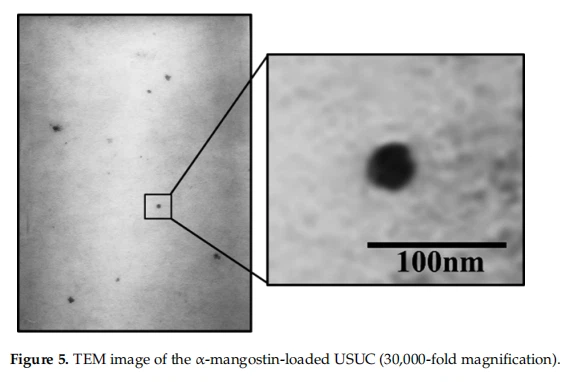
The stability characteristic of the optimum α-mangosteen-loaded USUC was confirmed through the determination of zeta potential, polydispersity index values, and particle-size distribution. Results (Figure 4) showed homogeneously distributed vesicles (PDI = 0.445) with a droplet size of 16.5 nm and a zeta-potential value of −25.8 mV. EE of the α-mangostinloaded USUC was 72.46%, showing the encapsulation capacity of the USUC base. Morphological examination of the α-mangosteen-loaded USUC using TEM showed ultra-small unilamellar vesicles characterized by the formation of spherical globules (Figure 5).

3.5. Visual Evaluation of α-Mangostin-Loaded USUCs in Human Volunteers
Dermal safety assessments were carried out on the skin of healthy volunteers to evaluate potential skin irritation of the USUC. This test was by the ban on animal testing for cosmetics and is suitable to show sensitization to a substance that could cause an allergic reaction [36]. Patch testing on the skin of the inner forearms of volunteers showed no sign of skin irritation, indicating that the formula is safe to apply on the skin. Application to the faces of two volunteers for two weeks resulted in “more glowing” skin (Figure 6). The results in Figure 7 and Table 5 show a significant increase in the RGB value of the skin image before and after treatment in both volunteers (p < 0.05), indicating the skin-brightening effect of the α-mangosteen-loaded USUC. Data also showed a significant reduction in the length and width of the dark spots of both volunteers (p < 0.05) (Figure 8, Table 5).


4. Discussion
This study demonstrates the optimization of an α-mangosteen-loaded USUC via consideration of factors that influence the formation of nanosized globules. Optimization was dependent not only on the proportion of the oily phase, the aqueous phase, and the chosen stabilizers (soy lecithin: Tween 80) but also on the manufacturing conditions of stirring time and speed. Variation of these factors greatly influenced the formation of a micro- or nanoemulsion [3,8,31].
In a USUC, a single-layer lipid core is composed of a phospholipid (soy lecithin) and a co-surfactant (Tween 80) at a fixed ratio obtained from an optimization procedure. At the optimum ratio of soy lecithin and Tween 80, the cosurfactant intercalates between the soy lecithin molecules and forms a monolayer membrane that is stabilized by van der Waals hydrophobic interaction forces [32]. The 25 experimental design used in this study was successfully applied to obtain the optimized composition and manufacturing conditions for the USUC [18]. The optimized conditions obtained from this study were 28.2% Tween 80, 1% soy lecithin, and 2.3% VCO, with 15 min stirring duration at a stirring speed of 1500 rpm [17]. These conditions provided the Nanotope™ solution with a predicted vesicle size of 34.04 nm.

The incorporation of α-mangostin into the USUC base provided a transparent to cloudy white solution that remained stable after freeze-and-thaw tests [31]. The transmittance of the USUC base was varied; high transmittance values indicated clarity of solution and correlated with smaller droplet size. Nanosized particles scatter incoming light, which was demonstrated in an opalescent appearance [37]. Surfactants may intercalate into the phospholipid bilayer and induce vesicle disruption to obtain a clearer solution, even though a stable vesicle should maintain a light-scattering nature [8]. The transmittance of the α-mangosteen-loaded USUC was 90.95%; the solution showed slight opaqueness and remained stable after storage [27].
The α-mangosteen-loaded USUC showed spherical globules surrounded by a thin-layer membrane. Unilamellar appearance is usually indicated by a transparent layer surrounding the globules; this is not visible in Figure 4. This distinguishes Nanotopes™, which are ultra-small unilamellar vesicles, from large multilamellar liposomes whose vesicles are surrounded by thick transparent layers [8]. Droplet size was much smaller than that of the optimum USUC base, with moderate stability against agglomeration, as indicated by zeta potential <−25 mV [38]. EE of the α-mangosteen-loaded USUC was 72.46%, showing good encapsulation capacity of the USUC base. Encapsulation or entrapment efficiency, an important parameter to evaluate the success of a drug-delivery system, is the ability of a drug carrier to entrap active ingredients. It depends on the lipophilicity of the active compound, the nature of the vesicle’s bilayer structure, and the process of vesicle formation [8,32]. A previous study reported that the entrapment efficiency of a mangosteen-pericarp-extract loaded liposome was 77.09% [31].

The viscosity of the USUC base correlated with the content of Tween 80. The less-viscous solution contained a Tween 80 content of 15% while the most viscous contained a higher level (35%) at the same soy lecithin and VCO levels. A more viscous solution is preferred for topical application because it is easy to apply and lasts longer on the skin surface to provide better penetration of α-mangostin [37].
The anti-dark-spot effect of the α-mangosteen-loaded USUC on the faces of human volunteers was analyzed via digital skin-image analysis using RGB values. Use of RGB values aimed to calibrate each image so that influences of factors such as subject parameters (face curvature, view angle) and imaging parameters (light, time difference) before and after photos could be eliminated [35]. RGB scores before and after treatment were also used to measure changes in the color intensity of the dark spots. The RGB value of any image is in the range 0–255, where 0 is black and 255 is white [34]. Therefore, an increase in this value correlates with a decrease in the color intensity of the spots. The optical-property effect from the use of the USUC formula or makeup products by the subjects the night before on anti-age-spot-effect observation was eliminated through the removal of all attached makeup before the photo was taken. The use of an α-mangosteen-loaded USUC for 2 weeks reduced the dark spots and provided a lightening effect on the face. These results are preliminary data that show the potential of the α-mangosteen-loaded USUC as an anti-age-spot serum. Further studies need to be carried out with a larger number of subjects and with those whose dark spots are in a contralateral position.
Nanotopes™ with the size range 20–40 nm is designed to deliver cosmetic ingredients to a specific target, not only due to their smaller size than the width of the intercornyocite pores of the skin (50 nm) but also to the lipophilic nature of the phospholipid membranes of the vesicles. An increase in drug delivery causes an increase in effect and reduces the dose, consequently increasing efficacy. An in vivo study on the efficacy of D-panthenol-loaded Nanotopes™ showed a 100-fold increase in the anti-inflammatory effect compared to that of its conventional formulation [8]. The anti-dark-spot effect of the α-mangosteen-loaded USUC in this study is attributed mainly to the inhibition of melanin formation [39]. The beneficial effects of other components in the formula, such as soy lecithin (rich in isoflavones and amino acid) [22] and virgin coconut oil (rich in short and medium-chain fatty acids), that nourish skin may also facilitate brightening and hydrating effects on the skin in less time than with conventional formulae [40].
5. Conclusions
An α-mangosteen-loaded USUC was successfully developed using the “bottom-up” method, with an optimized composition of 3% α-mangostin, 1% soy lecithin, 28.3% Tween 80, and 2.3% VCO, produced through an optimized manufacturing process with a 1500 rpm stirring speed for 15 min. The USUC displayed spherical globules (16.5 nm) that were homogenously distributed (PDI = 0.445) and a zeta potential of −25.8 mV. The use of the optimized USUC formula for 2 weeks showed a significant reduction of dark spots in human volunteers (p < 0.05). Further studies to identify the interaction of α-mangostin with soy lecithin–Tween 80 in the USUC and to reveal the mechanism of the optimized formula to reduce age spots will enhance the application of the cosmeceutical serum. In conclusion, the α-mangosteen-loaded USUC has anti-age-spot properties and is a promising product for improving skin conditions.

Author Contributions: Conceptualization: U.C., R., C.M.R.R.N., F.D.O.R., H.A.E.B., and H.L.; methodology: U.C., R., and H.L.; software: U.C., R., and H.L.; validation: U.C., R., and H.L.; formal analysis: U.C., R., and H.L.; investigation: U.C., R., and H.L.; resources: U.C. and H.L.; data curation: U.C., R., and H.L.; writing—original draft preparation: U.C., C.M.R.R.N., F.D.O.R., and H.L.; writing—review and editing: U.C., C.M.R.R.N., F.D.O.R., H.A.E.B., and H.L.; visualization: U.C., C.M.R.R.N., F.D.O.R., and H.L.; supervision: H.A.E.B. and H.L.; project administration: U.C. and H.L.; funding acquisition: U.C. and H.L. All authors have read and agreed to the published version of the manuscript.
Funding: This research was self-funded.
Institutional Review Board Statement: This study was conducted by the Declaration of Helsinki and approved by the Institutional Review Board (or Ethics Committee) of the Faculty of Medicine, Andalas University (document No. 181/UN.16.2/KEP-FK/2020 on 23 December 2020).
Informed Consent Statement: Informed consent was obtained from all subjects involved in this study. Written informed consent has been obtained from the patient(s) to publish this paper.
Data Availability Statement: Not applicable.
Conflicts of Interest: The authors declare no conflict of interest.
References
1. Roberts, M.S.; Cheruvu, H.S.; Mangion, S.E.; Alinaghi, A.; Benson, H.A.E.; Mohammed, Y.; Holmes, A.; van der Hoek, J.; Pastore, M.; Grice, J.E. Topical Drug Delivery: History, Percutaneous Absorption, and Product Development. Adv. Drug Deliv. Rev. 2021, 177, 113929. [CrossRef] [PubMed]
2. Ramírez-Gamboa, D.; Díaz-Zamorano, A.L.; Meléndez-Sánchez, E.R.; Reyes-Pardo, H.; Villaseñor-Zepeda, K.R.; López-Arellanes, M.E.; Sosa-Hernández, J.E.; Coronado-Apodaca, K.G.; Gámez-Méndez, A.; Afewerki, S.; et al. Photolyase Production and Current Applications: A Review. Molecules 2022, 27, 5998. [CrossRef] [PubMed]
3. Montenegro, L. Nanocarriers for Skin Delivery of Cosmetic Antioxidants. J. Pharm. Pharmacogn. Res. 2014, 2, 73–92.
4. Mu, L.; Sprando, R.L. Application of Nanotechnology in Cosmetics. Pharm. Res. 2010, 27, 1746–1749. [CrossRef]
5. Nastiti, C.M.R.R.; Ponto, T.; Mohammed, Y.; Roberts, M.S.; Benson, H.A.E. Novel Nanocarriers for Targeted Topical Skin Delivery of the Antioxidant Resveratrol. Pharmaceutics 2020, 12, 108. [CrossRef]
6. Roberts, M.S.; Mohammed, Y.; Pastore, M.N.; Namjoshi, S.; Yousef, S.; Alinaghi, A.; Haridass, I.N.; Abd, E.; Leite-Silva, V.R.; Benson, H.A.E. Topical and Cutaneous Delivery Using Nanosystems. J. Control. Release 2017, 247, 86–105. [CrossRef]
7. Nastiti, C.M.R.R.; Ponto, T.; Abd, E.; Grice, J.E.; Benson, H.A.E.; Roberts, M.S. Topical Nano, and Microemulsions for Skin Delivery. Pharmaceutics 2017, 9, 37. [CrossRef] [PubMed]
8. Baschong, W.; Herzog, B.; Artmann, C.W.; Mendrok, C.; Mongiat, S.; Lupia, J.A. NanotopesTM: A Novel Ultra-Small Unilamellar Carrier System for Cosmetic Actives; William Andrew Inc.: Norwich, NY, USA, 2005; ISBN 9780815516828.
9. Georg, H.; Ag, V. Verwendung von Nanodispersionen in kosmetischen Endformulierungen (Use of Nanotopes in Cosmetic Products). European Patent EP 0 956 851 B1, 1 2006.
10. Zolghadri, S.; Bahrami, A.; Hassan Khan, M.T.; Munoz-Munoz, J.; Garcia-Molina, F.; Garcia-Canovas, F.; Saboury, A.A. A Comprehensive Review on Tyrosinase Inhibitors. J. Enzyme Inhib. Med. Chem. 2019, 34, 279–309. [CrossRef]
11. Zhou, S.; Yotsumoto, H.; Tian, Y.; Sakamoto, K. α-Mangostin Suppressed Melanogenesis in B16F10 Murine Melanoma Cells through GSK3β and ERK Signaling Pathway. Biochem. Biophys. Rep. 2021, 26, 100949. [CrossRef]
12. Ganesan, P.; Choi, D.K. Current Application of Phytocompound-Based Nanocosmeceuticals for Beauty and Skin Therapy. Int. J. Nanomed. 2016, 11, 1987–2007. [CrossRef]
13. Chen, Z.L.; Huang, M.; Wang, X.R.; Fu, J.; Han, M.; Shen, Y.Q.; Xia, Z.; Gao, J.Q. Transferrin-Modified Liposome Promotes α-Mangostin to Penetrate the Blood-Brain Barrier. Nanomed. Nanotechnol. Biol. Med. 2016, 12, 421–430. [CrossRef] [PubMed]
14. Limphapayom, W.; Loylerd, K.; Leabwan, N.; Sukhasem, S. Encapsulation of Alpha-Mangostin in Cosmetic Production by Using Nanotechnology. Acta Hortic. 2017, 1186, 189–191. [CrossRef]
15. Chin, G.S.; Todo, H.; Kadhum, W.R.; Hamid, M.A.; Sugibayashi, K. In Vitro Permeation and Skin Retention of α-Mangostin Proniosome. Chem. Pharm. Bull. 2016, 64, 1666–1673. [CrossRef]
16. Barel, A.H.; Paye, M.; Maibach, H.I. Handbook of Cosmetic Science and Technology; Informa Healthcare: New York, NY, USA, 2018; ISBN 0824702921.
17. Hidayat, I.R.; Zuhrotun, A.; Sopyan, I. Design-Expert Software Sebagai Alat Optimasi Formulasi Sediaan Farmasi. Maj. Farmasetika 2020, 6, 99–120. [CrossRef]
18. Bolton, S.; Bon, C. Pharmaceutical Statistics: Practical and Clinical Applications, 4th ed.; Revised and Expanded; Marcel Dekker: New York, NY, USA, 2004; ISBN 9780203912799.
19. Khanam, N.; Alam, M.I.; Md Yusuf Ali, Q.M.A.I.; Siddiqui, A.U.R. A Review on Optimization of Drug Delivery System with Experimental Designs. Int. J. Appl. Pharm. 2018, 10, 7–12. [CrossRef]
20. Damayanti, H.; Wikarsa, S.; Jafar, G. Formulasi Nanoemulgel Ekstrak Kulit Manggis (Garcinia Mangostana L.). J. Ris. Kefarmasian Indones. 2019, 1, 166–176. [CrossRef]
21. Ciba Inc. Ciba® TINODERM™.
22. Fiume, M.Z. Final Report on the Safety Assessment of Lecithin and Hydrogenated Lecithin. Int. J. Toxicol. 2001, 20, 21–45. [CrossRef]
23. Handayani, F.S.; Nugroho, B.H.; Munawiroh, S.Z. Optimization of Low Energy Nanoemulsion of Grape Seed Oil Formulation Using D-Optimal Mixture Design (DMD) Optimasi Formulasi Nanoemulsi Minyak Biji Anggur Energi Rendah Dengan D-Optimal Mixture Design (DMD). J. Ilm. Farm. 2018, 14, 17–34.
24. Gurpreet, K.; Singh, S.K. Review of Nanoemulsion Formulation and Characterization Techniques. Indian J. Pharm. Sci. 2018, 80, 781–789. [CrossRef]
25. Kakran, M.; Shegokar, R.; Sahoo, N.G.; Al Shaal, L.; Li, L.; Müller, R.H. Fabrication of Quercetin Nanocrystals: Comparison of Different Methods. Eur. J. Pharm. Biopharm. 2012, 80, 113–121. [CrossRef]
26. Ali, S.M.; Yosipovitch, G. Skin PH: From Basic Science to Basic Skin Care. Acta Derm. Venereol. 2013, 93, 261–267. [CrossRef] [PubMed]
27. Bali, V.; Ali, M.; Ali, J. Study of Surfactant Combinations and Development of a Novel Nanoemulsion for Minimising Variations in Bioavailability of Ezetimibe. Colloids Surfaces B Biointerfaces 2010, 76, 410–420. [CrossRef] [PubMed]
28. Thakkar, H.; Nangesh, J.; Parmar, M.; Patel, D. Formulation and Characterization of Lipid-Based Drug Delivery System of Raloxifene- Microemulsion and Self-Microemulsifying Drug Delivery System. J. Pharm. Bioallied Sci. 2011, 3, 442–449. [CrossRef] [PubMed]
29. Kale, S.N.; Deore, S.L. Solubility Enhancement of Nebivolol by Micro Emulsion Technique. J. Young Pharm. 2016, 8, 356–367. [CrossRef]
30. Ariviani, S.; Raharjo, S.; Anggrahini, S.; Naruki, S. Formulasi Dan Stabilitas Mikroemulsi O/W Dengan Metode Emulsifikasi Spontan Menggunakan Vco Dan Minyak Sawit Sebagai Fase Minyak: Pengaruh Rasio Surfaktan-Minyak. J. Agritech 2015, 35, 27. [CrossRef]
31. Wathoni, N.; Rusdin, A.; Motoyama, K.; Joni, I.M.; Lesmana, R.; Muchtaridi, M. Nanoparticle Drug Delivery Systems for α-Mangostin. Nanotechnol. Sci. Appl. 2020, 13, 23–36. [CrossRef]
32. Ghanbarzadeh, B.; Babazadeh, A.; Hamishehkar, H. Nano-Phytosome as a Potential Food-Grade Delivery System. Food Biosci. 2016, 15, 126–135. [CrossRef]
33. Vander Haeghen, Y.; Naeyaert, J.M. Consistent Cutaneous Imaging with Commercial Digital Cameras. Arch. Dermatol. 2006, 142, 42–46. [CrossRef]
34. Jung, B.; Choi, B.; Shin, Y.; Durkin, A.J.; Nelson, J.S. Determination of Optimal View Angles for Quantitative Facial Image Analysis. J. Biomed. Opt. 2005, 10, 024002. [CrossRef]
35. Schindewolf, T.; Albert, R.; Harms, H. Evaluation of Different Image Acquisition Techniques for a Computer Vision System in the Diagnosis of Malignant Melanoma. J. Am. Acad. Dermatol. 1994, 31, 33–41. [CrossRef]
36. Schnuch, A.; Aberer, W.; Agathos, M.; Becker, D.; Brasch, J.; Elsner, P.; Frosch, P.J.; Fuchs, T.; Geier, J.; Hillen, U.; et al. Performing Patch Testing with Contact Allergens. JDDG-J. Ger. Soc. Dermatol. 2008, 6, 770–775. [CrossRef]
37. Kallay, N.; Žalac, S. Stability of Nanodispersions: A Model for Kinetics of Aggregation of Nanoparticles. J. Colloid Interface Sci. 2002, 253, 70–76. [CrossRef] [PubMed]
38. Ðor ¯devi´c, S.M.; Santraˇc, A.; Ceki´c, N.D.; Markovi´c, B.D.; Divovi´c, B.; Ili´c, T.M.; Savi´c, M.M.; Savi´c, S.D. Parenteral Nanoemulsions of Risperidone for Enhanced Brain Delivery in Acute Psychosis: Physicochemical and in Vivo Performances. Int. J. Pharm. 2017, 533, 421–430. [CrossRef] [PubMed]
39. Muchtaridi, M.; Suryani, D.; Qosim, W.A.; Saptarini, N.M. Quantitative Analysis of A-Mangostin in Mangosteen (Garcinia Mangostana L.) Pericarp Extract from Four Districts of West Java by HPLC Method. Int. J. Pharm. Pharm. Sci. 2016, 8, 232–236.
40. Suaniti, N.; Manurung, M.; Hartasiwi, N. Uji Sifat Virgin Coconut Oil (VCO) Hasil Ekstraksi Enzimatis Terhadap Berbagai Produk Minyak Kelapa Hasil Publikasi. J. Kim. 2014, 8, 171–177.
【For more info:george.deng@wecistanche.com / WhatApp:86 13632399501】