An Insight Of Deep Learning Based Demand Forecasting in Smart Grids(2)
Jun 05, 2023
5.2.5. Conditional Restricted Boltzmann Machine
A Restricted Boltzmann Machine (RBM) is a stochastic RNN with two layers, one with visible units and one with binary hidden units. This type of network can learn a probability distribution over its set of inputs. RBMs are a variant of Boltzmann Machines (BM) and can be in supervised or unsupervised mode, depending on the task to be performed.

Chinese herb cistanche-Improve Memory
When BMs are restricted, a pair of nodes from each of the two groups of units (visible and hidden) can have a symmetric connection between them, but there are no connections between nodes in the same group, allowing for more efficient training. On the other hand, unrestricted BMs can have connections between hidden units.
RBM consists of m visible units V = (v1, . . . , vm) representing observable data and n hidden units H = (h1, . . . , hn) capturing dependencies between observable variables, with the conditional layer units F = (f 1, . . . , fp), as it is shown in Figure 5 [72].

where m represents the number of items the user rated; H is the number of hidden layers; F is the number of conditional layers; K is the high rating; v k i is the binary value of visible layer unit I and rating k; hj is the binary value of hidden unit j; fq is the binary value of conditional layer F; bi k is the bias of rating k with visible layer unit I; bj is the bias of feature j; Wk ij is the connected weight between hidden layer H and visible layer V; D is the connected weight between hidden layer H and conditional layer F; Dqj is the connected weight between hidden feature j and conditional layer unit q.

Figure 5. Restricted Boltzmann machine [73.
In [73], the authors introduced the Factored Conditioned Restricted Boltzmann Machines (FCRBMs) by adding the concept of factored, multiplicative, and tridirectional interactions to predict multiple human movement styles.
Finally, Deep Belief Networks (DBNs) are formed by several RBMs stacked on top of each other [74]
6. Deep Learning Models and Demand Forecasting in the Context of Smart Grids
Researchers have proposed forecasting models in the two main areas where Deep Learning techniques can be applied [8]: (1) demand management (e.g., [75,76]) and (2) grid control (e.g., [77–79]).
Due to the growing demand for energy from different sectors, supply, and demand must be balanced in the electrical grid. In this scenario, smart grids can play an important role by providing a bidirectional flow of energy between consumers and utilities. Unlike traditional electrical grids, smart grids have sophisticated sensing devices that generate data from which energy patterns can be derived. These patterns are extremely useful for load forecasting, peak shaving, and demand response management.

Cistanche powder health benefits-Improve Memory
As the amount of data generated by a smart grid is huge and constantly increasing, Deep Learning based models are a good option to understand consumption patterns and make forecasts. Researchers have studied the possibilities of using Deep Learning models, with LSTM networks playing a leading role (e.g., [32,57,80])
Table 5 summarizes different works where practitioners have successfully used Deep Learning techniques for forecasting purposes. These experiences have been identified after a systematic review of the published literature. The search for references has been carried out in different scientific databases (e.g., ScienceDirect, SpringerLink, IEEExplore,etc.). Papers from various relevant scientific journals such as Energy Informatics, IEEE Transactions on Smart Grid, Energies, and Applied Energy have also been reviewed. The keywords used include: terms like Deep Learning, ANN, neural networks, and the names of different Deep Learning models, both full and acronyms (e.g., Long Short-Term Memory networks and LSTM),
combined(AND)with terms related to the energy field, more specifically, "energy demand forecasting", "electricity demand forecasting", "load forecasting", "demand response", "demand-side response" and variations of these expressions.
Table 5. Examples of application of Deep Learning techniques in the energy domain, focusing on demand/load forecasting.


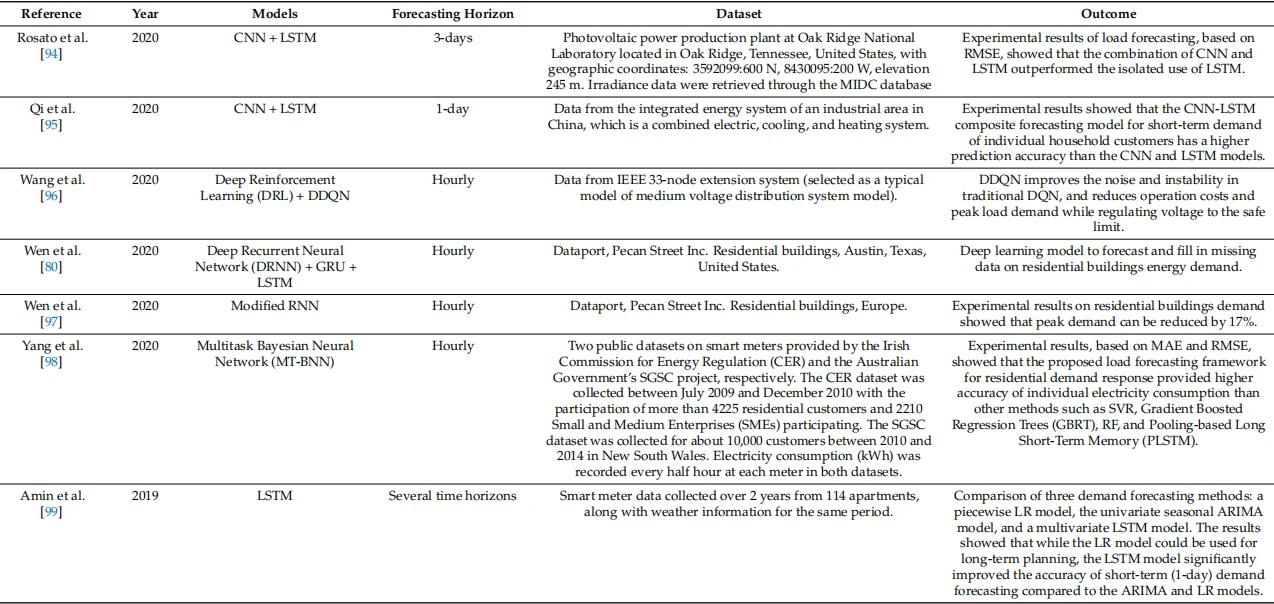


The search was limited to the last 6 years. The decision as to which articles were finally included in Table 5 was made by the authors after reviewing the search results and ensuring that the work involved the use of a Deep Learning model for demand or load forecasting purposes.
7. Conclusions
Increasing energy demand puts pressure on the power grid to balance supply and demand. Smart grids can play an important role. In these systems, data related to energy use are regularly collected and analyzed to obtain energy consumption. The usage patterns obtained can be useful for demand and load forecasting. This is a challenging task in the context of smart environments, which is why researchers are putting special efforts into this.
To meet today’s demand forecasting challenges, where smart grids generate large amounts of data, it is necessary to use modern data-driven techniques. Deep Learning based models are a good alternative. Traditionally, research has focused on forecasting customers’ energy consumption using the small historical data sets available on their behavior. However, current research applying Deep Learning methods has demonstrated better performance than conventional forecasting methods. The use of Deep Learning models involves using large amounts of data, such as those provided by the different datasets used by practitioners in the works collected in Table 5. It is a fact that smart grids generate large amounts of data, so Big Data is also a key technology to overcome the challenges of renewable energy integration, load fluctuation, and sustainable development. With the introduction of renewables into the smart grid, an increasing number of variables are brought into the system and more data need to be processed. This situation is also aggravated by the gradual introduction of electric vehicles, so these Big Data technologies are also becoming increasingly necessary [124].

Cistanche supplement near me-Improve Memory
Click here to view Cistanche Improve Memory products
【Ask for more】 Email:cindy.xue@wecistanche.com / Whats App: 0086 18599088692 / Wechat: 18599088692
The study conducted has revealed that the most widely used Deep Learning models in the energy domain for demand forecasting purposes are CNNs, RNNs, LSTM, DQNs, and CRBM, and a variation of any of them, a combination of two or more of them, or the combination of any of them with other techniques. Notable are CNN and its variations such as Pyramid-CNN [82,85,88,90,91,94,95,101,106,107,109,115,118,119,123], LSTM and its variations such as B-LSTM [80,82,86–88,91,93–95,99,100,103,104,106,107,109–113,118,119,122], and a combination of both [82,88,91,94,95,106,107,109,118,119]. Real testbeds with high-quality data are not common but are necessary to determine the performance of Deep Learning models. It is important to continue testing future Deep Learning models, including potential variations and/or combinations of two or more models, for forecasting purposes in the context of smart grids. It is also important that these tests are carried out for different scenarios. Deep Learning models capable of automatically forecasting load for different types of customers, premises/buildings, and different weather conditions are still needed. It is important to test the performance of Deep Learning, but also to determine which model is best for each scenario.
In terms of datasets, practitioners used different options, highlighting PJM electricity market [32,92,102,108,112], SGSC [85,90,98], CER [98,114,120], ISO-NE [105,109,115], Pecan Street Inc. [80,97], UCI [106,107], UKDALE [113] and REDD [21]. Many reviews on-demand/load forecasting in the context of smart grids focus on the Deep Learning models used but forget about the data. However, for a Deep Learning implementation to be successful, the algorithms are as valuable as the data. In fact, it would be desirable for researchers to incorporate more information about the data used in their works, addressing for example the training/validation/testing data split, the sampling interval of the data, the method for data cleaning, etc. One of the limitations of using Deep Learning models is the lack of high-quality real-world datasets. A future trend would probably be to shift the emphasis from the model to the data. Furthermore, the authors foresee an integration of IoT into Deep Learning models used for demand/load forecasting. IoT is enabling the democratization of sense. This opens exciting opportunities in terms of high-quality data collection, which is critical in the context of demand/load forecasting. Related to this, another future trend would be the development of integrated systems that include the necessary data acquisition and pre-processing.

Benefits of cistanche tubulosa-Improve Memory
Finally, it is also remarkable that in most cases researchers focused on short-term forecasting.
Load forecasting is a challenging task in the context of smart environments. Consequently, researchers are putting special efforts into it. Real testbeds with high-quality data are not common but necessary to determine the performance of the Deep Learning models. Deep Learning models capable of automatically forecasting load for different types of customers, premises/buildings, and different weather conditions are still needed.

What does cistanche do- Improve Memory
References
1. Butt, O.M.; Zulqarnain, M.; Butt, T.M. Recent advancement in smart grid technology: Future prospects in the electrical power network. Ain Shams Eng. J. 2021, 12, 687–695. [CrossRef]
2. Cecati, C.; Mokryani, G.; Piccolo, A.; Siano, P. An Overview of the Smart Grid Concept. In Proceedings of the IECON 2010—36th Annual Conference on IEEE Industrial Electronics Society, Glendale, CA, USA, 7–10 November 2010; pp. 3322–3327. 3. Vakulenko, I.; Saher, L.; Lyulyov, O.; Pimonenko, T. A Systematic Literature Review of Smart Grids. In Proceedings of the 1st Conference on Traditional and Renewable Energy Sources: Perspectives and Paradigms for the 21st Century (TRESP 2021), Prague, Czech Republic, 22–23 January 2021; Volume 250. [CrossRef]
4. Yan, Y.; Qian, Y.; Sharif, H.; Tipper, D. A survey on cyber security for smart grid communications. IEEE Commun. Surv. Tutor. 2012, 14, 998–1010. [CrossRef]
5. Shawkat Ali, A.B.M.; Azad, S.A. Demand forecasting in smart grid. Green Energy Technol. 2013, 132, 135–150. [CrossRef]
6. Prabadevi, B.; Pham, Q.-V.; Liyanage, M.; Deepa, N.; Vvss, M.; Reddy, S.; Madikunta, P.K.R.; Khare, N.; Gadekallu, T.R.; Hwang, W.H. Deep learning for intelligent demand response and smart grids: A comprehensive survey. arXiv 2021. [CrossRef]
7. Ferreira, H.C.; Lampe, L.; Newbury, J.; Swart, T.G. Power Line Communications. Theory and Applications for Narrowband and Broadband Communications Over Power Lines; John Wiley and Sons: Chichester, UK, 2010.
8. Vanting, N.B.; Ma, Z.; Jørgensen, B.N. A scoping review of deep neural networks for electric load forecasting. Energy Inform. 2021, 4, 49. [CrossRef]
9. Hernández, L.; Baladrón, C.; Aguiar, J.M.; Carro, B.; Sánchez-Esguevillas, A.J.; Lloret, J.; Massana, J. A survey on electric power demand forecasting: Future trends in smart grids, microgrids, and smart buildings. IEEE Commun. Surv. Tutor. 2014, 16, 1460–1495. [CrossRef]
10. Javed, F.; Arshad, N.; Wallin, F.; Vassileva, I.; Dahlquist, E. Forecasting for demand response in smart grids: An analysis on use of anthropologic and structural data and short-term multiple loads forecasting. Appl. Energy 2012, 96, 150–160. [CrossRef]
11. Khodayar, M.E.; Wu, H. Demand forecasting in the smart grid paradigm: Features and challenges. Electr. J. 2015, 28, 51–62. [CrossRef]
12. Boza, P.; Evgeniou, T. Artificial intelligence to support the integration of variable renewable energy sources to the power system. Appl. Energy 2021, 290, 116754. [CrossRef]
13. Lasseter, R.; Akhil, A.; Mamy, C.; Stephens, J.; Dagle, J.; Guttromson, R.; Meliopoulous, A.S.; Yinger, R.; Eto, J. Integration of Distributed Energy Resources. The CERTS Microgrid Concept. White Paper. 2003. Available online: https://certs.lbl.gov/ publications/integration-distributed-energy (accessed on 20 November 2022).
14. Anduaga, J.; Boyra, M.; Cobelo, I.; García, E.; Gil, A.; Jimeno, J.; Laresgoiti, I.; Oyarzabal, J.M.; Rodríguez, R.; Sánchez, E.; et al. La Microrred, Una Alternativa de Futuro Para un Suministro Energético Integral; TECNALIA, Corporación Tecnológica: Derio, Spain, 2008.
15. Hoy, M.B. Smart buildings: An introduction to the library of the future. Med. Ref. Serv. Q. 2016, 35, 326–331. [CrossRef] [PubMed]
16. Fang, X.; Misra, S.; Xue, G.; Yang, D. Smart grid—The new and improved power grid: A Survey. IEEE Commun. Surv. Tutor. 2012, 14, 944–980. [CrossRef]
17. Singh, A.; Nasiruddin, I.; Khatoon, S.; Muazzam, M.; Chaturvedi, D.K. Load Forecasting Techniques and Methodologies: A Review. In Proceedings of the 2nd International Conference on Power, Control and Embedded Systems (ICPCES), Allahabad, India, 17–19 December 2012. [CrossRef]
18. Nti, I.K.; Teimeh, M.; Nyarko-Boateng, O.; Adekoya, A.F. Electricity load forecasting: A systematic review. J. Electr. Syst. Inf. Technol. 2020, 7, 13. [CrossRef]
19. Ahmed Mir, A.; Alghassab Kafait, M.; Ullah, K.; Ali Khan, Z.; Lu, Y.; Imran, M. A review of electricity demand forecasting in low and middle-income countries: The demand determinants and horizons. Sustainability 2020, 12, 5931. [CrossRef]
20. Clements, A.E.; Hurn, A.S.; Li, Z. Forecasting day-ahead electricity load using a multiple equation time series approach. Eur. J. Oper. Res. 2016, 251, 522–530. [CrossRef]
21. Hong, Y.; Zhou, Y.; Li, Q.; Xu, W.; Zheng, X. A deep learning method for short-term residential load forecasting in smart grid. IEEE Access 2020, 8, 55785–55797. [CrossRef] 22. Phuangpornpitak, N.; Prommee, W. A study of load demand forecasting models in electric power system operation and planning. GMSARN Int. J. 2016, 10, 19–24.
23. Xiao, L.; Shao, W.; Liang, T.; Wang, C. A combined model based on multiple seasonal patterns and a modifified fifireflfly algorithm for electrical load forecasting. Appl. Energy 2016, 167, 135–153. [CrossRef]
24. Xue, B.; Geng, J. Dynamic Transverse Correction Method of Middle and Long-term Energy Forecasting based on Statistic of Forecasting Errors. In Proceedings of the 10th Conference on Power and Energy (IPEC), Ho Chi Minh, Vietnam, 12–14 December 2012; pp. 253–256. [CrossRef]
25. Khatoon, S.; Nasiruddin, I.; Singh, A.; Gupta, P. Effects of Various Factors on Electric Load Forecasting: An Overview. In Proceedings of the IEEE Power India International Conference (PIICON), Delhi, India, 5–7 December 2014; pp. 1–5.
26. Hippert, H.S.; Pedreira, C.E.; Souza, R.C. Neural networks for short-term load forecasting: A review and evaluation. IEEE Trans. Power Syst. 2001, 16, 44–55. [CrossRef]
27. Fahad, M.U.; Arbab, N. Factor affecting short-term load forecasting. J. Clean Energy Technol. 2014, 2, 305–309. [CrossRef]
28. Novianto, D.; Gao, W.; Kuroki, S. Review on people’s lifestyle and energy consumption of Asian communities: A case study of Indonesia, Thailand, and China. Energy Power Eng. 2015, 7, 465. [CrossRef]
29. Hernández, L.; Baladrón, C.; Aguiar, J.M.; Calavia, L.; Carro, B.; Sánchez-Esguevillas, A.; García, P.; Lloret, J. Experimental analysis of the input variables’ relevance to forecasting next day’s aggregated electric demand using neural networks. Energies 2013, 6, 2927–2948. [CrossRef]
30. Issi, F.; Kaplan, O. The determination of load profiles and power consumptions of home appliances. Energies 2018, 11, 607. [CrossRef]
31. Shi, Y.; Yu, T.; Liu, Q.; Zhu, H.; Li, F.; Wu, Y. An approach of electrical load profile analysis based on time series data mining. IEEE Access 2020, 8, 209915–209925. [CrossRef] 32. Hafeez, G.; Alimgeer, K.S.; Khan, I. Electric load forecasting based on deep learning and optimized by the heuristic algorithm in smart grid. Appl. Energy 2020, 269, 114915. [CrossRef]
33. Gillies, D.K.A.; Bernholtz, B.; Sandiford, P.J. A new approach to forecasting daily peak loads. Trans. Am. Inst. Electr. Eng. Part III Power Appar. Syst. 1956, 75, 382–387. [CrossRef]
34. Park, D.C.; El-Sharkawi, M.A.; Marks II, R.J.; Atlas, L.E.; Damborg, M.J. Electric load forecasting using an artificial neural network. IEEE Trans. Power Syst. 1991, 6, 442–449. [CrossRef]
35. Bakirtzis, A.G.; Petridis, V.; Kiartzis, S.J.; Alexiadis, M.C.; Maissis, A.H. A neural network short-term load forecasting model for the Greek power system. IEEE Trans. Power Syst. 1995, 11, 858–863. [CrossRef]
36. Lu, C.-N.; Wu, H.-T.; Vemuri, S. Neural network based short term load forecasting. IEEE Trans. Power Syst. 1993, 8, 336–342. [CrossRef] 37. Papalexopoulos, A.D.; Hao, S.; Peng, T.-M. An implementation of a neural network-based load forecasting model for the EMS. IEEE Trans. Power Syst. 1994, 9, 1956–1962. [CrossRef]
38. Wang, P. On defining artificial intelligence. J. Artif. Gen. Intell. 2019, 10, 1–37. [CrossRef]
39. Ongsulee, P. Artificial Intelligence, Machine Learning, and Deep Learning. In Proceedings of the 15th International Conference on ICT and Knowledge Engineering (ICT&KE), Bangkok, Thailand, 22–24 November 2017; pp. 1–6. [CrossRef]
40. Raz, A.R.; Llinas, J.; Mittu, R.; Lawless, W.F. Engineering for emergence in information fusion systems: A review of some challenges. In Human-Machine Shared Contexts; Lawless, W.F., Mittu, R., Sofge, D.A., Eds.; Academic Press: Cambridge, MA, USA, 2020; pp. 241–255, ISBN 9780128205433. [CrossRef]
41. Cohen, S. The basics of machine learning: Strategies and techniques. In Artificial Intelligence and Deep Learning in Pathology; Cohen, S., Ed.; Elsevier: Amsterdam, The Netherlands, 2021; pp. 13–40, ISBN 9780323675383. [CrossRef]
42. Bonetto, R.; Latzko, V. Machine learning. In Computing in Communication Networks, From Theory to Practice; Fitzek, F.H.P., Granelli, F., Seeling, P., Eds.; Academic Press: Cambridge, MA, USA, 2020; pp. 135–167, ISBN 9780128204887. [CrossRef]
43. Delua, J. Supervised vs. Unsupervised Learning: What’s the Difference? 2021. Available online: https://www.ibm.com/cloud/ blog/supervised-vs-unsupervised-learning (accessed on 15 November 2022).
44. Sarker, I.H. Machine learning: Algorithms, real-world applications, and research directions. SN Comput. Sci. 2021, 2, 160. [CrossRef] [PubMed]
45. Choi, R.Y.; Coyner, A.S.; Kalpathy-Cramer, J.; Chiang, M.F.; Campbell, J.P. Introduction to machine learning, neural networks, and deep learning. Transl. Vis. Sci. Technol. 2020, 9, 14. [CrossRef]
46. Alloghani, M.; Al-Jumeily, D.; Mustafifina, J.; Hussain, A.; Aljaaf, A.J. A systematic review on supervised and unsupervised machine learning algorithms for data science. In Supervised and Unsupervised Learning for Data Science; Berry, M., Mohamed, A., Yap, B., Eds.; Springer: Cham, Switzerland, 2020; pp. 3–21. [CrossRef]
47. Satinet, C.; Fouss, F. A supervised machine learning classification framework for clothing products’ sustainability. Sustainability 2022, 14, 1334. [CrossRef]
48. Jiang, T.; Gradus, J.L.; Rosellini, A.J. Supervised machine learning: A brief primer. Behav. Ther. 2020, 51, 675–687. [CrossRef] [PubMed]
49. El Bouchefry, K.; de Souza, R.S. Learning in big data: Introduction to machine learning. In Knowledge Discovery in Big Data from Astronomy and Earth Observation; Škoda, P., Adam, F., Eds.; Elsevier: Amsterdam, The Netherlands, 2020; pp. 225–249, ISBN 9780128191545. [CrossRef]
50. Uddamari, N.; Ubbana, J. A study on unsupervised learning algorithms analysis in machine learning. Turk. J. Comput. Math. Educ. 2021, 12, 6774–6782.
51. Khanum, M.; Mahboob, T.; Imtiaz, W.; Ghafoor, H.; Sehar, R. A survey on unsupervised machine learning algorithms for automation, classification, and maintenance. Int. J. Comput. Appl. 2015, 119, 34–39. [CrossRef]
52. Avinash, K.; William, G.; Ryan, B. Network Attack Detection Using an Unsupervised Machine Learning Algorithm. In Proceedings of the Hawaii International Conference on System Sciences (HICSS), Maui, HI, USA, 7–10 January 2020. [CrossRef]
53. Chen, Y.; Kong, R.; Kong, L. Applications of artificial intelligence in astronomical big data. In Big Data in Astronomy; Kong, L., Huang, T., Zhu, Y., Yu, S., Eds.; Elsevier: Amsterdam, The Netherlands, 2020; pp. 347–375, ISBN 9780128190845. [CrossRef]
54. Van Engelen, J.E.; Hoos, H.H. A survey on semi-supervised learning. Mach. Learn. 2020, 109, 373–440. [CrossRef]
55. ZhongKaizhu, G.; Huang, H. Semisupervised Learning: Background, Applications and Future Directions; Nova Science Publishers: New York, NY, USA, 2018.
56. Huynh, T.; Nibali, A.; He, Z. Semisupervised learning for medical image classification using imbalanced training data. Comput. Methods Programs Biomed. 2022, 216, 106628. [CrossRef]
57. Kaur, A.; Gourav, K. A study of reinforcement learning applications & its algorithms. Int. J. Sci. Technol. Res. 2020, 9, 4223–4228.
58. Mohammed, M.; Khan, M.B.; Bashier Mohammed, B.E. Machine Learning: Algorithms and Applications; CRC Press: Boca Raton, FL, USA, 2016.
59. Tanveer, J.; Haider, A.; Ali, R.; Kim, A. An overview of reinforcement learning algorithms for handover management in 5G ultra-dense small cell networks. Appl. Sci. 2022, 12, 426. [CrossRef]
60. Liu, S.; See, K.C.; Ngiam, K.Y.; Celi, L.A.; Sun, X.; Feng, M. Reinforcement learning for clinical decision support in critical care: Comprehensive review. J. Med. Internet Res. 2020, 22, e18477. [CrossRef] [PubMed]
61. Hao, X.; Zhang, G.; Ma, S. Deep learning. Int. J. Semant. Comput. 2016, 10, 417–439. [CrossRef]
62. Nichols, J.A.; Herbert Chan, H.W.; Baker, M. Machine learning: Applications of artificial intelligence to imaging and diagnosis. Biophys. Rev. 2019, 11, 111–118. [CrossRef]
63. Sadiq, R.; Rodríguez, M.J.; Mian, H.R. Empirical models to predict Disinfection By-Products (DBPs) in drinking water: An updated review. In Encyclopedia of Environmental Health, 2nd ed.; Nriagu, J., Ed.; Elsevier: Amsterdam, The Netherlands, 2019; pp. 324–338, ISBN 978-0-444-63952-3.
64. Teuwen, J.; Moriakov, N. Convolutional neural networks. In Handbook of Medical Image Computing and Computer Assisted Intervention; Zhou, S.K., Rueckert, D., Fichtinger, G., Eds.; Elsevier: Amsterdam, The Netherlands, 2020; pp. 481–501, ISBN 9780128161760. [CrossRef]
65. He, Z. Deep Learning in Image Classification: A Survey Report. In Proceedings of the 2nd International Conference on Information Technology and Computer Application (ITCA), Guangzhou, China, 18–20 December 2020; pp. 174–177. [CrossRef]
66. Khan, A.; Sohail, A.; Zahoora, U.; Qureshi, A.S. A survey of the recent architectures of deep convolutional neural networks. Artif. Intell. Rev. 2020, 53, 5455–5516. [CrossRef]
67. Cho, K.; van Merrienboer, B.; Bahdanau, D.; Bengio, Y. On the Properties of Neural Machine Translation: Encoder-Decoder Approaches. arXiv 2014, arXiv:1409.1259.
68. Elman, J. Finding structure in time. Cogn. Sci. 1990, 14, 179–211. [CrossRef]
69. Toha, S.F.; Tokhi, M.O. MLP and Elman Recurrent Neural Network Modelling for the TRMS. In Proceedings of the 7th IEEE International Conference on Cybernetic Intelligent Systems, London, UK, 9–10 September 2008; pp. 1–6. [CrossRef]
70. Liu, Y.; Guo, J.; Cai, C.; Wang, Y.; Jia, L. Short-Term Forecasting of Rail Transit Passenger Flow Based on Long Short-Term Memory Neural Network. In Proceedings of the International Conference on Intelligent Rail Transportation (ICIRT), Singapore, 12–14 December 2018; pp. 1–5. [CrossRef]
71. Zhao, Z.; Liang, Y.; Jin, X. Handling Large-Scale Action Space in Deep Q Network. In Proceedings of the International Conference on Artificial Intelligence and Big Data (ICAIBD), Chengdu, China, 26–28 May 2018; pp. 93–96. [CrossRef]
72. Xie, W.; Ouyang, Y.; Ouyang, J.; Rong, W.; Xiong, Z. User Occupation Aware Conditional Restricted Boltzmann Machine Based Recommendation. In Proceedings of the IEEE International Conference on Internet of Things (iThings) and IEEE Green Computing and Communications (GreenCom) and IEEE Cyber, Physical and Social Computing (CPSCom) and IEEE Smart Data (SmartData), Chengdu, China, 15–18 December 2016; pp. 454–461. [CrossRef]
73. Taylor, G.W.; Hinton, G.E.; Roweis, S.T. Two distributed-state models for generating high-dimensional time series. J. Mach. Learn. Res. 2011, 12, 1025–1068.
74. Hinton, G.E.; Osindero, S.; Teh, Y.W. A fast learning algorithm for deep belief nets. Neural Comput. 2006, 18, 1527–1554. [CrossRef]
75. Bedi, G.; Venayagamoorthy, G.K.; Singh, R. Development of an IoT-driven building environment for prediction of electric energy consumption. IEEE Internet Things J. 2020, 7, 4912–4921. [CrossRef]
76. Timur, O.; Zor, K.; Çelik, Ö.; Teke, A.; ˙Ibrikçi, T. Application of statistical and artificial intelligence techniques for medium-term electrical energy forecasting: A case study for a regional hospital. J. Sustain. Dev. Energy Water Environ. Syst. 2020, 8, 520–536. [CrossRef]
77. Selvi, M.V.; Mishra, S. Investigation of Weather influence in Day-Ahead Hourly Electric Load Power Forecasting with New Architecture Realized in Multivariate Linear Regression Artificial Neural Network Techniques. In Proceedings of the 8th IEEE India International Conference on Power Electronics (IICPE), Jaipur, India, 13–15 December 2018.
78. Selvi, M.V.; Mishra, S. Investigation of performance of electric load power forecasting in multiple time horizons with new architecture realized in multivariate linear regression and feed-forward neural network techniques. IEEE Trans. Ind. Appl. 2020, 56, 5603–5612. [CrossRef]
79. Eseye, A.T.; Lehtonen, M.; Tukia, T.; Uimonen, S.; Millar, R.J. Machine learning based integrated feature selection approach for improved electricity demand forecasting in decentralized energy systems. IEEE Access 2019, 7, 91463–91475. [CrossRef]
80. Wen, L.; Zhou, K.; Yang, S. Load demand forecasting of residential buildings using a deep learning model. Electr. Power Syst. Res. 2020, 179, 106073. [CrossRef]
81. Rodríguez, F.; Galarza, A.; Vasquez, J.C.; Guerrero, J.M. Using deep learning and meteorological parameters to forecast the photovoltaic generators intra-hour output power interval for smart grid control. Energy 2022, 239, 122116. [CrossRef]
82. Taleb, I.; Guerard, G.; Fauberteau, F.; Nguyen, N.A. Flexible deep learning method for energy forecasting. Energies 2022, 15, 3926. [CrossRef]
83. Xu, A.; Tian, M.-W.; Firouzi, B.; Alattas, K.A.; Mohammadzadeh, A.; Ghaderpour, E. A new deep learning Restricted Boltzmann Machine for energy consumption forecasting. Sustainability 2022, 14, 10081. [CrossRef]
84. Yem Souhe, F.G.; Franklin Mbey, C.; Teplaira Boum, A.; Ele, P.; Foba Kakeu, V.J. A hybrid model for forecasting the consumption of electrical energy in a smart grid. J. Eng. 2022, 6, 629–643. [CrossRef]
85. Aurangzeb, K.; Alhussein, M.; Javed, K.; Haider, S.I. A Pyramid-CNN-based deep learning model for power load forecasting of similar-profile energy customers based on clustering. IEEE Access 2021, 9, 14992–15003. [CrossRef]
86. Jahangir, H.; Tayarani, H.; Gougheri, S.S.; Golkar, M.A.; Ahmadian, A.; Elkamel, A. Deep learning-based forecasting approach in smart grids with micro clustering and bidirectional LSTM network. IEEE Trans. Ind. Electron. 2021, 68, 8298–8309. [CrossRef]
87. Mubashar, R.; Awan, M.J.; Ahsan, M.; Yasin, A.; Singh, V.P. Efficient residential load forecasting using deep learning approach. Int. J. Comput. Appl. Technol. 2022, 68, 205–214. [CrossRef]
88. Rosato, A.; Araneo, R.; Andreotti, A.; Panella, M. 2-D Convolutional Deep Neural Network for Multivariate Energy Time Series Prediction. In Proceedings of the 2019 IEEE International Conference on Environment and Electrical Engineering and 2019 IEEE Industrial and Commercial Power Systems Europe (EEEIC/I&CPS Europe), Genova, Italy, 11–14 June 2019.
89. Zhang, X.; Biagioni, D.; Cai, M.; Graf, P.; Rahman, S. An edge-cloud integrated solution for buildings demand response using reinforcement learning. IEEE Trans. Smart Grid 2020, 12, 420–431. [CrossRef]
90. Aurangzeb, K.; Al-Hussein, M. Deep Learning Framework for Short-term Power Load Forecasting, a Case Study of Individual Household Energy Customer. In Proceedings of the 2019 International Conference on Advances in the Emerging Computing Technologies (AECT), Al Madinah Al Munawwarah, Saudi Arabia, 10 February 2020.
91. Escobar, E.; Rodríguez Licea, M.A.; Rostro-Gonzalez, H.; Espinoza Calderon, A.; Barranco Gutiérrez, A.I.; Pérez-Pinal, F.J. Comparative Analysis of Multivariable Deep Learning Models for Forecasting in Smart Grids. In Proceedings of the 2020 IEEE International Autumn Meeting on Power, Electronics and Computing (ROPEC), Ixtapa, Mexico, 4–6 November 2020. [CrossRef]
92. Hafeez, G.; Alimgeer, K.S.; Wadud, Z.; Shafifiq, Z.; Ali Khan, M.U.; Khan, I.; Khan, F.A.; Derhab, A. A novel accurate and fast converging deep learning-based model for electrical energy consumption forecasting in a smart grid. Energies 2020, 13, 2244. [CrossRef]
93. Nguyen, V.-B.; Duong, M.-T.; Le, M.-H. Electricity Demand Forecasting for Smart Grid Based on Deep Learning Approach. In Proceedings of the 2020 5th International Conference on Green Technology and Sustainable Development (GTSD), Ho Chi Minh City, Vietnam, 27–28 November 2020; pp. 353–357. [CrossRef]
94. Rosato, A.; Succetti, F.; Araneo, R.; Andreotti, A.; Mitolo, M.; Panella, M. A Combined Deep Learning Approach for Time Series Prediction in Energy Environments. In Proceedings of the 2020 IEEE/IAS 56th Industrial and Commercial Power Systems Technical Conference (I&CPS), Las Vegas, NV, USA, 29 June–28 July 2020.
95. Qi, X.; Zheng, X.; Chen, Q. A Short-term Load Forecasting of Integrated Energy System based on CNN-LSTM. In Proceedings of the 2020 International Conference on Energy, Environment, and Bioengineering (ICEEB 2020), Xi’an, China, 7–9 August 2020; Volume 185, p. 01032. [CrossRef]
96. Wang, B.; Li, Y.; Ming, W.; Wang, S. Deep reinforcement learning method for demand response management of interruptible load. IEEE Trans. Smart Grid 2020, 11, 3146–3155. [CrossRef]
97. Wen, L.; Zhou, K.; Li, J.; Wang, S. Modified deep learning and reinforcement learning for an incentive-based demand response model. Energy 2020, 205, 118019. [CrossRef]
98. Yang, Y.; Li, W.; Gulliver, T.A.; Li, S. Bayesian deep learning-based probabilistic load forecasting in smart grids. IEEE Trans Ind. Inf. 2020, 16, 4703–4713. [CrossRef]
99. Amin, P.; Cherkasova, L.; Aitken, R.; Kache, V. Automating Energy Demand Modeling and Forecasting Using Smart Meter Data. In Proceedings of the 2019 IEEE International Congress on Internet of Things (ICIOT), Milan, Italy, 8–13 July 2019.
100. Atef, S.; Eltawil, A.B. A Comparative Study Using Deep Learning and Support Vector Regression for Electricity Price Forecasting in Smart Grids. In Proceedings of the IEEE 6th International Conference on Industrial Engineering and Applications (ICIEA), Tokyo, Japan, 12–15 April 2019; pp. 603–607. [CrossRef]
101. Chan, S.; Oktavianti, I.; Puspita, V. A Deep Learning CNN and AI-Tuned SVM for Electricity Consumption Forecasting: Multivariate Time Series Data. In Proceedings of the 2019 IEEE 10th annual information technology, Electronics and Mobile Communication Conference (IEMCON), Vancouver, BC, Canada, 17–19 October 2019.
102. Hafeez, G.; Javaid, N.; Riaz, M.; Ali, A.; Umar, K.; Iqbal, Q.Z. Day Ahead Electric Load Forecasting by an Intelligent Hybrid Model based on Deep Learning for Smart Grid. In Proceedings of the 14th International Conference on Complex, Intelligent and Software Intensive Systems (CISIS-2020), Lodz, Poland, 1–3 July 2020.
103. Kaur, D.; Kumar, R.; Kumar, N.; Guizani, M. Smart Grid Energy Management using RNN-LSTM: A Deep Learning-Based Approach. In Proceedings of the IEEE Global Communications Conference (GLOBECOM), Big Island, HI, USA, 9–13 December 2019; pp. 1–6. [CrossRef]
104. Al Khafaf, N.; Jalili, M.; Sokolowski, P. Application of deep learning long short-term memory in energy demand forecasting. Commun. Comput. Inf. Sci. 2019, 1000, 31–42. 105. Khan, A.B.M.; Khan, S.; Aimal, S.; Khan, M.; Ruqia, B.; Javaid, N. Half hourly electricity load forecasting using convolutional neural network. In Innovative Mobile and Internet Services in Ubiquitous Computing; Barolli, L., Xhafa, F., Hussain, O., Eds.; Springer: Cham, Switzerland; Volume 994. [CrossRef]
106. Kim, T.Y.; Cho, S.B. Predicting residential energy consumption using CNN-LSTM neural networks. Energy 2019, 182, 72–81. [CrossRef]
107. Kim, T.; Cho, S. Particle Swarm Optimization-based CNN-LSTM Networks for Forecasting Energy Consumption. In Proceedings of the 2019 IEEE Congress on Evolutionary Computation (CEC), Wellington, New Zealand, 10–13 June 2019.
108. Lu, R.; Hong, S.H. Incentive-based demand response for smart grid with reinforcement learning and deep neural network. Appl. Energy 2019, 236, 937–949. [CrossRef]
109. Pramono, S.H.; Rohmatillah, M.; Maulana, E.; Hasanah, R.N.; Hario, F. Deep learning-based short-term load forecasting for supporting demand response program in the hybrid energy system. Energies 2019, 12, 3359. [CrossRef]
110. Rahman, S.; Alam, M.G.R.; Rahman, M.M. Deep Learning based Ensemble Method for Household Energy Demand Forecasting of Smart Home. In Proceedings of the 2019 22nd International Conference on Computer and Information Technology (ICCIT), Dhaka, Bangladesh, 18–20 December 2019.
111. Syed, D.; Refaat, S.S.; Abu-Rub, H.; Bouhali, O.; Zainab, A.; Xie, L. Averaging Ensembles Model for Forecasting of Short-Term Load in Smart Grids. In Proceedings of the IEEE International Conference on Big Data (Big Data), Los Angeles, CA, USA, 9–12 December 2019; pp. 2931–2938. [CrossRef]
112. Ustundag Soykan, E.; Bilgin, Z.; Ersoy, M.A.; Tomur, E. Differentially Private Deep Learning for Load Forecasting on Smart Grid. In Proceedings of the 2019 IEEE Globecom Workshops (GC Wkshps), Waikoloa, HI, USA, 9–13 December 2019; pp. 1–6. [CrossRef]
113. Vesa, A.V.; Ghitescu, N.; Pop, C.; Antal, M.; Cioara, T.; Anghel, I.A.; Salomie, I. Stacking Ulti-Learning Ensemble Model for Predicting Near Real Time Energy Consumption Demand of Residential Buildings. In Proceedings of the 2019 IEEE 15th International Conference on Intelligent Computer Communication and Processing (ICCP), Cluj-Napoca, Romania, 5–7 September 2019.
114. Yang, Y.; Hong, W.; Li, S. Deep ensemble learning based probabilistic load forecasting in smart grids. Energy 2019, 189, 116324. [CrossRef]
115. Zahid, M.; Ahmed, F.; Javaid, N.; Abbasi, R.A.; Zainab Kazmi, H.S.; Javaid, A.; Bilal, M.; Akbar, M.; Ilahi, M. Electricity price, and load forecasting using enhanced convolutional neural network enhanced support vector regression in smart grids. Electronics 2019, 8, 122. [CrossRef]
116. Ouyang, T.; He, Y.; Li, H.; Sun, Z.; Baek, S. Modeling and forecasting short-term power load with copula model and deep belief network. IEEE Trans. Emerg. Top. Comput. Intell. 2019, 3, 127–136. [CrossRef]
117. Hafeez, G.; Javaid, N.; Ullah, S.; Iqbal, Q.Z.; Khan, M.; Rehman, A.U.; Ullah, Z. Short-Term Load Forecasting based on Deep Learning for Smart Grid Applications. In Proceedings of the 12th International Conference on Innovative Mobile and Internet Services in Ubiquitous Computing (IMIS-2018), Matsue, Japan, 4–6 July 2018. [CrossRef] 118. Koprinska, I.; Wu, D.; Wang, Z. Convolutional Neural Networks for Energy Time Series Forecasting. In Proceedings of the 2018 International Joint Conference on Neural Networks (IJCNN), Rio de Janeiro, Brazil, 8–13 July 2018.
119. Kuo, P.H.; Huang, C.J. A high precision artificial neural networks model for short-Term energy load forecasting. Energies 2018, 11, 213. [CrossRef]
120. Shi, H.; Xu, M.; Li, R. Deep learning of household load forecasting—A novel pooling deep RNN. IEEE Trans Smart Grid 2018, 9, 5271–5280. [CrossRef]
121. Ghaderi, A.; Sanandaji, B.M.; Ghaderi, F. Deep forecast: Deep learning-based spatiotemporal forecasting. arXiv 2017. [CrossRef]
122. Jarábek, T.; Laurinec, P.; Lucká, M. Energy Load Forecast using S2S Deep Neural Networks with K-Shape Clustering. In Proceedings of the 2017 IEEE 14th International Scientific Conference on Informatics 2017, Poprad, Slovakia, 14–16 November 2017.
123. Li, L.; Ota, K.; Dong, M. Everything is Image: CNN-Based Short-Term Electrical Load Forecasting for Smart Grid. In Proceedings of the 2017 14th International Symposium on Pervasive Systems, Algorithms, and Networks & 2017 11th International Conference on Frontier of Computer Science and Technology & 2017 Third International Symposium of Creative Computing (ISPAN-FCST-ISCC), Exeter, UK, 21–23 June 2017; pp. 344–351. [CrossRef]
124. Zhan, J.; Huang, J.; Niu, L.; Peng, X.; Deng, D.; Cheng, S. Study of the Key Technologies of Electric Power Big Data and Its Application Prospects in Smart Grid. In Proceedings of the IEEE PES Asia-Pacifific Power and Energy Engineering Conference (APPEEC), Hong Kong, China, 7–10 December 2014; pp. 1–4. [CrossRef]