Asynapsis in Cistanche Tubulosa (Orobanchaceae)
Mar 10, 2022
Contact: joanna.jia@wecistanche.com / WhatsApp: 008618081934791
BATIA PAZYand Uzi PLITMANN
Key words Orobanchaceae, Cistanche tubulosa. - Meiosis, asynapsis.
Abstract Asynapsis, i.e., lack of chromosome pairing in meiosis, is reported and documented for the first time in the holoparasitic plant Cistanche tubulosa in a natural population.

Partial or complete failure of chromosome pairing in meiosis can be brought about either by lack of chromosome homology (e.g., in interspecific hybrids or monoploids) or by synaptic mutations. The latter can be spontaneous (e.g., in maize, BEADLE1930; rye, SOSMKHINA& al. 1992), or induced (KATAYAMA1961, GOTTSCttALK 1968, GOTTSCHALK& KAUL1980). Altogether, synaptic mutants have been detected in 126 species of higher plants, belonging to 93 genera mostly in cultivation (KoDuRU 8Z; RAO 1981), as well as in animals (e.g., KOYKUL& BASRUR1993) and man (e.g., NAVARRO~7 al. 1990). This note presents an additional case, in Cistanche tubulosa (SCHENK)HOOK., a root holoparasite infesting desert shrubs in saline habitats in southern Israel.

acteoside in cistanche can improve immunity
Meiosis was examined in microsporocytes obtained from three C. tubulosa plants growing at En-Aveda area, in the Central Negev, after fixation in ethanol-acetic acid (3: 1) and staining and squashing in 2% acetocarmine (Fig. 1). Two plants showed the regular formation of bivalents and had 2n = 40 chromosomes (Fig. 1 a', b '). The meiosis of a third plant was abnormal in all ten examined buds (Fig. 1 a-f). Pachytene was characterized by unpaired chromosomes (Fig. 1 a), and at metaphase I (Fig. 1 b) the chromosomes appeared mostly as univalents. Only in a few microsporocytes could some bivalents (up to four) be discerned (Fig. 1 c). The univalents did not orientate on the equatorial plane and at anaphase I, they were distributed at random between the two poles (Fig. 1 d). During the second division, pollen mother cells were characterized by irregular distribution of chromosomes which at telophase II resulted in the formation of nuclei of different numbers and sizes (Fig. 1 e). The products of the meiocytes were therefore not normal tetrads, but largely aborted cells of various numbers and sizes (Fig. 1 f), of which 1.6% were normally stained pollen grains. No morphological differences between the synaptic plant and its normal neighbors could be discerned. Completely absent or very low seed setting was found later in the season in three (out of nine) more mature individuals, indicating that over 30% of this population may be synaptic.


Fig. 1. Chromosome behavior in meiosis of a synaptic (a-J) and regular (a '-b ) individuals of Cistanche tubulosa (2n = 40). a "Pachytene" - "diplotene", unpaired chromosomes. a ' Regular diplotene, b Metaphase I, scattered chromosomes appear mostly as univalents. b ' Pro-Metaphase I, regular formation of bivalents, c Metaphase I, some bivalents may be discerned in a few synaptic meiocytes, d Anaphase I, random distribution of univalents between the two poles, e Telophase II, formation of variable number and variable sizes of nuclei, f The outcome of synaptic meiosis: variable, largely aborted cells. - Bar: a-f 10 μm.
The term synaptic mutants were adapted by RILEY & LAW (1965) to describe deficiencies of chromosome pairing in prophase I. The abnormal individual of C. tubulosa detected by us fits well into this description. Pachytene figures clearly indicate (Fig. 1 a) that it is an "a synaptic" rather than a "desynaptic" mutant.
Special thanks are due to DANPORATHwho collected samples of Cistanche tubulosa, to DANIELZOHARYfor his valuable remarks, and to SYLVIAFISnMANfor for her technical assistance.

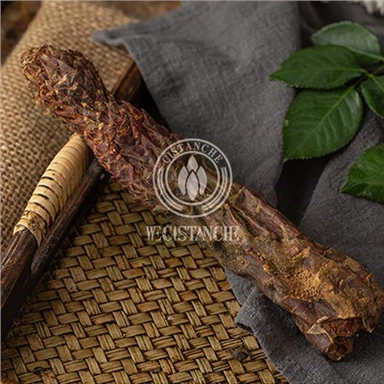
Cistanche tubulosa
From: ' Asynapsis in Cistanche tubulosa (Orobanchaceae) ' by BATIA PAZYand Uzi PLITMANN
----P1. Syst. Evol. 201:271-273 (1996)
Reference:
BEADLE, G. W., 1930: Genetical and cytological studies of Mendelian asynapsis in Zea mays. - Cornell Univ. Agric. Exp. Stat. Mem. 129: 1-23.
GOTTSCHALK, W., 1968: Investigations on the genetic control of meiosis. - Nucleus, Suppl. on chromosomes: 345.
- KAUL, M. L. H., 1980: Asynapsis and desynapsis in flowering plants. I. Asynapsis. -Nucleus 23: 1-15.
KATAYAMA, T., 1961: Cytogenetical studies on a synaptic rice plant (Oryza sativa L.) induced by x-ray. - La Kromosomo 48: 1591-1601.
KODURU, R R. K., RAO, M. K., 1981: Cytogenetics of synaptic mutants in higher plants. -Theor. Appl. Genet. 59: 197-214.
KOYKUL, W., BASRUR, R K., 1994: Synaptic anomalies in fetal bovine oocytes. - Genome 3 7: 83-91.
NAVARRO, J., TEMPLADO, C., B~NET, J., LANGE, R., RAJMIL, O., EGOZCUE, J., 1990: Sperm chromosome studies in an infertile man with partial, complete asynapsis of meiotic bivalents. - Human Reprod. 5: 227-229.
RILEY, R., LAW, C. N., 1965: Genetic variation in chromosome pairing. - Advances Genet. 13: 57-107.
SOSNtKHINA,S. P., FEDOTOVA, YU. S., MIKHAILOVA, E. I., KALOMIETS,O. L., BOGDANOV, Yu. F., 1992: Meiotic mutants of rye Secale cereale L. I. Synaptic mutant by-1.- Theor. Appl. Genet. 84: 979-985.
Address of the authors: BATIAPAZY, UzI PLITMANN, Department of Botany, Institute of Life Sciences, The Hebrew University of Jerusalem, Jerusalem 91904, Israel.