Authentic Medicinal Materials: Origin Environment And Growth Cycle Of Cistanche Tubulosa in Hotan, Xinjiang
Apr 24, 2026
As a traditional, authentic medicinal herb, Cistanche tubulosa is known as the "desert ginseng", and the Hotan Guanhua Cistanche tubulosa (scientific name * Castanche tubulosa *) in Xinjiang is one of the best. As a Chinese national geographical indication product, Hotan Guanhua Cistanche has become a model of authentic medicinal herbs with its unique desert ecological endowment, strict growth laws, and excellent quality. The uniqueness of its production environment and the special growth cycle have jointly created its medicinal value and market reputation, with over two thousand years of written records of its consumption and use as medicine.

Cistanche tubulosa florescence
The production environment of Hotan Guanhua Cistanche: an exclusive breeding ground gifted by Tiangong
The authentic nature of Cistanche tubulosa stems from the irreplaceable natural conditions in the Hotan region. Its growth has extremely high requirements for climate, soil, water sources, and symbiotic environment, and Hotan perfectly fits all of these, becoming the confidence of "China's Cistanche tubulosa looks at Hotan".
(1) Unique climatic conditions: sufficient sunlight, temperature difference quenching
Hotan is located on the southern edge of the Taklamakan Desert, with a warm temperate continental arid climate. Its core growth area is clearly defined as the administrative regions of eight counties and cities, including Hotan City, Hotan County, and Pishan County, with an altitude range of 800-1400 meters. The annual sunshine duration here exceeds 3000 hours, providing sufficient energy for the photosynthesis of Cistanche tubulosa and assisting in the accumulation of active ingredients. The temperature difference between day and night can reach 20 ℃. This extreme temperature difference can effectively reduce the water content in the body of Cistanche tubulosa, promote the precipitation of core active ingredients such as phenylethanolic glycosides, and form its characteristic of "plump meat and rich nutrition". At the same time, the average annual precipitation in the region is only 49-97 millimeters, and the air is extremely dry. This arid environment can effectively suppress the growth of pests and diseases, ensuring the purity of medicinal materials from the source, and allowing natural growth without the need for manual pesticide spraying.

(2) Suitable soil and water source: pure and nourishing, suitable for growth
The soil in which Hotan Guanhua Cistanche grows is mainly pure sandy loam and brown desert soil, with a pH value of ≤ 8 and a total salt content of less than 0.7% in a 60-centimeter soil base. This soil has excellent permeability and water permeability, fully matching the growth characteristics of Guanhua Cistanche, which is tolerant to salt and alkali and prefers looseness. It can allow its fleshy stems to freely extend underground and absorb deep nutrients. The irrigation water source comes from the melting water of Kunlun Mountain glaciers, with pure and pollution-free water quality. Combined with mature drip irrigation technology in the local area, it achieves the ideal water condition of "dry but not dry, moist but not flooded", which not only ensures the healthy growth of the host red willow, but also avoids the rotting of the fleshy stem of Cistanche tubulosa due to waterlogging, providing stable water support for its growth. In addition, there is no industrial pollution in the Hotan area, further ensuring the natural quality of Cistanche tubulosa.

(3) Exclusive ecological symbiosis: Red willows as companions, mutually beneficial symbiosis
Guanhua Cistanche is a typical obligate parasitic herbaceous plant that can only parasitize on the roots of red willows (Tamarix genus), relying on red willows to provide all nutrients and water. The two form a unique ecological symbiotic system of "red willows protecting sand and Cistanche parasitizing". The Hotan area relies on the windbreak and sand-fixing forest belt along the edge of the Taklamakan Mountains. Red willows grow vigorously and have developed root systems. One red willow can fix 4-6 square meters of sand, which not only plays an ecological role in windbreak and sand fixation, but also provides a high-quality parasitic host for Cistanche tubulosa, achieving a win-win situation for ecological management and medicinal plant cultivation. This symbiotic relationship not only determines the growth range of Cistanche tubulosa but also directly affects its quality. The high-quality growth of Hotan red willow lays the foundation for the accumulation of sufficient nutrients in Cistanche tubulosa.

Host of Cistanche tubulosa- Red Willow
The growth cycle of Hotan Guanhua Cistanche tubulosa: long dormancy, accumulation, and gradual development
The growth cycle of Hotan Guanhua Cistanche tubulosa is as long as 3-5 years, following the natural law of "underground dormancy and short growth above ground". From seed germination to fruit maturity, each stage requires specific environmental conditions and time precipitation. Among them, the parasitic reed head can survive for many years, while the Cistanche tubulosa plant itself is one year old and grows and matures in the same year. Its growth process can be clearly divided into four key stages, each of which carries the important mission of quality accumulation.
(1) Vaccination parasitic period (1-2 years): underground incubation, quietly rooted
This stage is the foundation of the growth of Cistanche tubulosa, which is completed underground and cannot be observed by the naked eye. The seeds of Cistanche tubulosa need to complete the ripening process first, and can only germinate under the induction of the secretion from the root system of Salix matsudana. Then, they form suckers and slowly extend into the roots of Salix matsudana, establishing stable nutrient connections and forming an inoculation disk. This process is called "inoculation parasitism". Since the successful artificial inoculation of Cistanche tubulosa in Hotan Prefecture in 1976, the inoculation technology has been continuously optimized. Currently, the main methods used are seed paper inoculation and seed sowing inoculation. The inoculation time is mostly arranged during the red willow planting season in spring, from March to April, and timely irrigation after inoculation promotes seed germination and root formation, greatly improving the success rate of inoculation. Its inoculation formula and method are at the leading level in China, which can advance the inoculation time by 1-2 years.

(2) Succulent stem growth period (2-3 years): nutrient accumulation, steady and robust
After establishing a stable connection between the suckers and the roots of red willows, Cistanche tubulosa enters the period of fleshy stem growth, during which the core is to accumulate nutrients and strengthen the fleshy stem. The fleshy stem rapidly elongates underground, with an annual elongation rate of 10-20 centimeters. Its growth rate is closely related to burial depth: it can be unearthed in the same year when buried at a depth of about 20 centimeters, 2-3 years for buried at a depth of 40-50 centimeters, and 3-4 years for buried at a depth of 70-80 centimeters. Moreover, the deeper the burial depth, the thicker the fleshy stem per plant. The advantages of the extreme climate in the Hotan region were fully demonstrated during this stage, with abundant light and large temperature differences between day and night, accelerating the accumulation of core active ingredients such as echinacoside and verbascoside. Among them, the content of echinacoside in the first grade Hotan Guanhua Cistanche was ≥ 5.0%, and verbascoside was ≥ 1.2%, far exceeding the standards stipulated in the Chinese Pharmacopoeia, and even 5 to 10 times higher than other production areas.

Cistanche tubulosa a nourishing legend that crosses regions
(3) Blooming period (4th year): Emerging from the soil and briefly blooming
After 2-3 years of underground dormancy, mature fleshy stems will break through the sandy soil and emerge in May or June of the fourth year, followed by rapid sprouting, budding, and flowering, completing the above-ground growth stage. The inflorescence of Cistanche tubulosa is spike-shaped, and the corolla is funnel-shaped. When it first blooms, it is white and gradually turns purple, accompanied by a unique aroma. The height of a single plant can reach 30-40 centimeters, and the longest can even exceed two meters. This stage lasts for a short period of time, and the Hotan area is prone to sandstorms in spring. Farmers need to take measures to prevent wind and insect damage, avoid damage to the inflorescence, and ensure the quality of subsequent seeds and fleshy stems, as flowering plants consume a large amount of nutrients. If damaged, it will directly reduce the value of medicinal materials.

Cistanche tubulosa florescence
(4) Ripening period of fruit cracking (4-5 years): The fruit matures and completes the cycle
Every July and August, the capsules of Cistanche tubulosa gradually mature and then crack, releasing a large number of brown oval seeds that scatter in sandy soil, completing the cycle of life. The underground inoculation tray can survive for many years, and when conditions are suitable, new Cistanche tubulosa plants can grow, achieving sustained growth. The harvesting of Hotan Guanhua Cistanche tubulosa strictly follows the principle of "timely harvesting and scientific processing", and is carried out in two seasons: spring from late March to early April, when the fleshy stems are full, the water content is moderate, and the active ingredient content reaches its peak; From late October to early November in autumn, the texture is soft and moist. In Hotan production areas, autumn harvesting is commonly used, and the principle of "harvesting large and leaving small" is followed after excavation to ensure sustainable development of resources. After harvesting, it takes 10-15 days to dry in spring and 20-30 days in autumn. In late autumn, drying measures are taken to avoid mold caused by residual moisture. No chemical components are added during the processing to ensure that the finished product retains its natural color and active ingredients.

Desert living cistanche
Authentic Advantage: The Unique Value of Hotan Guanhua Cistanche
The reason why Hotan Guanhua Cistanche can become a benchmark for authentic medicinal herbs lies in its irreplaceable comprehensive advantages. One is the advantage of ingredients. The extreme desert climate and pure growth environment make its core active ingredient content far exceed the pharmacopoeia standards, highlighting its medicinal value. The second is the ecological advantage. The symbiotic model of "Red Willow and Cistanche tubulosa" not only achieves the ecological benefits of windbreak and sand fixation, but also ensures the natural pollution-free nature of medicinal materials. Thirdly, there are industrial advantages. The Hotan region has established over 500000 acres of standardized planting bases, formulated GAP standards for the Cistanche tubulosa base, and formed a complete "planting processing sales" industrial chain. Through technical training and standardized management, the quality of each Hotan Cistanche tubulosa plant is stable and controllable, promoting the transformation of desert resources into "wealth-generating resources" and helping local farmers increase their income.
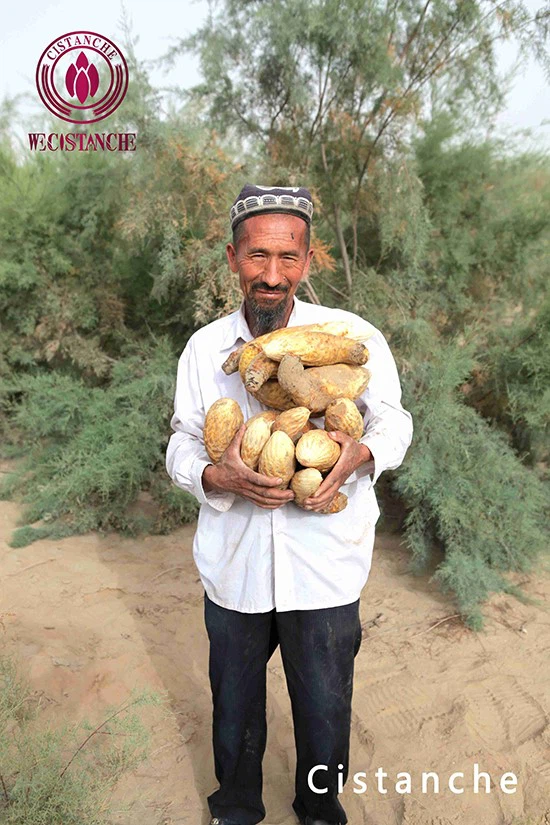
Harvest of Cistanche tubulosa
Click here to view Cistanche for Kidney disease products
【Ask for more】 Email:cindy.xue@wecistanche.com / WhatsApp: 0086 18599088692 / Wechat: 18599088692
The authentic nature of Cistanche tubulosa in Hotan, Xinjiang, is nourished by the melting water of Kunlun Mountains glaciers, tempered by the climate of the Taklamakan Desert, and gifted by the symbiotic system of red willows. It is also the patient's precipitation of a long growth cycle of 3-5 years. As a genuine medicinal herb with both ecological and medicinal value, it is not only an important component of the treasure trove of traditional Chinese medicine but also a result of the perseverance and innovation of the people of Hotan. It carries the dual mission of desert ecological governance and traditional Chinese medicine inheritance, and is worthy of being understood and cherished by more people.