When You Get Old, You Should Know About Alzheimer's Disease
Aug 11, 2026
When memories begin to fade
Have you ever noticed a scene where your mother repeatedly asks you, "What day is today?", your father hides the key in the refrigerator, and your grandmother can't name the person in the photo? We habitually smile and say 'I'm old and confused', but few people realize that these seemingly ordinary 'little problems' may be a silent thief named Alzheimer's who is gradually stealing the closest people.
Every 3 seconds, a new dementia patient is added globally. China has the highest number of Alzheimer's disease patients in the world, with over 10 million cases and an annual increase of over 300000. What is even more heart-wrenching is that due to insufficient public awareness of the disease, over 70% of patients only seek medical attention for the first time after experiencing obvious symptoms, missing the optimal intervention window period.
Desert living cistanche-Anti Alzheimers disease
This article is written for every person who is aging, as well as for everyone who loves the elderly. What we want to talk about is not only a disease, but also a traditional Chinese medicine that has traveled through thousands of years and comes from the depths of the desert - Cistanche tubulosa. It may not be able to create miracles, but scientific evidence is telling us that the power of some plants and trees is worth taking seriously.
Understanding Alzheimer's Disease: It's Not Just 'Old Confusion'
Alzheimer's Disease (AD) is a neurodegenerative disease with a subtle onset and progressive development. It was first described by German doctor Eros Altzmar in 1906- a woman named August Deqi 03 exhibited strange behavioral changes at the age of 51, and after her death, pathological examination revealed abnormal protein deposits in her brain.

The efficacy of Cistanche tubulosa-Anti Alzheimers disease
One hundred years have passed, and our understanding of this disease has made significant progress, but it remains one of the major challenges facing human medicine.
Simply put, Alzheimer's disease is a "joint disorder" of two abnormal proteins in the brain:
β - amyloid protein (Aβ): abnormally aggregates between nerve cells, forming "plaques" that block communication channels between neurons like garbage.
Tau protein: Entangles into "neurofibrillary tangles" inside nerve cells, causing the "transport system" inside the cell to collapse and ultimately leading to neuronal death.
As more and more neurons are damaged and die, the brain shows significant atrophy, especially in the hippocampus region closely related to memory. The patient's memory, language, judgment, and spatial perception abilities are sequentially impaired, ultimately making it difficult for them to take care of even the most basic clothing and food.
Not all forgetfulness is AD
As we grow older, we all experience 'benign forgetting' - occasionally unable to remember a name, walking into the kitchen and forgetting what to bring. This is a normal aging phenomenon. But Alzheimer's disease is different; its core features are:
Progressive and irreversible: Forgetting becomes increasingly severe and does not improve on its own.
Affects daily life: not just forgetting things, but gradually losing the ability to live independently.
Accompanied by other cognitive impairments: language disorders, loss of orientation, decreased judgment, personality changes, etc.
A simple principle of judgment: normal forgetting is "temporarily unable to remember, but later remembered again"; And the forgetfulness of Alzheimer's disease is completely disappearing, and increasing '.

cistanche-prevent Alzheimers disease
Who is stealing our memories? --Analysis of the pathogenesis
The etiology of Alzheimer's disease has not been fully elucidated yet, but the scientific community has identified several key "suspects":
genetic factors
About 6% -10% of Alzheimer's disease is early-onset (occurring before the age of 65), which is often related to genetic mutations, such as mutations in APP, PSEN1, and PSEN2 genes. Late-onset (the vast majority) is closely related to the apolipoprotein E (APOE) gene - people carrying the APOE ε 4 allele have a significantly increased risk of disease. However, genes are only a matter of 'loading the bullet'; whether or not to 'bolt down the gun' depends on postnatal factors.
Chronic inflammation and oxidative stress
Recent studies have revealed an important fact: Alzheimer's disease is not just a protein disease, but also an "inflammatory disease". Microglia in the brain (equivalent to immune cells in the brain) continue to release pro-inflammatory cytokines during chronic activation, causing chronic damage to neurons. Meanwhile, the imbalance between the excessive production and clearance of free radicals (i.e., oxidative stress) accelerates the aging process of brain tissue.
Vascular factors

cistanche-prevent Alzheimers disease
Hypertension, diabetes, hyperlipidemia, arteriosclerosis, and other vascular risk factors will damage the microcirculation of the brain and reduce the blood supply and oxygen delivery of brain tissue. Research has shown that controlling vascular risk factors can significantly reduce the risk of developing Alzheimer's disease. This reminds us: protect the brain first, protect the blood vessels.
Warning signal: Don't take forgetting for granted
The early signals of Alzheimer's disease are often mistaken for 'normal old confusion'. The following 10 warning signals are worth everyone's attention (refer to the "10 Warning Signs" of the Alzheimer's Association):
1. Memory loss affects daily life: repeatedly asking the same question and forgetting what just happened.
Difficulty in planning or solving problems: The cooking steps are chaotic, and there are always errors in accounting.
Completing familiar tasks has become difficult: I don't know how to use the remote control, and I can't cook anymore.
4. Confusion of time and location: Unable to distinguish between year, month, and day, getting lost in a familiar place.
5. Visual and spatial judgment issues: Unable to understand traffic lights, always spilling water from the cup.
6. Language and communication barriers: Unable to say words at the tip of the tongue, and using increasingly verbose language.
7. Things are placed in the wrong place and cannot be traced back: put the phone in the washing machine, put the key in the shoe cabinet.
8. Decreased judgment: Trusting fraudulent phone calls and going out in cold weather wearing only clothes.
Social withdrawal: no longer participating in activities that I used to enjoy, becoming silent and introverted.
10. Emotional and personality changes: becoming suspicious, anxious, depressed, or irritable.
If your family members exhibit the aforementioned symptoms, please do not wait and seek professional evaluation at a neurology or memory clinic as soon as possible. Early diagnosis means more opportunities for intervention.

Effects of Cistanche-Anti Alzheimers disease
How is modern medicine treating it? --Limitations and Challenges
Inventory of existing drugs
There are currently two main categories of drugs approved for the treatment of Alzheimer's disease:
Acetylcholinesterase inhibitors (donepezil, carbapenem, galantamine): improve cognitive function by increasing the level of acetylcholine in the brain, and have a certain effect on mild to moderate patients.
NMDA receptor antagonist (memantine): regulates the overactivation of glutamate, which is helpful for moderate to severe patients.
Since the 2020s, monoclonal antibody drugs targeting Aβ, such as aducanamab and lencanamab, have been approved one after another, attempting to clear amyloid plaques in the brain at the etiological level. These new drugs bring hope, but they also come with the risk of side effects such as cerebral edema and microbleeds, and are expensive. Long-term effects still require more data validation.
The unavoidable reality
To be frank, there is currently no medication that can cure Alzheimer's disease or reverse its progression. The current treatment can only delay the deterioration of symptoms to a certain extent and strive for more quality time for patients and families. That's why scientists around the world are actively seeking new intervention strategies, including uncovering treasures from traditional Chinese medicine.
Traditional Chinese Medicine Perspective: Kidney essence deficiency and brain marrow loss of nourishment
In the theoretical system of traditional Chinese medicine, there is no name for "Alzheimer's disease", but there is a set of highly corresponding syndrome descriptions such as "dementia", "forgetfulness", "dementia", "literary dementia", etc. As early as more than 2000 years ago, there was a record in the Yellow Emperor's Inner Canon: "If the marrow sea is insufficient, the brain will turn, and the ears will be ringing, the tibia will be sore and dizzy, and there will be no visible sight. It will disappear and wait to lie down
The kidney controls the bone and generates marrow, which aggregates to form the brain
Traditional Chinese Medicine believes that "the kidneys store essence, essence generates marrow, and marrow aggregates into the brain". The brain is the 'marrow sea' and the material basis for spiritual consciousness and thinking activities. If the kidney essence is sufficient, the marrow sea is full, the brain is strong, and the memory is clear; Kidney essence deficiency leads to insufficient marrow and brain nourishment, resulting in forgetfulness, slow response, and dull expression - which is highly consistent with the symptoms of Alzheimer's disease described by modern medicine.

Effects of Cistanche: Improve Kidney Function
As people age, their kidney essence naturally declines, which is a natural law of human aging. But modern lifestyles such as staying up late, sitting for long periods of time, high mental stress, and irregular eating have accelerated the depletion of kidney essence, leading to an early onset of "marrow deficiency".
Excessive deficiency, stasis, and phlegm
Throughout history, medical practitioners have summarized in extensive clinical practice that the pathogenesis of senile dementia can be summarized as "multiple deficiencies, multiple blood stasis, and multiple phlegm":
Deficiency: Based on kidney deficiency, it also includes both heart and spleen deficiency.
Stagnation: Long-term illness enters the meridians, causing cerebral blood stasis and obstruction, resulting in poor circulation of qi and blood.
Phlegm: The spleen is not functioning properly, and moist phlegm is produced internally, which can obscure the clear window.
Therefore, the core idea of traditional Chinese medicine in treating Alzheimer's disease is to nourish the kidneys and essence to fill the marrow sea, promote blood circulation and remove blood stasis to unblock the brain and collaterals, and invigorate the spleen and phlegm to awaken the mind. Among these three major treatment methods, there is a medicine highly praised by medical practitioners throughout history - Cistanche tubulosa.
Cistanche tubulosa: the 'root of life' in the desert
Where does it come from?
Cistanche tubulosa, a plant of the family Rhamnaceae, parasitizes the roots of the desert plant Salix. It grows in desert areas such as Inner Mongolia, Xinjiang, and Gansu, and is known as the "desert ginseng". Every spring, while most plants are still waiting for rain, Cistanche tubulosa has already emerged from the sand underground, pulling out thick inflorescences and displaying astonishing vitality.
It also has vivid names: Dayun, Cunyun, Cistanche tubulosa, Chagan Gaoya (Mongolian). In the treasure trove of traditional Chinese medicine, Cistanche tubulosa has a history of more than 1800 years of medicinal use. It was first recorded in the "Shennong Bencao Jing" and is classified as a top-grade medicine. It is recorded as having a sweet and slightly warm taste, mainly used for five labor and seven injuries, nourishing the middle, removing cold and hot pain in the stem, nourishing the five organs, strengthening yin, nourishing essence and qi, having many children, and taking it for a long time can lighten the body.

Cistanche tubulosa
Sex, taste, meridian and efficacy
Cistanche tubulosa has a sweet and salty taste, a warm nature, and belongs to the kidney and colon meridians. Its core functions can be summarized in eight words: tonifying kidney yang, nourishing essence and blood, moisturizing the intestines and promoting bowel movements.
In classic prescriptions throughout history, the figure of Cistanche tubulosa can be seen everywhere:
The "Jin Kui Yao Shen Qi Wan" is modified to warm and tonify the kidney yang;
The "Cistanche Runchang Pill" is specifically designed to treat elderly patients with deficiency constipation;
In the book "Dihuang Yinzi", the combination therapy for "swoosh blister" (language disorder accompanied by limb stasis) - this indication description is surprisingly similar to some neurodegenerative diseases in modern medicine.
It is worth noting that, unlike many warming tonics, the nourishing effect of Cistanche tubulosa is mild and not burning, and it is known as the "calm" product - nourishing but not steep, warm but not hot, smooth but not leaking, hence the name "Cistanche tubulosa" (calm). This is precisely the important reason why it is suitable for long-term care of the elderly.
The mechanism of action of Cistanche tubulosa in combating Alzheimer's disease
In recent years, with the deepening of modern pharmacological research, the value of Cistanche tubulosa in the field of neuroprotection is being scientifically verified one by one. Its active ingredients mainly include phenylethanoid glycosides (such as echinacoside and verbascoside), cyclohexene ether esters, polysaccharides, amino acids, and trace elements. These ingredients exert their anti Alzheimer's disease effects through multiple pathways.
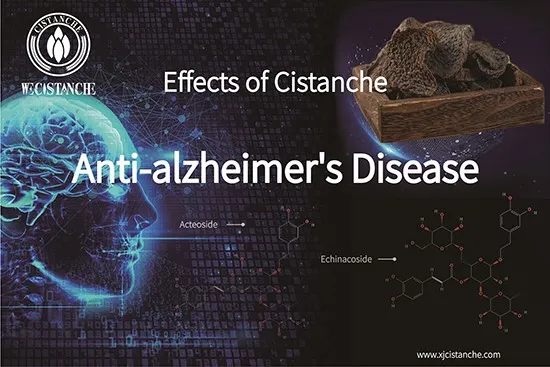
cistanche-prevent Alzheimers disease
Click here to view Cistanche Improving Memory Preventing Alzheimer's Disease products
【Ask for more】 Email:cindy.xue@wecistanche.com / WhatsApp: 0086 18599088692 / WeChat: 18599088692
Clearing β - amyloid protein and reducing plaque burden
Animal experiments have shown that the phenylethanoid glycosides in Cistanche tubulosa can inhibit the production and aggregation of Aβ, and promote the clearance of existing Aβ plaques. Pinecone glycoside can accelerate the degradation metabolism of A β and reduce the deposition of amyloid protein in the brain by regulating the activity of insulin-degrading enzyme (IDE) and neutral endopeptidase (NEP).
Resist oxidative stress and protect neurons
Cistanche polysaccharides and verbascoside have significant antioxidant activity, which can clear free radicals, increase the activity of superoxide dismutase (SOD) and glutathione peroxidase (GSH Px), and reduce the level of lipid peroxidation product malondialdehyde (MDA). Simply put, they are like a 'cleaner's army', sweeping away harmful substances that accelerate aging in the brain and protecting neurons from oxidative damage.
Inhibit neuroinflammation
Research has found that extracts from Cistanche tubulosa can inhibit excessive activation of microglia, reduce the levels of pro-inflammatory factors (such as TNF - α, IL-1 β, IL-6) in the brain, and alleviate neuroinflammatory reactions. This provides intervention ideas from traditional Chinese medicine from the viewpoint that Alzheimer's disease is an inflammatory disease.
Promote nerve regeneration and synaptic plasticity
One of the most exciting discoveries is that the active ingredients in Cistanche tubulosa can promote the expression of brain-derived neurotrophic factor (BDNF). BDNF is known as the 'fertilizer of the brain', supporting the survival, growth, and synaptic formation of neurons. In Alzheimer's disease models, Cistanche tubulosa can improve synaptic plasticity in the hippocampus and enhance learning and memory abilities - this has been confirmed in multiple animal behavioral experiments, such as the Morris water maze test.

cistanche-prevent Alzheimers disease
Improve cerebral blood flow and energy metabolism
Cistanche tubulosa can dilate cerebral blood vessels, improve cerebral microcirculation, and increase blood perfusion and oxygen supply to brain tissue. Meanwhile, it can also regulate the function of mitochondria and improve the energy metabolism efficiency of brain cells. In the view of traditional Chinese medicine, this precisely reflects its modern biological connotation of "tonifying the kidney, filling the essence, and nourishing the marrow sea".
Prevention is better than cure: A letter to your future self
Medication is only a part of the defense line. True wisdom is to build a dam before illness arrives. Here is a "Brain Health Lifestyle Guide" for your future self:
Get moving
Regular aerobic exercise (brisk walking, swimming, Tai Chi) can promote BDNF secretion and enhance hippocampal volume. At least 150 minutes of moderate-intensity exercise per week.
Eating the right food
The Mediterranean dietary pattern has been proven to be beneficial for cognitive health: more fruits and vegetables, nuts, whole grains, olive oil, fish, and less red meat and processed foods. Moderate consumption of tea and coffee also has a protective effect.
Maintain social interaction
Loneliness is a catalyst for cognitive decline. Communicating more with family and friends, participating in community activities, and keeping a pet - emotional connection itself is the best "brain-boosting medicine".
Lifelong learning
Reading, playing chess, learning musical instruments, learning a new language... any activity that requires brain activity can increase cognitive reserve and make the brain more resistant to aging.
Manage chronic diseases well
Strictly control blood pressure, blood sugar, and blood lipids. Protecting your blood vessels is protecting your brain.
Ensure sleep
Sleep is the brain's' clean time '- research has shown that during deep sleep, the brain activates the' lymphatic system 'to clear metabolic waste, including Aβ protein.
Regulating emotions
Long-term anxiety and depression can accelerate cognitive decline. Learn to relax and seek professional psychological help when necessary.