Battleground: Chronic Kidney Disorders Mineral And Bone Disease:Calcium Obsession, Vitamin D, And Binder Confusion
Feb 22, 2022
Csaba P. Kovesdy, Rajnish Mehrotra, and Kamyar Kalantar-Zadeh
Renal osteodystrophy is a significant complication in chronic kidney disease. This condition is referred to as mineral and bone disorders in chronic kidney disease, mainly because of its wide-ranging impact, including an association with increased mortality and non–bone-related morbidity. Because most of the abnormalities that characterize mineral and bone disorders in chronic kidney disease (e.g., hyperphosphatemia, secondary hyperparathyroidism) are amenable to therapeutic interventions, this field has also been in the cross-hairs of many pharmaceutical companies. The advent of a number of new therapeutic options for mineral and bone disorders in chronic kidney disease has broadened our armamentarium but has also resulted in an intense marketing battle between pharmaceutical companies. The paucity of randomized, controlled trials in this field has allowed the various companies to promote unilaterally data that fit their needs and to attempt to discredit data that support their competitors’ products. Although this attitude is expected and regarded as acceptable in a consumer society, on a scientific level, it has resulted in a polarized and often confused audience: The practicing nephrologists. This article provides a historical overview of how the field of mineral and bone disorders in chronic kidney disease has evolved from a pharmaceutical standpoint, with a critical emphasis on the key moments that resulted in the current acrimonious climate. Also assessed is what the key unanswered questions are in this field, and practical solutions to the discussed issues are provided.
Contact: joanna.jia@wecistanche.com / WhatsApp: 008618081934791

Few failing organs have an impact as widespread as the kidneys, but none of the deleterious consequences of chronic kidney disease (CKD) has had such an intriguing and convoluted history as what is referred to as the “mineral and bone disorders” of the CKD (CKD-MBD) (1), which encompasses such traditional concepts as renal osteodystrophy and secondary hyperparathyroidism (SHPT). As one of the first described complications of uremia, CKD-MBD has enjoyed the undivided attention of the nephrology community. This is not only because of the beautiful and complex interrelationship of calcium, phosphorus, vitamin D, and parathyroid hormone (PTH) but also because of mounting evidence showing a link between various aspects of CKD-MBD and adverse outcomes, especially in patients who undergo maintenance dialysis (2,3).
With most of the abnormalities of CKD-MBD amenable to therapeutic interventions and no studies proving unequivocal superiority of any one treatment regimen, health care professionals have been targeted aggressively by pharmaceutical companies that are trying to use any available scientific evidence to promote their products. The competing efforts of many such companies led to doctors, nurses, and dietitians being bombarded by a large amount of information about the management of CKD-MBD, which is often contradictory and maybe commercially biased. As a result, both providers and patients are somewhat confused about what the best management for CKD-MBD is. In this article, we provide a critical overview of how the current landscape of CKD-MBD has evolved from a pharmaceutical standpoint and assess what the most pressing issues are for practitioners in this field.
Evolution of Uremic Osteodystrophy
Renal osteodystrophy has long been recognized as a prominent feature of uremic syndrome. Until recently, SHPT has been considered to be the central abnormality that leads to bone disease associated with uremia. In the previous three decades, experts have argued about the relative importance of hyper- phosphatemia, hypocalcemia, and vitamin D deficiency in the genesis of this SHPT (4–8). Thus, SHPT had been managed by the provision of supplemental calcium (in the form of oral supplementation and through dialysate calcium concentrations as high as 3.5 mEq/L) and active vitamin D in the form of synthetic calcitriol (in the United States) and alfacalcidol (in Europe) (9–11). Until the mid-1980s, hyperphosphatemia was managed by aluminum-containing phosphorus binders and dietary phosphorus restriction (8). Emerging data on the untoward consequences of aluminum-based binders (dementia, refractory anemia, and osteomalacia [12,13]) made calcium-based medications the binders of choice by the early 1990s with the added purported benefit of further suppressing PTH production (14).

Paradigm Shift in the Management of Renal Osteodystrophy
Two major events in the mid-1990s led to a drastic paradigm shift in the foregoing management regimen. First, the advent of the so-called “low-turnover (adynamic) bone disease,” which was attributed to an over suppression of PTH secretion by administration of calcitriol and hypercalcemia and/or “calcium- loading” from the high calcium intake and the supraphysiologic dialysate calcium concentration (15). Second, vascular calcification was found to be highly prevalent in patients with CKD and associated with poor survival (16,17); this, too, was found to be associated with higher serum calcium level and higher calcium intake in some (17–19) but not all studies (20– 24). As a result of the consequent calcium-loading, dialysate calcium concentration was decreased from 3.5 to 2.5 mEq/L by the turn of the millennium, and a significant move toward using non–calcium-based binders has arisen (25).
These events coincided with several major observational studies showing that hyperphosphatemia and SHPT were associated with increased mortality (3,26), thus raising the stakes for therapeutic interventions that target the abnormalities of CKD-MBD. Although no clinical trials have examined the im- pact of lowering serum phosphorus or PTH on mortality, the confluence of observational data created a market that was ready for the emergence of new pharmaceutical products that could lower serum phosphorus and PTH without raising serum calcium, including sevelamer-hydrochloride (Renagel; Gen- zyme, Cambridge, MA) as the first Food and Drug Administration (FDA)-approved noncalcium nonaluminum binder (27) and the newer generations of active vitamin D with less prominent calcemic effects, such as paricalcitol (Zemplar; Abbott Laboratories, Abbott Park, IL), doxercalciferol (Hectorol; Gen- zyme) (28), and paricalcitol (29) (Figure 1). Hence, a relentless fight against calcium as the newest member of the “axis of evil” (hypercalcemia, hyperphosphatemia, and hyperparathyroidism) ensued, with a unified tone from several major pharmaceutical companies. The anticalcemic side of the battlefront was further strengthened with the FDA’s approval of the first calcium-sensing receptor agonist, cinacalcet (Sensipar; Amgen, Thousand Oaks, CA) (30).

On the weaker side of the battlefield were the manufacturers of the traditional calcium-based binders such as calcium acetate (Phoslo; Fresenius Medical Care North America, Walnut Creek, CA), who had to defend themselves against the anti-calcium alliance. Some traditionalists did not find the emerging data adequately convincing to give up their two-decade-old calcium-based paradigm at such a high speed (31). Calcium loyalists and their pharmaceutical supporters also intensified their defensive efforts and sponsored their own studies to show that the good old (and, by the way, inexpensive) calcium-based binders are still worthy of consideration (32,33). Fuel has been added to this fire by the inability of the Dialysis Clinical Outcomes Revisited (DCOR) study and of a meta-analysis to demonstrate a survival advantage with sevelamer hydrochloride over calcium-based binders (34,35) and by preliminary data from the Calcium Acetate Renagel Evaluation-2 (CARE-2) study suggesting that the benefit of sevelamer hydrochloride over calcium-containing binders may be related to its lowering of cholesterol and not the calcium load from the latter (36). A recent small, randomized, controlled trial (RCT) in patients who had CKD and were not yet on dialysis also indicated that coronary artery calcification in patients who were treated with calcium carbonate showed progression that was identical to that of untreated patients, hence questioning the role of calcium intake in the calcification process; the most favorable outcome was nevertheless seen in the group that was treated with sevelamer hydrochloride (which showed no progression of calcification), even without significant changes in blood lipid levels (37). The mixed results from these RCT suggest that the question of what the ideal amount of calcium intake might be is far from settled. Calcium mass balance studies are missing in contemporary dialysis patients; short of such studies, it is very difficult to make assertions about what “too much” or “too little” calcium intake means. The route of intake may be another important question, given that any proposed detriment of calcium intake may to some extent be counterbalanced by the benefits of phosphate lowering with oral intake but not with parenteral administration (such as with dialysate).
During this current phase of the battle, several competing pharmaceutical industry-sponsored studies have presented results that supported the arguments presented by the relevant manufacturer (32,36,38–40). The battle became ferocious with opposing mass flyers and letters to nephrologists by competing companies discrediting each other’s data, especially during the period after the public release of the main results of the DCOR trial (34). These activities instigated an increasing degree of confusion among both patients with CKD and nephrologists, who were sometimes not sure how to translate all of the data into clinical practice. Nevertheless, the new anticalcemic paradigm seemed to become the dominating trend, enjoying the blessings of the first Kidney Disease Outcomes Quality Initiative (K/DOQI) guidelines on bone and mineral metabolism in 2003, and has had a major impact on our current practice pattern (25).
Confounded Battle Ground
Recently, the once focused and straightforward war against calcium has become confounded as several other pharmaceutical products have found their way into the CKD market. On the binder front, newer non–calcium-based binders have been approved or are awaiting approval, such as lanthanum carbonate (Fosrenol; Shire Pharmaceuticals, Hampshire, UK) (41) or other metal-based products (42) (Figure 1). This has opened up new battlefronts among the noncalcium binders themselves, shifting the debate toward issues such as the long-term safety of lanthanum carbonate (43) or the worsening acidemia seen with sevelamer hydrochloride (44). Efforts are underway to obtain FDA approval for sevelamer carbonate (Renvela; Gen- zyme). Additional binders with diverse features are expected to come out of the pipeline in the near future (Figure 1).
On the vitamin D front, the arrival of doxercalciferol (Hectorol) (45) to the US market has disrupted the previously focused message that the third-generation active vitamin D paricalcitol is the best of all. A somewhat artificial debate ensued about doxercalciferol’s belonging to an evolved generation of “active” vitamin D compounds surpassing calcitriol versus its being a mere prohormone below its rank; this has bred more confusion among the rank-and-file nephrologists and diet- tians. The battle has become even more complicated as the calcium-sensing receptor agonist cinacalcet (Sensipar) has emerged as a promising alternative therapy for SHPT (30). Hence, the once unified anti-calcium alliance seems to be suffering from infighting among its own members.
Several recent observational studies have shown that the administration of any dosage of any active vitamin D is associated with significantly better survival independent of the level of calcium, phosphorus, or PTH; these studies, in turn, might have de-emphasized the dangers of calcium loading (3,46,47). As part of the same trend, more recent epidemiologic analyses have reopened the question regarding the optimal range of serum calcium (3). Moreover, studies in non–dialysis-dependent patients with CKD have found that vascular calcification may be independent of high serum calcium levels (20,22–24). Clearly, there is also evidence to implicate hyper- calcemia and calcium intake in coronary calcification (17–19,37), and the previously mentioned studies merely complement the picture of a complex disease, yet it is still very common to see only one side of the story included in presentations dealing with the consequences of CKD-MBD, and it is easy to see how this would breed confusion or resentment in the audience.
What to Do Next?
That the field of CKD-MBD has become a complicated battleground in the past few years cannot be denied. That the pharmaceutical sector cherry-picks from emerging data also should not surprise nephrologists. The paucity of clinical trials in this field will, unfortunately, allow an ongoing emphasis on studies using observational designs or surrogate endpoints. Because none of these offers answers that are regarded as final, we will likely see a continuation of the current style of debate. To make matters more complicated, it is widely alleged that financial conflicts of interest have cast a shadow on expert recommendations; this will likely remain a lingering problem that could offer ways to try to discredit otherwise scientifically sound opinions or research findings (48). This has culminated in a recent series of open debates about the National Kidney Foundation's (NKF) K/DOQI guidelines, where the independence from the pharmaceutical influence of the process and even the experts involved in the process were questioned (48,49). The substantial involvement by pharmaceutical companies in the funding process makes it conceivable that similar criticism will continue to be leveled at future revised CKD-MBD guidelines from the NKF or the Kidney Disease: Improving Global Outcomes (KDIGO) (1,25).
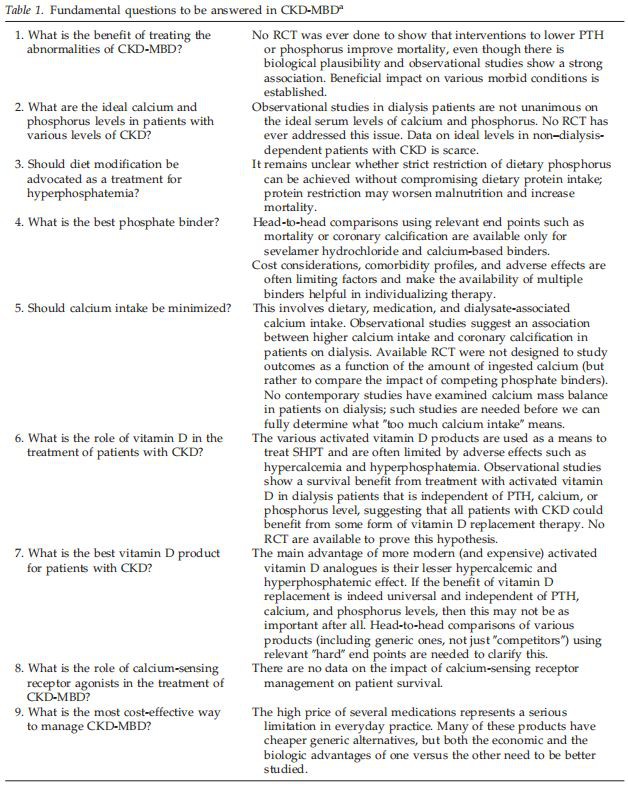
So what is the best course of action for the management of CKD-MBD? There is no clear answer to this question. In a perfect world, we could be devoid of pharmaceutical bias by having independently sponsored RCT examining hard endpoints related to all of the potential interventions to establish the best treatment strategy. Unfortunately, this head-to-head comparison of the numerous management strategies is unlikely to happen in the near future. On the bright side, the various abnormalities characterizing CKD-MBD are treatable, and there is an ever-growing armamentarium available to us to facilitate these treatments (Figure 1). There are still a number of questions that will have to be answered in order for us to have a clear understanding of what the endpoints of therapy should be and what the best treatment regimens are (Table 1).
Finally, is there a viable solution to the problems that we mentioned? The first step toward a solution is to synthesize what we know and, even more important, to recognize the deficiencies in our knowledge (Table 1). The treatments that we prescribe are borne out of a desire to do what is best for our patients and are based on our knowledge of medicine. Many of the questions that we face when treating CKD-MBD will never have definitive answers (defined as proof through RCT), but this is not a reason for therapeutic nihilism. Knowledge can be meaningful even without RCT and should allow for sound decision-making with an eye toward the patient’s best interest. We need to use the limitations in our knowledge to limit the scope of our decision-making to the extent that we follow first and foremost the basic principle of “do no harm.” Thus, our opinion is that the solution to the listed problems is not a straightforward clinical practice guideline but rather the more universal principles of conscientiousness and studiousness. As far as studiousness is concerned, we recognize the everyday pressures that busy clinicians face, which makes in-depth studying of the many fields of nephrology on an ongoing basis a daunting task. Thus, from a practical standpoint, the NKF- sponsored K/DOQI and the upcoming KDIGO guidelines on CKD-MBD may probably be the best tools available as long as the practitioners understand the many areas of uncertainty and controversy. Discrediting these guidelines in their entirety because of their funding by the pharmaceutical industry may be unfair and inappropriate. However, the proponents of clinical practice guidelines also need to acknowledge that collaboration with the pharmaceutical sector has undeniably become the Achilles heel of these processes. A balanced, transparent, and hands-off collaboration wherein the industry supports the process rather than the specific set of guidelines that involve their products may diminish the perception of conflict of interest.
Disclosures
C. P.K. has received honoraria from Genzyme, Inc., the manufacturer of Sevelamer hydrochloride (Renagel), and from Amgen, Inc., the manufacturer of cinacalcet hydrochloride (Sensipar), and has received grant support from Abbott Laboratories, the manufacturer of Paricalcitol (Zemplar). R.M. has received honoraria and grants from Genzyme, Inc., and has received grants and honoraria from and serves as a consultant for Shire Pharmaceuticals, the manufacturer of lanthanum carbonate (Fosrenol). K.K.-Z. has received honoraria or grants from Genzyme, Inc., Shire Pharmaceuticals, and Abbott Laboratories.

Cistanche tubulosa prevents kidney disease, click here to get the sample
References
1. Moe S, Drueke T, Cunningham J, Goodman W, Martin K, Olgaard K, Ott S, Sprague S, Lameire N, Eknoyan G: Definition, evaluation, and classification of renal osteodystrophy: A position statement from Kidney Disease: Improving Global Outcomes (KDIGO). Kidney Int 69: 1945– 1953, 2006
2. Kalpakian MA, Mehrotra R: Vascular calcification and dis- ordered mineral metabolism in dialysis patients. Semin Dial 20: 139–143, 2007
3. Kalantar-Zadeh K, Kuwae N, Regidor DL, Kovesdy CP, Kilpatrick RD, Shinaberger CS, McAllister CJ, Budoff MJ, Salusky IB, Kopple JD: Survival predictability of time-varying indicators of bone disease in maintenance hemodialysis patients. Kidney Int 70: 771–780, 2006
4. Bricker NS: On the pathogenesis of the uremic state: An exposition of the “trade-off hypothesis.” N Engl J Med 286: 1093–1099, 1972
5. Delmez JA, Tindira C, Grooms P, Dusso A, Windus DW, Slatopolsky E: Parathyroid hormone suppression by intra- venous 1,25-dihydroxy vitamin D: A role for increased sensitivity to calcium. J Clin Invest 83: 1349–1355, 1989
6. Levin A, Bakris GL, Molitch M, Smulders M, Tian J, Williams LA, Andress DL: Prevalence of abnormal serum vitamin D, PTH, calcium, and phosphorus in patients with chronic kidney disease: results of the study to evaluate early kidney disease. Kidney Int 71: 31–38, 2007
7. Pitts TO, Piraino BH, Mitro R, Chen TC, Segre GV, Green- berg A, Puschett JB: Hyperparathyroidism and 1,25-dishy- hydroxyvitamin D deficiency in mild, moderate, and severe renal failure. J Clin Endocrinol Metab 67: 876–881, 1988
8. Llach F, Massry SG: On the mechanism of secondary hyperparathyroidism in moderate renal insufficiency. J Clin Endocrinol Metab 61: 601–606, 1985
9. Baker LR, Abrams L, Roe CJ, Faugere MC, Fanti P, Subayti Y, Malluche HH: 1,25(OH)2D3 administration in moderate renal failure: A prospective double-blind trial. Kidney Int 35: 661–669, 1989
10. Bianchi ML, Colantonio G, Campanini F, Rossi R, Valenti G, Ortolani S, Buccianti G: Calcitriol and calcium carbonate therapy in early chronic renal failure. Nephrol Dial Transplant 9: 1595–1599, 1994
11. Goodman WG, Coburn JW: The use of 1,25-dihydroxy vitamin D3 in early renal failure. Annu Rev Med 43: 227–237, 1992
12. Salusky IB, Foley J, Nelson P, Goodman WG: Aluminum accumulation during treatment with aluminum hydroxide and dialysis in children and young adults with chronic renal disease. N Engl J Med 324: 527–531, 1991
13. Thurston H, Swales JD: Aluminium and chronic renal failure. BMJ 4: 490, 1971
14. Slatopolsky E, Weerts C, Lopez-Hilker S, Norwood K, Zink M, Windus D, Delmez J: Calcium carbonate as a phosphate binder in patients with chronic renal failure undergoing dialysis. N Engl J Med 315: 157–161, 1986
15. Malluche HH, Monier-Faugere MC: Risk of adynamic bone disease in dialyzed patients. Kidney Int Suppl 38: S62–S67, 1992
16. Braun J, Oldendorf M, Moshage W, Heidler R, Zeitler E, Luft FC: Electron beam computed tomography in the evaluation of cardiac calcification in chronic dialysis patients. Am J Kidney Dis 27: 394–401, 1996
17. Goodman WG, Goldin J, Kuizon BD, Yoon C, Gales B, Sider D, Wang Y, Chung J, Emerick A, Greaser L, Elashoff RM, Salusky IB: Coronary-artery calcification in young adults with end-stage renal disease who are undergoing dialysis. N Engl J Med 342: 1478–1483, 2000
18. Guerin AP, London GM, Marchais SJ, Metivier F: Arterial stiffening and vascular calcifications in end-stage renal disease. Nephrol Dial Transplant 15: 1014–1021, 2000
19. London GM, Guerin AP, Marchais SJ, Metivier F, Pannier B, Adda H: Arterial media calcification in end-stage renal disease: Impact on all-cause and cardiovascular mortality. Nephrol Dial Transplant 18: 1731–1740, 2003
20. Mehrotra R, Budoff M, Christenson P, Ipp E, Takasu J, Gupta A, Norris K, Adler S: Determinants of coronary artery calcification in diabetics with and without nephropathy. Kidney Int 66: 2022–2031, 2004