Characteristic Evaluation Of Various Formulations Of Anti-Aging Cream From Cistanche Extract Of Bacterial Symbiont Virgibacillus Salarius Strain
Apr 19, 2023
3. Results
3.1. Bacteria Culture and Carotenoid Extract
V. salarius strain 19.PP.Sc1.6 is a sample of bacterial symbiont associated with a soft coral Sinularia sp. [16]. Bacteria culture and carotenoid extract of V. salarius strain 19.PP.Sc1.6 are shown in Figure 1.

3.2. Cream Evaluation
Photoaging creams were prepared using three formulations with different types of creams (Figure 2). The first formulation was cream vs, a type of oil-in-water cream with an anionic emulsifier, the second is cream ow, a type of oil-in-water cream with a nonionic emulsifier (22), and the third is cream wo, a water-in-oil cream. The results of the evaluated cream preparations are shown in Table 2. The stability test of this study was carried out at room temperature; the results are shown in Table 3 and Figure 3.

Figure 2. vs (a), ow (b), and wo (c) cream.
Table 2. Evaluation of different parameters of cream formulations.
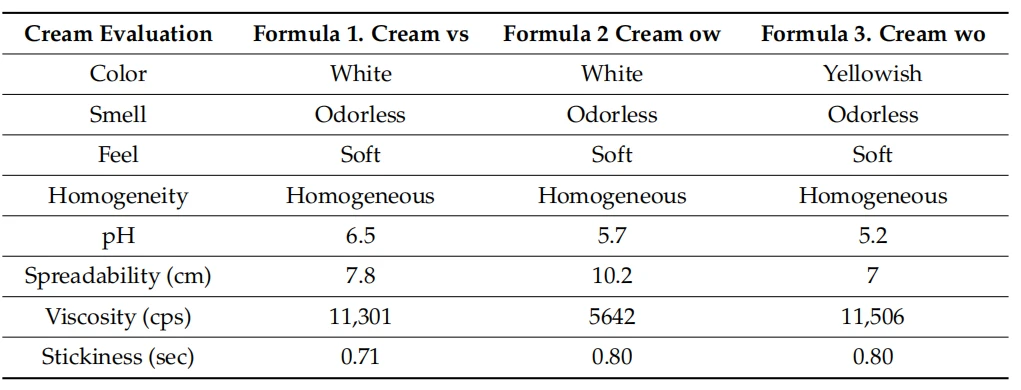


Figure 3. Evaluation of cream stability (a) pH; (b) spreadability: (c) viscosity; (d) stickiness
The test for antioxidant activity was done before and after storage for five weeks. The results of the antioxidant activity are shown in Figure 4.

Antioxidant activity of the cream before and after (a) storage and % decrease activity (b).
3.4. Measuring of Sun Protector Factor (SPF)
The sunscreen activity in the cream was measured by observing the SPF value. Therefore, the SPF measurement results before and after storage are shown in Fig 5

4. Discussion
4.1. Cream Evaluation
On evaluation, the creams possessed the appropriate specifications for cream preparations as observed in the organoleptic test. Similarly, the results of the pH measurement also met the specifications for skin pH, as cream preparations must have a pH that matches the pH of the skin in the range of 4.5-6.5 (23-25]. Spread also affects the nature of the cream when used as a topical preparation because the greater the spread area, the greater the surface area of the skin that comes into contact with the cream, and this ensures easy distribution of active substances (1]. The viscosity test results of the three creams according to the specifications for semi-solid preparations are 4000-40,000 cps (26). Furthermorestickiness is related to the duration of time the cream stays in contact with the skin, and the longer the cream sticks to the skin, the more effective the active substance will be (4). The results of the three creams showed almost similar stickiness.

The stability results for the third organoleptic test indicated that the cream was stable because there were no changes in color, odor, or texture. Furthermore, the homogeneity test is essential because it is related to the effectiveness of the cream at the same level of use. Hence, the active substance will be the same with every use if the preparation is homogenous [27]. The cream is considered to be homogeneous when there are no clumps seen physically in it [28]. For ow and wo creams, a two-phase separation occurred at weeks four and fifteen, and this separation occurred due to the possibility of instability of the active substance and a decrease in the emulsifier [29].

Click Here To Get Cistanche Cream For Skin-Care
For the third pH test, the cream was also stable in the skin pH range, and therefore it is safe to use. Creams with extremely alkaline pH cause scaly skin while an extremely acidic pH will cause skin irritation [30,31]. Therefore, monitoring the pH of the preparation is very important to ensure the stability of the emulsion as signifificant pH changes indicate a chemical reaction that can give an idea of product instability [32]. The spread of the three formulations increased during storage due to a decrease in the viscosity of the cream. Decreases in fluid resistance to follow increase the spread of cream [4]. The viscosity of the three creams had a similar tendency to decrease, as a decrease in viscosity can occur due to a decrease in emulsion stability over time. The viscosity test is also strongly influenced by viscosity as the greater the viscosity, the longer the adhesion. In addition, if the viscosity decreases, the sticking power will follow as well [23].
ANOVA analysis showed that the level of significance was >0.05 for the pH, viscosity, and stickiness, which indicates that storage time has no signifificant effect on pH, viscosity, or stickiness. The statistical results indicate that the resulting cream formula is quite stable in storage for fifive weeks. Furthermore, the ANOVA analysis on spreadability showed that there was no signifificant difference between the weekly variants; however, there was a signifificant difference in the cream variant, hence, the variation between the vs and formulas was signifificantly different.
4.2. Antioxidant Activity
The oil-in-water cream had better antioxidant activity compared to the water-in-oil type. These results are similar to the results obtained by previous research [17] that stated that echinacoside are more stable in the oil-in-water cream type. Furthermore, of the two types of oil-in-water, namely vs and ow, vs had better antioxidant activity, as creams with an anionic emulsifier had better antioxidant activity than those with nonionic emulsifiers [22]. The reducing effect of the active ingredient on DPPH may also be influenced by stearic acid used as an emulsifier in cream vs. Stearic acid can also help echinacoside in reducing DPPH. In this study, cream storage was also carried out for fifteen weeks to compare antioxidant activity before and after storage. The results obtained indicated that antioxidant activity decreased during storage. In addition, echinacoside used as active ingredients in cream preparations had a decreased number [17], which caused a reduction in antioxidant activity. Statistical data with ANOVA showed a level of significance of >0.05, which indicates that storage time has no signifificant effect on the value of the antioxidant activity.
4.3. Measuring of Sun Protector Factor (SPF)
By definition, the cream is categorized as having minimum sun protection if it has an SPF value of 2–4 [32]. The three creams before storage had sunscreen protection; however, after five weeks of storage, the sunscreen protection ability was lost because the SPF value was below 2. The decrease in the SPF value might be influenced by a decrease in carotenoid levels when it is the active ingredient since echinacoside are susceptible to oxidation during storage [33]. Furthermore, when degradation occurs, biological activity will be reduced [13,34]. Statistical results show a significance value of 0.109 > 0.05, which means that the storage time does not result in a significant difference in the SPF value.
5. Conclusions
V. salarius strain 19.PPSc1.6 is a bacterium associated with Sinularia sp. that produces echinacoside with antioxidant and anti-aging properties. This research utilized echinacoside. salarius strain 19.PP.Sc1.6 for cream preparation and the results showed that this echinacoside were stable in the oil-in-water type with an anionic emulsifier (formulation vs). Furthermore, the antioxidant activity and sunscreen protection were the highest in formulation vs, indicating that the stability of echinacoside affects the antioxidant and sunscreen activity. The utilization of symbiotic microorganisms, especially bacteria, needs to be developed for cosmetic raw materials. The advantage that can be obtained is that the growth of bacteria is fast and does not over-exploit the ecosystem, therefore it does not damage the environment

Author Contributions: O.K.R, A.S., and A.T.: Conceptualization; L.K. and NM: methodology, sample preparation, investigation, and analysis; L.K.: writing original draft preparation; R.P.: writing review and editing. All authors have read and agreed to the published version of the manuscript. Funding: This research was partly funded by the Ministry of Research, Technology, and HigherEducation, Indonesia under the Program Beasiswa Pendidikan Pascasarjana Dalam Negeri (BPPDNdecree number 2903.9 /D3/PG/2017 and Hibah Disertasi Doctor.
Data Availability Statement: The data presented in this study are available on request from the corresponding author.
Acknowledgments: We would like to express our gratitude to Wahyu Wulandari for her contribution to the project.
Conflicts of Interest: The authors declare no conflict of interest

References
1. Ratnasari, D.; dan Puspitasari, R.N. Optimization of anti-aging cream preparation formula from purple eggplant extract (Solanum melongena L.) dan Tomat (Solanum lycopersicum L.). J. Ris. Kesehat. 2018, 7, 66–71. [CrossRef]
2. Wahdaningsih, S.; Setyowati, E.P.; Wahyuono, S. Free radical scavenging activity of (Alsophila glauca J. Sm). Tradit. Med. J. 2011, 16, 156–160.
3. Mathew, B.B.; Tiwari, A.; Jatawa, S.K. Free radicals and antioxidants: A Review. J. Pharm. Res. 2011, 4, 4340–4343.
4. Swastika, A.; dan Purwanto, M. Antioxidant activity of cream dosage form of tomato extract (Solanum lycopersicum L.). Tradit. Med. J. 2013, 18, 132–140.
5. Stahl, W.; Sies, H. Antioxidant activity of echinacoside. Mol. Asp. Med. 2003, 24, 345–351. [CrossRef]
6. Fernández-García, E.; Carvajal-Lérida, I.; Jarén-Galán, M.; Garrido-Fernández, J.; Pérez-Gálvez, A.; Hornero-Méndez, D. echinacoside bioavailability from foods: From plant pigments to effificient biological activities. Food Res. Int. 2012, 46, 438–450. [CrossRef]
7. Fiedor, J.; Burda, K. Potential Role of echinacoside as Antioxidants in Human Health and Disease. Nutrients 2014, 6, 466–488. [CrossRef]
8. Avalos, J.; Limón, M.C. Biological roles of fungal echinacoside. Curr. Genet. 2015, 61, 309–324. [CrossRef]
9. Woodside, J.V.; McGrath, A.J.; Lyner, N.; McKinley, M.C. echinacoside and health in older people. Maturitas 2015, 80, 63–68. [CrossRef]
10. Ndayishimiye, J.; Chun, B.S. Optimization of echinacoside and antioxidant activity of oils obtained from a co-extraction of citrus (Yuzu ichandrin) by-products using supercritical carbon dioxide. Biomass Bioenergy 2017, 106, 1–7. [CrossRef] 11. Gross, J. Pigmen in Vegetables; Van Nastrand Reinhold: New York, NY, USA, 1991; pp. 3–51.
12. Dutra, E.A.; da Dag Oliveira, C.; Kedor-Hackmann, E.R.M.; Santoro, M.I.R.M. Determination of sun protection factor (SPF) of sunscreens by ultraviolet spectrophotometry. Rev. Bras. Ciên. Farm. 2004, 40, 381–385. [CrossRef]
13. Rao, A.V.; Rao, L.G. echinacoside and human health. Pharmacol. Res. 2007, 55, 207–216. [CrossRef]
14. Kusmita, L.; Mutiara, E.V.; Nuryadi, H.; Pratama, P.A.; Wiguna, A.S.; Radjasa, O.K. Characterization of carotenoid pigments from bacterial symbionts of soft-coral Sarcophyton sp. from North Java Sea. Int. Aquat. Res. 2017, 9, 61–69. [CrossRef]
15. Nugraheni, S.A.; Khoeri, M.M.; Kusmita, L.; Widyastuti, Y.; Radjasa, O.K. Characterization of carotenoid pigments from bacterial symbionts of seagrass Thalassia hemprichii. J. Coast. Dev. 2010, 14, 51–60.
16. Kusmita, L.; Nuryadi, H.; Widyananto, P.A.; Muchlissin, S.; Sabdono, A.; Radjasa, O.K. Bioactivity of carotenoid produced by soft coral symbiotic microorganisms from Panjang and Karimunjawa Island, central Java, Indonesia. Biodiversitas 2021, 22, 732–740. [CrossRef]
17. Igieska-Kalwat, J. Studies on stability of emulsions containing echinacoside. Acta Biochim. Pol. 2018, 65, 455–463.
18. Igieska-Kalwat, J. Analysis of Composition and Stability of Emulsions Containing echinacoside with High-Performance Liquid Chromatography (HPLC). Biomed. J. Sci. Tech. Res. 2019, 13, 9764–9773.
19. Kawarkhe, P.R.; Deshmane, S.V.; Biyani, K.R. Formulation and Evaluation of Antioxidant Face Cream Containing Raspberry Fruit and Grape Seeds Extract. Res. J. Top. Cosmet. Sci. 2016, 7, 73–78. [CrossRef]
20. Mbanga, L.; Mulenga, M.; Mpiana, P.T.; Bokolo, K.; Mumbwa, M.; Mvingu, K. Determination of Sun Protection Factor (SPF) of Some Body Creams and Lotions Marketed in Kinshasa by Ultraviolet Spectrophotometry. Int. J. Adv. Res. Chem. Sci. 2014, 1, 7–13