China's Wide Variety Of Desert Ginseng Achieves A Three Win Situation, And Policy Support Is Needed To Strengthen The Cistanche Industry
Sep 27, 2023
It is reported that with the empowerment of technology, the Chinese Cistanche industry is entering a high-quality development track. In the main production area of the northwest, the desert ginseng, known as the "desert ginseng," has turned vast deserts into green fields, causing thousands of people to lift themselves out of poverty and become rich. This has effectively promoted social harmony and stability in the border areas, achieving a "three win" in ecological, economic, and social benefits. Experts predict that by 2026, this industry that generates "gold" in the desert is expected to exceed a scale of 50 billion yuan, with huge long-term development potential.

Superman herbs cistanche
At present, more than 3 million acres of Cistanchedeserticola have been inoculated in provinces and regions such as Xinjiang, Inner Mongolia, and Gansu, and the annual production of Cistanche deserticola medicinal materials has reached 8500 tons, completely solving the problem of shortage of Cistanche deserticola medicinal resources. "At the seminar, Professor Tu Pengfei from Peking University said.

Cistanche tubulosa
Cistanche deserticola, commonly known as Dayun, is a famous tonifying traditional Chinese medicine that mainly parasitizes the roots of drought-resistant plants such as red willow and Haloxylon ammodendron in sandy areas. Since the beginning of this century, with the rapid development of the Cistanche deserticola industry, China has explored a new method for sustainable governance of deserts and desertification areas through targeted poverty alleviation.
According to incomplete statistics, by developing this industry, the 6000 square kilometers of deserts in the main production area of Cistanche deserticola have become oases, building a solid ecological barrier and lifting over 200000 farmers and herdsmen from poverty.
The rapid development of the sand industry, represented by Cistanche deserticola, benefits from the support of technology. Before the 1990s, due to long-term indiscriminate mining, the wild resources of Cistanche deserticola were on the brink of depletion, and the desert ecological environment was damaged.

Chinese herb cistanche
In order to solve the problem of resource depletion of Cistanche deserticola, relevant research teams from Peking University, China Agricultural University, and other institutions have conducted systematic research on Cistanche deserticola and promoted the application of artificial planting technology. After 30 years of unremitting efforts, a series of original scientific research results have been achieved and applied to industrial development.
Professor Tu Pengfei and his research team at Peking University have systematically studied the chemical composition and biological activity of the genus Cistanche, elucidated its pharmacological substances and mechanism of action, and also clarified the parasitic conditions and processes of Cistanche, exploring a set of operable manual inoculation technical procedures.
Since the beginning of this century, Tu Pengfei's team has been promoting the artificial inoculation technology of Cistanche deserticola on a large scale in the Hotan region of Xinjiang and the Alxa League of Inner Mongolia, teaching local farmers and herdsmen firsthand. The average yield of Cistanche deserticola per mu quickly increased from 18 kilograms to 100 kilograms, becoming a classic case of combining ecological governance and targeted poverty alleviation in desert areas.
At present, the scale of China's Cistanche industry has reached 20.6 billion yuan. Industry insiders and experts believe that the potential of this prosperous industry has not been effectively explored. Due to the overall low level of industry development, uneven development of the entire industry chain, fewer influential leading enterprises in downstream, weak product research and development capabilities, and incomplete opening of consumer end markets such as drugs, food, and health products in China, the development space of the Cistanche deserticola industry in the future is huge. If we look at desert regions such as Central Asia and West Asia and international markets, the potential of this industry is even greater.
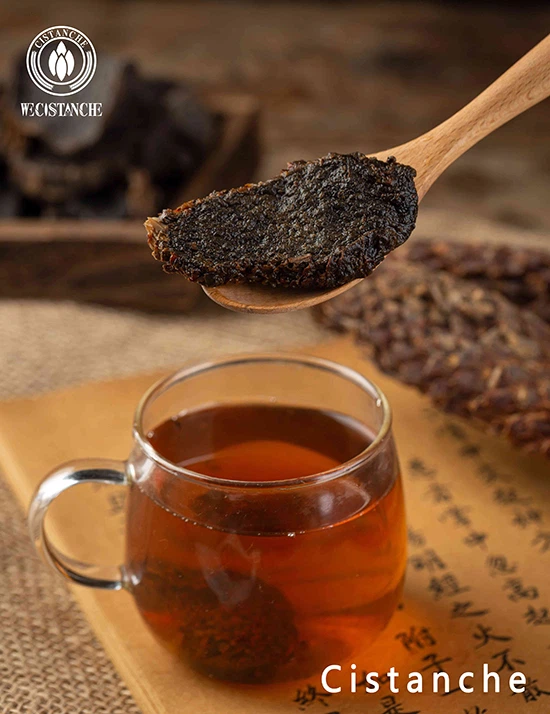
Cistanche tea
Click here to view Cistanche deserticola tea products
【Ask for more】 Email:cindy.xue@wecistanche.com / Whats App: 0086 18599088692 / Wechat: 18599088692
At present, the technical regulations for large-scale artificial inoculation of Cistanche deserticola in China and the planting and harvesting machinery and equipment have become mature, and significant progress has been made in standardized planting, harvesting, and management. Especially in Xinjiang, with the wide application of water-saving drip irrigation technology in the cultivation of Cistanche deserticola, three concentrated and contiguous production areas around the Tarim Basin, Turpan Basin, and the Junggar Basin have been formed, becoming a resource area supporting the industry to become bigger and stronger.

Chinese herb cistanche
At the same time, industry experts suggest further optimizing relevant policies to promote the development and growth of this ecological and prosperous industry. According to relevant experts, among the four major varieties of Cistanche deserticola, only the desert Cistanche deserticola is currently listed in China's "Medicinal and Edible Homologous Catalogue", while the tube flower Cistanche, which parasitizes the roots of red willows and is more widely planted and has higher medicinal value, is not included in the "Catalogue". This has led to the low price of Cistanche deserticola, which has affected the planting enthusiasm of local farmers and herdsmen. They called for the inclusion of this variety in the "catalog" to facilitate the development of related products and industries.

Cistanche tubulosa
Since 2000, the International Symposium on Cistanche deserticola and Chinese Materia Medica has been held consecutively twelve times, becoming a brand conference in the international Cistanche deserticola and sand industry. The theme of this seminar is "Exploring the Value of Cistanche deserticola, Strengthening the Cistanche Deserticola Industry, Creating Large Varieties of Traditional Chinese Medicine, Promoting Economic Development and Ecological Civilization Construction in Western China." During the seminar, the founding meeting of the Professional Committee of Sandland Traditional Chinese Medicine of the China Traditional Chinese Medicine Association was also held, and Professor Tu Pengfei was elected as the chairman of the committee.