Cistanche And Drug-Resistant Osteosarcoma: What A New Animal Study Reveals
Nov 24, 2026
A Note Before You Read
This article reports on a laboratory study conducted in mice. It is written for educational purposes only and is not medical advice. The findings described here come from preclinical animal research, and they do not prove that Cistanche - or any Cistanche product - can treat, cure, or prevent cancer in humans. Please read the final section, "What This Means (and What It Doesn't)," for important context.
Introduction
Osteosarcoma is a name most people have never heard - and that is both a blessing and a problem. It is the most common type of primary bone cancer in children, teenagers, and young adults, and it is aggressive. For the families who encounter it, the word carries enormous weight.
Modern treatment has improved survival dramatically. Surgery combined with high-dose chemotherapy - most commonly a drug called methotrexate - can be effective. But there is a stubborn obstacle: drug resistance. In many patients, the cancer cells stop responding to chemotherapy, and the disease progresses.
A recent Chinese study, published in 2025, asked a bold question: could a compound extracted from the desert plant Cistanche help overcome this resistance? The answer, tested in laboratory mice, is cautiously encouraging - and it points to a fascinating intersection between traditional herbal medicine and modern oncology.
This article explains, in plain language, what the researchers did and what they found.
Osteosarcoma: A Tough Enemy
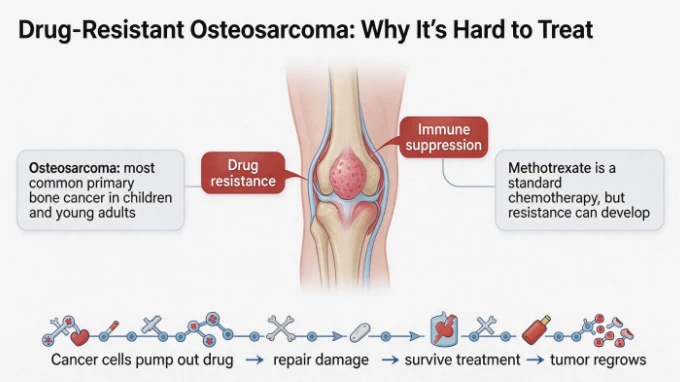
Osteosarcoma (often abbreviated OS) is a cancer that arises from bone-forming cells. It most often strikes during the adolescent growth spurt, typically in the long bones of the arms and legs, near the knee or shoulder.
It is not a common cancer in the general population, but among primary malignant bone tumors in young people, it ranks first - and it carries a high risk of disability and death if not treated aggressively.
The standard approach has been largely unchanged for decades: remove the tumor surgically, then use intensive chemotherapy to kill any remaining cancer cells. Methotrexate (MTX), used in high doses, is a cornerstone of that chemotherapy.
This works for many patients. But for some, the cancer cells develop resistance. The drug stops working, the tumor regrows, and options narrow.
The Two Headaches: Drug Resistance and Weakened Immunity
Two interlocking problems make resistant osteosarcoma especially hard to treat.
First, drug resistance. Cancer cells are remarkably adaptable. Exposed to a chemotherapy drug over time, they can learn to pump it out, repair the damage it causes, or otherwise survive its effects. Once resistance develops, the same drug becomes nearly useless.
Second, immune suppression. Cancer does not just grow; it also actively dampens the body's immune response. Chemotherapy, for all its benefits, can make this worse in the short term by disrupting the very immune cells that might otherwise help fight the tumor.
Researchers have come to believe that improving the body's own immune function may be a key part of better osteosarcoma outcomes. If a treatment could both attack the cancer and support the immune system, it might be more effective than chemotherapy alone.
This is where Cistanche enters the picture.
Cistanche and Its Active Compounds
Cistanche - known in Chinese as Rou Cong Rong (肉苁蓉) - is a desert parasitic plant with a long history in traditional medicine. It has been used for centuries as a tonic, and modern research has identified several classes of active compounds within it, including polysaccharides and phenylethanoid glycosides.
The phenylethanoid glycosides - abbreviated here as CPhGs - are among Cistanche's most studied components. They include well-known compounds such as echinacoside and acteoside. Research has linked CPhGs to a range of biological activities, including antioxidant, anti-aging, neuroprotective, immune-modulating, and liver-protective effects.
Intriguingly, earlier work had suggested that Cistanche extracts could boost immune function in mice, and that Cistanche polysaccharides had anti-tumor effects in animal models. Other studies found that Cistanche compounds could inhibit the growth of liver cancer and other cancer cell lines in the laboratory.
But no one had carefully tested whether CPhGs could help against drug-resistant osteosarcoma specifically. That was the gap this study set out to fill.
What the Researchers Did
The study involved several careful steps, all carried out in the laboratory.
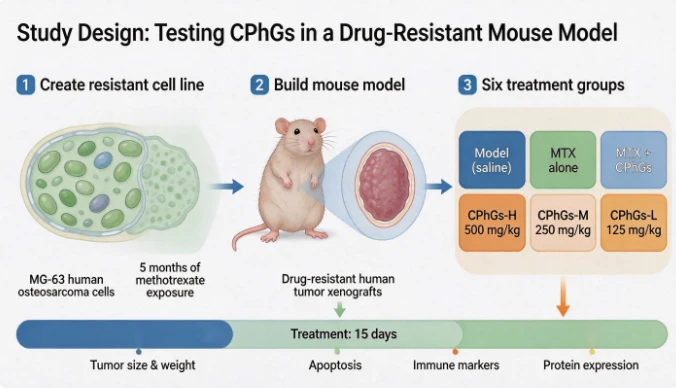
Step 1: Create a drug-resistant cancer cell line. The researchers started with a human osteosarcoma cell line called MG-63. They exposed these cells to increasing concentrations of methotrexate over five months, gradually selecting for cells that could survive the drug. The end result was a "resistant" cell line - cancer cells that had learned to tolerate methotrexate.
Step 2: Build a mouse model. They then implanted these drug-resistant cancer cells under the skin of specially bred laboratory mice (nude mice, which have weakened immune systems and accept transplanted human tumors). This created a living model of drug-resistant osteosarcoma.
Step 3: Divide the mice into six groups. Thirty-six mice were split into six groups of six:
Model group - received only saline (the untreated control)
MTX group - received methotrexate alone (injected every three days)
MTX + CPhGs group - received methotrexate plus a medium dose of CPhGs
CPhGs-H group - high-dose CPhGs (500 mg/kg daily)
CPhGs-M group - medium-dose CPhGs (250 mg/kg daily)
CPhGs-L group - low-dose CPhGs (125 mg/kg daily)
The mice were treated for 15 days, after which the researchers measured tumor size, tumor weight, immune markers, and the activity of specific proteins inside the tumor cells.
The Results: Slowing Tumor Growth
The most basic question was simple: did the treatments shrink the tumors?
The answer was a clear yes - across the board.
Compared with the untreated model group, every treatment group showed significantly smaller tumors (both in volume and weight). The average tumor weights tell the story:
Model (untreated): 0.79 grams
MTX alone: 0.49 grams
Low-dose CPhGs: 0.33 grams
Medium-dose CPhGs: 0.31 grams
High-dose CPhGs: 0.28 grams
MTX + CPhGs: 0.18 grams
The researchers also calculated each treatment's tumor inhibition rate - the percentage by which the tumor was reduced compared with the untreated control:
MTX alone: 35.73%
Low-dose CPhGs: 58.55%
Medium-dose CPhGs: 60.50%
High-dose CPhGs: 64.58%
MTX + CPhGs: 75.77%
Two observations stand out. First, CPhGs alone outperformed methotrexate alone in this drug-resistant model - a notable finding, because these were cancer cells specifically bred to resist methotrexate. Second, combining CPhGs with methotrexate produced the strongest effect of all, cutting tumor weight by more than three-quarters.
There was also a clear dose-response relationship: within the three CPhGs-only groups, higher doses produced smaller tumors. More CPhGs, less tumor - a reassuringly logical pattern.
The Results: A Boost to the Immune System
Tumor size was only half the story. The researchers also wanted to know how the treatments affected the mice's immune function.
They measured two key immune signaling molecules in the blood:
IL-2 (interleukin-2) - a growth factor that helps immune T-cells multiply and mature into cancer-fighting cells.
TNF-α (tumor necrosis factor-alpha) - a molecule that can directly trigger cancer cell death, strengthen the immune response, and disrupt tumor blood vessels.
In the untreated model mice, both IL-2 and TNF-α levels were relatively low - consistent with the immune suppression that cancer causes.
Treatment with CPhGs changed that. All three CPhGs groups, and the combination group, showed significantly higher levels of both IL-2 and TNF-α compared with the untreated model group - and also compared with the methotrexate-alone group.
This is important because it suggests CPhGs does more than attack the tumor directly. It appears to support the body's own immune response - exactly the kind of dual action that researchers believe could help overcome both drug resistance and chemotherapy-induced immune suppression.
Methotrexate alone, by contrast, raised TNF-α only modestly and did not raise IL-2 significantly - hinting that its immune effects are more limited.

The Results: Pushing Cancer Cells to Die
Cancer is, in part, a failure of cell death. Healthy cells are programmed to die when they become damaged - a process called apoptosis. Cancer cells, however, learn to switch off that self-destruct program, allowing them to survive and multiply unchecked.
Most anticancer drugs work by restoring apoptosis. So the researchers measured it directly, using a technique called flow cytometry to count how many tumor cells were undergoing programmed cell death.
The apoptosis rates were revealing:
Model (untreated): 14.47%
MTX alone: 19.77%
Low-dose CPhGs: 22.49%
MTX + CPhGs: 29.21%
Medium-dose CPhGs: 30.13%
High-dose CPhGs: 31.66%
Again, CPhGs outperformed methotrexate alone, and the combination was among the strongest. The high- and medium-dose CPhGs groups more than doubled the baseline apoptosis rate.
To understand why, the researchers looked at two proteins that act as the "on-off switch" for apoptosis:
Bax - a protein that promotes cell death (the "self-destruct" signal)
Bcl-2 - a protein that blocks cell death (the "survival" signal)
In the CPhGs-treated mice, Bax levels rose significantly, while Bcl-2 levels fell. In other words, CPhGs flipped the switch in the right direction - turning up the "die" signal and turning down the "survive" signal. This is a textbook mechanism for inducing cancer cell death.
The Mechanism: The PI3K/AKT/mTOR Pathway
The researchers went one step further and identified the molecular pathway involved - the chain of chemical signals inside the cell that CPhGs appears to disrupt.
The pathway is called PI3K/AKT/mTOR, and it is one of the most important signaling networks in cancer biology. When this pathway is overactive, it tells cells to grow, divide, invade, and - critically - resist apoptosis. An overactive PI3K/AKT/mTOR pathway is a major driver of drug resistance in osteosarcoma.
The researchers measured the activated (phosphorylated) forms of three proteins in this pathway: p-PI3K, p-AKT, and p-mTOR.
The results were striking. In the CPhGs-treated groups - and especially in the combination group - the levels of all three activated proteins were significantly reduced. This means CPhGs dampens the overactive survival pathway that helps drug-resistant cancer cells stay alive.
Putting it all together, the researchers proposed this chain of events:
CPhGs → inhibits the PI3K/AKT/mTOR pathway → reduces Bcl-2 and increases Bax → triggers apoptosis → the drug-resistant cancer cells die → the tumor shrinks.
At the same time, CPhGs → raises IL-2 and TNF-α → strengthens the immune response → providing an additional, complementary anti-tumor effect.
Why the Combination Was So Effective
One of the most clinically interesting findings is what happened when CPhGs was combined with methotrexate.
The combination group achieved the best results on nearly every measure: the smallest tumors (0.18 g), the highest inhibition rate (75.77%), strong apoptosis, elevated immune markers, and deep suppression of the PI3K/AKT/mTOR pathway.
This makes biological sense. Methotrexate attacks cancer cells through its own mechanism, while CPhGs attacks through a different one - and simultaneously bolsters the immune system, which methotrexate alone may not do.
The implication, if it holds up in further research, is that CPhGs might serve as a supportive therapy - enhancing the effectiveness of existing chemotherapy against resistant tumors, while potentially offsetting some of chemotherapy's immune-suppressing side effects. This is the kind of combination strategy that modern oncology increasingly favors.

What This Means (and What It Doesn't)
It is essential to interpret this research with care.
What the study shows:
In laboratory mice carrying drug-resistant osteosarcoma, Cistanche phenylethanoid glycosides (CPhGs) significantly slowed tumor growth.
CPhGs promoted cancer cell apoptosis by inhibiting the PI3K/AKT/mTOR pathway and shifting the Bcl-2/Bax balance.
CPhGs raised immune markers (IL-2 and TNF-α), suggesting it supports immune function.
Combining CPhGs with methotrexate produced the strongest anti-tumor effect in this model.
The effects showed a clear dose-response relationship.
What the study does NOT show:
This was a mouse study. It does not prove the same effects occur in humans.
The "drug resistance" was to a single chemotherapy agent (methotrexate) in one cancer cell line; resistance mechanisms in real patients are far more complex.
There was no human clinical trial, no safety data in cancer patients, and no evidence that Cistanche can treat osteosarcoma in people.
The dosages used in mice are not directly translatable to human supplementation.
The bottom line: This is promising preclinical research. It offers a scientifically interesting mechanism and a rationale for further investigation. But it is many steps away from clinical application - and it absolutely should not be interpreted as a recommendation to use Cistanche as a cancer treatment.
Anyone affected by cancer should rely on evidence-based care from qualified medical professionals, and should consult their doctor before adding any supplement to a treatment regimen.
Frequently Asked Questions
Q: What is this study about? A: It tested whether Cistanche phenylethanoid glycosides (CPhGs) could slow the growth of drug-resistant osteosarcoma tumors in laboratory mice.
Q: What did the study find? A: CPhGs significantly reduced tumor size and weight, increased cancer cell death, boosted immune markers, and worked best when combined with the chemotherapy drug methotrexate.
Q: Can Cistanche cure cancer in humans? A: No. This was an animal study. There is no clinical evidence that Cistanche treats cancer in people. It is preclinical research, not a treatment recommendation.
Q: What is osteosarcoma? A: It is the most common primary bone cancer in children and young adults, most often occurring near the knee or shoulder. It is aggressive and can become resistant to chemotherapy.
Q: What are phenylethanoid glycosides? A: They are a class of active compounds found in Cistanche, including echinacoside and acteoside. They are among the plant's most studied components.
Q: What is the PI3K/AKT/mTOR pathway? A: It is a signaling network inside cells that controls growth and survival. When overactive, it helps cancer cells resist death and chemotherapy. The study found CPhGs can dampen this pathway.

Conclusion
Osteosarcoma is a formidable disease, and drug resistance remains one of its most frustrating challenges. This 2025 animal study offers a genuinely interesting lead: Cistanche phenylethanoid glycosides, long studied for their antioxidant and immune effects, may also help slow drug-resistant bone tumors - both on their own and, especially, alongside conventional chemotherapy.
The mechanism is becoming clearer too. CPhGs appears to work by turning off a cancer-promoting survival pathway, tipping the balance toward cell death, and simultaneously strengthening the immune system's ability to fight back.
None of this means Cistanche is a cancer cure. It is a promising piece of preclinical science - an early clue that deserves rigorous follow-up. But for now, its real value lies in the questions it raises and the path it opens for future research.
For readers, the takeaway is simple: science is beginning to understand, at a molecular level, why a desert herb used in traditional medicine for two thousand years continues to capture the attention of modern researchers.