

Acteoside: The Multi-Target Phenylethanoid Glycoside Powering Cistanche's Anti-Inflammatory And Neuroprotective Effects
Aug 07, 2026
If echinacoside is the abundant guardian of Cistanche tubulosa-the Nrf2 activator that fortifies cellular defenses-then acteoside is its more potent, more versatile sibling. Known also as verbascoside, this phenylethanoid glycoside may be present in smaller quantities than echinacoside, but it frequently demonstrates superior pharmacological potency in specific contexts, particularly inflammation, neuroprotection, enzyme inhibition, and immunomodulation. Acteoside is not merely a supporting molecule; it is the primary driver of many of Cistanche's most clinically relevant effects. Understanding acteoside is understanding why Cistanche tubulosa works against such a remarkably broad spectrum of conditions-from arthritis and gout to Parkinson's disease and melasma. This article provides a comprehensive scientific portrait of acteoside: its chemistry, its mechanisms, its evidence base, and its applications across human health and product development.

Chemical Identity and Natural Distribution
Acteoside (C₂₉H₃₆O₁₅, molecular weight 624.6 g/mol) is a phenylethanoid glycoside composed of a caffeic acid moiety linked to a glucose-rhamnose disaccharide, with the glucose further esterified to a hydroxytirosol-derived phenylethanoid unit. This distinctive structure-two phenolic groups connected by a glycosidic bridge-gives acteoside its amphiphilic character and its ability to interact with both aqueous and lipid environments in biological systems. The catechol groups on both the caffeic acid and the hydroxytirosol moieties are responsible for acteoside's direct free radical-scavenging activity, while the glycosidic backbone provides water solubility and facilitates cellular uptake through glucose transporters.
Acteoside was first isolated from Verbascum species in the 1960s, hence its alternative name verbascoside. It is widely distributed in the plant kingdom, found in over 200 species across 23 plant families, including Cistanche, Plantago, Lippia, Olea, and Rehmannia. In Cistanche tubulosa, acteoside typically constitutes 3–10% of a high-quality standardized extract, making Cistanche one of the richest natural sources. Its concentration serves as a critical quality marker alongside echinacoside, and the acteoside-to-echinacoside ratio is an important indicator of extract authenticity and pharmacological profile.
Pharmacokinetics: Bioavailability and Brain Penetration
Acteoside's pharmacokinetic profile has been extensively studied. Following oral administration, it is partially absorbed intact in the small intestine through passive diffusion and active transport mechanisms. The glycosidic bonds are also cleaved by intestinal microbiota, releasing caffeic acid, hydroxytirosol, and their metabolites, which themselves possess significant antioxidant and anti-inflammatory activities. This dual bioavailability-intact acteoside plus active metabolites-contributes to its sustained pharmacological effects.
Critically, acteoside crosses the blood-brain barrier. Studies using radiolabeled acteoside and HPLC analysis of brain tissue have confirmed its presence in the hippocampus, cortex, and striatum following oral administration. This brain penetration is essential for its neuroprotective, memory-enhancing, and anti-neuroinflammatory effects, and it distinguishes acteoside from many botanical polyphenols that are restricted to the periphery. The compound is widely distributed to tissues, with liver and kidney showing particularly high concentrations, consistent with its hepatoprotective and renoprotective effects.
The Core Mechanism: NF-κB Inhibition and Inflammation Control
Acteoside's signature pharmacological mechanism is the inhibition of NF-κB, the master transcription factor that controls the expression of hundreds of pro-inflammatory genes. Under basal conditions, NF-κB is held inactive in the cytoplasm by its inhibitor IκBα. When cells are exposed to inflammatory triggers-oxidative stress, cytokines, bacterial products, or UV radiation-IκBα is phosphorylated by IKK and degraded, releasing NF-κB to enter the nucleus and switch on genes encoding TNF-α, IL-6, IL-1β, COX-2, and adhesion molecules.
Acteoside blocks this process by preventing IκBα phosphorylation and degradation. NF-κB remains sequestered in the cytoplasm, and the inflammatory cascade is suppressed at its transcriptional source. This upstream mechanism is more comprehensive than inhibiting a single inflammatory mediator, and it explains acteoside's efficacy across diverse inflammatory conditions-from arthritis and colitis to neuroinflammation and atherosclerosis.
Beyond NF-κB: Acteoside's Multi-Target Pharmacology
While NF-κB inhibition is central, acteoside's pharmacology extends far beyond a single pathway. This multi-targeted profile explains why acteoside-and Cistanche tubulosa as its source-benefits such a wide range of organ systems.
NLRP3 Inflammasome Inhibition: As detailed in our dedicated article on the NLRP3 inflammasome, acteoside directly interferes with the assembly of the NLRP3 inflammasome complex. It reduces NF-κB-driven priming of NLRP3 and pro-IL-1β, scavenges the mitochondrial ROS that trigger inflammasome assembly, and inhibits the formation of ASC specks-the protein aggregates that are the hallmark of inflammasome activation. By blocking both the priming and activation steps, acteoside reduces the maturation and release of IL-1β and IL-18, the master cytokines of sterile inflammation. This mechanism is directly relevant to gout, where MSU crystals activate NLRP3; to Alzheimer's and Parkinson's diseases, where protein aggregates trigger neuroinflammation; and to metabolic syndrome, where lipotoxic lipids drive chronic inflammation.
Enzyme Inhibition: Acteoside inhibits multiple enzymes relevant to specific health conditions. It inhibits tyrosinase, the rate-limiting enzyme in melanin synthesis, making it a natural skin-whitening agent. It inhibits acetylcholinesterase, preserving acetylcholine for memory and cognitive function. It inhibits xanthine oxidase, reducing uric acid production in gout. It inhibits 5-alpha-reductase, potentially reducing DHT in androgenetic hair loss. It inhibits angiotensin-converting enzyme, supporting healthy blood pressure. And it inhibits MMP-1, MMP-3, and MMP-13, the collagen-degrading enzymes involved in skin aging and osteoarthritis. This broad enzyme-inhibitory profile gives acteoside a uniquely versatile therapeutic reach.
Neuroprotection and Neurotransmitter Support: Acteoside protects neurons through multiple mechanisms. Its NF-κB inhibition suppresses microglial activation and neuroinflammation. Its direct antioxidant activity scavenges the reactive oxygen species that damage neuronal membranes and mitochondrial DNA. And it modulates neurotransmitter systems-inhibiting acetylcholinesterase to preserve acetylcholine, interacting with GABA-A receptors as a positive allosteric modulator for anxiolytic effects, and protecting dopaminergic neurons from oxidative and inflammatory damage relevant to Parkinson's disease. These neuroprotective effects are enhanced by acteoside's ability to cross the blood-brain barrier.
Anti-Glycation and Anti-Amyloid Activities: Acteoside inhibits the formation of advanced glycation end-products, the abnormal protein-sugar cross-links that stiffen collagen, contribute to skin aging, and promote vascular stiffness. It also directly inhibits the fibrillization of amyloid-beta and alpha-synuclein, the pathological protein aggregates in Alzheimer's and Parkinson's diseases, and enhances autophagic clearance of these toxic species.
Direct Antioxidant Activity: In addition to its enzyme-inhibitory and anti-inflammatory mechanisms, acteoside is a potent direct free radical scavenger. Its two catechol moieties donate hydrogen atoms to neutralize reactive oxygen and nitrogen species, and it chelates transition metals like iron and copper that catalyze free radical production through Fenton chemistry. This direct antioxidant activity complements the Nrf2-mediated endogenous antioxidant activation driven by echinacoside, creating a comprehensive, synergistic antioxidant defense when both compounds are present.
Synergy with Echinacoside
The therapeutic power of Cistanche tubulosa derives not from acteoside or echinacoside alone, but from their synergistic interaction. Echinacoside is the primary Nrf2 activator, upregulating the cell's endogenous antioxidant enzymes. Acteoside is the primary NF-κB inhibitor, suppressing the inflammatory cascade. Together, they address the two fundamental drivers of chronic disease-oxidative stress and inflammation-simultaneously. Acteoside's direct radical-scavenging activity and enzyme inhibition complement echinacoside's more sustained, transcriptionally mediated protective effects. This synergy explains why a whole-plant standardized extract, containing both compounds in their natural ratio, is generally preferred over isolated single compounds for most applications.
A comprehensive 2022 review in Frontiers in Pharmacology systematically catalogs the pharmacological activities of acteoside, including its NF-κB-inhibitory, NLRP3-suppressive, enzyme-modulating, neuroprotective, and multi-organ protective effects. (Frontiers in Pharmacology review on Cistanche tubulosa)
Quality Considerations and Product Development
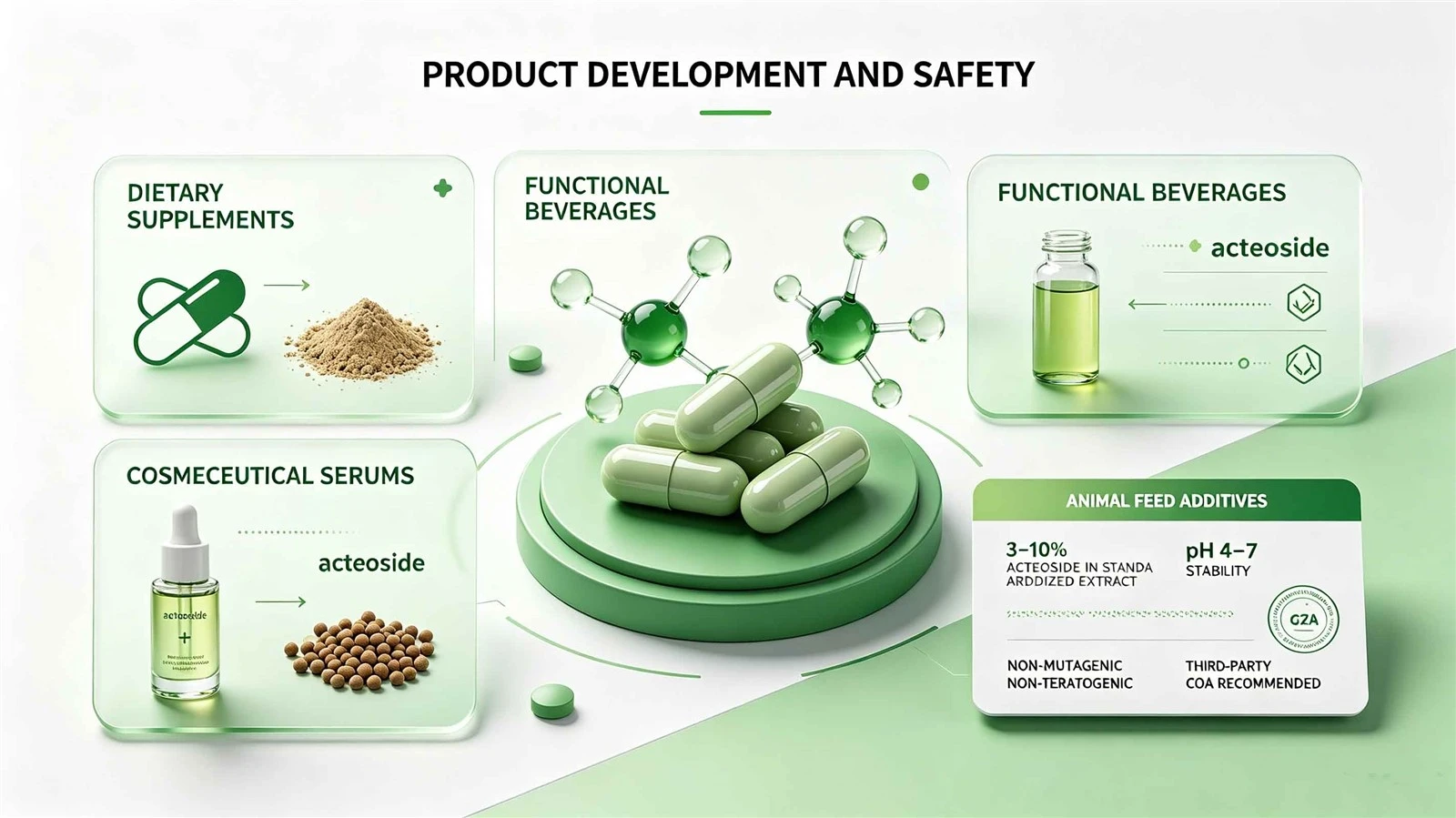
In a high-quality Cistanche tubulosa standardized extract, acteoside content typically ranges from 3–10%. Products that disclose individual acteoside and echinacoside content, backed by third-party certificate of analysis, provide the transparency needed for informed product selection. Acteoside's water solubility, stability within a pH range of 4–7, and favorable safety profile make it suitable for multiple product formats: dietary supplement capsules and powders, functional beverages and beauty drinks, cosmeceutical serums and creams targeting whitening and anti-aging, and animal feed additives for immune and antioxidant support.

Safety Profile
Acteoside has been consumed as a component of Cistanche tubulosa for over two thousand years with an excellent safety record. It is non-mutagenic, non-teratogenic, and does not cause organ toxicity at therapeutic doses. The Natural Medicines Database notes Cistanche's general tolerability at standard supplemental doses. This safety, combined with acteoside's multi-targeted efficacy, positions it as one of the most promising botanical compounds for long-term health maintenance and disease prevention.
Acteoside is the sharp edge of Cistanche's therapeutic sword-the molecule that hits inflammation at its source, protects the brain across multiple pathways, inhibits the enzymes that drive pigmentation and cognitive decline, and works in concert with echinacoside to provide comprehensive cellular protection. It is a molecule that repays deep study, and it is the reason Cistanche tubulosa deserves its place at the forefront of evidence-based natural medicine.


